
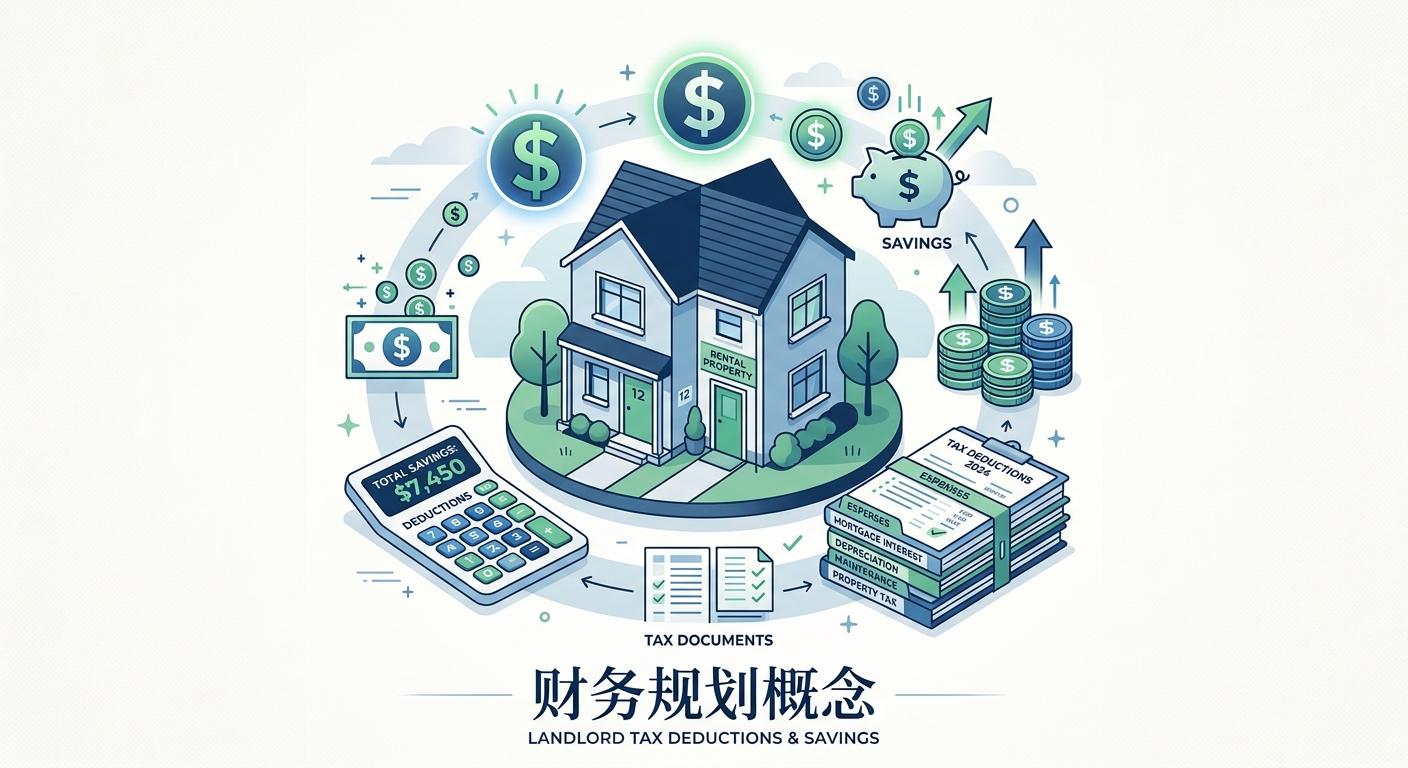
What Most Landlords Don’t Know About Their Tax Bill
If you’re a landlord filing Schedule E and treating rental income like W-2 wages, you’re leaving serious money on the table. Most property owners miss an average of $8,400 in deductions annually because they don’t understand how the IRS classifies rental real estate. Unlike active business income, rental property generates passive income with its own set of tax advantages, and landlord taxes operate under completely different rules than ordinary wages.
Here’s the truth: The IRS doesn’t tax your rental income the same way it taxes your paycheck. You can write off expenses most people never think to claim, depreciate your building over 27.5 years even if it’s appreciating in value, and potentially qualify for real estate professional status to unlock unlimited loss deductions. But none of that happens automatically. You need to know the rules, keep the right records, and structure your ownership correctly.
Quick Answer: How Are Landlord Taxes Different?
Landlord taxes are filed on Schedule E and allow you to deduct expenses like mortgage interest, property management fees, repairs, depreciation, and travel to your rental property. Unlike W-2 income, rental income is considered passive, which means losses can offset other passive income and, in some cases, up to $25,000 of ordinary income if you actively participate. The real advantage comes from depreciation: you can deduct 1/27.5th of your building’s value every year without spending a dime.
The Tax Structure Every Landlord Must Understand
Rental real estate sits in a unique tax category. It’s not earned income like your salary, and it’s not portfolio income like stock dividends. It’s passive income, reported on IRS Schedule E. This classification unlocks deductions that employees and even many business owners can’t access.
Passive Income vs. Active Income: Why It Matters
When you collect rent, the IRS treats it as passive income by default. This means you can’t deduct rental losses against your W-2 wages unless you meet specific requirements. However, if you actively participate in managing your property, which means making management decisions like approving tenants, setting rent prices, and approving repairs, you can deduct up to $25,000 in rental losses against your ordinary income.
Here’s the catch: This $25,000 allowance phases out once your modified adjusted gross income hits $100,000, disappearing completely at $150,000. If you earn $120,000 from your day job and have a $15,000 rental loss, you can only deduct $10,000 of that loss this year. The remaining $5,000 carries forward indefinitely until you have passive income to offset it or sell the property.
Real Estate Professional Status: The Game Changer
If you qualify as a real estate professional under IRS rules, your rental activity converts from passive to active. That means unlimited loss deductions against your W-2 or business income. To qualify, you must spend more than 750 hours per year in real estate activities and more than half your working time in real estate trades or businesses.
This status works best for someone who owns multiple properties, manages them personally, and can document their time. If you’re a full-time landlord with 8+ units, you likely qualify. If you’re a software engineer with one rental duplex, you don’t. The IRS audits this designation heavily, so meticulous time logs are mandatory.
The Big 7: Deductions Most Landlords Overlook
1. Depreciation: Your Largest Non-Cash Deduction
Every residential rental property can be depreciated over 27.5 years, meaning you deduct roughly 3.636% of the building’s value annually. If you bought a rental house for $400,000, with $350,000 allocated to the building (land isn’t depreciable), you’ll deduct $12,727 per year. Over 10 years, that’s $127,270 in tax savings without spending a penny.
Most landlords know about depreciation. What they miss is the recapture consequence. When you sell, the IRS taxes all depreciation taken at a 25% rate, regardless of your ordinary income bracket. If you’ve claimed $100,000 in depreciation and sell for a gain, you’ll owe $25,000 in depreciation recapture tax before calculating capital gains on the appreciation.
Pro Tip: Use a cost segregation study on properties over $500,000 to accelerate depreciation. This reclassifies portions of your property into 5, 7, or 15-year categories, frontloading deductions and improving cash flow in early years.
2. Mortgage Interest and Points
Every dollar of mortgage interest you pay on a rental property is fully deductible on Schedule E. Unlike personal residence mortgage interest, which caps at $750,000 of debt, rental property mortgage interest has no limit. If you’re paying $18,000 per year in interest on your rental mortgage, that’s $18,000 off your taxable rental income.
If you paid points to buy down your interest rate, those must be amortized over the life of the loan. A $3,000 point payment on a 30-year mortgage gives you a $100 annual deduction for 30 years.
3. Repairs vs. Improvements: Know the Difference
Repairs are fully deductible in the year you pay for them. Improvements must be capitalized and depreciated over time. The distinction matters because most landlords misclassify major work.
Replacing a broken window? That’s a repair. Deduct the full $400 this year. Replacing all windows in the property with energy-efficient models? That’s an improvement. Add it to your basis and depreciate it over 27.5 years.
Here’s where landlords win: The IRS allows you to use the safe harbor for small taxpayers if your average annual gross receipts are $10 million or less (which includes nearly all individual landlords). Under this rule, you can deduct up to $10,000 per building or 2% of the building’s unadjusted basis, whichever is less, even for improvements.
4. Property Management Fees and Professional Services
Every dollar you pay to a property manager, real estate attorney, or CPA for rental-related work is deductible. If you pay 10% of rent to a property manager, that’s a direct write-off. Same with legal fees for evictions, lease drafting, or entity formation for holding your properties.
5. Travel and Mileage to Your Rental Property
Every trip to your rental property for management, maintenance, or tenant meetings is deductible. Use the standard mileage rate (67 cents per mile in 2026) or actual expenses if you track them meticulously. If you drive 800 miles per year managing your rental, that’s a $536 deduction.
Overnight travel works too. If your rental is in another city and you travel there to meet contractors, inspect the property, or handle tenant issues, you can deduct airfare, hotel, and 50% of meals. Just document the business purpose in writing.
6. Home Office Deduction for Landlord Activities
If you use a dedicated space in your home exclusively and regularly for rental management, you can claim a home office deduction. This is separate from the home office deduction for a business. Use the simplified method ($5 per square foot, up to 300 square feet) or the actual expense method.
A 150-square-foot office gives you a $750 annual deduction under the simplified method. If you manage multiple properties and spend significant time on bookkeeping, tenant communication, and expense tracking, this deduction is legitimate and often overlooked.
7. Utilities, Insurance, and Property Taxes
Every utility bill you pay for a rental property is deductible: water, sewer, trash, gas, electric. If the tenant pays utilities, you get no deduction. If you pay them, you do. Landlord insurance premiums are fully deductible in the year paid. Property taxes are also fully deductible with no cap, unlike the $10,000 SALT cap on personal residences.
Red Flag Alert: Common Landlord Tax Mistakes That Trigger Audits
Claiming Personal Use as Rental Expenses
If you use the property personally for more than 14 days per year or 10% of the days it’s rented (whichever is greater), the IRS reclassifies it as a personal residence. That kills most of your deductions. Rent it out for 200 days and use it personally for 15 days? You’re still okay. Use it for 21 days? Now you’re subject to the vacation home rules, and expenses must be allocated between personal and rental use.
Failing to Report All Rental Income
Every dollar of rent collected must be reported, even if the tenant pays cash. The IRS matches 1099-K forms from payment processors like Venmo, PayPal, and Zelle. If you collect $24,000 in rent but only report $18,000, expect a letter.
Misclassifying Improvements as Repairs
Replacing a roof, installing a new HVAC system, or renovating a kitchen are improvements, not repairs. You must capitalize these costs and depreciate them. Deducting a $25,000 roof replacement in full will trigger IRS scrutiny and potential reclassification with penalties.
KDA Case Study: Multi-Property Investor Cuts Tax Bill by $14,200
Marcus owned three single-family rentals in Sacramento and filed his own taxes for years using TurboTax. He reported rental income, deducted mortgage interest and property taxes, but missed everything else. His effective tax rate on rental income was 28%.
KDA reviewed his situation and immediately identified missed deductions: $31,000 in depreciation across three properties, $4,200 in property management fees, $1,800 in mileage, $2,400 in repairs he’d capitalized incorrectly, and $900 in professional fees. We restructured his Schedule E filings, applied bonus depreciation to a recent kitchen remodel using cost segregation, and documented his active participation to unlock the $25,000 loss allowance.
Result: Marcus reduced his taxable rental income from $42,000 to $11,300, saving $14,200 in federal and California state taxes in year one. He paid KDA $2,800 for the analysis and amended returns, generating a 5.1x return on investment.
Ready to see how we can help you? Explore more success stories on our case studies page to discover proven strategies that have saved our clients thousands in taxes.
California-Specific Landlord Tax Considerations
California doesn’t conform to all federal tax rules, and landlords need to know where the gaps are. The state follows federal depreciation rules for residential rental property, so your 27.5-year schedule applies to both returns. However, California has its own passive loss rules and doesn’t allow the same unlimited carryforward treatment in all cases.
California Proposition 19 and Property Tax Reassessment
Proposition 19, which took effect in 2021, changed how inherited properties are taxed. If you inherit a rental property and don’t use it as your primary residence, it will be reassessed at current market value, potentially spiking your property tax bill by 200% or more. This doesn’t change your income tax, but it dramatically affects cash flow and whether the property remains profitable.
Local Rent Control and Tax Planning
Cities like Oakland, San Francisco, and Los Angeles have strict rent control ordinances. While rent control doesn’t directly change your federal tax treatment, it affects cash flow planning and whether you can justify improvements that trigger higher basis and depreciation. Many landlords in rent-controlled markets find their effective tax rate climbs because they can’t raise rents to match increasing expenses.
If you’re operating rental properties in California, integrating state compliance with federal tax planning is critical. Our tax planning services help landlords navigate these intersections and avoid costly mistakes.
Scaling Strategies: Managing Taxes Across Multiple Properties
Once you own more than three rental properties, tax complexity multiplies. You’re tracking depreciation schedules for multiple buildings, managing separate expense categories, and potentially dealing with properties in multiple states. Here’s how to scale without losing money to poor record-keeping.
Entity Structuring for Asset Protection and Tax Efficiency
Many landlords hold properties in LLCs for liability protection. From a tax perspective, a single-member LLC is disregarded, meaning you still file Schedule E. The LLC protects your personal assets from tenant lawsuits but doesn’t change your tax treatment.
If you have multiple properties, consider a series LLC structure (available in California and other states) where each property sits in its own protected series. This isolates liability without creating multiple tax returns. Alternatively, holding properties in an S Corp doesn’t work because rental income is passive and S Corps are designed for active business income, creating unnecessary complexity.
When to Hire a Property Manager and How It Affects Taxes
Property management fees typically run 8-12% of collected rent. If you’re paying $2,000 per month in rent and giving 10% to a manager, that’s $200 per month or $2,400 per year in deductions. This is worth it if it frees you to focus on acquiring more properties or if your time is better spent elsewhere.
From a tax perspective, using a property manager doesn’t disqualify you from active participation. You still make major decisions. However, it does reduce your hours spent on real estate activities, which matters if you’re trying to qualify as a real estate professional.
What Happens When You Sell: Depreciation Recapture and 1031 Exchanges
The tax bill on selling a rental property catches most landlords off guard. You’ll pay capital gains tax on the appreciation (0%, 15%, or 20% depending on income), depreciation recapture tax at 25% on all depreciation taken, and potentially the 3.8% net investment income tax if your income exceeds $200,000 (single) or $250,000 (married).
Depreciation Recapture Example
You bought a rental property for $300,000 in 2016, allocated $250,000 to the building, and claimed $10,000 in depreciation over 10 years ($100,000 total). You sell in 2026 for $450,000. Here’s the tax breakdown:
- Adjusted Basis: $300,000 purchase price minus $100,000 depreciation = $200,000
- Gain: $450,000 sale price minus $200,000 adjusted basis = $250,000
- Depreciation Recapture: $100,000 taxed at 25% = $25,000
- Capital Gain: $150,000 taxed at 15% (assuming mid-income) = $22,500
- Total Federal Tax: $47,500
Add California state tax (roughly 9.3% on the gain), and you’re looking at a $70,750 total tax bill on a $450,000 sale. That’s 15.7% of your sale price gone.
Using a 1031 Exchange to Defer Taxes Indefinitely
A 1031 exchange allows you to sell a rental property and reinvest the proceeds into another like-kind property without paying taxes immediately. You must identify replacement property within 45 days and close within 180 days. The tax basis carries over, meaning you defer the gain until you eventually sell without doing another exchange.
If you 1031 exchange repeatedly and hold properties until death, your heirs receive a stepped-up basis, erasing all deferred gains permanently. This is the wealthiest landlords’ favorite strategy for building generational wealth without ever paying capital gains tax.
Ready to Reduce Your Tax Bill?
KDA Inc. specializes in strategic tax planning for business owners, S Corps, LLCs, and high-net-worth individuals. Book a personalized consultation and walk away with a clear plan.
Frequently Asked Questions About Landlord Taxes
Can I Deduct Rental Losses If I Have a Full-Time Job?
Yes, up to $25,000 per year if you actively participate in managing the property and your modified adjusted gross income is below $100,000. The deduction phases out between $100,000 and $150,000. Above $150,000, losses are suspended until you have passive income to offset them or sell the property.
Do I Need to Collect Sales Tax on Rental Income?
No. Rental income is not subject to sales tax in California or federally. However, short-term rentals under 30 days (like Airbnb) may trigger transient occupancy taxes (TOT) in many California cities. These are separate from income tax and must be remitted to local jurisdictions.
What Records Do I Need to Keep for Landlord Tax Deductions?
Keep all receipts, invoices, bank statements, and lease agreements for at least three years (the IRS audit window for most returns, or six years if you underreport income by 25% or more). Document mileage in a log with date, destination, and business purpose. Save before-and-after photos for repairs and improvements to prove the scope of work if audited.
Can I Deduct HOA Fees on a Rental Property?
Yes. Homeowner association fees for a rental property are fully deductible on Schedule E. If you pay $300 per month in HOA fees, that’s $3,600 in annual deductions.
Book Your Landlord Tax Strategy Session
If you’re managing rental properties and want to stop overpaying taxes on your rental income, it’s time to get strategic. KDA specializes in helping real estate investors structure their holdings, maximize deductions, and plan for long-term wealth building through real estate. Book your personalized tax consultation today and discover exactly how much you’re leaving on the table.
Key Takeaway: Landlord taxes aren’t complicated, but they’re specific. Miss depreciation, misclassify repairs, or fail to document active participation, and you’ll overpay by thousands every year. Get it right, and rental real estate becomes one of the most tax-advantaged wealth-building strategies available.
This information is current as of 5/9/2026. Tax laws change frequently. Verify updates with the IRS or your tax advisor if reading this later.



