
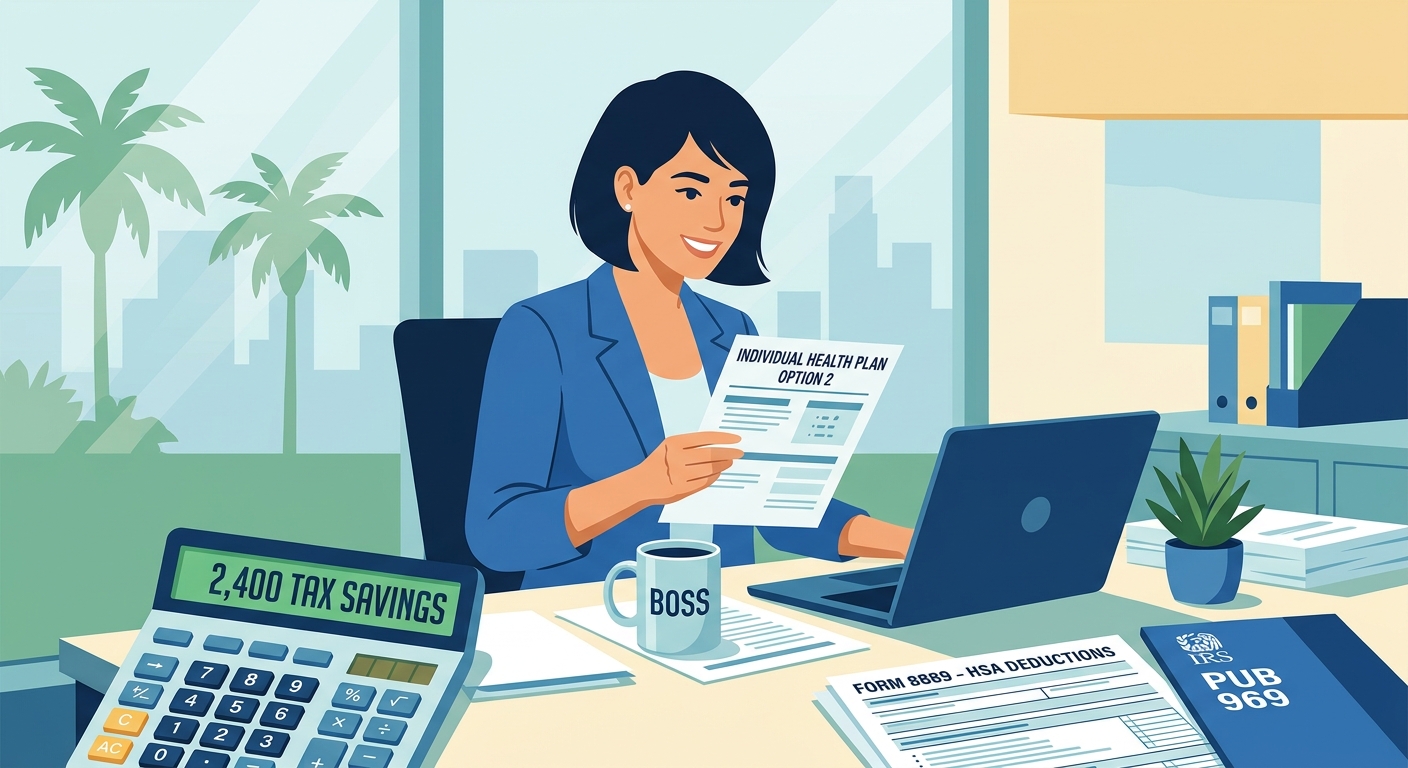
You’re running your own business, paying $800 a month for health insurance, and wondering if the IRS will let you write it off. The answer isn’t what most self-employed taxpayers expect. While W-2 employees rely on employer-sponsored plans with pre-tax benefits, is self-employed health insurance tax deductible? Yes, and it’s one of the most powerful above-the-line deductions available. But there’s a catch that trips up thousands of taxpayers every year, and it could cost you the entire deduction if you don’t get it right.
Quick Answer
Yes, self-employed health insurance premiums are 100% tax-deductible as an above-the-line deduction on Form 1040. This means you can deduct your premiums even if you don’t itemize. However, you cannot claim the deduction for any month you were eligible for employer-sponsored coverage through your own job or your spouse’s employer.
What Is the Self-Employed Health Insurance Deduction?
The self-employed health insurance deduction is an adjustment to income (not an itemized deduction) that allows qualifying self-employed individuals to deduct premiums paid for medical, dental, and qualified long-term care insurance. This deduction reduces your adjusted gross income (AGI), which can lower your overall tax liability and potentially qualify you for other income-based tax benefits. Unlike itemized medical expenses, which require you to exceed 7.5% of your AGI, this deduction has no floor and doesn’t require itemization.
For tax year 2026, this deduction appears on Schedule 1 (Form 1040), line 17, and flows directly to your Form 1040. The deduction cannot exceed your net self-employment income for the year. If you earned $45,000 in self-employment income and paid $12,000 in health insurance premiums, you can deduct the full $12,000. But if you only earned $8,000, your deduction is limited to $8,000.
Who Qualifies for the Self-Employed Health Insurance Deduction in 2026?
Not every business owner automatically qualifies. The IRS has specific eligibility requirements that must be met for every month you claim the deduction.
You Must Have Net Self-Employment Income
Your deduction is limited to your net profit from self-employment reported on Schedule C, Schedule F, or as a general partner’s share of partnership income. If you operated at a loss or had zero self-employment income, you cannot claim this deduction for that tax year. S corporation shareholders who own more than 2% of the company can also qualify, but the premiums must be included in their W-2 wages.
You Cannot Be Eligible for an Employer Plan
This is where most self-employed taxpayers get tripped up. You are not eligible to claim the deduction for any month you or your spouse were eligible to participate in an employer-sponsored health plan, even if you chose not to enroll. Eligibility alone disqualifies you for that month, regardless of whether you actually used the coverage.
Example: Maria runs a freelance graphic design business and pays $950 per month for a Covered California health plan. Her husband started a new W-2 job in September 2026 that offered family health coverage starting October 1. Maria can deduct her premiums from January through September ($8,550), but she loses the deduction for October through December, even though they declined her husband’s employer plan and continued paying for her individual coverage.
The Insurance Must Be Established Under Your Business
According to IRS guidelines, the insurance plan must be established under your business name. For sole proprietors, this typically means the policy is in your name as the business owner. For partnerships and S corporations, the entity can pay the premiums directly or reimburse you, and those amounts must be properly reported on your Schedule K-1 or W-2.
What Types of Insurance Premiums Are Deductible?
The self-employed health insurance deduction isn’t just for medical coverage. Several types of insurance premiums qualify, giving you additional tax savings opportunities.
Medical and Hospitalization Insurance
This includes premiums for major medical plans, whether purchased through the Health Insurance Marketplace (Covered California, Healthcare.gov), directly from an insurance carrier, or through a professional association. Short-term health insurance policies and health care sharing ministry memberships generally do not qualify under current IRS rules.
Dental and Vision Insurance
Stand-alone dental and vision insurance premiums are fully deductible. If you pay $65 per month for dental coverage and $25 per month for vision coverage, that’s an additional $1,080 in annual deductions beyond your medical premiums.
Qualified Long-Term Care Insurance
Long-term care insurance premiums are deductible, but only up to IRS-specified limits based on your age at the end of the tax year. For 2026, the limits are:
- Age 40 or younger: $480
- Age 41-50: $890
- Age 51-60: $1,790
- Age 61-70: $4,770
- Age 71 or older: $5,960
If you’re 58 years old and pay $2,200 annually for long-term care insurance, you can deduct $1,790 as part of your self-employed health insurance deduction.
Coverage for Your Spouse and Dependents
You can deduct premiums paid for health insurance covering your spouse, dependents, and any child under age 27 at the end of the tax year, even if that child is not your dependent for tax purposes. This expanded coverage rule provides significant savings for self-employed parents with adult children still on their health plan.
How to Calculate Your Self-Employed Health Insurance Deduction
Calculating the deduction requires careful attention to your net self-employment income and the months you were eligible for other coverage.
Step 1: Determine Your Net Self-Employment Income
Start with your net profit from Schedule C, Schedule F, or your share of partnership income reported on Schedule K-1. For S corporation owners, use your W-2 wages (which must include the health insurance premiums as income). This is your deduction ceiling. You cannot deduct more than you earned from self-employment.
Step 2: Total Your Qualifying Premiums
Add up all premiums paid during the tax year for medical, dental, vision, and qualified long-term care insurance for yourself, your spouse, and your dependents. Do not include premiums paid with pre-tax dollars through a cafeteria plan or premiums for months you were eligible for employer coverage.
Step 3: Apply the Income Limitation
Compare your total premiums to your net self-employment income. Your deduction is the lesser of the two amounts. If your net self-employment income was $62,000 and you paid $14,400 in qualifying premiums, you can deduct the full $14,400. If your income was only $11,000, your deduction is limited to $11,000.
Step 4: Report on Schedule 1
Enter the calculated deduction amount on Schedule 1 (Form 1040), Part II, line 17. This amount then transfers to Form 1040, reducing your adjusted gross income. You do not need to complete Schedule A or itemize deductions to claim this benefit.
Pro Tip: The self-employed health insurance deduction reduces your income tax but does not reduce your self-employment tax. Your net earnings from self-employment on Schedule SE are calculated before this deduction is applied.
Common Mistakes That Disqualify Your Deduction
Even experienced self-employed taxpayers make errors that trigger IRS adjustments and potential penalties. Avoiding these mistakes protects your deduction.
Deducting Premiums While Eligible for Spouse’s Plan
This is the number one mistake. If your spouse’s employer offered family coverage at any point during the year, you cannot claim the deduction for those months, even if you declined enrollment and paid for your own separate policy. The IRS considers “eligible” to mean you had the option to enroll during open enrollment or within 30 days of hire, not whether you actually enrolled.
Red Flag Alert: The IRS increasingly cross-references W-2 data with Form 1040 deductions. If your spouse’s W-2 shows employer health insurance contributions and you claim the self-employed health insurance deduction, expect a CP2000 notice proposing adjustments and additional tax.
Exceeding Your Net Self-Employment Income
Your deduction cannot exceed your net profit from self-employment. If you had a loss or minimal income, you cannot create or increase a tax loss by claiming this deduction. Excess premiums that cannot be deducted as self-employed health insurance may qualify as an itemized medical expense if your total medical costs exceed 7.5% of your AGI, but this is far less beneficial.
Claiming Premiums Paid with Subsidies
If you received Premium Tax Credits (subsidies) through Covered California or the federal Health Insurance Marketplace, you can only deduct the net premiums you actually paid out of pocket. If your monthly premium was $800 but you received a $500 monthly subsidy, your deductible premium is $300 per month, not $800.
Including Medicare Premiums in the Wrong Place
Once you’re enrolled in Medicare, your situation changes. Medicare premiums (Parts B, C, and D) are still deductible as self-employed health insurance, but Medicare supplement (Medigap) policies are also included. However, if you’re over 65 and continuing to work self-employed, make sure you’re not double-dipping by claiming these premiums in multiple places on your return.
KDA Case Study: Self-Employed Consultant
Jason, a 42-year-old independent marketing consultant in Sacramento, came to KDA after receiving an IRS notice disallowing his $11,800 self-employed health insurance deduction for tax year 2025. He couldn’t understand why, since he was clearly self-employed and paid his premiums in full.
Our team discovered the issue immediately. Jason’s wife worked part-time at a local retail company that offered health benefits to employees working 25+ hours per week. She worked 28 hours weekly and was offered coverage during the November 2024 open enrollment period for coverage starting January 2025. She declined it because Jason’s Covered California plan had better coverage and lower out-of-pocket costs.
The problem? The IRS doesn’t care if you declined better coverage. Eligibility alone disqualifies you. KDA helped Jason properly amend his return, removing the disallowed deduction and claiming the premiums as itemized medical expenses for the portion that exceeded 7.5% of his AGI, recovering $2,340 of the original $11,800 deduction. We also restructured his wife’s work schedule to 24 hours per week for 2026, making her ineligible for employer coverage and restoring his full self-employed health insurance deduction going forward.
Tax savings for 2026: $11,800 deduction at his 24% effective rate = $2,832 annual savings. KDA’s fee for the consultation and amendment was $850, delivering a 3.3x first-year return.
Ready to see how we can help you? Explore more success stories on our case studies page to discover proven strategies that have saved our clients thousands in taxes.
Special Rules for S Corporation Owners
If you operate your business as an S corporation and own more than 2% of the company, you face additional requirements to claim the self-employed health insurance deduction.
Premiums Must Be Included in W-2 Wages
The S corporation must either pay your health insurance premiums directly or reimburse you for premiums you paid personally. Either way, the total premium amount must be reported as wages in Box 1 of your W-2. These amounts are not subject to FICA or FUTA taxes, but they are included in your taxable income. You then claim the offsetting deduction on Schedule 1.
The Corporation Must Establish a Plan
The S corporation must formally establish a health insurance plan for employees. This doesn’t require a group plan with multiple participants, but there must be documentation showing the corporation’s intent to provide health insurance as compensation. Board resolutions, corporate minutes, or written reimbursement policies satisfy this requirement.
You Cannot Deduct Through the Corporation
The S corporation cannot deduct the premiums as a business expense because they must be treated as wages paid to you. The deduction only happens on your personal Form 1040, not on the corporation’s Form 1120-S. This is one of the most commonly misunderstood aspects of S corp health insurance taxation.
Example: Carlos owns 100% of an S corporation that generated $120,000 in net income in 2026. The corporation paid $15,600 in health insurance premiums on his behalf. The corporation includes $15,600 in Box 1 of his W-2 (but not in Boxes 3 or 5). Carlos’s W-2 shows $80,000 in salary plus $15,600 in health insurance, totaling $95,600 in Box 1. He then claims a $15,600 self-employed health insurance deduction on his Form 1040, Schedule 1. His taxable income reflects the proper tax treatment, and he saves approximately $3,744 in federal income tax at the 24% bracket.
How the Self-Employed Health Insurance Deduction Saves You Money
The financial impact of this deduction extends beyond the immediate tax savings. Because it’s an above-the-line deduction, it reduces your adjusted gross income, which can trigger additional benefits.
Lower Your Effective Tax Rate
For most self-employed taxpayers, this deduction saves 22% to 35% of the premium cost, depending on your tax bracket. If you paid $13,200 in annual premiums and you’re in the 24% federal bracket, that’s $3,168 in federal tax savings. Add California’s 9.3% marginal rate on middle-income earners, and you’re looking at $4,388 in combined savings.
Qualify for Other Income-Based Benefits
Reducing your AGI can help you qualify for tax credits and deductions that phase out at higher income levels. These include the Premium Tax Credit itself (which is based on your AGI after this deduction), the Child Tax Credit, the American Opportunity Credit for education expenses, and IRA contribution deductibility limits.
Reduce State Income Tax
California and most other states with income tax honor the self-employed health insurance deduction, providing additional state-level savings. California’s top marginal rate reaches 13.3% for high earners, making this deduction particularly valuable for self-employed professionals in the state.
2026 Updates and Recent IRS Changes
Recent tax legislation and IRS guidance have introduced several changes affecting self-employed taxpayers claiming health insurance deductions in 2026.
No Changes to Core Deduction Rules
Despite significant tax legislation changes in early 2026 under the One Big Beautiful Bill Act (OBBBA), the fundamental structure and eligibility requirements for the self-employed health insurance deduction remain unchanged from prior years. The deduction continues to be claimed on Schedule 1, line 17, and the same income limitations and eligibility restrictions apply.
Increased Reporting Threshold Relief for 1099 Filers
While not directly related to the health insurance deduction, the 2026 increase in Form 1099-MISC and 1099-NEC reporting thresholds to $2,000 (up from $600 under previous proposals) reduces administrative burden for self-employed taxpayers. Fewer 1099 forms to track means less paperwork headaches when calculating your net self-employment income that determines your deduction ceiling.
State-Level Divergence on Tax Treatment
More than 20 states have introduced varying legislation addressing tax treatment of certain income and deductions. While most states conform to federal treatment of self-employed health insurance deductions, California taxpayers should verify conformity each year. As of April 2026, California continues to allow the deduction using the same rules as the federal government.
California-Specific Considerations for Self-Employed Health Insurance
California’s unique health insurance landscape and tax regulations create additional planning considerations for self-employed taxpayers in the state.
Covered California and Premium Tax Credits
If you purchase insurance through Covered California, you may receive advance premium tax credits based on your projected income. When calculating your self-employed health insurance deduction, remember that you can only deduct the net premium amount you actually paid out of pocket, not the full premium before subsidies. At tax time, you’ll reconcile your advance premium tax credits on Form 8962, and any repayment due reduces the benefit of the overall deduction.
California’s Minimum Essential Coverage Penalty
California continues to enforce an individual mandate penalty for residents who don’t maintain qualifying health coverage. The penalty for 2026 is the greater of $900 per adult and $450 per child (up to $2,700 per family) or 2.5% of household income above the filing threshold. Self-employed taxpayers should factor this penalty into their decision-making when evaluating health insurance options, as the cost of premiums partially offsets the risk of mandate penalties.
California State Disability Insurance (SDI) Is Not Deductible
Many self-employed California taxpayers voluntarily participate in the state’s Disability Insurance Elective Coverage (DIEC) program. While this provides valuable income protection, the premiums paid for SDI coverage are not deductible as self-employed health insurance. These are considered personal insurance and would only be deductible as an itemized medical expense if your total medical expenses exceed 7.5% of AGI.
Ready to Reduce Your Tax Bill?
KDA Inc. specializes in strategic tax planning for business owners, S Corps, LLCs, and high-net-worth individuals. Book a personalized consultation and walk away with a clear plan.
Frequently Asked Questions
Can I deduct health insurance premiums if I also have a part-time W-2 job?
Yes, as long as your part-time employer does not offer health insurance benefits that you’re eligible for. If your W-2 job offers health coverage, even if you work only 15 hours per week, you cannot claim the self-employed health insurance deduction for any month you were eligible for that coverage. Many part-time employers don’t offer benefits, so verify your eligibility carefully.
What if I started my self-employment business mid-year?
You can only claim the deduction for months you were self-employed and paid premiums. If you left a W-2 job in June and started your business in July, you cannot claim the deduction for January through June, even if you paid COBRA premiums during that time. Your deduction is limited to July through December premiums, and only up to your net self-employment income for the year.
Do Health Savings Account (HSA) contributions count as health insurance premiums?
No, HSA contributions are claimed as a separate above-the-line deduction and are not part of the self-employed health insurance deduction. If you have a high-deductible health plan and contribute to an HSA, you claim the insurance premiums on Schedule 1, line 17 and your HSA contributions on Schedule 1, line 13. Both deductions work together to reduce your AGI.
Can I deduct health insurance premiums if my business lost money?
No, your deduction is limited to your net self-employment income. If your Schedule C shows a loss or zero profit, you cannot claim the self-employed health insurance deduction. However, if you have self-employment income from a different business or as a partner in a partnership, you can use that income to support the deduction.
What happens if I forget to claim the deduction on my original return?
You can file an amended return using Form 1040-X to claim the deduction for any tax year within three years of the original filing deadline. For example, you have until April 15, 2029, to amend your 2025 tax return to claim missed self-employed health insurance deductions. You’ll need to recalculate your tax liability and show the difference, which will result in a refund if the deduction reduces your tax owed.
Strategic Planning: Maximizing Your Health Insurance Tax Benefits
Beyond simply claiming the deduction, strategic planning can significantly increase your overall tax savings related to health insurance.
Consider a Spousal Hire Strategy
If your spouse is eligible for employer coverage that disqualifies your deduction, consider whether reducing their work hours below the employer’s benefits eligibility threshold makes financial sense. In some cases, the tax savings from restoring your self-employed health insurance deduction exceeds the lost wages from fewer hours worked, especially if those hours occurred at a relatively low hourly rate.
Coordinate with Retirement Contributions
Since the self-employed health insurance deduction reduces your AGI but not your self-employment income, it doesn’t affect your ability to make SEP-IRA, Solo 401(k), or other self-employed retirement plan contributions. These work in tandem. For 2026, you can contribute up to 25% of your net self-employment earnings to a SEP-IRA (up to $70,000), and that contribution is also an above-the-line deduction, further reducing your taxable income.
Evaluate High-Deductible Plans with HSAs
If you’re in good health and can afford higher out-of-pocket costs, a high-deductible health plan (HDHP) combined with a Health Savings Account (HSA) may provide superior tax benefits. You deduct the HDHP premiums as self-employed health insurance, contribute pre-tax dollars to the HSA (up to $4,300 for individuals or $8,550 for families in 2026), and withdraw HSA funds tax-free for qualified medical expenses. This triple tax advantage (deductible contribution, tax-free growth, tax-free withdrawal) can outperform traditional health insurance in the right circumstances.
Document Everything
Maintain detailed records of all health insurance premium payments, including receipts, bank statements, or credit card statements showing the payments. If you’re an S corporation owner, keep board minutes or written policies establishing the health insurance reimbursement arrangement. In an audit, documentation is everything. The IRS will disallow the deduction if you cannot prove you paid the premiums and met all eligibility requirements.
What Happens If You Claim the Deduction Incorrectly?
Mistakes happen, but the consequences of improperly claiming the self-employed health insurance deduction can be costly.
IRS Adjustment Notices
The IRS uses automated systems to identify discrepancies between reported income and claimed deductions. If your return shows a large self-employed health insurance deduction but limited or no self-employment income, expect a CP2000 notice proposing adjustments. You’ll owe the additional tax plus interest from the original due date of the return.
Penalties for Negligence or Substantial Understatement
If the IRS determines your error was due to negligence or disregard of rules and regulations, you may face a 20% accuracy-related penalty on the additional tax owed. If your deduction error resulted in a substantial understatement of income (generally a discrepancy exceeding the greater of $5,000 or 10% of correct tax), the penalty applies automatically unless you can show reasonable cause.
Audit Risk Factors
Large deductions relative to income, inconsistencies between your claimed business income and health insurance deduction amounts, and patterns of aggressive deductions across multiple years all increase audit risk. The IRS is particularly focused on Schedule C filers who claim extensive deductions while reporting marginal income, as this pattern often indicates hobby loss or tax avoidance schemes.
Pro Tip: If you receive an IRS notice challenging your self-employed health insurance deduction, don’t ignore it. You typically have 30 days to respond with supporting documentation. Our audit representation services help clients navigate these situations efficiently, often resolving disputes without penalties or additional interest.
Book Your Tax Strategy Session
Still confused about whether you qualify for the self-employed health insurance deduction, or worried you’ve been claiming it incorrectly for years? Don’t risk an IRS adjustment notice that costs you thousands in back taxes, interest, and penalties. Our team specializes in helping self-employed professionals and 1099 contractors maximize legitimate deductions while staying 100% compliant. Book a personalized consultation with our strategy team and get clarity on your specific situation. Click here to book your consultation now and stop leaving money on the table.
This information is current as of April 9, 2026. Tax laws change frequently. Verify updates with the IRS or consult with a tax professional if reading this later.



