Meta description (145–155 characters): Is an llc a c corp s corp or partnership? Learn the default IRS rules, election forms, and the tax math that can save $7,000+.
This information is current as of 5/13/2026. Tax laws change frequently. Verify updates with the IRS or FTB if reading this later.
Most LLC owners think their entity name determines how they’re taxed. It doesn’t. The IRS doesn’t care that your website says “LLC” if your filings and elections say something else, and that disconnect is how people overpay thousands or get hit with avoidable notices.
If you’ve ever asked is an llc a c corp s corp or partnership, you’re asking the right question, but most people ask it too late, after they’ve already filed the wrong return, skipped payroll, or created self-employment tax they didn’t need.
Quick Answer: What an LLC “is” for tax purposes
An LLC is a legal structure under state law. For federal taxes, an LLC is taxed based on its number of owners and any elections it files. By default, a one-owner LLC is a disregarded entity (reported on Schedule C or Schedule E), and a multi-owner LLC is a partnership (Form 1065). An LLC can also elect to be taxed as a C corporation (Form 8832) and then potentially elect S corporation status (Form 2553) if it qualifies.
What the IRS means by “LLC classification” (and why it changes your tax bill)
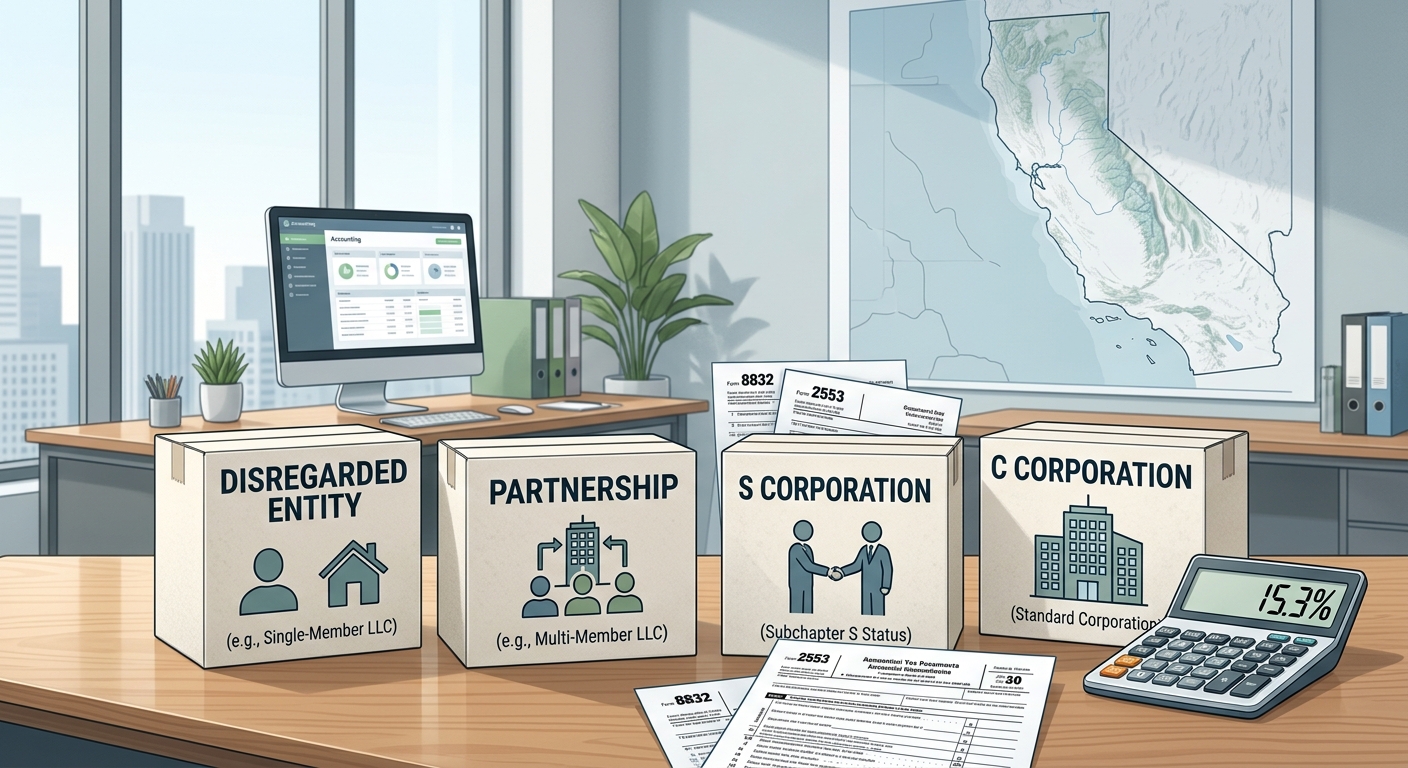
Here’s the strategist-level point: “LLC” is not a federal tax classification. The IRS uses a set of classification rules often called the “check-the-box” rules. The practical result is that your LLC can land in one of four buckets:
- Disregarded entity (single-member LLC by default)
- Partnership (multi-member LLC by default)
- C corporation (if elected)
- S corporation (if elected and eligible)
If your goal is to keep more of what you earn, the choice affects:
- Whether you pay self-employment tax (the 15.3% Social Security and Medicare tax on business net income)
- Whether you must run payroll (W-2 wages and payroll tax filings)
- Which returns you file (Schedule C, Form 1065, Form 1120-S, or Form 1120)
- How California hits you with minimum taxes and fees
Key takeaway: When people ask “is an llc a c corp s corp or partnership,” the real question is: “Which tax engine am I running under the hood, and is it the right one for my profit level and risk tolerance?”
The forms that control the answer
The IRS doesn’t decide your LLC tax treatment by vibes. It’s controlled by defaults and elections:
- Form 8832 (Entity Classification Election): tells the IRS to treat your LLC as a corporation (C corp for tax purposes).
- Form 2553 (Election by a Small Business Corporation): tells the IRS you want S corporation status (if eligible).
Default tax treatment: the “automatic setting” most LLCs never question
Let’s make the defaults plain and practical.
Single-member LLC default: disregarded entity
If you have one owner and you don’t file an election, the IRS ignores the LLC for income tax purposes. That’s what “disregarded entity” means in plain English: the LLC exists legally, but the IRS taxes you directly.
Common reporting paths:
- 1099 contractor, consultant, creator: usually Schedule C attached to your Form 1040 (see IRS Publication 334).
- Rental real estate in an LLC: usually Schedule E attached to your Form 1040, with passive activity rules applying (see IRS Publication 527).
The tax trap: net profit from active business on Schedule C is usually subject to self-employment tax (see IRS Publication 334 and Schedule SE). That’s where the “hidden” 15.3% comes from.
Example: 1099 consultant with $140,000 of net profit
Sofia is a 1099 marketing consultant in California. Her LLC has $220,000 of revenue and $80,000 of ordinary business expenses, leaving $140,000 net profit.
- Income tax applies based on her bracket.
- Self-employment tax applies on the net profit (subject to wage base limits and Medicare rules).
If Sofia is still asking is an llc a c corp s corp or partnership at tax time, it’s usually because she felt that self-employment tax hit and wants options.
Multi-member LLC default: partnership
If there are two or more owners (members), the default is partnership taxation. That means the LLC files Form 1065 (an informational return) and issues Schedule K-1 to each owner showing their share of income, deductions, and credits (see Form 1065 guidance).
Partnerships have flexibility, but they also create complexity:
- Special allocations in the operating agreement
- Guaranteed payments
- Basis and capital account tracking
- Potential self-employment tax on active income
Key takeaway: The partnership “bucket” often answers the question “is an llc a c corp s corp or partnership” for multi-owner businesses, but it’s not always the most tax-efficient bucket once profits rise.
When electing S corporation taxation actually saves real money (and when it backfires)
This is where the tax math matters. S corp status is not a legal entity type; it’s a tax status. Your LLC can elect S corp taxation if it qualifies, and the reason people do it is simple: in an S corp, you can split income between W-2 wages and distributions. W-2 wages are subject to payroll tax. Distributions generally are not subject to self-employment tax.
For the self-employed, that split is often where the $7,000+ savings shows up.
Persona link and service link (planned insertion, mid-article, natural fit)
If you’re running a business that looks like a solo practice, agency, or consulting shop, you’re in the exact group that tends to outgrow Schedule C first. Many self-employed taxpayers don’t realize that the right election and payroll setup is a tax strategy, not just paperwork.
This is also where our tax planning services pay for themselves, because an S corp only works when the salary is defensible, the books are clean, and the timing is right.
Step-by-step: How an LLC elects S corp status
- Confirm eligibility: generally, you need allowable shareholders (U.S. individuals and certain trusts), one class of stock, and other requirements. Start with the IRS overview on S corporations.
- Make sure your LLC is eligible at the entity level: your LLC is typically eligible to file Form 2553 directly as an eligible entity. In some situations, Form 8832 may be part of the path.
- File Form 2553: file on time for the intended effective date and keep proof of filing.
- Set up payroll: pay yourself a reasonable salary through a payroll system, with quarterly payroll reports and year-end W-2.
- Change how you do bookkeeping: separate distributions from payroll, track shareholder basis, and keep minutes and reimbursements clean.
What is “reasonable compensation” in plain English?
Reasonable compensation is the wage you’d pay someone else to do your job. In an S corp, paying yourself $20,000 of salary while taking $180,000 of distributions is the fastest way to invite trouble. The IRS expects wages for services performed, and you should be able to explain the number with market data, your role, hours, and profitability.
See the IRS S corp overview and employment tax materials, including IRS Publication 15 (Circular E) for payroll tax fundamentals.
Example: $180,000 profit, S corp election, $7,000+ payroll tax difference
Chris is a software implementation consultant with $180,000 of business profit after expenses. As a disregarded entity, most of that is exposed to self-employment tax. As an S corp, Chris might pay a $95,000 W-2 salary and take the remaining $85,000 as distributions.
- Payroll taxes apply to $95,000.
- Distributions are not subject to self-employment tax.
That delta can easily translate to $6,000 to $9,000 in annual savings depending on wage base limits, Medicare surtax exposure, and other factors. It’s not magic. It’s classification.
Pro Tip: Before you assume an S corp saves you money, run a conservative salary estimate first. Most “instant savings” pitches collapse when you price payroll, bookkeeping, and compliance correctly.
KDA Case Study: 1099 Agency Owner Stops Overpaying SE Tax
Jared runs a two-person marketing agency in Los Angeles. He formed an LLC years ago and assumed the “LLC” meant he had the same tax treatment as larger companies. In reality, he was filing Schedule C as a disregarded entity. By 2025, his net profit was consistently around $165,000, and he was getting crushed by self-employment tax and big April surprises.
Our team started by answering the real question he was asking: is an llc a c corp s corp or partnership for his situation, and which option reduces tax without creating audit exposure. We modeled a conservative S corp plan with a defensible $90,000 salary based on his role, billable hours, and comparable pay. We filed the election, set up payroll, cleaned up reimbursements under an accountable plan, and rebuilt his bookkeeping so distributions were tracked correctly.
Result: Jared reduced payroll-style tax exposure on roughly $75,000 of annual profit and saved about $8,200 in the first year. He paid $3,200 for the combined advisory, election support, and compliance setup. First-year ROI: 2.6x, and the structure stays in place for future years as long as the salary stays reasonable and filings stay clean.
Ready to see how we can help you? Explore more success stories on our case studies page to discover proven strategies that have saved our clients thousands in taxes.
What if I choose C corporation taxation instead?
Electing C corp taxation is usually a strategic move, not a default move. A C corp is its own taxpayer. It files Form 1120, pays corporate tax, and then you may pay a second tax when profits come out as dividends.
So why would anyone do it?
- Reinvestment strategy: you plan to retain earnings to grow the business.
- Benefits strategy: certain fringe benefits can be more favorable in a C corp context, depending on facts.
- Investor fit: some capital structures and institutional investors prefer C corps.
The election path usually involves Form 8832. But the headline risk is dividend double taxation and messy exits if you change your mind later.
Example: High earner trying to “hide” income in a C corp
A high-income W-2 employee who starts a side LLC sometimes thinks a C corp will let them park money at a lower rate. If you need the cash personally, it has to come out as W-2 wages, bonuses, or dividends. Each has its own tax cost. C corps can work, but they’re not a shortcut for personal spending.
Key takeaway: If your main reason for asking is an llc a c corp s corp or partnership is “I want to pay less tax this year,” C corp is rarely the first move. It’s an architecture decision.
California-specific considerations that change the math
California adds its own friction. Two big items matter for LLC owners:
- California LLC annual tax and fee: California charges an annual LLC tax and may charge an additional LLC fee based on total income. These are separate from federal tax concepts.
- California S corp tax: S corps generally pay a 1.5% entity-level tax in California (with a minimum), even though they’re pass-through federally.
Also, California has the Pass-Through Entity (PTE) elective tax rules (often associated with SALT cap workarounds). The value depends on your income, ownership structure, and whether you can actually use the credit. This is the type of analysis that needs modeling, not guessing.
Why CA makes “just elect S corp” bad advice
In California, you must price in:
- Payroll costs
- Bookkeeping discipline
- S corp minimum taxes
- The reality that a sloppy S corp is worse than a clean Schedule C
Red Flag Alert: If your books are messy and you mix personal and business spending, an S corp can turn a simple audit into a painful one. Fix the accounting first, then optimize the entity.
Common mistake: filing the wrong return because your CPA “assumed” the answer
This is one of the most expensive unforced errors we see. Someone forms an LLC, then:
- They file Schedule C for years even though they added a partner and should have filed Form 1065.
- They start filing Form 1120-S because “we’re an S corp now,” but never filed Form 2553 or got acceptance.
- They treat draws like distributions without payroll.
How to verify your current classification fast
- Pull your last filed return: Schedule C, 1065, 1120-S, or 1120 is a strong clue.
- Check for filed elections: confirm whether Form 8832 or Form 2553 was filed and accepted.
- Look at payroll filings: if you are “an S corp” but have no payroll, you have a problem.
- Get IRS transcripts if needed: transcripts can confirm what the IRS has on file.
Key takeaway: The IRS doesn’t need to “reclassify” you to cause damage. If you file the wrong return type, you can trigger notices, penalties, and years of amended return clean-up.
Decision framework: which LLC tax treatment fits which persona?
Use this as a starting point. It’s not a substitute for modeling, but it will prevent the most common mistakes.
LLC tax treatment comparison table
| Bucket | Best for | Main tax upside | Main trap |
|---|---|---|---|
| Disregarded | Solo, low profit | Simple filing | SE tax on net profit |
| Partnership | Multi-owner | Flex allocations | Complex K-1, SE tax |
| S corporation | Solo with profit | Reduce SE tax | Payroll, salary scrutiny |
| C corporation | Reinvest, investors | Retain earnings | Double tax on dividends |
Should you consider an S corp election?
Yes, often, if:
- Your net profit is consistently above about $80,000
- You can support a reasonable salary that still leaves distributions
- You’re willing to run payroll and keep clean books
No, usually, if:
- Your profit is under about $40,000 or volatile
- You have consistent losses
- You want zero admin burden
What if I don’t get a 1099? Does it change whether my LLC is a partnership or S corp?
No. A 1099 is an information report sent by someone who paid you. It does not determine your entity classification. Your classification is determined by your ownership structure and elections (or defaults). You still must report income whether or not a 1099 was issued.
Ready to Reduce Your Tax Bill?
KDA Inc. specializes in strategic tax planning for business owners, S Corps, LLCs, and high-net-worth individuals. Book a personalized consultation and walk away with a clear plan.
FAQ: the questions people ask right after “is an llc a c corp s corp or partnership”
Do I need Form 8832 before filing Form 2553?
Often, an eligible LLC can file Form 2553 to elect S corp treatment without separately filing Form 8832. But edge cases exist, and clean documentation matters. When in doubt, confirm your starting classification and the intended effective date.
Can a husband and wife LLC be a partnership?
Yes, a multi-owner LLC defaults to partnership treatment. There are special situations in community property states and qualified joint venture rules, but you should not assume you qualify without reviewing the facts and IRS guidance.
Can my rental property LLC elect S corp?
It can, but it’s often a bad fit. Rental real estate usually belongs on Schedule E, and the S corp adds payroll and distribution complexity without solving the core tax levers in real estate (depreciation, cost segregation, passive activity strategy). Structure needs to match the income type.
Will electing S corp status reduce my income tax?
Usually, it reduces payroll-style taxes (self-employment tax exposure) by changing how income is characterized. It does not automatically reduce income tax on the same profit.
What happens if I elect S corp status and then stop running payroll?
You create an audit risk and potential back payroll tax liability. An S corp without payroll is one of the most common triggers for IRS scrutiny because it looks like an attempt to avoid employment taxes.
Book Your Tax Strategy Session
If you’re still stuck on the question “is an llc a c corp s corp or partnership,” you’re probably leaving money on the table or taking on risk without realizing it. We’ll model your actual numbers, determine the right classification, and build a compliance plan that doesn’t crumble under IRS or California pressure. Click here to book your consultation now.
Mic drop: The IRS isn’t confused about what your LLC is. Your paperwork is.
Direct link to this blog post: https://kdainc.com/?p=99999