
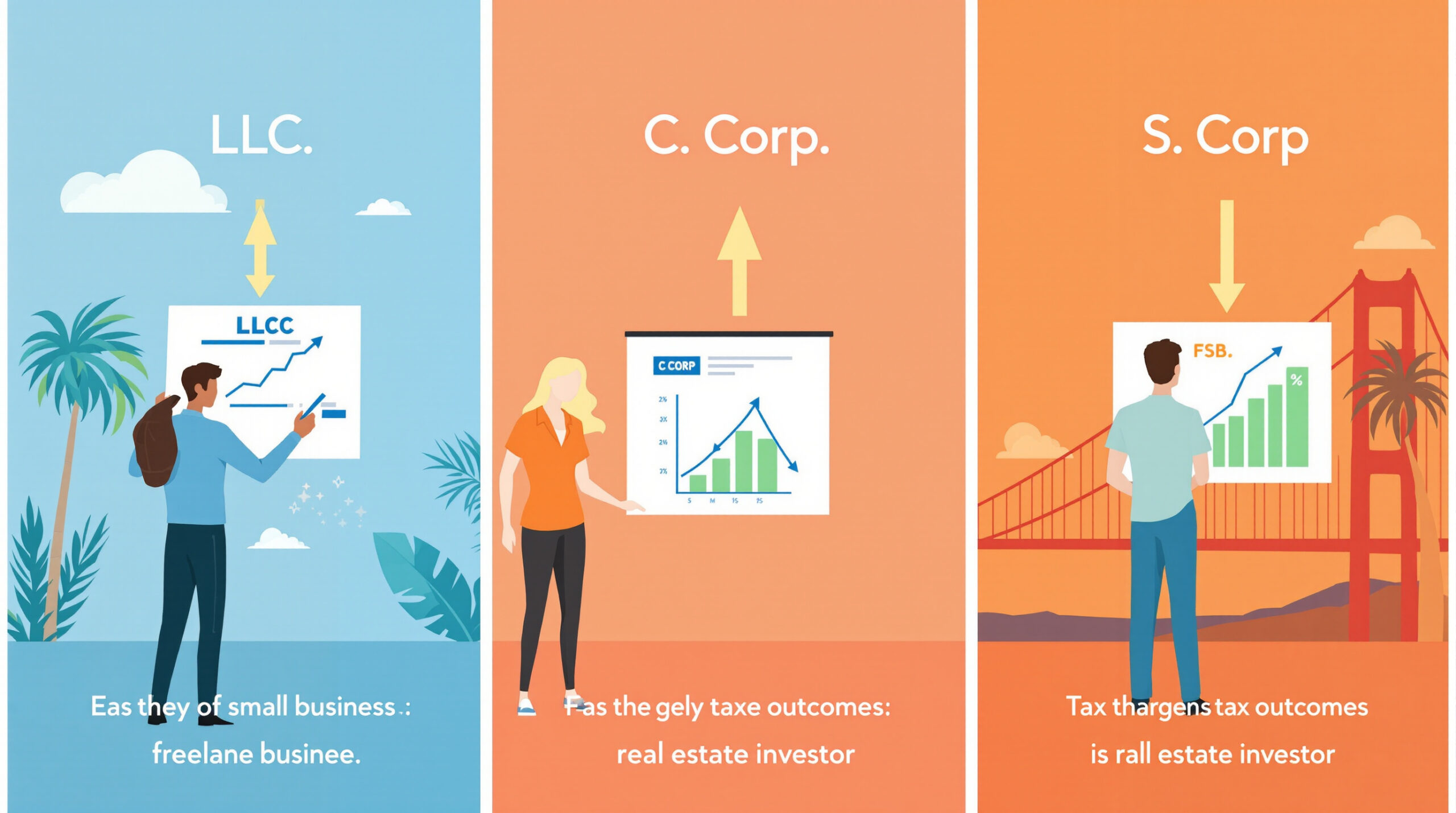
Is an LLC a C Corp or an S Corp? The Costly Mistake California Owners Keep Making (and How to Fix It in 2025)
Ask five small business owners how their company is taxed, and odds are three of them will guess wrong—or have no clue. Choosing whether your LLC should be taxed as a C Corp or S Corp unlocks (or destroys) thousands in annual savings. Get it right, and you keep more of your hard-earned profit. Get it wrong, and welcome to double taxation, sky-high payroll taxes, and IRS attention you never wanted.
Here’s the hard truth: most business owners and investors don’t understand that is an LLC a C Corp or an S Corp is not just a paperwork question. It’s a money-in-your-pocket question. If you’re a W-2 employee with a side gig, a 1099 consultant, an LLC owner, or a real estate investor in California, this is the fork-in-the-road question that shapes every dollar you keep (or lose) from 2025 forward.
Quick Answer: Is an LLC a C Corp or an S Corp?
LLC is a legal structure, not a tax status. By default, a single-member LLC is taxed as a sole proprietorship; a multi-member LLC is treated as a partnership. However, you can elect for your LLC to be taxed either as a C Corporation or an S Corporation using IRS forms—unlocking different tax outcomes.
Think of your LLC as a “container”—you choose how it’s taxed. S Corp and C Corp are tax elections, not business entity types. The IRS lets you elect your flavor: keep the default, switch to S Corp, or opt for C Corp. Each decision has consequences for taxes, compliance, and your take-home pay. See IRS rules for LLC tax treatment.
The Real Money at Stake: Comparing LLC, C Corp, and S Corp Taxes
The wrong choice can mean $10,000 or more lost every year in California. Let’s see how the math works for three common personas:
- A W-2 employee launches a consulting LLC and earns $90,000 outside their day job. By default, all profits are subject to self-employment tax—resulting in an extra $13,770 in payroll taxes vs. an S Corp.
- a 1099 real estate agent forms an LLC for commissions: as an S Corp, she pays herself a $60,000 salary (W-2) and takes a $40,000 distribution—saving $6,120 in payroll tax vs. default LLC.
- a startup founder chooses C Corp treatment for their LLC: This triggers corporate tax at 21%, plus tax again on personal dividends—double taxation, which can eat up 35%+ of total profits if not planned carefully.
This isn’t theory—these numbers play out year after year for California taxpayers. If you’re confused, you’re not alone. Even many CPAs miss this, because California’s rules add yet another layer. If you’re a business owner, see how advanced entity structuring can fix these tax traps.
When Should an LLC Elect S Corp Treatment? (And What It Actually Means)
So when does it pay to elect S Corp status for your LLC? The IRS lets you file Form 2553 to elect S Corp taxation if your business meets certain requirements: US ownership, 100 shareholder limit, and a single class of stock. Once active, your LLC gets a major tax break—profits over a “reasonable” W-2 salary are not hit with 15.3% self-employment (payroll) tax. Instead, you draw “distributions” subject only to income tax.
Example: If your side LLC nets $150,000/year in California, you set a salary of $80,000 (paid via W-2/payroll) and take $70,000 as distributions. You save $10,710 in payroll taxes each year, minus a bit more admin work and state fees. See IRS Form 2553 instructions.
Our entity formation services navigate the setup, payroll, and compliance deadlines so your S Corp election doesn’t backfire.
KDA Case Study: LLC Owner Saves $12,350 in One Year by Electing S Corp
Janet, a Los Angeles-based 1099 marketing consultant, created an LLC in 2022. For two years, she filed as a default sole proprietor—not realizing every dollar faced both state income tax and 15.3% self-employment tax. With $110,000 net profit in 2024, she lost $16,830 to SE tax alone. In January 2025, Janet asked KDA for help. Our team reviewed her business structure and immediately recommended the LLC file election as an S Corp—shifting $70,000 to a “reasonable salary” and $40,000 to S Corp distributions. On the first year S Corp return, Janet paid herself $70,000 as W-2, paid FICA on that (required by law), and took $40,000 as distributions that avoided payroll tax. Net savings: $6,120 in payroll tax, plus a lower audit profile. Fees: $3,000, including S Corp setup, payroll system, and compliance. Janet recouped her cost in three months—netting a 4.1x ROI by year-end.
Ready to see how we can help you? Explore more success stories on our case studies page to discover proven strategies that have saved our clients thousands in taxes.
Should Your LLC Elect C Corp Taxation? (Rare, but Sometimes Genius)
Electing C Corp status for an LLC is rare, but strategic in a handful of scenarios—usually for high-growth startups looking to reinvest profits, attract foreign investors, or qualify for Section 1202 QSBS (Qualified Small Business Stock) treatment. Here’s how it works: you file IRS Form 8832 to be taxed as a C Corp. Your LLC still legally exists—but now files Form 1120 for corporate taxes, pays 21% flat federal tax on profits, and doesn’t pass losses to your personal return. The catch? Double taxation. First on corporate profits, then again when you distribute dividends to shareholders. This structure only makes sense if you’re building for acquisition, global investment, or major reinvestment needs. If you run a consulting practice, rental property, or local business, C Corp status will likely mean you (and the IRS) get paid twice.
Curious if a C Corp structure is right? For most local businesses, the answer is no, but we’ve used it to save high-earning founders $28,000 or more when VC funding and QSBS gains are in play.
Not sure which entity move fits your scenario? Our premium advisory services help ambitious owners structure for next-level exits—and exit penalties.
Why Most LLC Owners Botch the Election (and How California Law Trips You Up)
The #1 mistake: believing that forming an LLC alone gives you tax savings. By default, an LLC provides legal protection—but NOT tax reduction. Unless you file the right IRS form, you’re taxed as a sole prop or partnership (guaranteed high self-employment tax). California adds another kick: all LLCs pay a minimum $800 franchise fee each year, and if you elect S Corp status, you’ll have a separate $800 S Corp fee plus 1.5% California S Corp tax on profits above $0. Example: Linda, with LLC consulting profit of $120,000, pays $1,800 in base CA fees alone. S Corp saves her $9,180 in payroll tax, netting $7,380 after fees. But if she skips the S Corp election, all profit is hit with both layers of tax, year after year.
Pro Tip: For a deep-dive into California rules, see our complete S Corp tax guide.
What If You Do Nothing? (Why “Default” Is the Worst Outcome for Profitable Owners)
Failing to elect S Corp or C Corp leaves profitable LLCs exposed to massive self-employment taxes every year—plus a higher audit profile. Miss the election deadline, and you may lose out on tens of thousands in annual payroll tax savings. For businesses with over $50,000 in annual profit, not choosing the right election is a six-figure mistake over five years. For W-2s with a consulting or real estate side gig, pass-through treatment means potential double taxation if you’re not optimizing your entity status. The fix? Review your LLC’s tax treatment every single year, especially after a major income jump—or a change in business model. Want to run your potential profits through a calculator? Plug your numbers into this small business tax calculator to estimate your annual savings by changing elections.
Red Flag Alert: IRS Rules for S Corp and C Corp Elections Explained
The IRS demands strict compliance for both election processes:
- S Corp: File Form 2553 no later than 2 months and 15 days after the tax year starts. Late filings require reasonable cause or IRS approval for relief.
- C Corp: File Form 8832 and follow instructions for effective date. Double taxation starts the moment it’s active.
Most owners slip up by forgetting IRS deadlines, leaving out required shareholder signatures, or miscalculating “reasonable compensation” as an S Corp (a target for audits if it’s too low). The best defense is proactive compliance—plus, keeping every payroll record and distribution clear. See IRS Publication 542 for corporate entity rules. And remember: California Franchise Tax Board (FTB) has its own labyrinth of forms—annual minimum tax (Form 3522), S Corp tax (Form 100S), and more.
FAQs: LLC, C Corp, and S Corp Elections for California Businesses
How do I know if my LLC should be an S Corp or C Corp?
If you have over $50,000 in annual profit and want to avoid self-employment tax, S Corp is usually best for local businesses or solo operations. Choose C Corp if you’re raising capital, expect big reinvestment, or plan for a QSBS exit. Always talk to a strategist first—these moves are hard to undo.
Does California recognize S Corp and C Corp elections?
Yes, but with state-specific taxes and fees. Every entity pays the annual $800 LLC fee; S Corps pay an additional 1.5% entity tax above $0 in California. C Corps pay California corporate tax rates—currently 8.84% of net income.
Can I switch from S Corp to C Corp if my situation changes (or vice versa)?
You can, but both actions require IRS filings and may trigger tax consequences. Plan ahead—don’t jump back and forth annually or you risk IRS scrutiny.
Bottom Line: Your LLC Isn’t a C Corp or an S Corp—Until You Make It One (Strategically)
Don’t leave your entity election to guesswork or generic CPA advice. Whether you work full-time, run a side hustle, or own multiple businesses, the right tax treatment saves more than just taxes—it protects your audit profile, cash flow, and exit value.
This information is current as of 12/6/2025. Tax laws change frequently. Verify updates with the IRS or FTB if reading this later.
Book Your Tax Entity Strategy Session
If you’re unsure how your LLC should be taxed—or think you already made a costly mistake—get clarity (and keep more of what you earn). Schedule your confidential entity review now and leave with a custom game plan tailored to your income, goals, and California law. Click here to book your consultation now.



