
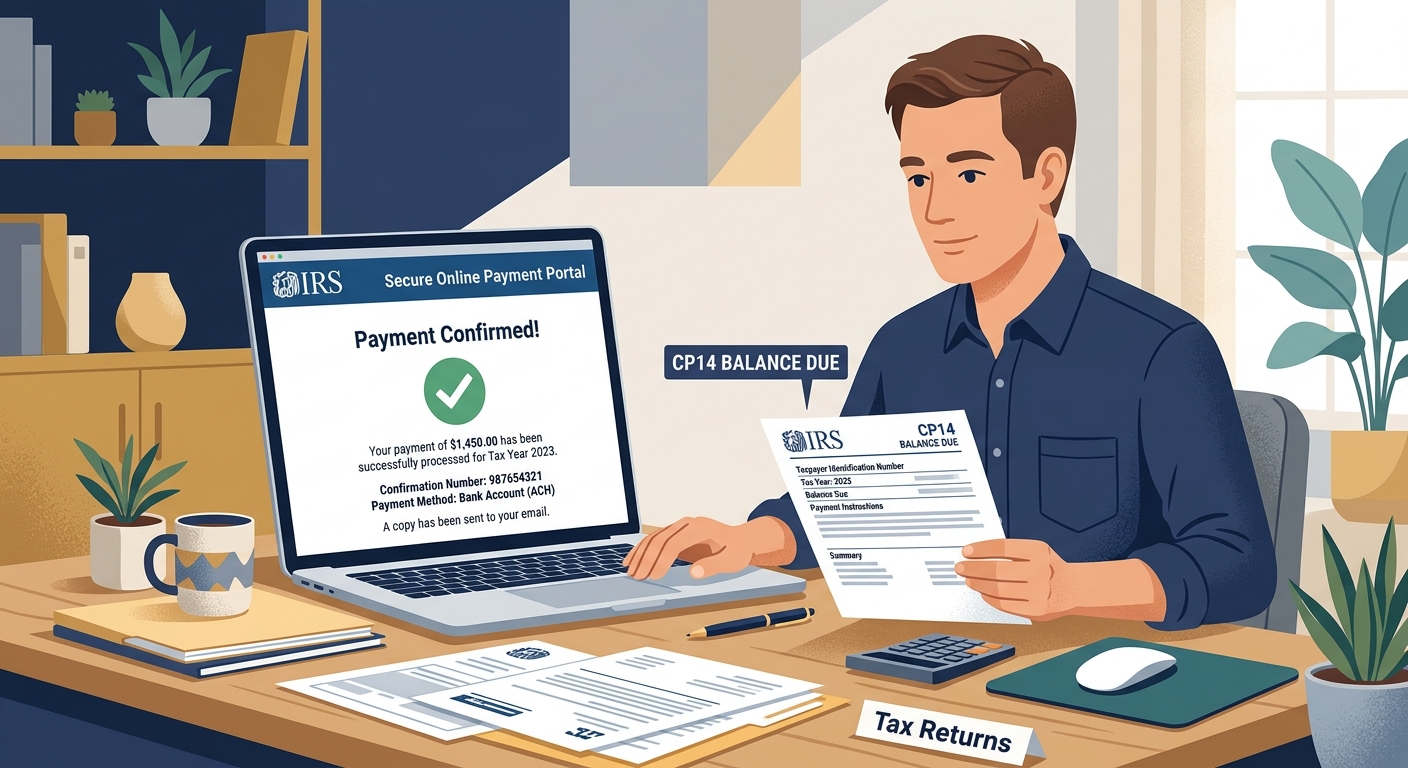
Roughly 5 million taxpayers receive an IRS CP14 notice every summer, and the single most common mistake they make is doing nothing for weeks because the letter looks intimidating. Here is the reframe: a CP14 is not an audit, it is not a threat, and it is not a mystery. It is a bill. And like any bill, the fastest way to make it stop growing is to irs cp14 pay online the same day you understand what you owe. This guide walks you through exactly what the notice means, how to pay it in minutes, how to dispute it if it is wrong, and how to make sure you never see one again.
This information is current as of 7/21/2026. Tax laws and IRS procedures change frequently. Verify updates with the IRS or the California Franchise Tax Board (FTB) if you are reading this later.
Quick Answer: What a CP14 Is and How to Handle It
A CP14 is the first balance-due notice the IRS sends when its records show you owe federal tax that has not been paid. The fastest resolution is to log into IRS Direct Pay or your IRS Online Account and submit payment electronically, which posts within one to two business days. If you cannot pay in full, you can set up a payment plan online in the same session, and if you believe the balance is wrong, you should respond in writing before the deadline printed on the notice.
Key Takeaway: The date on your CP14 is the clock. You generally have 21 days from the notice date to pay before additional interest and failure-to-pay penalties keep compounding, so the smartest move is to choose the option that lets you irs cp14 pay online immediately.
What Is an IRS CP14 Notice?
An IRS CP14 notice is an official letter, sent by mail, informing you that the IRS has calculated a balance due on your federal tax account. The acronym is simply the IRS internal document code, not a category of severity. In plain English, the IRS is saying: our records show you filed a return, and the tax owed was more than the tax paid, so here is the difference plus any interest and penalties accrued to date.
The notice will show four things you need to read carefully. First, the tax year in question. Second, the amount of tax the IRS says you owe. Third, any penalties and interest added on top. Fourth, the total balance and the response deadline. Everything you do next depends on those four numbers being accurate.
Why Did I Get a CP14?
There are several common triggers, and most are boringly mechanical rather than sinister.
- You filed but underpaid – You submitted your return with a balance due and either did not send payment or sent less than the full amount.
- Estimated payments fell short – A common 1099 or self-employed scenario where quarterly payments did not cover the actual liability.
- Withholding was too low – A W-2 employee who claimed too many allowances or had a bonus under-withheld.
- A payment was misapplied – You paid, but the IRS applied it to the wrong year or the wrong spouse’s account.
- Math or credit adjustment – The IRS recalculated a credit and the change increased your balance.
Notice that only some of these mean you actually owe money. That is why step one is always verification, not panic.
How to Pay Your CP14 Online: Step-by-Step
If you have confirmed the balance is correct, paying electronically is faster, cheaper, and more traceable than mailing a check. Here is the exact process. When you decide to irs cp14 pay online, you have three primary electronic routes, and each takes only a few minutes.
Step-by-Step: IRS Direct Pay (Best for One-Time Payments)
- Go to the official site – Visit IRS Direct Pay directly. This service is free and pulls funds straight from your checking or savings account.
- Select the reason for payment – Choose “Balance Due” and then select “CP14” or “Income Tax Form 1040” as the notice type.
- Enter the tax year – Match it exactly to the year printed on your notice.
- Verify your identity – The system asks for information from a prior-year return to confirm you are you. Have that return handy.
- Enter your bank details and amount – Type the exact balance from the notice. Submit and save the confirmation number.
Pro Tip: Screenshot or download your confirmation number immediately. If the IRS later claims non-payment, that number is your proof, and it resolves misapplied-payment disputes in one phone call.
Step-by-Step: IRS Online Account (Best for Full Visibility)
- Create or log into your account – Set up your IRS Online Account using ID.me verification.
- Review your balance by year – This is the single best tool for confirming whether the CP14 amount is real, because it shows every payment and adjustment on file.
- Choose “Make a Payment” – Pay from a bank account for free, or by card for a processing fee.
- Confirm and record – Save the receipt to your tax folder.
Step-by-Step: Debit or Credit Card
If you must use a card, the IRS routes you to third-party processors that charge a fee. Debit card fees are a flat rate of roughly $2 to $3, while credit card fees run about 1.75 to 1.99 percent of the payment. For a $4,000 balance, a credit card charge adds around $70 to $80 in fees, so only use this route if the rewards or float genuinely outweigh the cost. Big-picture planners who want to model how a balance fits into their annual liability can run scenarios through this federal tax calculator before deciding how much to pay now versus over time.
KDA Case Study: The 1099 Consultant Who Beat the Penalty Clock
Marcus, a 38-year-old independent marketing consultant in Sacramento, earned $142,000 in 1099 income and made estimated payments that fell about $9,400 short of his actual liability. In June he received a CP14 showing a balance of $9,400 plus $310 in accrued interest and failure-to-pay penalties. His instinct was to wait until he could pay the whole thing after a big client invoice cleared in the fall.
That instinct would have been expensive. The failure-to-pay penalty is 0.5 percent of the unpaid balance per month, and interest compounds daily, so waiting four months would have added roughly $500 to $700 more. When Marcus came to KDA, we did three things. First, we verified the balance against his IRS Online Account and confirmed it was accurate. Second, we had him pay $5,000 immediately through IRS Direct Pay to shrink the penalty base. Third, we set up a short-term online payment plan for the remaining $4,400, which he cleared in 90 days.
The result: he avoided an estimated $560 in additional penalties and interest, protected his account from escalating notices, and restored his good standing. He paid KDA $1,200 for the strategy and cleanup, producing a first-year return of roughly 3.5x once the avoided penalties, corrected estimated-payment schedule for the following year, and peace of mind were factored in.
Ready to see how we can help you? Explore more success stories on our case studies page to discover proven strategies that have saved our clients thousands in taxes.
What If You Cannot Pay the Full Balance?
Many taxpayers assume that if they cannot pay everything, their only choice is to ignore the notice and hope. That is the worst option. The IRS offers several structured paths, and most can be arranged in the same online session where you would otherwise pay in full. If you are weighing how a payment plan fits into your broader tax picture, our tax planning services can map the most cost-effective route for your situation.
Short-Term Payment Plan (Up to 180 Days)
If you can clear the balance within 180 days, this option carries no setup fee. Interest and the failure-to-pay penalty still accrue, but at a far smaller cost than doing nothing. Apply through your IRS Online Account under the payment plan tab.
Long-Term Installment Agreement
For balances you need to spread over months or years, an installment agreement is available. There is a setup fee that is lower when you apply online and enroll in direct debit. For balances under $50,000, you can usually qualify for a streamlined agreement without providing detailed financial statements.
Offer in Compromise or Currently Not Collectible
These are for genuine financial hardship. An Offer in Compromise lets you settle for less than the full amount if you can prove you cannot reasonably pay it. Currently Not Collectible status pauses collection when paying would prevent you from covering basic living expenses. Both require documentation, and this is where professional guidance pays for itself.
Decision Framework:
Pay in full online now, if:
- You have the cash and the balance is confirmed accurate
- You want the penalty and interest clock to stop today
- You want the simplest possible resolution
Set up an online payment plan, if:
- You can pay within 180 days or need structured monthly payments
- Your balance is under $50,000
- You want to stop escalating notices while you catch up
Dispute or seek hardship relief, if:
- The balance is wrong or a payment was misapplied
- Paying would prevent you from covering basic living costs
What If the CP14 Is Wrong?
Do not assume the IRS is always right. Misapplied payments, duplicate assessments, and credit errors happen. If your IRS Online Account does not match the notice, you have the right to dispute it, but you must respond before the deadline to protect yourself.
How to Dispute a CP14 Notice
- Gather proof – Cancelled checks, bank statements, Direct Pay confirmation numbers, or prior IRS correspondence.
- Call the number on the notice – The CP14 lists a direct phone line. Many misapplied-payment errors are fixed in a single call.
- Follow up in writing – Send a letter with copies of your evidence to the address on the notice, keeping the originals.
- Request a hold if needed – Ask the representative to note the dispute so penalties do not compound while it is reviewed.
Red Flag Alert: Never send original documents, and never ignore the deadline just because you are disputing. If you miss the response window, the IRS can move to enforced collection even on an amount you do not actually owe. A timely written response preserves your appeal rights.
California Considerations: Federal Notice, State Follow-Up
A CP14 is a federal notice from the IRS. It does not come from the California FTB. However, California taxpayers should watch for a parallel issue. If you underpaid federal tax, there is a strong chance you also underpaid California state tax, which means an FTB balance-due notice may be on its way separately.
The FTB has its own online payment system through the Web Pay portal and its own penalty structure, which is often stricter than the federal version. California’s failure-to-pay and estimated-payment penalties can stack quickly for high earners. If your CP14 traces back to under-withholding or short estimated payments, treat it as an early warning to review both your federal and state accounts in the same sitting.
Key Takeaway: Fixing only your federal balance while ignoring a looming FTB notice is a classic California mistake. Reconcile both accounts together so you are not surprised by a second bill in 60 days.
How to Never Get a CP14 Again
The best CP14 is the one you never receive. Prevention comes down to matching what you pay in throughout the year to what you will actually owe.
For W-2 Employees
Review your Form W-4 whenever your income changes. A raise, a bonus, or a working spouse can push you into a higher bracket and leave your withholding short. If you received a large bonus, check whether the flat supplemental withholding rate covered your real marginal rate.
For 1099 Contractors and Business Owners
Make quarterly estimated payments on time using the safe harbor rule. If you pay in at least 100 percent of last year’s tax liability, or 110 percent if your prior-year adjusted gross income was over $150,000, you generally avoid an underpayment penalty even if you owe more at filing. Self-employed taxpayers can estimate quarterly obligations using this self-employment tax calculator so payments are accurate rather than guesswork.
For Everyone
Keep a dedicated tax savings account and set aside a percentage of every payment or paycheck. When the bill comes, the money is already there, and you can irs cp14 pay online the moment any balance appears rather than scrambling.
Ready to Reduce Your Tax Bill?
KDA Inc. specializes in strategic tax planning for business owners, S Corps, LLCs, and high-net-worth individuals. Book a personalized consultation and walk away with a clear plan.
Frequently Asked Questions
How long do I have to respond to a CP14?
You generally have 21 days from the notice date to pay before additional penalties and interest continue to accrue, or 10 days in some cases for larger balances. Read your specific notice, because the printed deadline controls. Even if you cannot pay in full, act before that date by setting up a payment plan to protect your standing.
Does paying my CP14 online stop the penalties immediately?
Interest and the failure-to-pay penalty stop accruing on the portion you pay once the electronic payment posts, which is typically one to two business days. This is exactly why paying online beats mailing a check, since a mailed payment can take a week or more and penalties keep compounding in the meantime.
Will a CP14 hurt my credit score?
The CP14 itself is not reported to credit bureaus. However, if you ignore it and the balance escalates to a federal tax lien, that public record can affect your ability to borrow. Resolving the notice promptly keeps the issue entirely between you and the IRS.
Can I set up a payment plan and pay part of the balance the same day?
Yes. This is often the smartest move. Pay as much as you can immediately to shrink the penalty base, then arrange an online payment plan for the remainder. Reducing the unpaid balance lowers every future monthly penalty calculation.
Book Your Tax Strategy Session
A CP14 in your mailbox is not a crisis, but ignoring it becomes one. Whether you need to confirm the balance is accurate, set up the right payment plan, or fix the withholding and estimated-payment gaps that caused it, our strategy team can resolve it fast and make sure it never happens again. Stop letting penalties compound while you wait. Click here to book your consultation now.



