
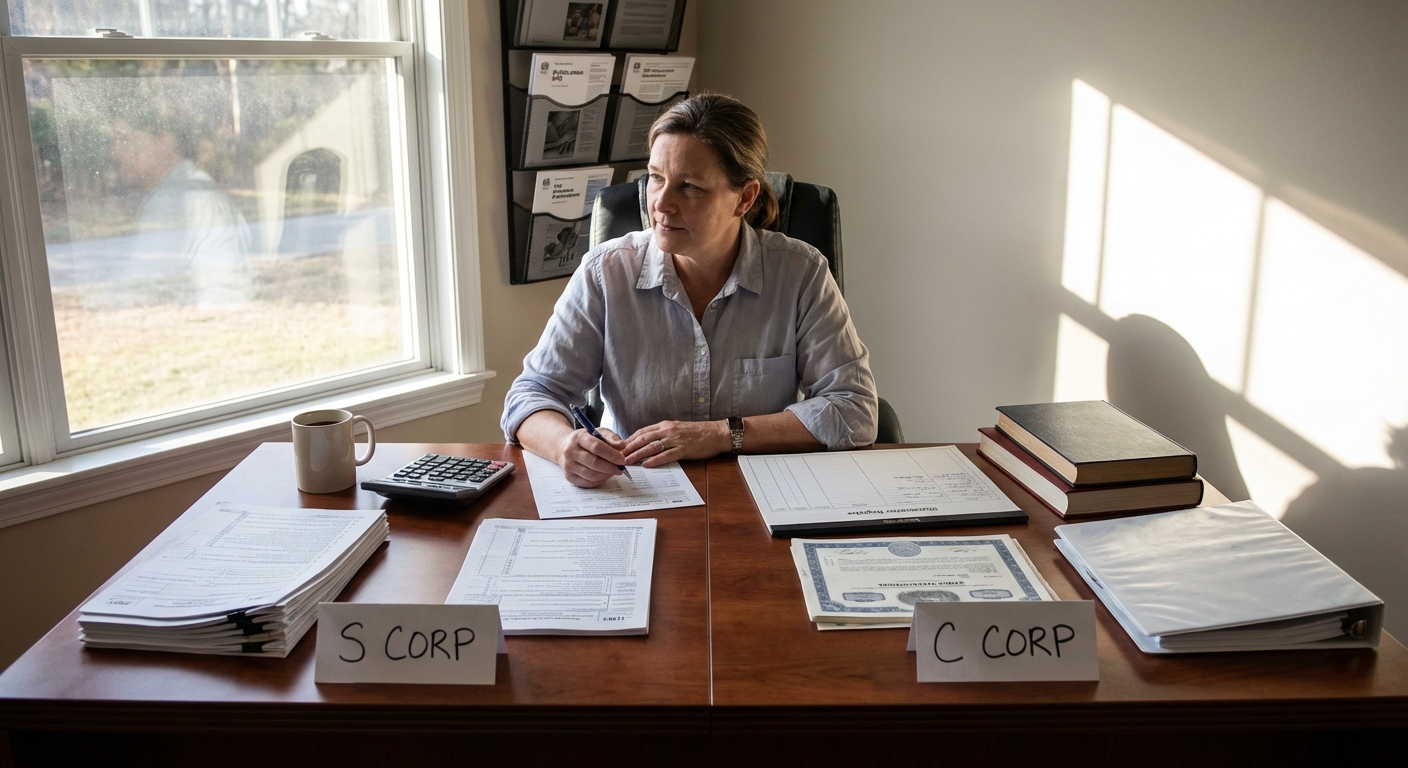
How to Find Out If S Corp or C Corp: The 2026 California Guide to Entity Identity, Audit Traps, and Tax Savings
Most California business owners believe their legal entity type is obvious—until an IRS or FTB notice lands in the mail questioning their classification, payroll setup, or tax filings. The confusion between S Corps (S Corporations) and C Corps (C Corporations) isn’t just a detail: it is often the root cause of six-figure tax errors, disallowed deductions, and audit penalties. Owners routinely discover, late in the year or even during an audit, that what their operating agreement or CPA says does not always match IRS or state records. The cost? Easily $12,000–$61,000 in unnecessary taxes, lost deductions, or fines in a single year.
For 2026, California’s rules, federal IRS changes, and the aftermath of the latest corporate alternative minimum tax (CAMT) guidance have further raised the stakes for getting this distinction right. Here’s exactly how to determine if your business is treated as an S Corp or C Corp—and why the difference could make or break your financial future.
Quick Answer: How to Tell If Your Business Is an S Corp or C Corp
How to find out if S Corp or C Corp: Check your IRS acceptance letter for Form 2553 (S Corp), your last federal tax return (Form 1120S for S Corps, Form 1120 for C Corps), and confirm your election status with the IRS Business & Specialty Tax Line (800-829-4933). On the California side, match your SOS (Secretary of State) entity status with FTB records and the exact forms filed each year.
When clients ask how to find out if s corp or c corp, I tell them to ignore assumptions and verify election status at the federal level first. The IRS controls classification under Internal Revenue Code §1362, and the only binding proof of S status is an accepted Form 2553 with a CP261 confirmation letter. If that acceptance does not exist in IRS records, you are legally taxed as a C corporation (if incorporated) — regardless of what your CPA intended. Strategy starts with documented proof, not belief.
Why This Distinction Matters: Red Flags, Penalties, and Tax Savings
The difference between S Corp and C Corp is not merely about legal language. The primary distinction impacts:
- Taxation: S Corps are pass-through entities—owners pay tax on business profits in their personal returns (unless subject to California S Corp tax). C Corps pay their own taxes, then shareholders pay again on dividends (the classic “double tax”).
- Filing Forms: S Corps file Form 1120S. C Corps file Form 1120. If you file the wrong one, the IRS can disallow your election retroactively.
- Payroll and Benefits: IRS requires S Corp owners to take “reasonable salary,” but not C Corp owners. Deductibility of benefits and fringe perks varies dramatically.
- Audit Triggers: Mistaking S for C Corp (or vice versa) is high on IRS/FTB audit algorithms. Mixing forms, inconsistent payroll, or misclassified draws can all generate audit notices or rejection of corporate tax status.
- California Franchise Tax Board Rules: The FTB uses different codes, minimum taxes, and withholding schemes for each.
The result: even one mistaken filing can expose you to penalties ($2,500–$50,000+) and force back payments for several years. Nearly every business owner who has “changed accounting firms” or “filed late” is at elevated risk of this mismatch.
If you’re a California LLC owner considering an S Corp election, understanding the technical and practical requirements is critical. Many business owners and consultants miss these technical details and pay the price during IRS/FTB review.
Pro Tip: Never rely solely on your bank account title or internal QuickBooks settings. The IRS and FTB care only about tax election paperwork and the forms you actually file.
Step-By-Step: How to Confirm Your Entity’s S Corp or C Corp Status
Here’s a clear, actionable process any California business owner or high-net-worth taxpayer can use to confirm S Corp vs C Corp status—before the IRS or FTB does it for you in the middle of an audit.
- Locate Original Formation Documents
• For California, check your Articles of Incorporation pulled from the Secretary of State (SOS) site. This tells you if you’re a corporation or LLC—but not tax status. - Find IRS Election Acceptance:
• If you filed IRS Form 2553 and got a CP261 Acceptance Letter, you’re an S Corp (for that year and forward, unless revoked).
• No 2553 or no acceptance? You’re defaulted to C Corp for a corporation, or default/partnership for LLC. - Review Your Most Recent Business Tax Return:
• S Corps file IRS Form 1120S. C Corps file IRS Form 1120.
• California S Corps file FTB Form 100S; C Corps file FTB Form 100.
• The form your CPA or tax software submitted is definitive for IRS/FTB classification. - Call the IRS Business Hotline:
• If you’re unsure, call the IRS at 800-829-4933. They’ll verify your current entity election based on EIN. - Double-Check Annual Filings:
• S Corps must keep filing Form 1120S annually. Miss a year or file a C Corp return by mistake? Your S election could be invalidated, per IRS instructions. - Confirm California FTB Consistency:
• In California, check your entity’s status with the Secretary of State’s online tool and compare to your FTB account. Mismatches—like showing S Corp with IRS but not with FTB—are a leading cause of franchise tax notices and penalty letters.
If you’re wondering how to find out if s corp or c corp, your filed return history is often more powerful than your formation documents. Filing Form 1120 instead of 1120S—even one year—can signal to the IRS that your S election was never valid or has terminated. That can trigger retroactive reclassification, back corporate tax at 21% under IRC §11, and dividend treatment on prior distributions. Always reconcile filed returns with election acceptance before assuming your status is intact.
Strategic year-end entity reviews can save LLCs, S Corps, and C Corps from expensive mismatches and lost tax benefits. Our entity formation and structuring services can help you avoid these traps, correct errors, and preserve your tax savings for 2026 and beyond.
KDA Case Study: S Corp Audit Rescue for a California Tech Consultant
“Daniel” (not his real name), a Los Angeles-based freelance software developer, had earned around $185,000 annually on a 1099 for several years. On advice from a well-meaning advisor, he “set up an S Corp,” started running his income through it, and believed all was handled. What he didn’t realize: while his LLC was set up with the California Secretary of State and his CPA began filing as an S Corp with the IRS, his original Form 2553 election was never properly accepted. Furthermore, all his California FTB annual statements were filed as an LLC, not as an S Corp or C Corp.”
When Daniel received an IRS audit notice in early 2025, the problem quickly became clear: the IRS had Daniel’s entity classified as a default LLC, not an S Corp. His prior “S Corp” filings (1120S) were deemed invalid—triggering over $39,700 in back taxes, lost payroll deduction eligibility, and new late-filing penalties.
Our KDA team mobilized to pull all original entity documents, confirm the missing 2553 acceptance, and work with the IRS/FTB on late-election relief (using IRS Rev Proc 2013-30’s late relief protocol). Within three months, Daniel’s entity classification was corrected, $25,400 in penalties were eliminated, and his business now saves $14,250 yearly in self-employment taxes through proper S Corp status. Daniel paid $4,900 for the full correction and received a direct first-year ROI of 2.9x, not counting years of future savings.
Ready to see how we can help you? Explore more success stories on our case studies page to discover proven strategies that have saved our clients thousands in taxes.
How Entity Status Affects Your Taxes and Audit Risk for 2026
The economic and tax differences between S Corps and C Corps have never been more pronounced. Under the current rules for 2026:
- S Corps: Pass incomes and losses directly through to the owners—no double taxation. Subject to “reasonable compensation” payroll rule.
- C Corps: Subject to 21% federal tax (plus state tax), then personal tax on dividends. No “reasonable compensation” rule, but high audit focus on owner payroll, benefits, and retained earnings.
Audit Red Flags in 2026:
- Mismatched forms (filing Form 1120 when S Corp was elected, or vice versa).
- Late or missing S Corp election filings.
- Incorrect California FTB compliance (wrong business code, wrong franchise tax minimum paid).
- Owner compensation not matching industry benchmarks for S Corps (see IRS Publication 535 for “reasonable salary” guidance).
For a complete breakdown of S Corp strategies, see our comprehensive S Corp tax guide—especially if your operating agreement, tax filings, and state records are not 100% consistent.
What If I Don’t Know My Entity Status? FAQs and Immediate Steps
What if I never filed Form 2553?
If you never filed IRS Form 2553, you are not validly treated as an S Corp—even if you told your CPA to do so. Your default status will be C Corp (if incorporated) or disregarded entity/partnership (if LLC). Ask your CPA for a copy of the filed and accepted 2553.
High-income owners frequently ask how to find out if s corp or c corp after years of operating under the wrong assumption. The fastest method is a direct IRS entity verification call tied to your EIN (800-829-4933) combined with confirmation of your original EIN assignment letter (CP 575) and any S-election approval notice. If IRS records do not reflect an approved S election effective for your tax year, your payroll strategy, distributions, and K-1 filings may all require correction under Rev. Proc. 2013-30 relief rules. This is where proactive damage control protects five-figure exposures.
What if my SOS records say “corporation” but IRS says LLC?
This is a classic California mismatch. Go back to your SOS filing and IRS EIN assignment letter. If you are a corporation with no 2553, you are a C Corp. If you incorporated as an LLC, your default status (unless elected) is disregarded entity or partnership, not S or C Corp.
How do W-2 employees and real estate investors verify their business entity status?
W-2: Check if you receive a W-2 from the entity. If so, it’s likely S Corp or C Corp. Real estate investors: Most file on Schedule E as individuals or through an LLC; only rarely should a real estate play be a C Corp or S Corp due to unfavorable tax treatment.
What’s the simplest way to confirm my California franchise tax obligation?
Log into your FTB account and review your last 3 payments. FTB Form 100S indicates S Corp status; FTB Form 100 is for C Corp.
Pro Tip: If you’re in doubt, run your scenario through a small business tax calculator for a rough estimate of how your entity choice is impacting your federal and CA taxes.
Red Flag Alert: The Mistake That Triggers Audit and Penalties
The #1 way California business owners trigger IRS or FTB audits is by having inconsistent entity documentation. Saying you’re an S Corp on your website, but filing as an LLC or C Corp with the state, is a red flag the IRS and FTB actively look for using database cross-checks. Inconsistent filing is not a clerical issue—it’s the most common trigger for late tax notices, payroll audits, or even loss of S election status.
- Not keeping a current, signed, and IRS-accepted 2553 form on file.
- Not matching your payroll setup with your actual tax filing status.
- Letting your CPA or bookkeeper file forms without confirming your actual entity type each year.
This can be resolved with one IRS call (800-829-4933)—but far better is to lock down your classification before the next filing season, not after it’s flagged.
FAQs: Common S Corp vs C Corp Questions
Do I need to file both Forms 2553 and 8832 to get S Corp status?
You do not usually need Form 8832 unless you’re an LLC electing to be taxed as a corporation first before then electing S status. Corporations just file 2553 by itself. See IRS instructions for Form 2553.
What if I missed the S Corp election deadline?
You can request late S Corp election relief using IRS Rev Proc 2013-30. File ASAP to avoid invalid filings and penalties.
Can I switch from S Corp to C Corp or vice versa?
Yes, but there are significant tax and compliance traps with both moves. See our in-depth coverage of entity conversions, late elections, and IRS/FTB rules for strategic scenarios.
What’s the penalty if I file the wrong California FTB form?
Minimum penalty is $2,500 and rises sharply with additional errors or unfiled years. California aggressively audits entity mismatches.
Book Your Entity Compliance Session Now
If you’re unsure about your S Corp or C Corp status—or want to prevent six-figure audit risks and unlock new tax savings—this is your moment. Book a personalized consultation with the KDA strategy team. We’ll review your documents, fix compliance gaps, and create a roadmap for real, worry-free savings in 2026. Click here to book your consultation now.


