
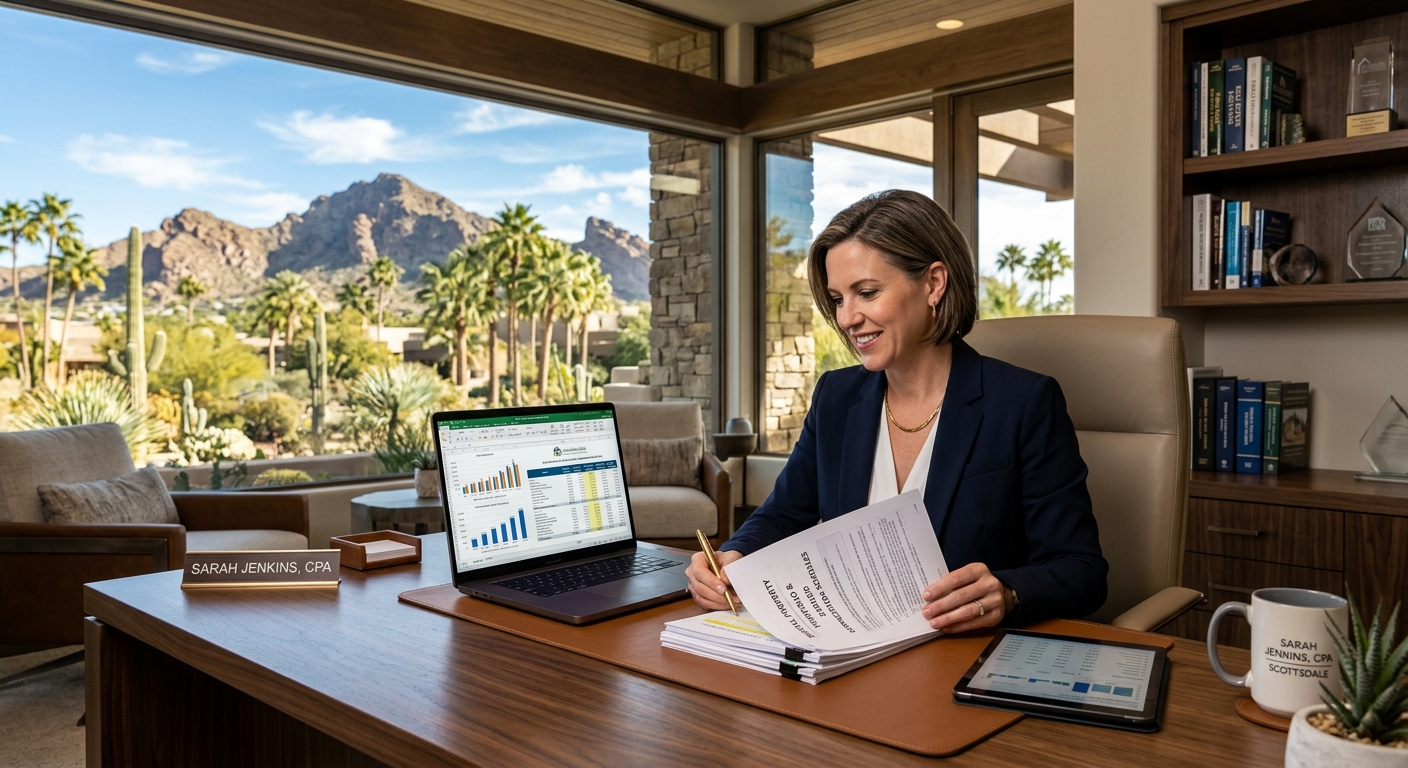
If you own rental property, flip homes, or run a short-term rental in Maricopa County, the single most important financial hire you will make is not a property manager or a real estate agent. It is finding the best real estate CPA in Scottsdale Arizona who actually understands depreciation, cost segregation, passive activity rules, and the 2026 tax law changes reshaping how investors keep their money. The wrong accountant treats your rentals like a hobby. The right one turns your portfolio into a legally aggressive tax-reduction machine.
This guide breaks down exactly what to look for, the questions that separate a generalist from a true real estate specialist, and the specific strategies a qualified advisor should be putting in front of you this year. This information is current as of 7/19/2026. Tax laws change frequently, so verify updates with the IRS or Arizona Department of Revenue if you are reading this later.
Quick Answer: What Makes the Best Real Estate CPA in Scottsdale Arizona?
The best real estate CPA in Scottsdale is one who specializes in real estate taxation, not general bookkeeping. They should proactively use cost segregation, understand the difference between passive and active real estate income, know how to qualify you for real estate professional status, and stay current on 2026 provisions like the increased Section 179 limits and 1099 reporting thresholds. If your current accountant only sees you once a year at filing time, you are almost certainly overpaying.
Why Real Estate Investors Need a Specialist, Not a Generalist
Real estate is one of the most tax-advantaged asset classes in the entire tax code, but only if someone knows how to unlock those advantages. A general CPA who prepares 400 individual returns a year simply does not have the bandwidth to master Schedule E depreciation strategies, 1031 exchange timing, and the passive loss limitation rules under Section 469.
Here is the plain-English reality. Two Scottsdale investors can own identical duplexes generating identical rent. One pays $11,000 in federal tax on that income. The other pays close to zero, legally, because their CPA front-loaded depreciation, grouped their activities correctly, and documented material participation. Same property. Same rent. Wildly different outcomes. The difference is the person preparing the return.
When you search for real estate tax preparation help, you want a firm that lives in Schedule E, Form 4562, and Form 8582 every single day. That fluency is what produces real savings.
The Warning Signs of the Wrong Accountant
- They never mention cost segregation on properties over $500,000
- They tell you rental losses “cannot be used” without explaining the exceptions
- They have never asked how many hours you spend managing your properties
- They do not know what real estate professional status is
- They only communicate during tax season, never for planning
Core Strategies the Best Real Estate CPA in Scottsdale Arizona Should Be Using
A qualified specialist does not just record what happened last year. They engineer what happens this year. Below are the pillars that separate elite real estate tax work from ordinary return preparation.
1. Cost Segregation Studies
Cost segregation is the single most powerful tool in a real estate investor’s arsenal, and it remains front and center in 2026. Instead of depreciating an entire building over 27.5 years (residential) or 39 years (commercial), a cost segregation study breaks the property into components. Carpeting, cabinetry, specialized electrical, landscaping, and parking surfaces can be reclassified into 5, 7, and 15-year property, dramatically accelerating deductions.
Here is what the math can look like. Say you buy a $1.2 million short-term rental near Old Town Scottsdale. A quality engineering-based study might reclassify roughly $300,000 of that basis into short-life assets. Combined with bonus depreciation, that can create six figures in first-year deductions instead of the roughly $43,000 you would get under straight-line depreciation.
One critical 2026 note: the IRS is scrutinizing AI-generated cost segregation studies heavily. Industry reporting confirms that self-generated studies from tools like ChatGPT are being rejected by qualified firms and flagged on audit. Your CPA should insist on an engineering-based study from a credentialed firm, not a shortcut. If you want to run rough numbers before you commit, a professional will help you model the impact rather than guessing. Explore how a formal cost segregation study could reposition your depreciation schedule.
2. Real Estate Professional Status (REPS)
By default, rental losses are “passive” and can only offset passive income under Section 469. But if you or your spouse qualifies as a real estate professional, those losses can offset your active W-2 or business income. That is the holy grail for high earners.
To qualify, you generally must spend more than 750 hours per year in real property trades and more than half of your total working hours in real estate. Documentation is everything here. The best real estate CPA in Scottsdale Arizona will set up contemporaneous time logs, help you group activities under a single election, and make sure your material participation holds up if the IRS asks. See IRS Publication 925 for the passive activity and at-risk rules that govern this.
3. The Short-Term Rental Loophole
Scottsdale is a short-term rental powerhouse, and the STR strategy is often overlooked. If the average guest stay is 7 days or fewer and you materially participate, the activity may not be treated as a rental under the passive loss rules at all. That means losses can potentially offset active income even without full real estate professional status. For an Airbnb owner with a demanding day job, this is a game changer that most generalist accountants miss entirely.
4. The 1031 Exchange
When you sell an investment property, a properly structured 1031 exchange lets you defer capital gains tax by rolling proceeds into a like-kind replacement property. The timing rules are strict: 45 days to identify replacement property and 180 days to close. A specialist coordinates the qualified intermediary, the timeline, and the reinvestment so you do not accidentally trigger a taxable event. Deferring $150,000 in gains keeps that capital compounding in your portfolio instead of sitting in the U.S. Treasury.
KDA Case Study: Scottsdale Short-Term Rental Investor Cuts Tax Bill by $46,000
A client came to us owning three short-term rentals in the Scottsdale and Fountain Hills area, generating about $210,000 in gross rental revenue. Her prior accountant, a general practitioner, had been depreciating each property straight-line and told her the rental losses were “trapped” because she also earned $180,000 as a W-2 marketing executive. She was writing checks to the IRS every April and had no idea she was leaving enormous deductions on the table.
Our real estate team did three things. First, we commissioned engineering-based cost segregation studies on all three properties, reclassifying roughly $340,000 of combined basis into short-life assets. Second, we documented that her average guest stay was under 7 days and that she materially participated in managing the properties, qualifying her for the short-term rental treatment. Third, we corrected her activity grouping and depreciation schedules on Form 4562.
The result: in the first year, she generated enough accelerated deductions to offset a large portion of both her rental income and her W-2 income, reducing her total federal tax liability by roughly $46,000. Her investment in our planning and study coordination was about $9,500, delivering nearly a 4.8x first-year return. More importantly, she now has a repeatable framework for future acquisitions.
Ready to see how we can help you? Explore more success stories on our case studies page to discover proven strategies that have saved our clients thousands in taxes.
2026 Tax Law Changes Every Scottsdale Investor Should Know
The One Big Beautiful Bill Act (OBBBA) brought several provisions that take effect for the first time in 2026. A sharp real estate CPA is already adjusting your strategy around them.
| Provision | 2025 Rule | 2026 Rule |
|---|---|---|
| 1099-MISC / 1099-NEC threshold | $600 | $2,000 |
| Section 179 expensing limit | Lower cap | $2.5 million |
| Section 179 investment limit | Lower cap | $4 million |
| Estate and gift tax exclusion | Prior amount | $15 million |
| Form 1099-K threshold | Reduced | $20,000 / 200 transactions |
The jump in the 1099 reporting threshold from $600 to $2,000 for payments made after December 31, 2025, matters if you pay contractors for repairs, cleaning, and maintenance. The increased Section 179 limits give property owners more room to expense qualifying improvements immediately. And the $15 million estate and gift exclusion opens meaningful planning windows for investors building generational real estate wealth. You can review the current federal framework at IRS depreciation guidance.
Arizona-Specific Considerations
Arizona has no separate state-level real estate transfer tax, which is a genuine advantage compared to high-tax states. However, Scottsdale and Maricopa County investors still deal with transaction privilege tax (TPT) on residential rentals in certain circumstances, county property tax assessments, and short-term rental licensing requirements. A local specialist ensures your TPT filings and city licensing are handled so a paperwork miss does not become a penalty. If you are researching a firm serving the region, KDA supports investors across Maricopa County including the Scottsdale market.
Should You Hire a Real Estate CPA? A Decision Framework
Yes, hire a specialist if:
- You own two or more rental properties
- Any single property is worth more than $400,000
- You operate short-term rentals
- You are planning to sell and want to defer gains
- You earn a high W-2 income you want rental losses to offset
You may be fine with a generalist if:
- You own a single low-value rental with minimal activity
- You have no plans to acquire or sell
- Your income is modest and simple
For nearly every serious investor in the Scottsdale market, the fee for a specialist pays for itself many times over. This is not an expense. It is one of the highest-ROI decisions in your entire investment strategy.
Step-by-Step: How to Vet and Hire the Right Real Estate CPA
- Confirm the specialty — Ask directly what percentage of their clients are real estate investors. You want 40 percent or higher.
- Ask about cost segregation — A qualified firm should immediately explain when it makes sense and insist on engineering-based studies.
- Test their REPS knowledge — Ask how they document real estate professional status. If they hesitate, keep looking.
- Verify proactive planning — The best advisors meet with you mid-year, not just at filing.
- Check the technology and communication — You want a firm that responds and integrates with your bookkeeping.
- Review the engagement scope — Make sure planning, not just preparation, is included.
Common Mistakes Scottsdale Investors Make
Even sophisticated investors trip on the same handful of errors. Missing cost segregation on a large purchase. Failing to document material participation hours. Blowing a 1031 exchange deadline by a single day. Treating an active flip as a rental (or vice versa). Forgetting Scottsdale short-term rental licensing. Each of these can cost tens of thousands, and each is completely avoidable with the right advisor in your corner. Explore how KDA supports real estate investors across the full portfolio lifecycle.
Ready to Reduce Your Tax Bill?
KDA Inc. specializes in strategic tax planning for business owners, S Corps, LLCs, and high-net-worth individuals. Book a personalized consultation and walk away with a clear plan.
Frequently Asked Questions
How much does a real estate CPA cost in Scottsdale?
Fees vary based on portfolio complexity, but serious investors typically invest a few thousand dollars annually in planning and preparation. When that work generates tens of thousands in tax savings, the return is substantial.
Can rental losses offset my W-2 income in Arizona?
Sometimes. Generally rental losses are passive, but they can offset active income if you qualify as a real estate professional or use the short-term rental strategy with material participation. See IRS Publication 925 for the rules.
Is cost segregation worth it for a single property?
Often yes, especially on properties above $500,000 or with significant renovation. Your CPA should model the benefit before you commission a study.
Does Arizona have a state income tax on rental income?
Yes, Arizona has a state income tax, though its flat rate is relatively low compared to states like California. Rental income is generally reportable at both the federal and state level.
What is the deadline for a 1031 exchange?
You have 45 days to identify replacement property and 180 days total to close. These deadlines are strict and cannot be extended for missing them.
Do I need to license my Scottsdale short-term rental?
Yes. Arizona and the City of Scottsdale have registration and licensing requirements for short-term rentals, along with potential transaction privilege tax obligations.
Book Your Real Estate Tax Strategy Session
If you own rental property in Scottsdale and your accountant has never mentioned cost segregation, real estate professional status, or the short-term rental strategy, you are almost certainly overpaying the IRS by thousands every single year. Let’s change that. Our real estate tax team will review your portfolio, model your depreciation opportunities, and build a proactive plan designed to keep more capital compounding in your name. Click here to book your consultation now.



