
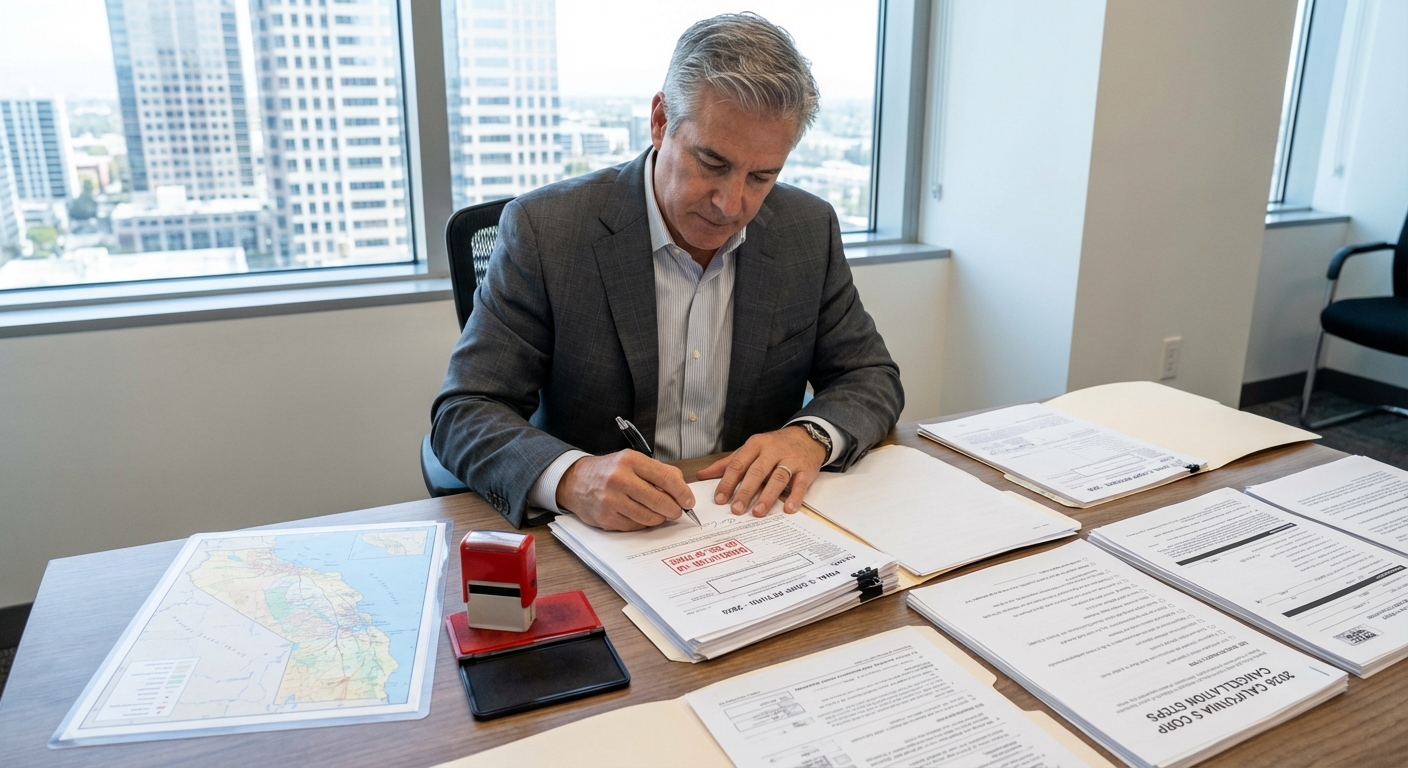
How to Cancel a California S Corp: The Brutally Honest 2026 Playbook for Business Owners
Most S Corp owners panic at the thought of shutting down their company—afraid of tax traps, five-figure penalties, or somehow “getting stuck” with the IRS or the California FTB. The reality? Canceling a California S Corp is absolutely survivable—if you follow the steps precisely (and skip the common mistakes that even veteran CPAs still make in 2026).
Quick Answer: To cancel your California S Corp in 2026, you must: file a final federal and state return (Form 1120S and Form 100S), make sure all payroll and sales tax liabilities are paid, dissolve the corporation with the Secretary of State (Form DISS STK), close all state and federal accounts, and formally notify the IRS. Miss a step, and you’re facing $2,000+ in annual minimum franchise tax plus IRS and FTB notices well into the future.
This is the playbook every owner, high-earning contractor, real estate pro, or online entrepreneur needs right now—especially if you want to shut down clean, keep your tax records audit-proof, and walk away without ugly surprises.
The Real Cost of Shutting Down Your S Corp in 2026
Too many business owners underestimate the true cost—and risk—of canceling an S Corp. Yes, the paperwork looks simple, but there are hidden traps:
- Minimum $800 Franchise Tax EXTENDS until your company is officially dissolved (not when you stop working).
- Failure to file a final S Corp tax return (IRS Form 1120S and CA Form 100S) triggers immediate audit flags at both state and federal levels.
- If you skip “Consent to Dissolve” or the DISS STK filing with the California Secretary of State, your S Corp will legally remain active—and so will tax liabilities.
Let’s ground this with real numbers: If you decide to shut down in June 2026, but your S Corp isn’t dissolved until March 2027, you’ll owe the $800 tax for both 2026 and 2027—even with zero business income. Late filings add another $200–$2,000 in penalties rapidly (see FTB’s warning).
Most business owners hit by these penalties made mistakes at three critical choke points:
- Mis-timing the final payroll run and forgetting to remit final taxes
- Failing to file “final” returns and close accounts with the IRS, EDD, and SBOE
- Overlooking dissolution with the Secretary of State, thinking everything is done after tax forms are filed
If you’re in the position of needing to close an S Corp, this is where seeking help from specialists serving business owners makes sense—not just to get through the forms, but to avoid endless compliance headaches.
Step-by-Step: How to Cancel a California S Corp in 2026
Here is the streamlined, audit-proof roadmap for closing your S Corp this year, including every major agency involved.
- Vote and Consent: All shareholders must consent to dissolve. This is usually done via a formal written resolution (especially if more than one shareholder).
- File the Final Federal Return (Form 1120S): Mark “Final return” on top of the IRS Form 1120S. List the closing date (usually your last payroll or final income event). Include all K-1s. See official IRS 1120S instructions.
- Prepare and File Final California Tax Return (Form 100S): Check the box for “Final Return.” The California Franchise Tax Board (FTB) will expect you to pay the minimum franchise tax through the year you file dissolution.
- Pay All Outstanding Liabilities: Settle any outstanding employment, payroll, and sales taxes (EDD and CDTFA accounts). File all required reports—including the final DE-9 with EDD if you had payroll.
- File Dissolution with Secretary of State (Form DISS STK): This step makes your S Corp’s dissolution official with the state. 100% required. You can find the form and file online at the Secretary of State site.
- Close All Tax Accounts: Close your EIN with the IRS (complete section 11 of Form 966 or write a letter), the CA EDD, CDTFA, and FTB (if you have other accounts open).
- Notify Remaining Creditors/Clients: Send formal notification—this is especially critical if your S Corp name appears on contracts or leases.
Once you’ve completed every step, keep all records and confirmations for at least seven years. The IRS and FTB both reserve the right to question previous filings for several years post-dissolution.
If you want a complete breakdown of S Corp strategies—including shutdown options—see our comprehensive S Corp tax guide.
KDA Case Study: S Corp Owner Avoids $9,400 in Penalties by Shutting Down Right
Client: Single-owner S Corp, consulting industry. Problem: Owner stopped working in May 2025, assumed she could “just ignore” the business, and didn’t file final returns or a formal dissolution. By January 2026, the business was flagged by both the IRS and FTB for non-filing, and the FTB assessed an additional $2,200 in penalties for two years’ worth of unpaid minimum franchise tax.
KDA’s Solution: We stepped in, coordinated final payroll/tax filings, prepared and filed the final IRS Form 1120S and CA Form 100S, completed FTB’s formal closure process, and walked the owner through dissolving the S Corp with Form DISS STK. We also closed all associated payroll and sales tax accounts. Total cost to the client: $2,500. Savings: $9,400 in penalties, plus no more compliance mail (and peace of mind).
Ready to see how we can help you? Explore more success stories on our case studies page to discover proven strategies that have saved our clients thousands in taxes.
Common Mistakes That Trigger Endless Notices (and How to Dodge Them)
There are no “do-overs” when it comes to shutting down an S Corp. Here are the traps that catch even experienced business owners every year:
- Not marking tax returns as “Final.” The IRS and FTB require you to check the “final return” box—otherwise, they expect another return next year and will issue penalties when you don’t file.
- Failing to file the DISS STK with California’s Secretary of State. The IRS does not communicate with the state. You must cancel your entity at both levels.
- Assuming closing bank accounts is enough. The legal existence of your S Corp (and tax liability) persists unless it is formally shut down with both the IRS and State.
Bottom line: Do not assume “no activity” equals “no filing requirement.” FTB and IRS computers don’t know if your business is inactive unless you’ve filed the proper forms. The costliest mistakes are pure paperwork errors.
Red Flag: Franchise Tax Responsibility Persists Until State Dissolution
Here’s what most S Corp owners aren’t told: Until your S Corp is formally dissolved with the Secretary of State (accepted, not just submitted), the $800 minimum franchise tax continues to accrue—regardless of revenue, assets, or business activity. If your S Corp lingers in “suspended” or “forfeited” status, these liabilities multiply. FTB can and will pursue collection years later. (See California FTB guidance: FTB required filings.)
Pro Tip: Filing Sequence Matters
Always file your final tax returns BEFORE submitting your dissolution paperwork to the Secretary of State. If you dissolve first and then file late tax forms, CA may re-activate your business—triggering even more fees.
What Forms Do You Need to Cancel a California S Corp?
- IRS Form 1120S: For the final federal S Corp return (see form instructions)
- California Form 100S: For state return (see 2025-100S Form)
- CA DISS STK: Secretary of State dissolution form (direct link)
- EDD Final Payroll Reports: For final payroll/deposit if applicable
- CDTFA Final Sales Tax Filing: For sales tax liability closure (if applicable)
How Long Does S Corp Dissolution Take in California?
Standard processing for dissolution is 4–6 weeks after submitting forms (can be faster if everything is correct on first submission). The clock on tax liability stops only once the dissolution is formally accepted—not when you file the paperwork. Plan for one final year’s worth of $800 minimum franchise tax, even if you’re shutting down mid-year.
What If You Forgot to File a Final Return or Didn’t Dissolve?
If you missed a filing, file ASAP with a professional explanation letter. Both the IRS and FTB have late-filing penalty abatement programs—but only if you show good faith (e.g., first-time mistake, medical emergency, etc.). Ignoring it will stack up notices and potentially lead to suspended driver’s license, levy, or property liens in CA.
Who Should Use a Professional for This Process?
If your S Corp had:
- Active payroll or employees (final DE-9/DE-9C filings required)
- Loan payoffs, significant assets, or residual liabilities
- Unfiled prior returns or penalties
- Multiple owners/shareholders
- Cross-state business activity
then working with a specialist is non-negotiable. Our tax preparation and filing services are built for owners who want to ensure everything is done once—and right.
California Dissolutions vs. Other State S Corps
If you incorporated in California but now operate elsewhere, remember: You must dissolve both in California and qualify your corporation in your new state. Failing to do so creates “foreign corporation” liabilities and dual reporting headaches.
This information is current as of 2/7/2026. Tax laws change frequently. Verify updates with the IRS or FTB if reading this later.
FAQs: S Corp Dissolution for 2026
What if my S Corp is suspended by the FTB?
You must first reactivate the entity by filing missed returns and paying penalties, then proceed with the dissolution steps. Suspension does not erase tax liabilities or filing requirements.
Can I dissolve online or do I need to mail forms?
You can now file dissolution forms online with the California Secretary of State, but always keep digital and physical copies for your records.
Is there a fast track for “No assets, no activity” S Corps?
Yes—if the S Corp had no business, debts, or assets since its last return, you may qualify for a “Short Form Dissolution Certificate”—much faster, zero fee, but still requires closing tax accounts.
How do I handle a final distribution to shareholders?
Report all final payouts on the last K-1s. Zero out all accounts to reflect proper wind-down. Use corporate records to support distributions in case of audit.
Book Your S Corp Dissolution Strategy Session
Ready to cancel your California S Corp and avoid every painful (and expensive) misstep? Book a 1-on-1 session with a KDA strategist. We’ll lay out the step-by-step process—from shutdown filings to final return review—so you can put your S Corp to rest for good. Click here to book your consultation now.


