
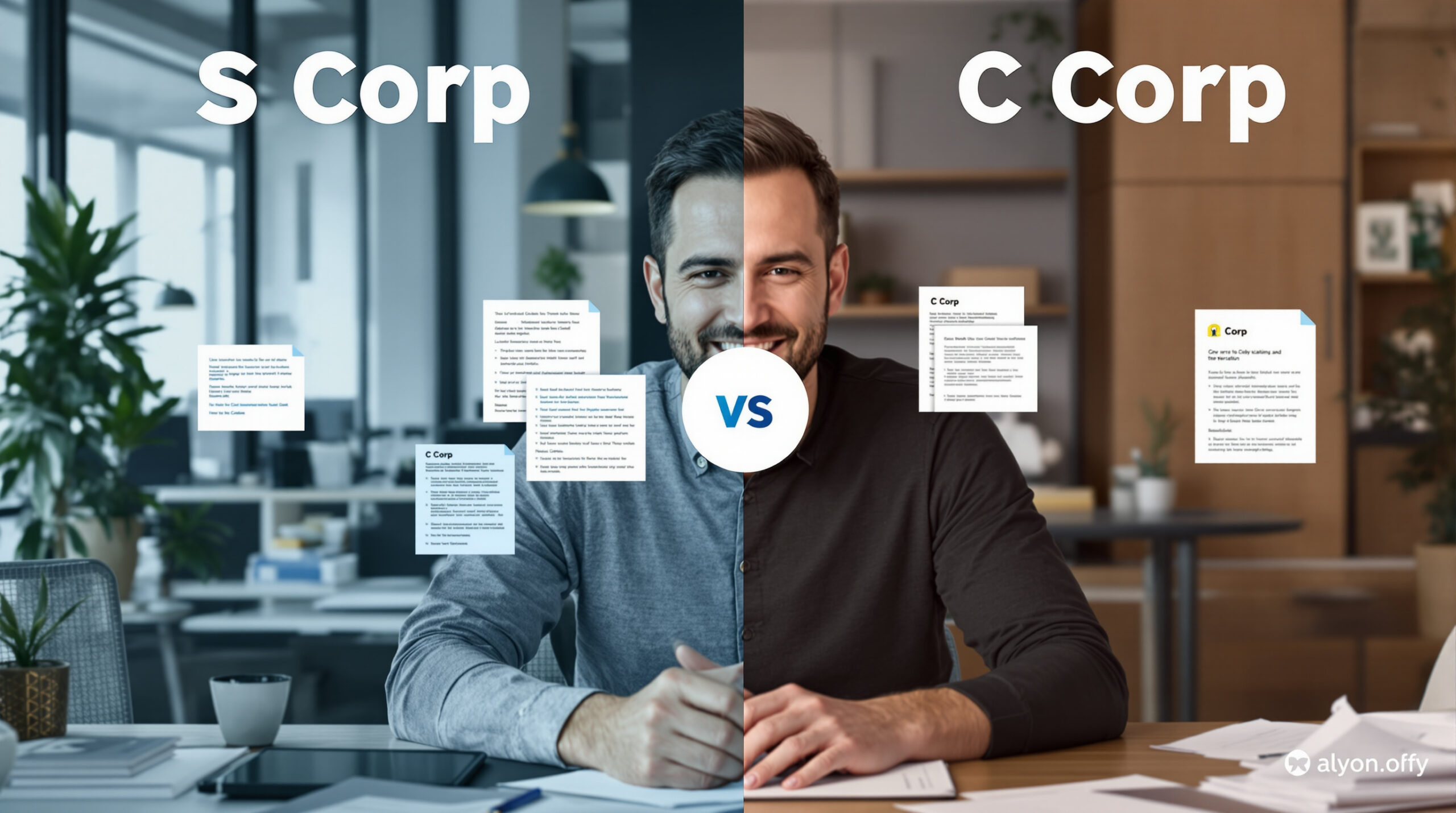
How the Snapchat S Corp vs C Corp Structure Debate Exposes the $37,800 Trap Most Tech Founders Miss
Snapchat, like many Silicon Valley startups, faced the classic entity dilemma: pick a path that could make founders fantastically wealthy, or leave them overexposed to taxes and compliance risk. What most founders do not realize is that the decision between S Corp and C Corp is less about headlines and more about whether you overpay six figures in taxes or get trapped by a corporate structure you cannot easily unwind.
snapchat s corp c corp may seem like a question for lawyers, but it has major tax and financial consequences for W-2 earners, 1099 tech consultants, startup founders, and real estate investors who want to learn from Silicon Valley’s cautionary tales.
Quick Answer: Why Snapchat and High-Growth Startups Default to C Corp (and Why You Should Not)
The majority of venture-backed companies, including Snapchat, default to the C Corporation structure because it is favored by investors and allows for unlimited growth. However, if your goal is legal tax savings and personal wealth protection in the first $1M–$10M of revenue, S Corporation status nearly always provides a better net payout due to self-employment tax savings, QBI deductions, and single-level taxation.
For the 2025 tax year, missing this can mean overpaying $37,800+ in combined IRS and FTB taxes, especially in California, where C Corp owners face double taxation and some state-specific franchise traps.
When founders talk about the ‘snapchat s corp c corp’ divide, they’re really pointing to how the IRS treats growth-stage equity versus owner-operated profits. A C Corp can stockpile retained earnings for years without triggering shareholder taxes, but every dollar pulled out as a dividend gets hit again under §1(h)(11). An S Corp, by contrast, forces immediate passthrough taxation but avoids double tax entirely—making it the superior choice for businesses with high profit-to-distribution ratios. In early years, that structural difference alone can swing your effective tax rate by 12%–18%.
The Real Difference Between S Corp and C Corp Taxation
Most new founders assume the transition from S Corp to C Corp is easy—but the two structures operate on different tax engines entirely. A C Corp is a separate taxable entity that pays its own corporate taxes (flat 21% federal for 2025), while distributions to shareholders (dividends) are taxed again on your personal tax return. An S Corp is a passthrough: corporate profits are only taxed once, at the shareholder level, and the owner can pay themselves a reasonable salary with the balance as potential K-1 distributions not subject to self-employment tax.
- C Corp (the Snapchat default): Double taxed—profits taxed at 21%, dividends taxed at your personal rate (15%–23.8% federal, plus up to 13.3% in California income tax).
- S Corp: Single layer of tax—no double taxation, often unlocks 15–16% self-employment tax savings on K-1 income, eligible for the 20% QBI (Qualified Business Income) deduction for many founders (see IRS Publication 535).
If you’re a business owner or early-stage founder, only the S Corp structure lets you capture these tax breaks without institutional capital’s strings attached.
The ‘snapchat s corp c corp’ debate also exposes how self-employment tax interacts with passthrough structures. Under IRS rules (see IRC §1402), S Corp K-1 distributions avoid the 15.3% self-employment tax that applies to sole proprietors and LLC members. That’s why a founder earning $300K–$600K can often save more from optimized salary/distribution planning than from any corporate-level tax rate advantage. Combine this with the §199A QBI deduction, and the math typically favors an S Corp until venture-scale capital is unavoidable.
Why Venture Capital Demands C Corps (and What That Means for Taxpayers)
Institutional investors insist on C Corps for one reason: flexibility. C Corps can issue multiple classes of stock, grant stock options, and welcome non-U.S. shareholders. S Corps are capped at 100 shareholders, all of whom must be U.S. citizens or residents, and allow only one class of stock.
This is why Snapchat, Uber, and Google could never have started as S Corps if they wanted outside investment. However, this flexibility comes at a major tax cost for founders who do not need it, especially in the first years. If your business model does not require venture money or high-velocity equity raises, an S Corp will often save five figures per year in avoidable taxes until the scale truly demands a C Corp.
2025 S Corp “Tech Founder’s Playbook”: Save $37,800 Before You Hit Escape Velocity
Consider a software consultant earning $400,000 in net income. As a C Corp, the company pays $84,000 in federal corporate tax (21%), then any money the founder takes out is taxed again as a dividend. If that founder structured as an S Corp:
- Pays a reasonable salary ($120,000), subject to standard payroll and employment taxes
- Remainder ($280,000) distributed as K-1 passthrough income, saving 15.3% self-employment tax compared to a sole proprietorship or LLC taxed as partnership
- Unlocks the QBI deduction (up to 20%, or $56,000), reducing taxable income further
Bottom line: An S Corp on $400,000 net income can save $42,840+ in federal and state taxes, compared to a C Corp or plain LLC. This is money the founder keeps—no venture dilution, no special lawyer required.
For advanced breakdowns, see our tax planning services built specifically for high-growth California and tech founders.
KDA Case Study: Serial SaaS Founder Avoids the C Corp Tax Trap
Profile: Jennifer, age 39, runs a $1.3M/year SaaS company out of Los Angeles, entirely bootstrapped and selling recurring subscriptions. Her accountant advised a Delaware C Corp for “professionalism,” but her profit was getting eaten alive—she took home just $440,000 after all taxes and expenses. She approached KDA in 2022 to audit her structure.
Our team painstakingly modeled her next three years under both structures. Under the C Corp, with $1.3M in net profit, she would pay $273,000 in federal corporate tax, $99,000 in state franchise taxes, then get hit again with $139,700 in qualified dividend taxes (federal and state) each time she paid herself. Her after-tax cash? Barely $788,000—a 46% effective tax rate. By transitioning to an S Corp, structuring a $210,000 salary, and taking $1.09M in K-1 distributions, she saved over $162,000 in payroll and double-taxation alone, plus received the full QBI deduction for three years.
Jennifer paid $7,500 for end-to-end execution, planning, and compliance review, a 21x ROI in the first two years. She retained total control of ownership and was able to sell for $3.8M in 2025 without negotiating against preferred stock investors.
Ready to see how we can help you? Explore more success stories on our case studies page to discover proven strategies that have saved our clients thousands in taxes.
What the IRS Will Not Warn You About “Snapchat S Corp vs C Corp” Legal Risks
Most taxpayers copy the structure of flashy startups like Snapchat and do not understand the traps:
- If your company is too late making the S election (after 75 days from formation), you are locked out and default to C Corp status.
- Switching from C Corp to S Corp is possible but triggers complex IRS rules, built-in gains taxes, and strict qualification hurdles—see IRS S Corporation guidance.
- California imposes a $800 minimum franchise tax and various fees regardless of entity type, but S Corps face simpler accountancy and less exposure to high-risk audits than C Corps holding retained earnings.
- Any foreign founder, investor, or trust involvement instantly disqualifies S Corp eligibility—critical for global teams.
Pro Tip: Only S Corps let business owners sidestep self-employment tax on K-1 distributions. C Corps, as with Snapchat, cannot do this.
Can You Start as an S Corp Then Switch to C Corp?
Yes, and often, that is the right move for tech and consulting founders. Begin as an S Corp for the initial years, pocket the self-employment tax and QBI savings, and convert to a C Corp only when external capital, stock incentives, or IPO is imminent. Making this switch requires careful advance planning with your legal and tax advisor so you are not saddled with hidden taxes on conversion day (consult IRS Form 1120-S and related instructions).
Common Founder Mistakes: The Cost of “Do What Snapchat Did”
- Blindly forming a Delaware C Corp too early—imposing double taxation and high compliance costs with no institutional investors in sight
- Missing the S Corp election cutoff (must be within 75 days of formation)
- Adding multiple founders or team members who are not U.S. citizens—disqualifies S Corp status
- Failing to file the proper annual franchise tax forms with the FTB (Form 100 or 1120S)
- Ignoring the state-level tax impact in high-cost states like California (especially with the $800 minimum tax owed on both structures)
Red Flag Alert: Once VC money comes in, the flip from S Corp to C Corp becomes urgent but can trigger IRS scrutiny. Plan your timeline and compliance from the start to avoid frantic last-minute filings, costly errors, and lost savings you cannot recover.
Can Real Estate Investors and 1099 Consultants Use These Strategies?
Absolutely. S Corp structures provide enormous tax savings for 1099 contractors with consistent profits above $75,000 and even more for investors running active real estate operations. However, passive rental income usually does not qualify for the QBI savings, so careful analysis is required. Consult how we help real estate investors navigate this territory.
How to Decide: S Corp vs C Corp Calculator and Action Steps
Want to estimate your specific take-home under each structure? Use this small business tax calculator to model both scenarios side by side. For 2025, the breakeven for forming a C Corp over an S Corp typically starts only when:
- You are raising more than $2M in institutional capital
- You have multiple classes of investors, foreign stakeholders, or plan to issue stock options broadly
- You are on track for IPO or acquisition within the next 12–18 months
Otherwise, S Corp wins both in after-tax income and audit risk for most U.S.-based tech and service founders.
What Paperwork Do You File?
- Form 2553 – To elect S Corp status within 75 days of incorporation
- Form 1120 or 1120S each year (C Corp vs S Corp filing)
- California Form 100 or 1120S, plus annual $800 Franchise Tax payment
- K-1s for S Corp shareholders, 1099s for contractors, W-2s for employees paid salary
See our entity formation services for founders needing a white-glove, audit-proof setup.
Frequently Asked Questions For Startup Founders and Business Owners
What happens if I accidentally miss the S Corp deadline?
You default to C Corp status, but IRS relief is sometimes available by showing reasonable cause or applying for late election—expect scrutiny and extra filings.
Will my outside investors care if I am an S Corp?
Most will only invest in C Corporations, period. Plan to flip your structure before negotiating any priced round with VC or private equity.
Can California LLCs elect S Corp status?
Yes, assuming they meet all S Corp requirements. LLCs can be taxed as S Corps simply by timely filing Form 2553, but must still pay the $800 annual franchise fee and file Form 568.
Bottom Line: The $37,800 Question—Are You Building “The Next Snapchat,” or Just Overpaying Taxes?
Unless your business requires immediate scale or institutional funding, S Corp usually provides simpler compliance, higher cash-in-pocket, and lower audit risk. Only convert to C Corp when it is time to take the big leap—by then, you will have a tax team like KDA on call to guide every step.
For a complete breakdown of S Corp strategies, see our comprehensive S Corp tax guide.
This information is current as of 12/10/2025. Tax laws change frequently. Verify updates with the IRS or FTB if reading this later.
Book Your Founders-Only Entity Strategy Session
If you have ever wondered whether your current business structure is setting you up for real wealth or just unnecessary taxes, now is the time to run the numbers. Book an advanced, founder-focused consultation—and walk away with a clear, compliant, and maximally profitable structure for your next stage. Click here to book your founder’s entity strategy session now.



