
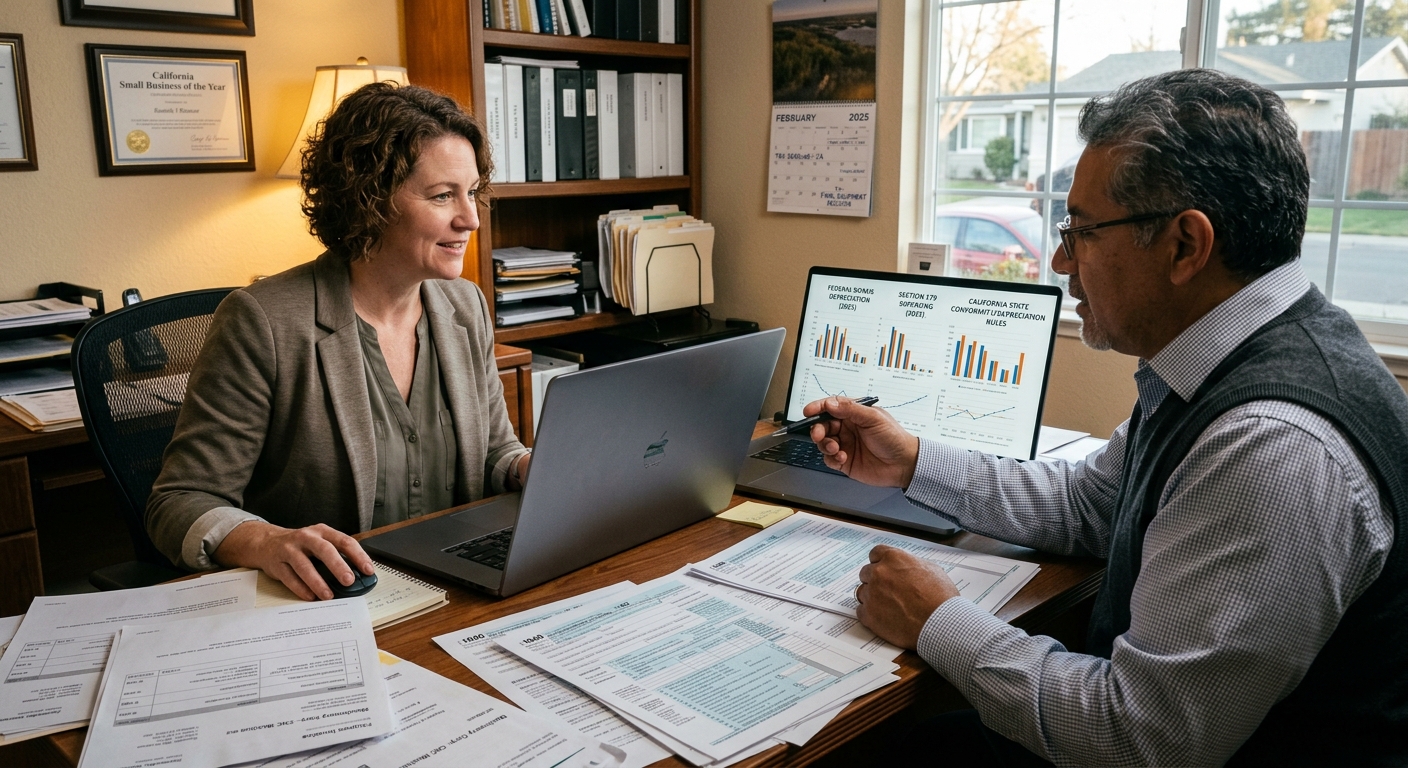
Most California business owners hear about bonus depreciation and assume it is a simple way to write off equipment fast. Then tax season hits and they find out their federal return shows one number while their California Franchise Tax Board (FTB) return shows something completely different. That gap can easily swing five or six figures if you are not planning around bonus depreciation rules for both federal and state returns.
Quick Answer
For the 2025 tax year, federal bonus depreciation drops again under the phaseout schedule that started in 2023, while California still largely ignores federal bonus rules and forces addbacks on your state return. That means you can often take a big upfront deduction on your federal return, but you will spread the writeoff over a longer period for California unless you use other tools such as Section 179 expensing or strategic entity planning.
How Bonus Depreciation Works After 2023
Bonus depreciation lets you deduct a large percentage of qualifying business property in the year you place it in service. Under prior rules, that percentage was 100 percent for many assets, which made year end equipment buying sprees extremely popular for growing businesses. Now, the percentage is stepping down each year until it eventually disappears unless Congress changes course.
For example, imagine your California S corporation buys $300,000 of manufacturing equipment in 2025. If the federal bonus depreciation percentage for that year is 40 percent, you might deduct $120,000 immediately on your federal return and then depreciate the remaining $180,000 over the normal recovery period. On the surface, that looks great for cash flow because it lowers your current year federal taxable income substantially.
However, California currently decouples from these federal bonus rules for most property. On your FTB return you often have to add back the federal bonus amount and instead depreciate the entire $300,000 over the regular schedule. That creates a mismatch between your federal and state taxable income that affects estimated taxes, cash planning, and sometimes bank covenant calculations.
Why California Treats Bonus Depreciation Differently
California frequently chooses not to follow federal tax changes that accelerate deductions. Lawmakers like the predictable revenue that comes from using longer depreciation schedules on the state side. So when federal law increased bonus depreciation percentages, California largely opted out. As a result, your California K 1 and state taxable income often show smaller deductions than your federal numbers in the early years after a purchase.
For a business owner with $500,000 in federal taxable income, that difference matters. If federal bonus rules let you deduct an extra $150,000 in year one, you might trim your federal bill by roughly $55,000, assuming a combined rate near 37 percent. But if California ignores that bonus and taxes the full $150,000 at a state rate near 10.3 percent, you still write a check of about $15,000 to the FTB. Without planning, that state bill can catch you off guard even when your federal refund looks strong.
Understanding this pattern is critical if you operate in multiple states. Some states fully conform to federal bonus depreciation, some partially conform, and California is on the strict side for addbacks and adjustments. Always check current guidance from the FTB and coordinate with your advisor to keep your federal and state strategy aligned instead of fighting each other.
Choosing Between Bonus Depreciation and Section 179
Business owners often confuse bonus depreciation with Section 179 expensing, but they are separate tools with different limitations and planning angles. Section 179 allows you to elect to expense part or all of the cost of qualifying property, up to an annual limit that is indexed for inflation. Unlike bonus depreciation, Section 179 can be applied asset by asset, giving you more control over how much you deduct in the current year.
For instance, consider a consulting firm structured as an LLC that buys $120,000 of computer equipment and office furniture in 2025. Depending on the Section 179 limits in effect that year, the owner might choose to expense $80,000 under Section 179, depreciate the rest, and skip federal bonus depreciation entirely. That approach can be useful if you want to avoid increasing future year taxable income when bonus depreciation deductions drop off.
Another distinction is that Section 179 is limited by your business income. If you have a loss or very low profit, Section 179 may be restricted or carried forward to a later year. Bonus depreciation does not have that same income limitation at the federal level, which means you can create or increase a loss to offset other income categories in many cases. That flexibility can be powerful for high income owners who expect variable earnings over time.
California Impact on Section 179 vs Bonus Depreciation
California also sets its own rules for Section 179. Historically the state has used lower dollar limits than the federal code, which reduces how much you can expense quickly on the FTB return. Even so, California treatment of Section 179 is often less harsh than its treatment of federal bonus depreciation, which is one reason many California business owners lean on Section 179 first and let regular MACRS depreciation handle the rest.
If the federal Section 179 limit allows a $1,250,000 expense in a given year but California caps the state Section 179 writeoff at a much smaller figure, you have to track two sets of depreciation schedules. That adds bookkeeping complexity but gives you a way to smooth your deductions so you are not slammed with high state taxable income later when federal bonus depreciation runs out.
Careful modeling can show you whether leaning on bonus depreciation, Section 179, or standard depreciation produces the best total tax outcome over several years. The answer is rarely obvious from looking at one year in isolation. Astute planning requires a multi year projection that considers changing bonus percentages, California conformity rules, and your expected profit trajectory.
Cash Flow Planning Around Federal and California Differences
The most common mistake we see is business owners making large equipment purchases in December purely to chase a federal deduction, without checking the California impact or their actual cash flow needs. For example, a construction company might buy $400,000 worth of trucks and machinery right before year end and rely on bonus depreciation to reduce the federal bill by $140,000. The owner feels smart until California tax payments still come due and bank balances get tight.
A better approach is to build a cash flow calendar that accounts for when each dollar of tax is due on both your federal and state returns. If your marginal state rate is 10 percent and your California addback is $200,000, you know to reserve roughly $20,000 for state tax, even if the federal side looks favorable. That discipline prevents surprises and keeps you from needing high interest short term loans or drawing extra capital from investors to pay the FTB.
Planning also matters if you are negotiating loans or covenants with lenders. Banks sometimes look at EBITDA or taxable income to evaluate your performance. A big federal bonus depreciation deduction can suppress reported income in a particular year, which may or may not help your story with a lender. Meanwhile, California adjustments might paint a different profit picture. Aligning your depreciation strategy with your financing plans avoids sending mixed signals to creditors.
Common Mistakes That Trigger Problems
One red flag is failing to maintain separate depreciation schedules for federal and California books. When your CPA asks for your fixed asset list and you produce only a single column of data, it can indicate that state differences have been ignored for years. Cleaning that up can involve amended returns, interest, and potentially penalties if underpayments were significant.
Another mistake involves assuming that software or off the shelf bookkeeping systems will handle all the nuance for you. Many small business accounting platforms default to federal rules and may not implement California specific modifications correctly. If you are relying on canned system settings without review, your state return could be off by tens of thousands of dollars over the life of your fixed assets.
Finally, some owners mix personal and business use of assets and still claim full bonus depreciation. For instance, if you buy a vehicle that is only 60 percent used for business but you deduct 100 percent of the price with bonus depreciation, you are inviting IRS scrutiny. When California adds its own rules on top of that, the situation can get messy fast. You need solid mileage logs, usage estimates, and documentation to support whatever deduction method you claim.
Will This Strategy Raise Audit Risk?
Any time you accelerate deductions significantly, you increase the chance that a revenue agency will want to look closer. That does not mean you should avoid bonus depreciation; it means you should document your position thoroughly and apply the rules correctly. The IRS often focuses on whether property truly qualifies, whether it was placed in service during the year claimed, and whether the percentage written off matches the law in effect for that year.
On the California side, the FTB is particularly sensitive to addbacks and schedule differences. If your federal return shows a huge depreciation deduction but your state return does not reconcile properly, it can trigger questions. Clean supporting schedules that tie federal and California numbers together make it far easier to respond to notices or information requests without turning the situation into a full audit.
It is also important to coordinate depreciation strategy with other areas of your tax planning, such as the qualified business income deduction, passive activity rules, and net operating losses. Accelerated deductions in one year can reduce the benefit of certain credits or deductions later. Working through those interactions ahead of time turns bonus depreciation from a blunt instrument into a precision tool for shaping your long term tax profile.
Bottom Line
Bonus depreciation remains a valuable lever for federal tax planning in 2025, but the phaseout and California decoupling make the landscape far more complicated than it was a few years ago. Relying on rules of thumb or old advice can lead to mismatched federal and state results, choppy cash flow, and avoidable scrutiny from the IRS or FTB.
If you regularly invest in equipment, vehicles, or technology, you should be reviewing your depreciation strategy every year, not just when you buy something big. Exploring the interaction between bonus depreciation, Section 179, regular MACRS, and California conformity rules can reveal opportunities to save tens of thousands of dollars over a multi year window while keeping your books and returns clean.
For owners with complex situations such as multi state operations, rapid growth, or pending exits, modeling scenarios before you spend is no longer optional. Proactive planning gives you the confidence to make capital investments without guessing at the tax impact. With the right strategy, you can align federal and California outcomes as much as possible rather than being surprised each April.
Ready to Reduce Your Tax Bill?
KDA Inc. specializes in strategic tax planning for business owners, S Corps, LLCs, and high-net-worth individuals. Book a personalized consultation and walk away with a clear plan.
Book Your Tax Strategy Session
If you are unsure whether your current depreciation approach is costing you money or creating hidden exposure with the IRS or FTB, this is the time to fix it. Book a personalized consultation with our team and walk away with a clear, multi year depreciation roadmap tailored to your business, including how to coordinate federal bonus rules with California requirements. Click here to book your consultation now.



