
What Is the Hacienda Heights Tax Rate in 2026?
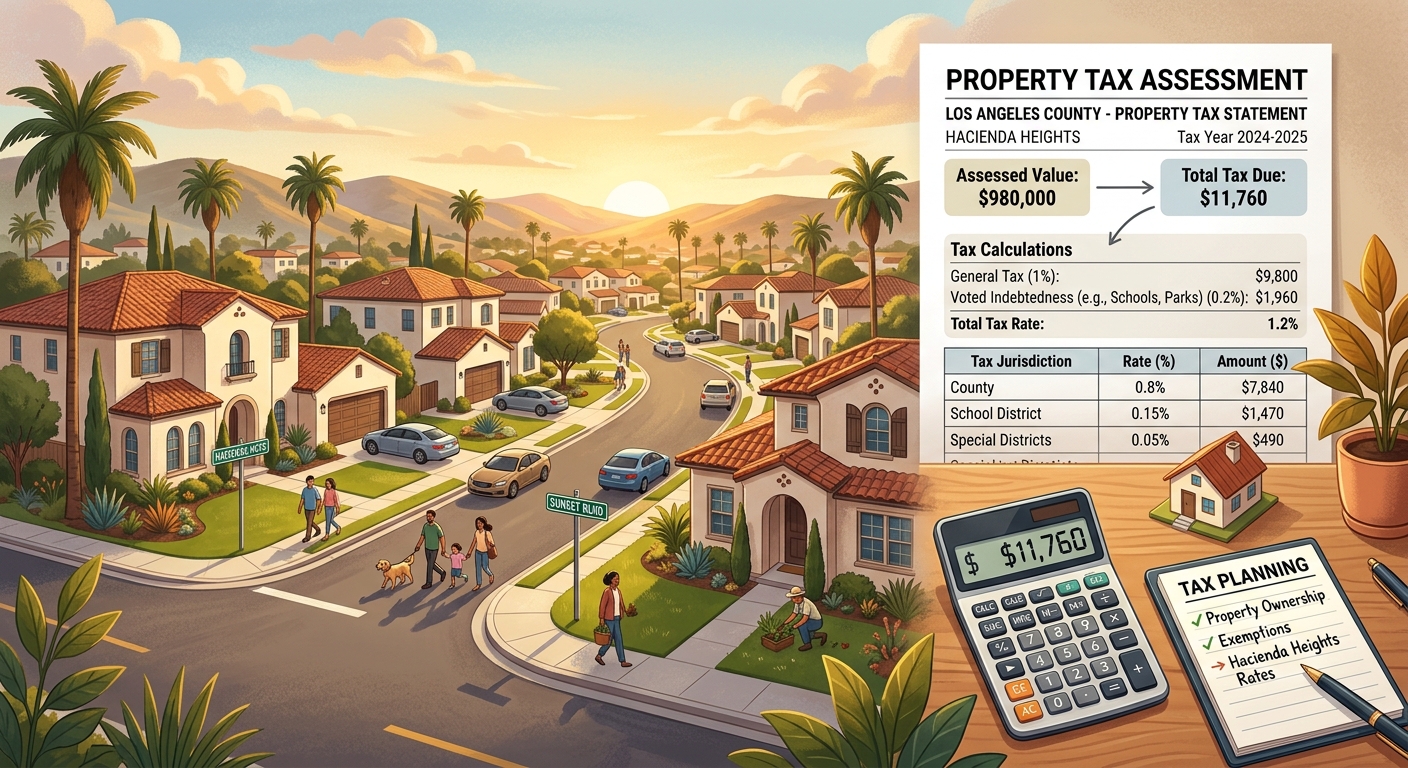
The hacienda heights tax rate in 2026 reflects California’s property tax structure, which is governed by Proposition 13. The base property tax rate throughout California, including Hacienda Heights, is 1% of the assessed property value. However, local voter-approved bonds, assessments, and special district fees can push the effective rate to 1.2% or higher depending on your specific location within Hacienda Heights.
For a home valued at $750,000 in Hacienda Heights, you’re looking at approximately $9,000 per year in property taxes at the 1.2% effective rate. That’s $750 per month in addition to your mortgage, insurance, and maintenance costs. Most California homeowners underestimate this burden until they see the first tax bill.
But here’s what most Hacienda Heights residents don’t realize: property taxes are only one part of your total tax picture. If you own a business, work as a 1099 contractor, or generate rental income from your property, understanding how your local tax rate intersects with state and federal obligations can save you thousands annually.
Quick Answer
The Hacienda Heights property tax rate is approximately 1% base rate plus local assessments, resulting in an effective rate of 1.1% to 1.3% depending on your parcel’s special district obligations. This translates to $8,250 to $9,750 annually on a $750,000 home. Business owners in Hacienda Heights can offset some of this burden through entity structuring, home office deductions, and strategic tax planning.
How California’s Proposition 13 Controls Your Hacienda Heights Property Tax
Since 1978, Proposition 13 has limited property tax increases to no more than 2% per year, regardless of how much your home’s market value rises. This protection applies to all California homeowners, including those in Hacienda Heights.
Your property tax is calculated based on your home’s assessed value, which starts at the purchase price. Each year, the Los Angeles County Assessor can increase this assessed value by up to 2%, even if your home’s actual market value jumps 10% or 20% in a hot real estate market.
How Reassessment Works in Hacienda Heights
When you buy a home in Hacienda Heights, the property gets reassessed at the purchase price. If you paid $800,000 in 2024, that becomes your new assessed value. Your base property tax would be $8,000 (1% of $800,000), plus any local assessments.
Here’s the advantage: if similar homes in your neighborhood sell for $950,000 in 2026, your assessed value can only increase by 2% per year from your $800,000 purchase price. After two years, your assessed value would be approximately $832,000, not $950,000. This protection saves long-term homeowners significant money as property values rise.
Special Assessments That Increase Your Effective Rate
The 1% base rate is just the starting point. Hacienda Heights properties may be subject to:
- School district bonds approved by voters to fund local schools
- Mello-Roos Community Facilities Districts for infrastructure in newer developments
- County and city assessments for specific services like street lighting or landscaping
- Water district fees in certain zones
These add-ons can push your effective property tax rate from 1% to 1.3% or even higher in some Hacienda Heights neighborhoods. Always review your property tax bill line by line. Many homeowners discover charges they don’t understand or assessments that should have expired years ago.
The Real Cost Breakdown: What Hacienda Heights Homeowners Actually Pay
Let’s look at actual numbers for three different property values in Hacienda Heights based on the current 2026 assessed values and effective rates.
Property Tax Calculation Examples
| Home Value | Base Tax (1%) | Local Assessments (0.2%) | Total Annual Tax | Monthly Cost |
|---|---|---|---|---|
| $600,000 | $6,000 | $1,200 | $7,200 | $600 |
| $750,000 | $7,500 | $1,500 | $9,000 | $750 |
| $900,000 | $9,000 | $1,800 | $10,800 | $900 |
These figures assume a 1.2% effective rate, which is common in Hacienda Heights. Some parcels face higher rates depending on when the home was built and which special districts apply.
For homeowners with mortgages, these property taxes are typically escrowed into your monthly payment. Your lender collects the monthly amount and pays the county twice per year when property taxes are due (December 10 and April 10).
How Property Taxes Compare Across Los Angeles County
Hacienda Heights sits in the middle range for Los Angeles County property tax burdens. Here’s how it compares to nearby communities:
- Hacienda Heights: Effective rate 1.1% to 1.3%
- La Habra Heights: Effective rate 1.15% to 1.25%
- Rowland Heights: Effective rate 1.2% to 1.35%
- Whittier: Effective rate 1.1% to 1.3%
While these differences seem small, they add up significantly over time. On a $750,000 home, the difference between a 1.1% and 1.3% effective rate is $1,500 per year, or $30,000 over 20 years.
Business Owners in Hacienda Heights: How Entity Structure Impacts Your Total Tax Bill
If you own a business and work from your Hacienda Heights home, your property tax is only part of your total tax strategy. The real opportunity lies in how you structure your business and claim deductions related to your property.
Many small business owners in Hacienda Heights operate as sole proprietors or single-member LLCs, which means all business income flows through to their personal tax return. This simplicity comes at a cost. Without strategic entity structuring and proper tax planning, you could be overpaying by $5,000 to $15,000 annually in federal and California state taxes.
Home Office Deduction for Hacienda Heights Business Owners
If you use part of your home exclusively for business, you can deduct a portion of your property taxes, mortgage interest, utilities, insurance, and maintenance costs. This is true whether you rent or own your Hacienda Heights property.
The IRS offers two methods:
- Simplified Method: Deduct $5 per square foot of home office space, up to 300 square feet ($1,500 maximum deduction)
- Actual Expense Method: Calculate the percentage of your home used for business and deduct that percentage of actual expenses
For a 2,000-square-foot Hacienda Heights home with a 200-square-foot dedicated office (10% of total space), you could deduct:
- 10% of property taxes: $900 (on $9,000 annual property tax)
- 10% of mortgage interest: $2,400 (on $24,000 annual interest)
- 10% of utilities: $360 (on $3,600 annual utilities)
- 10% of homeowners insurance: $180 (on $1,800 annual premium)
Total home office deduction using actual expenses: $3,840 per year
At a combined federal and California tax rate of 35%, this deduction saves you approximately $1,344 annually. That’s real money back in your pocket just for properly documenting space you’re already using for business.
If you’re looking to optimize your business structure and maximize deductions, our tax planning services can help you identify opportunities specific to your situation and ensure you’re not leaving money on the table.
S Corp Election: Advanced Strategy for High-Income Hacienda Heights Business Owners
Once your business profit exceeds $60,000 to $80,000 annually, an S Corporation election can save substantial self-employment tax. This strategy works particularly well for consultants, contractors, real estate agents, and other service-based businesses common in Hacienda Heights.
Here’s how it works: As a sole proprietor or single-member LLC, you pay 15.3% self-employment tax on all business profit. With an S Corp, you split your income into salary (subject to payroll tax) and distributions (not subject to self-employment tax).
Example: Maria runs a marketing consulting business from her Hacienda Heights home. Her business generates $120,000 in annual profit.
- As sole proprietor: Self-employment tax of $16,478 on $120,000
- As S Corp with $60,000 salary: Payroll tax of $9,180 on salary portion only
- Tax savings: $7,298 per year
This S Corp strategy requires running payroll and filing an additional tax return (Form 1120-S), but the tax savings far exceed the compliance costs for most business owners earning six figures.
KDA Case Study: Hacienda Heights Real Estate Agent
Jennifer, a real estate agent in Hacienda Heights, came to KDA in early 2025 paying approximately $38,000 in combined federal and California taxes on $145,000 in commission income. She operated as a sole proprietor and took the standard deduction.
We identified three immediate opportunities:
- S Corp Election: We helped Jennifer elect S Corp status, establish a reasonable salary of $65,000, and take the remaining $80,000 as distributions, saving $11,220 in self-employment tax
- Home Office Deduction: Jennifer dedicated a 240-square-foot room in her Hacienda Heights home exclusively for business, generating a $4,680 deduction using actual expenses
- Vehicle Deduction: We implemented mileage tracking for her business driving, which added $8,400 in deductions at the standard mileage rate
Total first-year tax savings: $14,200
Jennifer paid $4,500 for our tax planning and S Corp setup services, delivering a 3.2x first-year return on investment. These savings continue year after year with proper maintenance.
Ready to see how we can help you? Explore more success stories on our case studies page to discover proven strategies that have saved our clients thousands in taxes.
Red Flag Alert: Common Hacienda Heights Property Tax Mistakes
After reviewing hundreds of tax returns from Hacienda Heights residents, we see these mistakes repeatedly:
Mistake 1: Assuming Your Property Tax Bill Is Always Correct
Los Angeles County processes millions of property tax assessments. Errors happen more often than you’d think. Common issues include:
- Incorrect square footage or property characteristics
- Assessments that should have been removed after bond payoffs
- Failure to apply homeowner exemptions
- Wrong parcel classification (residential vs. commercial)
Review your annual property tax bill carefully. If you spot discrepancies, file an appeal with the Los Angeles County Assessment Appeals Board. The deadline is typically November 30 for the upcoming tax year. Many homeowners successfully reduce their assessed value by 5% to 15% through this process when legitimate errors exist.
Mistake 2: Not Claiming the Homeowner’s Exemption
California offers a $7,000 reduction in assessed value for owner-occupied primary residences. This saves approximately $70 per year in property taxes. It’s not automatic. You must file a one-time claim with the Los Angeles County Assessor’s Office.
If you bought your Hacienda Heights home within the past year and haven’t claimed this exemption, you’re leaving money on the table. File Form BOE-266, Claim for Homeowners’ Property Tax Exemption, as soon as possible.
Mistake 3: Mixing Business and Personal Property Tax Deductions
Business owners who work from home often confuse what they can deduct. Here’s the rule: You cannot deduct your personal property taxes as a business expense on Schedule C or your S Corp return. Property taxes are only deductible as an itemized deduction on Schedule A (subject to the $10,000 SALT cap) or as part of your home office deduction calculation.
The home office deduction allows you to deduct the business-use percentage of property taxes as a business expense, which is far more valuable than the limited itemized deduction.
Mistake 4: Ignoring Proposition 19 Transfer Rules
As of February 2021, California’s Proposition 19 changed how property tax bases transfer between family members. If you inherited property in Hacienda Heights from a parent or plan to transfer property to your children, the old rules no longer apply.
Under the new rules, parent-child transfers only preserve the original property tax base if:
- The property is the family home, AND
- The child uses it as their primary residence, AND
- The assessed value doesn’t exceed $1 million plus the parent’s original assessed value
Any transfer that doesn’t meet these requirements triggers a reassessment at current market value, which could increase property taxes by 200% to 400% for properties held by families since the 1980s or 1990s.
If you’re considering transferring property to family members, consult with a tax strategist before making any moves. The timing and structure of these transfers can save or cost your family tens of thousands of dollars over time.
Property Tax Payment Deadlines and Penalties in Hacienda Heights
Los Angeles County collects property taxes in two installments each year:
- First Installment: Due November 1, delinquent after December 10 at 5:00 PM
- Second Installment: Due February 1, delinquent after April 10 at 5:00 PM
If you miss these deadlines, penalties accrue immediately:
- First installment penalty: 10% of the installment amount
- Second installment penalty: 10% of the installment amount plus $10
- Redemption penalty: Additional 1.5% per month if taxes remain unpaid beyond June 30
On a $9,000 annual property tax bill ($4,500 per installment), a missed deadline costs you $450 immediately. Miss both deadments, and you’re looking at $910 in penalties alone.
Payment Options for Hacienda Heights Property Taxes
Los Angeles County offers several payment methods:
- Online: Pay at propertytax.lacounty.gov using bank account or credit card (2.25% to 2.5% credit card fee applies)
- By mail: Send check to LA County Tax Collector with payment stub
- In person: Visit the Tax Collector’s Office in Norwalk
- Automatic installment plan: Split each installment into smaller monthly payments (enrollment required by June 30)
If you’re not escrowing property taxes through your mortgage, set up calendar reminders well before the December 10 and April 10 deadlines. The 10% penalty is harsh and non-negotiable.
How Recent California Tax Changes Affect Hacienda Heights Homeowners in 2026
California tax policy continues to evolve. Here’s what changed for 2026 that directly impacts Hacienda Heights residents:
SALT Deduction Cap Remains at $10,000
The federal State and Local Tax (SALT) deduction cap of $10,000 continues to limit how much California property tax and state income tax you can deduct on your federal return. For most Hacienda Heights homeowners paying $9,000 to $11,000 in property taxes plus substantial California income tax, this cap creates a real tax burden.
High-income earners in California pay some of the highest effective tax rates in the nation due to this limitation. The $10,000 cap doesn’t adjust for inflation or cost of living, which means it becomes more restrictive each year.
This makes business entity structuring and strategic deductions even more valuable. Shifting income through S Corps, maximizing retirement contributions, and properly documenting business expenses can reduce your California tax liability, which indirectly helps you stay under or closer to the SALT cap threshold.
California Standard Deduction Increased for 2026
California’s standard deduction increased to:
- Single: $5,363 (up from $5,202 in 2025)
- Married Filing Jointly: $10,726 (up from $10,404 in 2025)
- Head of Household: $10,726 (up from $10,404 in 2025)
This modest increase means fewer California taxpayers will benefit from itemizing deductions on their state return. However, property taxes, mortgage interest, and charitable contributions can still push you over the standard deduction threshold, especially for Hacienda Heights homeowners with larger mortgages.
Proposition 19 Implications Continue
Since Proposition 19’s implementation in 2021, we’ve seen significant reassessments when properties transfer between family members without meeting the strict new requirements. If you own property in Hacienda Heights and have children who might inherit or receive the home as a gift, planning is essential.
One strategy: Consider transferring the property while you’re still alive and the children intend to use it as their primary residence. This preserves the lower property tax base if done correctly. Waiting until death or transferring when children don’t plan to live there triggers full reassessment.
Estate planning and tax strategy must work together. Don’t make property transfer decisions in a vacuum.
Rental Property Owners in Hacienda Heights: Different Rules Apply
If you own rental property in Hacienda Heights, your tax situation differs substantially from primary residence owners:
Deducting Property Taxes on Rental Properties
Unlike personal residences (subject to the $10,000 SALT cap), rental property taxes are fully deductible as a business expense on Schedule E. This means the entire $9,000 to $11,000 annual property tax bill reduces your taxable rental income dollar for dollar.
For a Hacienda Heights rental property generating $36,000 in annual rent with $10,800 in property taxes, $8,000 in mortgage interest, $2,400 in insurance, and $3,000 in maintenance, your taxable income drops from $36,000 to $11,800. At a 35% combined tax rate, this saves you approximately $8,470 in taxes.
Depreciation: The Landlord’s Secret Weapon
Beyond property tax deductions, rental property owners can depreciate the building value over 27.5 years. For a Hacienda Heights rental property valued at $750,000 with $600,000 allocated to the structure (land isn’t depreciable), annual depreciation is approximately $21,818.
This non-cash deduction can create “paper losses” that offset rental income and sometimes other passive income, significantly reducing your tax bill without any money leaving your pocket.
Section 1031 Exchange Strategy
California rental property owners face substantial capital gains when selling appreciated property. A Hacienda Heights rental purchased for $450,000 in 2015 and sold for $800,000 in 2026 generates $350,000 in capital gains (before depreciation recapture).
Federal capital gains tax: $52,500 (15% rate)
California capital gains tax: $38,500 (11% rate)
Depreciation recapture: $60,000+ (25% rate on accumulated depreciation)
Total tax hit: $151,000+
A properly structured Section 1031 exchange allows you to defer all of these taxes by reinvesting proceeds into another rental property within strict IRS timelines. You can repeat this strategy indefinitely, building a larger real estate portfolio without ever paying capital gains tax.
If this strategy interests you, timing is critical. You must identify replacement properties within 45 days of selling your Hacienda Heights rental and close on the new property within 180 days. Working with experienced tax advisors who understand 1031 mechanics prevents costly mistakes.
To learn more about rental property tax strategies, visit our dedicated page for real estate investors.
Ready to Reduce Your Tax Bill?
KDA Inc. specializes in strategic tax planning for business owners, S Corps, LLCs, and high-net-worth individuals. Book a personalized consultation and walk away with a clear plan.
Frequently Asked Questions About Hacienda Heights Tax Rates
How do I find my exact property tax rate in Hacienda Heights?
Your exact property tax rate appears on your annual property tax bill from Los Angeles County. You can also look it up online at propertytax.lacounty.gov by entering your Assessor’s Identification Number (AIN). The effective rate includes the 1% base rate plus all local assessments and bonds specific to your parcel.
Can I deduct Hacienda Heights property taxes on my federal return?
Yes, but only up to $10,000 total for all state and local taxes combined (including property tax and state income tax). This SALT deduction cap applies to your federal return. California allows you to deduct property taxes on your state return as an itemized deduction without this cap.
What happens if I disagree with my property’s assessed value?
You can appeal your assessment to the Los Angeles County Assessment Appeals Board. File your appeal between July 2 and November 30 for the following tax year. You’ll need evidence that your property’s market value is lower than the assessed value, such as recent comparable sales or a professional appraisal.
Do business owners in Hacienda Heights pay additional business property tax?
If you own business equipment, furniture, fixtures, or inventory valued over $100,000, you must file a Business Property Statement (Form 571-L) with the Los Angeles County Assessor. This equipment is subject to property tax at the same 1% base rate. Most home-based businesses with minimal equipment don’t reach this threshold.
How does Mello-Roos affect my Hacienda Heights property tax?
Mello-Roos Community Facilities Districts are special assessment areas that fund infrastructure like schools, parks, and roads in newer developments. If your Hacienda Heights property is within a Mello-Roos district, you’ll pay an additional annual fee that can range from $1,000 to $5,000 or more, depending on the district and your property size. These fees appear as separate line items on your property tax bill and typically last 20 to 40 years.
Strategic Tax Planning Beyond Property Taxes
Your property tax is just one component of your total tax picture. Hacienda Heights residents who proactively plan their overall tax strategy save far more than those who simply pay bills as they arrive.
When to Consider Professional Tax Strategy Help
You should schedule a tax planning consultation if any of these apply:
- Your business profit exceeds $60,000 annually
- You own rental property in Hacienda Heights or elsewhere
- You’re considering converting your LLC to an S Corp
- Your combined federal and California tax exceeds $25,000 per year
- You’re planning to transfer property to family members
- You received a large inheritance or windfall
- You’re selling a business or investment property
The cost of professional tax strategy typically ranges from $2,500 to $7,500 depending on complexity. The tax savings almost always exceed the cost by 3x to 10x in the first year alone.
Year-End Tax Moves for Hacienda Heights Residents
As we approach year-end 2026, consider these strategies before December 31:
- Maximize retirement contributions: Max out your 401(k), SEP IRA, or Solo 401(k) to reduce taxable income. For 2026, 401(k) limits are $23,500 for those under 50 and $31,000 for those 50 and older.
- Harvest investment losses: Sell underperforming investments to offset capital gains and up to $3,000 of ordinary income.
- Prepay property taxes: If the second installment (due April 2027) is available for prepayment in December 2026 and you’re not subject to Alternative Minimum Tax, prepaying can accelerate your deduction into the current tax year.
- Bundle charitable contributions: If you’re close to exceeding the standard deduction, consider bunching two years of charitable giving into one year to maximize itemized deductions.
- Purchase business equipment: Section 179 allows immediate expensing of up to $1,220,000 in qualifying business equipment purchased and placed in service by December 31, 2026.
Each of these moves requires proper execution and documentation. Don’t wait until December 29 to implement year-end strategies. Plan ahead starting in November to ensure you have time to complete transactions correctly.
Key Takeaway
The hacienda heights tax rate of approximately 1.1% to 1.3% creates a property tax burden of $8,000 to $12,000 annually for most homeowners, but this is only part of your total tax picture. Business owners, rental property investors, and high-income W-2 employees in Hacienda Heights can significantly reduce their overall tax liability through strategic entity structuring, proper deductions, and year-round tax planning.
This information is current as of 5/28/2026. Tax laws change frequently. Verify updates with the IRS or California Franchise Tax Board if reading this later.
Stop Overpaying Taxes on Your Hacienda Heights Property
If you’re a business owner, real estate investor, or high-income professional in Hacienda Heights paying more than $20,000 annually in combined taxes, you’re likely missing opportunities. Book a personalized tax strategy consultation with our team and discover exactly where you’re overpaying and how to fix it. Click here to book your consultation now.



