
Quick Answer
There is no single IRS form to convert from S Corp to C Corp. The process requires a written revocation statement signed by shareholders owning more than 50% of outstanding shares, filed directly with the IRS. California business owners must also notify the Franchise Tax Board separately. Filing this revocation triggers a five-year lockout under IRC Section 1362(g), meaning you cannot re-elect S Corp status during that period. At $200,000 in annual profit, that lockout costs California owners roughly $197,000 in additional taxes over five years.
This information is current as of April 22, 2026. Tax laws change frequently. Verify updates with the IRS or FTB if reading this later.
Why There Is No Single Form to Convert From S Corp to C Corp
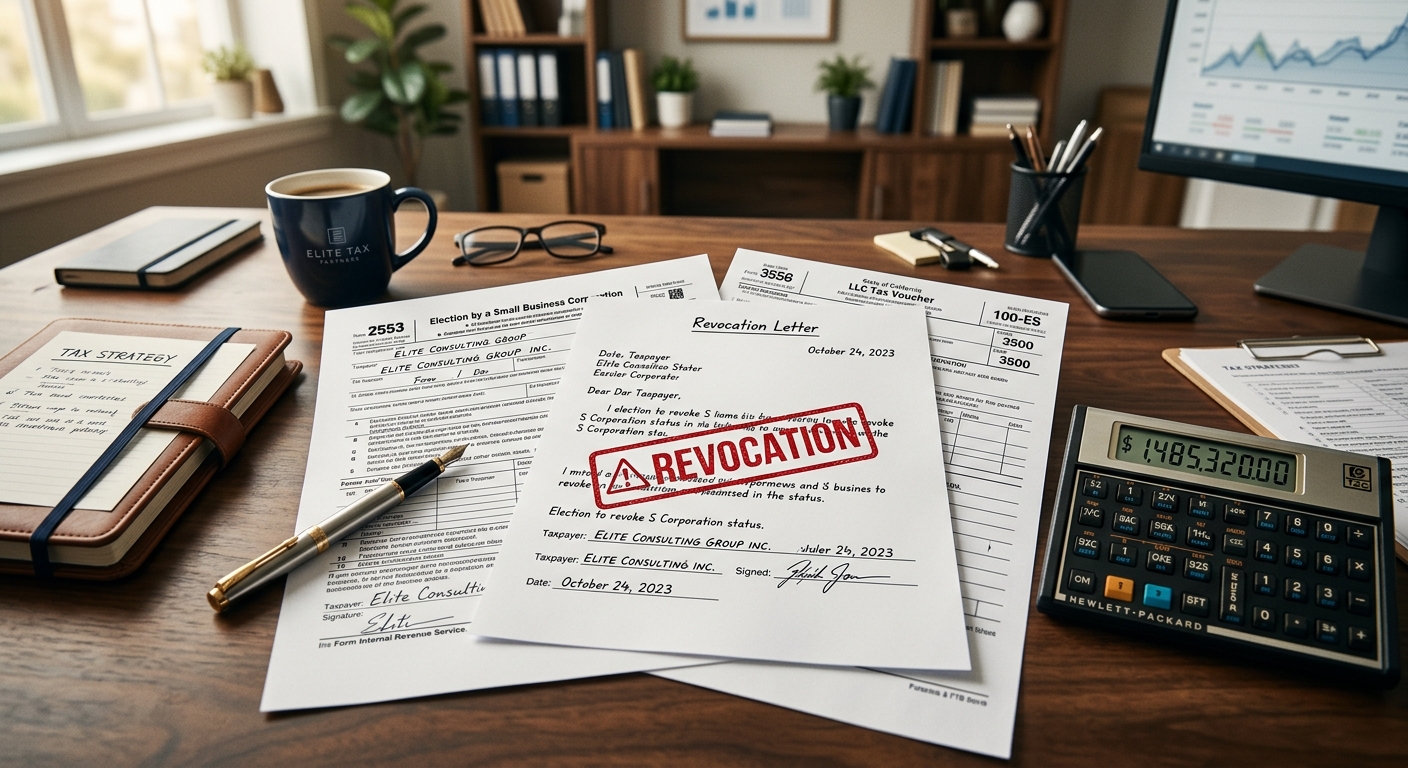
If you have been searching for the form to convert from S Corp to C Corp, you have probably noticed something frustrating: the IRS does not publish a single, dedicated form for this conversion. Unlike electing S Corp status, which uses Form 2553, revoking that election requires a custom-written revocation statement. That distinction catches thousands of business owners off guard every year.
The IRS revocation process is governed by IRC Section 1362(d)(1), which states that an S election can be revoked only if shareholders holding more than 50% of the total shares consent to the revocation. There is no checkbox form, no downloadable PDF, and no e-file option. You write the letter yourself, attach each shareholder’s consent, and mail it to the IRS service center where your corporation files its annual return.
This matters because a poorly drafted revocation letter can be rejected, leaving you stuck in S Corp status when you intended to convert. Worse, a valid revocation filed at the wrong time can lock you into C Corp status for five full years under the re-election prohibition in IRC Section 1362(g), even if you realize the conversion was a mistake within months.
What the Revocation Statement Must Include
Your revocation statement is not a casual letter. The IRS requires specific elements to accept it as valid:
- Corporation’s legal name exactly as it appears on your Articles of Incorporation
- Employer Identification Number (EIN) matching your filed returns
- Statement of revocation declaring that the corporation revokes its election under IRC Section 1362(a)
- Effective date of the revocation (if not specified, it defaults based on filing timing)
- Number of issued and outstanding shares at the time of revocation
- Shareholder consent signatures from holders of more than 50% of shares, with each shareholder’s name, address, SSN, and share count
Miss any of these elements and the IRS can treat the revocation as invalid. You will not receive a rejection letter for months, by which point you may have already stopped running payroll, filed as a C Corp, or made distributions under the wrong tax treatment.
March 15 Deadline and Effective Date Rules
The form to convert from S Corp to C Corp, meaning the revocation statement, must be filed by March 15 of the tax year for it to take effect on January 1 of that same year. If you file the revocation on March 16 or later without specifying an effective date, the revocation takes effect on January 1 of the following year. That one-day miss means an entire extra year of S Corp status you may not have planned for.
Alternatively, you can specify a prospective effective date on the revocation statement. For example, filing in June 2026 with a stated effective date of July 1, 2026 creates a split-year filing requirement under IRC Section 1362(e). Your corporation files an S Corp return (Form 1120-S) for January through June and a C Corp return (Form 1120) for July through December. Split-year returns are complex, expensive to prepare, and create allocation headaches for income, deductions, and credits.
The Five-Layer Tax Increase California Owners Trigger With This Conversion
Before filing any form to convert from S Corp to C Corp, every California business owner needs to understand the five-layer tax increase this conversion creates. At $200,000 in annual business profit, here is exactly what changes:
Layer 1: Federal Corporate Tax at 21%
As an S Corp, your business profit passes through to your personal return and is taxed at your individual rate. As a C Corp, the entity itself pays 21% federal corporate tax before you see a dollar. On $200,000 in profit, that is $42,000 in entity-level tax that did not exist before.
Layer 2: Federal Dividend Double Taxation
After the C Corp pays its 21% tax, you have $158,000 left. When you distribute that as dividends, you pay an additional 15% to 23.8% in federal qualified dividend tax. At the 15% rate, that is another $23,700. Your total federal burden on $200,000 just jumped to $65,700, compared to roughly $44,000 to $48,000 as an S Corp shareholder at the same income level.
Layer 3: California Franchise Tax Swing From 1.5% to 8.84%
California taxes S Corps at a flat 1.5% franchise tax rate on net income, which equals $3,000 on $200,000. C Corps pay 8.84%, which equals $17,680. That is a $14,680 annual increase just from the state-level entity tax. See FTB Publication 1060 for current California corporate tax rates.
Layer 4: QBI Deduction Evaporation
Under IRC Section 199A, S Corp shareholders can deduct up to 20% of qualified business income, saving roughly $8,000 to $14,000 per year at this income level. C Corp shareholders get zero QBI deduction. The One Big Beautiful Bill Act (OBBBA) made this deduction permanent, which means every year you remain a C Corp, you forfeit this benefit permanently. For a deeper look at how the QBI deduction interacts with S Corp strategy, read our comprehensive S Corp tax guide.
Layer 5: AB 150 Pass-Through Entity Tax Election Loss
California’s AB 150 lets S Corps elect to pay a 9.3% entity-level tax that generates a dollar-for-dollar federal tax credit, effectively bypassing the $40,000 SALT deduction cap under OBBBA. C Corps cannot make this election. At $200,000 in profit, that lost SALT bypass can cost an additional $3,000 to $5,000 per year depending on your marginal federal rate.
Side-by-Side Tax Comparison at Three Income Levels
| Annual Profit | Total Tax as S Corp | Total Tax as C Corp | Annual Cost of Conversion |
|---|---|---|---|
| $100,000 | $22,400 | $39,000 | $16,600 |
| $200,000 | $47,600 | $87,000 | $39,400 |
| $350,000 | $89,300 | $154,000 | $64,700 |
If you want to see exactly how your specific profit level plays out, plug your numbers into this small business tax calculator to estimate the difference.
The Eight-Step Revocation Process for California S Corp Owners
Since there is no single IRS form to convert from S Corp to C Corp, here is the exact process California owners must follow. Every step matters, and skipping one can result in penalties, rejected filings, or unintended tax consequences. If you are evaluating whether your entity structure still serves your goals, our entity formation services team can walk you through the analysis before you file anything.
Step 1: Run a Five-Year Tax Projection
Before touching any paperwork, calculate your total tax burden under both S Corp and C Corp status for the next five years. Use your actual profit numbers, not estimates. Include federal corporate tax, state franchise tax, double taxation, QBI deduction loss, and AB 150 PTE election loss. If the C Corp total exceeds the S Corp total, which it will for most California owners earning $60,000 or more in profit, stop here and reconsider.
Step 2: Document the Business Reason
While the IRS does not require a formal justification, documenting why you are converting protects you if the IRS or FTB questions the change. Valid reasons include pursuing VC funding (investors require C Corp structure for preferred stock), qualifying for QSBS under Section 1202, or retaining all earnings below $250,000 without distribution. “My accountant told me to” is not a valid reason.
Step 3: Draft the Revocation Statement
Write the revocation letter including all required elements listed above. Use your corporation’s legal name exactly as it appears on your Articles of Incorporation. Attach individual shareholder consent forms signed by holders of more than 50% of shares. Each consent must include the shareholder’s name, address, Social Security Number, number of shares owned, and signature with date.
Step 4: Choose Your Effective Date Carefully
If you file the revocation by March 15, it takes effect January 1 of that year. If you file after March 15 without specifying a date, it defaults to January 1 of the next year. If you specify a future date, you create a split-year return under IRC Section 1362(e). Most tax professionals recommend filing by March 15 to avoid split-year complexity.
Step 5: Mail the Revocation to the Correct IRS Service Center
The revocation statement goes to the same IRS service center where you file Form 1120-S. For most California corporations, that is the Ogden, UT service center. Send via certified mail with return receipt requested. Keep copies of everything, including the signed consents, the revocation letter, and the certified mail receipt.
Step 6: Notify the California Franchise Tax Board Separately
California does not automatically follow the IRS. You must file a separate notification with the FTB using their prescribed format. Failure to notify the FTB means California may continue treating you as an S Corp at 1.5% while the IRS treats you as a C Corp. That mismatch creates dual-filing chaos, potential penalties, and audit risk. Reference FTB Publication 1067 for California S corporation filing requirements.
Step 7: Drain the AAA Account Within the Post-Termination Transition Period
Under IRC Section 1371(e), you have a one-year post-termination transition period (PTTP) to distribute your Accumulated Adjustments Account (AAA) balance tax-free to shareholders. AAA represents previously taxed S Corp income. If you miss this window, those distributions become taxable dividends. On a $150,000 AAA balance, missing the PTTP window could cost $22,500 to $35,700 in unnecessary dividend taxes.
Step 8: Update All Tax Filings, Payroll Systems, and State Registrations
Switch your annual return from Form 1120-S to Form 1120. Update your California filing from Form 100S to Form 100. Adjust your estimated tax payments to reflect the higher franchise tax rate. If you had AB 150 PTE elections in place, those terminate immediately. Update your payroll system to reflect C Corp treatment of shareholder health insurance and fringe benefits.
Five Costliest Mistakes When Filing the Form to Convert From S Corp to C Corp
Mistake 1: Missing the AAA Distribution Window ($22,500 to $35,700)
The one-year PTTP under IRC Section 1371(e) is a hard deadline. Once it expires, your accumulated S Corp earnings trapped in the AAA account become taxable dividends when distributed. A Sacramento consulting firm owner with $150,000 in AAA who missed this deadline paid $26,250 in federal dividend tax plus $7,500 in California tax on money that had already been taxed as pass-through income. That is $33,750 in pure waste.
Mistake 2: Skipping the FTB Notification ($2,100 to $8,400 Per Year)
Many California owners file the IRS revocation but forget the FTB. California then continues computing your franchise tax at 1.5% (S Corp rate) while the IRS has you at the 21% corporate rate. When the FTB catches the mismatch, they retroactively reassess at 8.84%, plus penalties and interest. On $200,000 in profit, the back-tax exposure is $14,680 per year plus late-payment penalties of $2,100 or more.
Mistake 3: Filing After March 15 Without Understanding Split-Year Rules ($3,000 to $6,000 in Preparation Costs)
A split-year filing under IRC Section 1362(e) requires two short-period returns. Your CPA must allocate income, deductions, credits, and estimated payments between the S Corp period and C Corp period. The preparation cost alone runs $3,000 to $6,000 above a normal return, and any allocation error triggers IRS scrutiny. The IRS Palantir SNAP AI system cross-references entity classification changes against income patterns and flags inconsistencies for examination.
Mistake 4: Triggering the Five-Year Lockout Without Projecting Costs ($197,000)
Under IRC Section 1362(g), once you revoke your S election, you cannot re-elect for five tax years without IRS consent via Private Letter Ruling. PLRs cost $15,300 in filing fees alone, take 6 to 12 months, and carry no guarantee of approval. At $39,400 per year in additional taxes, the five-year lockout costs $197,000 for a business earning $200,000 annually. That is $197,000 you cannot recover.
Mistake 5: Ignoring California Bonus Depreciation Nonconformity
California does not conform to federal bonus depreciation under R&TC Sections 17250 and 24356. As a C Corp, you must maintain dual depreciation schedules: one for federal and one for California. Many owners forget this requirement, file identical schedules, and face FTB adjustments, penalties, and interest. This administrative burden persists for the entire useful life of every depreciable asset, adding $1,500 to $3,000 annually in compliance costs.
Three Narrow Scenarios Where Converting to C Corp Actually Wins
Despite the steep tax cost, three specific situations make C Corp status the right choice. If you do not fit one of these scenarios precisely, the form to convert from S Corp to C Corp should stay in your drawer.
Scenario 1: VC Funding With a Signed Term Sheet
Institutional venture capital investors require C Corp status for preferred stock classes, stock option pools, and SAFE note structures. S Corps allow only one class of stock. If you have a signed term sheet from a VC firm, converting makes sense because the capital injection and growth trajectory will dwarf the annual tax difference. Without a signed term sheet, converting “just in case” costs real money for a hypothetical benefit.
Scenario 2: Qualifying for QSBS Under IRC Section 1202
Qualified Small Business Stock allows shareholders to exclude up to $10 million in capital gains when selling C Corp stock held for five or more years. Under OBBBA, Congress expanded the QSBS tiers, making this benefit more accessible. However, service-based businesses (SSTBs) such as consulting, law, accounting, and financial services are excluded from QSBS. If your business qualifies and you plan to sell within five to seven years, the capital gains exclusion can outweigh the annual tax premium. Note: California does not conform to the federal QSBS exclusion, so you will still owe California capital gains tax at up to 13.3%.
Scenario 3: Full Earnings Retention Below $250,000
If your corporation retains all earnings and distributes nothing to shareholders, C Corp double taxation does not apply because there are no dividends. At a flat 21% federal rate versus individual rates of 32% to 37%, retaining earnings inside the entity can be cheaper. However, accumulated earnings above $250,000 trigger the accumulated earnings tax under IRC Section 531 at 20%, which eliminates most of the retention advantage. This strategy only works temporarily and for specific cash-intensive businesses.
KDA Case Study: Sacramento IT Firm Owner Avoids $197,000 Lockout Trap
Marcus, a Sacramento-based IT consulting firm owner, came to KDA after his previous accountant recommended converting to C Corp to “take advantage of the flat 21% rate.” Marcus earned $220,000 in annual profit through his S Corp and had been running payroll at a $95,000 reasonable salary. His accountant had already drafted the revocation letter but had not yet mailed it.
KDA’s analysis revealed the conversion would increase Marcus’s total tax burden by $42,800 per year across all five layers. Over the five-year lockout period, that equated to $214,000 in unnecessary taxes. Instead of converting, KDA restructured Marcus’s S Corp strategy by optimizing his reasonable salary to $88,000, activating the AB 150 PTE election for $3,800 in federal SALT credit, setting up a Solo 401(k) with $23,500 in annual employer contributions, and establishing dual depreciation schedules for $47,000 in equipment purchases. The result: Marcus saved $47,200 in year one at 8.1x ROI on his $5,800 engagement fee, with projected five-year savings of $236,000.
Ready to see how we can help you? Explore more success stories on our case studies page to discover proven strategies that have saved our clients thousands in taxes.
OBBBA Permanent Changes That Make This Decision Even More Critical
The One Big Beautiful Bill Act signed into law in 2025 made several temporary provisions permanent, widening the gap between S Corp and C Corp treatment:
- QBI Deduction (IRC Section 199A): Now permanent. S Corp shareholders benefit from up to 20% deduction on qualified business income indefinitely. C Corp shareholders never qualify.
- 100% Bonus Depreciation: Restored to full first-year expensing. S Corp owners claim this on personal returns. California still does not conform under R&TC Sections 17250 and 24356, requiring dual schedules.
- Section 179 Increased to $2.5 Million: Higher immediate expensing limits benefit both entities, but S Corp pass-through treatment makes the deduction more valuable for shareholders.
- SALT Cap Set at $40,000: Permanent cap hurts high-tax-state owners. AB 150 PTE election lets S Corps bypass this cap. C Corps cannot use AB 150.
- Estate Exemption at $15 Million: Relevant for succession planning. S Corp shares in trusts must comply with IRC Section 1361(c)(2) trust rules.
Every one of these provisions favors S Corp status for California business owners earning $60,000 or more in profit. Converting to C Corp forfeits all five benefits simultaneously.
What If You Already Filed the Revocation?
If you already mailed the revocation statement and it has not yet taken effect, you may be able to rescind it. The IRS allows rescission if all shareholders who consented to the revocation also consent to the rescission, and the rescission is filed before the effective date of the revocation. Once the effective date passes, rescission is no longer available, and you are locked into the five-year prohibition under IRC Section 1362(g).
If the effective date has passed, your only option for early re-election is a Private Letter Ruling from the IRS. PLRs cost $15,300 in filing fees, require detailed documentation showing the revocation was made under “inadvertent circumstances” or a “change in law,” and take 6 to 12 months to process. There is no guarantee of approval. During the waiting period, you continue paying C Corp rates.
Can I Use Rev. Proc. 2013-30 for Late Relief?
Rev. Proc. 2013-30 provides relief for late S Corp elections, not for revocation rescissions. If you missed the March 15 deadline to elect S Corp status on a new entity, this revenue procedure may help. But if you voluntarily revoked your S election and now regret it, Rev. Proc. 2013-30 does not apply. The distinction matters: elections and revocations are treated as entirely separate events under the tax code.
Ready to Reduce Your Tax Bill?
KDA Inc. specializes in strategic tax planning for business owners, S Corps, LLCs, and high-net-worth individuals. Book a personalized consultation and walk away with a clear plan.
Frequently Asked Questions About the Form to Convert From S Corp to C Corp
Is There a Specific IRS Form Number for Revoking S Corp Status?
No. The IRS does not publish a numbered form for this purpose. You must draft a custom revocation statement that includes the corporation’s name, EIN, a declaration of revocation under IRC Section 1362(a), the effective date, share counts, and signed shareholder consents from holders of more than 50% of shares.
How Long Does the IRS Take to Process an S Corp Revocation?
The IRS does not issue a confirmation letter for revocations the way it does for S Corp elections. Processing typically takes 60 to 90 days. You should file your next tax return based on the elected effective date and retain your certified mail receipt as proof of filing.
Does California Automatically Follow the Federal Revocation?
No. California requires a separate notification to the Franchise Tax Board. If you file only with the IRS, the FTB will continue treating your corporation as an S Corp, creating conflicting tax positions and potential penalties when the discrepancy is discovered.
Can I Convert Back to S Corp After Revoking?
Not for five tax years under IRC Section 1362(g), unless you obtain a Private Letter Ruling. PLRs cost $15,300 in fees and carry no guarantee. The five-year clock starts on the effective date of the revocation, not the filing date.
What Happens to My S Corp Losses When I Convert?
Suspended S Corp losses under IRC Section 1366(d) do not carry forward to the C Corp. Those losses are available only during the one-year post-termination transition period. If you do not use them within that window, they expire permanently.
Will This Trigger an IRS Audit?
Entity classification changes are flagged by the IRS Palantir SNAP AI system, which cross-references the revocation against income patterns, payroll changes, and distribution timing. An audit is not guaranteed, but the change increases scrutiny risk. Maintaining clean documentation of the revocation process, business justification, and all filings reduces your exposure.
Book Your S Corp Strategy Review Before Filing Anything
If you are holding a drafted revocation letter or considering whether the form to convert from S Corp to C Corp is the right move, do not mail it until a strategist runs the five-year projection. Most California business owners who think they need C Corp status actually need a better S Corp strategy. Book a personalized consultation with our team, walk through the five-layer tax comparison with your real numbers, and leave with a clear plan that saves you money instead of costing you $197,000. Click here to book your consultation now.



