
Meta description (145 to 155 characters): Do S corps use Schedule C? Learn when it’s never allowed, what forms replace it, and how to fix filings before IRS penalties hit.
This information is current as of 5/11/2026. Tax laws change frequently. Verify updates with the IRS or FTB if reading this later.
People keep asking whether do s corps use schedule c because they see “business income” on their bank statements and assume every small business reports the same way. That assumption is expensive. Filing the wrong form can turn a clean S corporation return into a correspondence nightmare, delay refunds, and, in the worst cases, create payroll tax exposure that dwarfs any deduction you thought you were claiming.
Here’s the strategist truth: the IRS doesn’t care that you “meant well.” They care whether the entity type you chose matches the tax forms you filed and the payroll you ran. If those don’t line up, you look sloppy at best and noncompliant at worst.
Quick Answer: Do S Corps Use Schedule C?
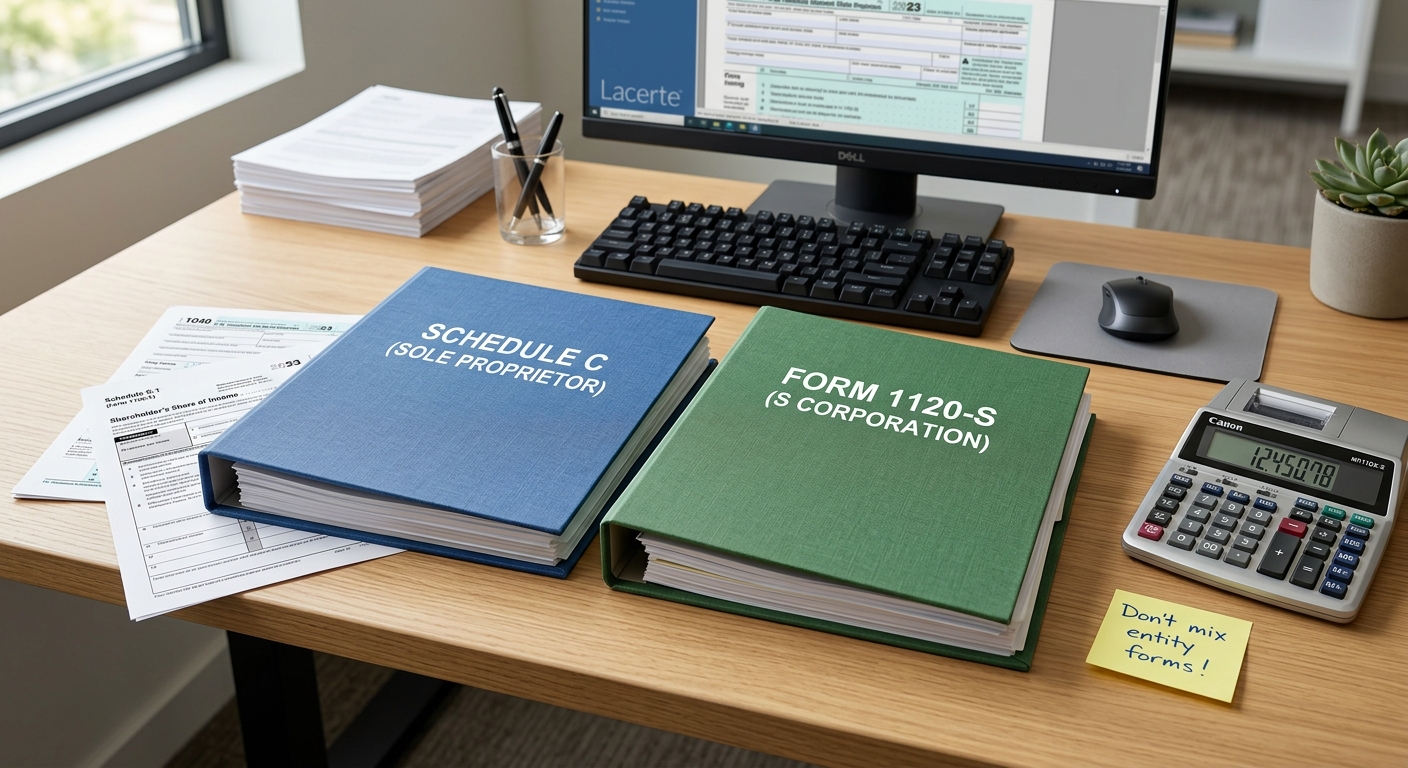
No. An S corporation does not use Schedule C to report the business’s profit or loss. Schedule C is for sole proprietors (including single-member LLCs taxed as disregarded entities). An S corporation reports business income and expenses on Form 1120-S, then passes results to owners on Schedule K-1 (Form 1120-S).
Why This Confusion Costs Real Money
Let’s make it concrete. Suppose Nina is a 1099 marketing consultant in California. She nets $180,000 after expenses. She “formed an S corp” online, but her tax preparer still files Schedule C because “it’s easier.” That mismatch typically causes three problems:
- Payroll never happens, so she didn’t pay herself a W-2 wage, which is a core S corp compliance requirement.
- Self-employment tax gets miscalculated. On Schedule C, her entire $180,000 can be subject to self-employment tax (with the Social Security wage base limit and Medicare). In a properly run S corp, payroll taxes apply to wages, not distributions.
- Documentation gets messy fast. You now have an entity with one legal structure, one banking reality, and a tax return that tells a different story.
Even if you “saved” $1,200 in tax prep fees by staying on Schedule C, that is a terrible trade if it leads to payroll fixes, amended returns, and IRS notices. If you’re already operating as an S corp, you should also be thinking about proactive planning with tax planning services before the year ends so the forms match the strategy, not the other way around.
Key Takeaway: The question do s corps use schedule c is really a signal that your entity compliance may not match your tax filing.
Schedule C vs Form 1120-S: The Form You File Follows the Tax Classification
Schedule C lives on your personal return (Form 1040). It is the profit-and-loss statement for a sole proprietor. The IRS explains Schedule C in the Schedule C instructions.
Form 1120-S is the separate tax return for an S corporation. It is not optional if the entity is an S corp for tax purposes. The IRS provides the structure and filing requirements in the Form 1120-S instructions.
Plain-English definitions (because this is where people get lost)
- Sole proprietor: You and the business are the same taxpayer. You report business activity on Schedule C and pay self-employment tax on net earnings (subject to limits).
- Disregarded entity: A single-member LLC that has not elected corporate tax treatment. It generally reports on Schedule C (or Schedule E/F depending on activity).
- S corporation: A corporation (or LLC that elected S status) filing Form 1120-S. Owners receive Schedule K-1. Wages are paid on a W-2 via payroll.
Where the money actually lands
If you’re asking “do s corps use schedule c,” you’re usually asking where the income shows up on your personal return. Here’s the clean mapping:
- Schedule C (Form 1040): Net profit flows to your Form 1040 and typically drives self-employment tax on Schedule SE.
- Form 1120-S: Business profit flows to owners via K-1 and is reported on the individual return, but it is not treated the same way as Schedule C profit for payroll tax purposes.
California layer (do not ignore this)
KDA is California-based, so we have to call out the state friction. California generally conforms to federal S corp treatment for income flow-through, but it also imposes an entity-level tax (the 1.5% franchise tax on net income, subject to minimums). This is why “I’ll just file Schedule C” is not a small mistake when you’re actually running an S corp.
Pro Tip: If you’re a California owner and you want the bigger strategic view, see our comprehensive S Corp tax guide for California. It connects the compliance pieces to the tax savings math.
Key Takeaway: You don’t choose Schedule C because it’s easier. The IRS chooses it for you based on your tax classification.
How to Tell If You’re Really an S Corp (Not Just “An LLC With a Logo”)
Clients say “I have an S corp” when what they really mean is “I opened an LLC and I heard S corp saves taxes.” So before we answer do s corps use schedule c again, verify what the IRS recognizes.
Step-by-step: confirm your federal tax status
- Find your accepted S election. That’s typically IRS Form 2553 acceptance (or proof of timely filing). If you can’t find it, don’t guess.
- Check what returns were filed for the last 1 to 2 years. If you see Form 1120-S filed, that is a strong indicator you’ve been treated as an S corp for tax purposes.
- Pull IRS transcripts. An account transcript can show what form type is on file. You can start at Get Transcript.
- Look for payroll evidence: quarterly payroll tax returns (Form 941) and year-end W-2/W-3 filings. An S corp without payroll is a red flag.
What if you never ran payroll?
If you’re truly an S corporation and you took money out of the business, you generally need to evaluate reasonable compensation. The IRS expects S corp shareholder-employees who provide services to be paid wages. While the rules are fact-specific, the enforcement theme is simple: distributions cannot replace wages when you’re actively working in the business.
Key Takeaway: If you can’t produce S election proof, 1120-S filings, and payroll records, your “S corp” may not exist for tax purposes, and the Schedule C question may be the wrong question.
KDA Case Study: 1099 Consultant Stops the Schedule C Spiral
Marco is a California-based IT security consultant (pure 1099 income). He formed an LLC and believed he had “switched to S corp” because he checked a box in a formation package. For two years, his preparer filed Schedule C because it matched the bookkeeping. He kept asking, do s corps use schedule c, because he saw other owners talk about “taking distributions” and assumed Schedule C was still part of the process.
KDA started with a classification audit: we pulled IRS transcripts, verified that no accepted S election existed, and confirmed no Form 1120-S had been filed. Then we built a clean plan: file the correct election, set up payroll, and align his books to an S corp workflow so his return could be filed accurately going forward. We also cleaned up his estimated tax approach so he wasn’t “catching up” every April.
Result: in year one after fixing the structure, Marco reduced payroll and self-employment tax drag by an estimated $14,700 (based on a reasonable wage of $95,000 and remaining profit as distributions), and eliminated the risk of IRS payroll reclassification. He paid $4,200 for entity cleanup, payroll setup, and tax planning support, for a 3.5x first-year ROI, with better compliance and cleaner lender-ready financials.
Ready to see how we can help you? Explore more success stories on our case studies page to discover proven strategies that have saved our clients thousands in taxes.
What to File Instead of Schedule C If You Have an S Corp
Once you accept that do s corps use schedule c is a “no,” the next question is what replaces it. Here’s the full stack most owner-operators need to understand.
Entity return: Form 1120-S
This is where the business’s income and expenses are reported. Think of it as the corporation’s tax return, even though the tax generally flows through to owners. The IRS overview is on Form 1120-S.
Owner reporting: Schedule K-1 (Form 1120-S)
The K-1 is the statement that tells each shareholder what to report on their personal return. It includes ordinary business income, separately stated items (like charitable contributions), and credits.
Payroll: W-2 wages and employment tax filings
If you perform services for the S corporation, wages generally belong on a W-2. Running payroll also means filing the right payroll tax forms (often Form 941 quarterly, Form 940 annually for FUTA, and state payroll filings).
Owner health insurance: special handling for more-than-2% shareholders
If you own more than 2% of an S corporation, shareholder health insurance often needs to be included in wages for income tax withholding purposes, but it can still be deductible on the owner’s personal return if structured correctly. This is one of the most common “we filed Schedule C because it was easier” casualties because Schedule C filers handle health insurance differently.
Key Takeaway: A compliant S corp isn’t just a different tax form. It’s a different operating system: books, payroll, reimbursements, and reporting.
Common Mistake That Triggers IRS Letters: Mixing Schedule C and S Corp Activity
If you want the fastest way to get the IRS to ask questions, create a return that looks like you’re double-reporting or misreporting business income. Here are the most common messes we unwind.
Mistake 1: Filing Schedule C for the same activity the S corp reports
If you file Form 1120-S for the business and also file Schedule C for the same business income, you can create mismatched 1099 reporting, duplicate income, or expense duplication. Vendors may issue a 1099-NEC to you personally, even though the income belongs to the S corp. That mismatch is common, but it requires clean bookkeeping and proper income reporting, not a second Schedule C.
Mistake 2: Using Schedule C to claim expenses that belong on the 1120-S
This is the “I’ll just deduct it somewhere” move. If the expense was paid by the S corp or incurred for the S corp’s business, it belongs on the S corp books and return. If you personally paid it, you need a reimbursement policy (often an accountable plan) so the corporation can reimburse you properly.
Mistake 3: Taking owner draws without wages
Owners hear “distributions aren’t subject to self-employment tax” and then stop paying themselves wages. The IRS has litigated this issue. The details vary, but the theme is consistent: if you work in the business, pay yourself wages that can be defended.
Mistake 4: Ignoring basis and loss limitations
S corp owners can only deduct losses to the extent of stock and debt basis, and there are at-risk and passive activity rules that can apply. These are tracked through the K-1 and basis schedules, not Schedule C.
Red Flag Alert: If your preparer says “Schedule C is fine even though you’re an S corp,” ask them to explain how you’re meeting the S corp wage requirement and why Form 1120-S is not required. If they can’t explain it in two minutes, you’re the one holding the risk.
Key Takeaway: The IRS doesn’t punish you for having an S corp. They punish you for running an S corp like a sole proprietorship.
Step-by-Step: How to Fix It If You Filed Schedule C but Should Have Filed 1120-S
Fixing an incorrect filing depends on what’s actually true: were you an S corp for that year, or did you only think you were? Either way, you need a clean sequence, not panic.
Scenario A: You were never actually an S corp (no accepted election)
If the IRS never accepted an S election, you may have legitimately been a Schedule C filer (for example, a single-member LLC). In that case, the fix is not amending to an 1120-S. The fix is deciding whether to elect S status going forward and implementing payroll and bookkeeping correctly.
Scenario B: You were an S corp, but you filed Schedule C anyway
- Confirm the S status year via acceptance letter, transcript, or prior filings.
- Rebuild clean books for that year in the S corp accounting format.
- Run retroactive payroll analysis to determine reasonable compensation and whether payroll corrections are needed.
- Amend returns if required. This can include replacing the Schedule C reporting with proper K-1 reporting.
- Document the why: keep a memo in your tax file explaining what happened and what you changed, in case of later questions.
What if you got 1099s in your personal name?
This is common for new S corps. You may need to update W-9s with clients so future 1099-NECs are issued to the corporation’s EIN, not your Social Security number. That is an operational fix, not a reason to keep filing Schedule C forever.
Want to sanity-check the size of your payroll tax exposure as a self-employed person versus an S corp structure? Run a rough estimate with this self-employment tax calculator and compare it to your actual payroll setup.
Key Takeaway: Fixes that stick are operational: payroll, books, W-9s, reimbursement policy, and the correct entity return. Not just an amended form.
Special Situations and Edge Cases (Where People Accidentally Create a Schedule C)
The question do s corps use schedule c pops up in edge cases where people have more than one income stream. Here are the most common ones.
Edge case 1: You have an S corp and a separate side gig
You can have both. Example: Sarah owns an S corp for her engineering consulting business, but she also sells handmade furniture on weekends under her own name. That furniture income may belong on Schedule C if it is truly separate and not run through the corporation. The key is separation: separate bank account, clear bookkeeping, and no mixing expenses.
Edge case 2: Real estate rentals and an S corp
Rental activity is generally reported on Schedule E, not Schedule C, unless you are providing substantial services that rise to a level that changes the character of the income (facts matter). Many real estate investors also operate an S corp for management or other service activities, but the rental income itself usually does not belong on the S corp return. If you’re a landlord or investor, you will get more value from content and planning designed for real estate investors rather than generic business advice.
Edge case 3: You are paid on a 1099 personally, but you did the work through the S corp
This is the “wrong payee” problem. You still should not file Schedule C just because a client issued a 1099 to you personally. The better move is to fix the paperwork and report correctly. This is one of those cases where clean documentation matters more than arguing with the IRS later.
Edge case 4: Multi-owner LLC taxed as an S corp
A multi-member LLC that elected S status still files Form 1120-S. Members are shareholders for tax purposes, and each gets a K-1. If someone tells you “LLCs use Schedule C,” that’s only true for single-member LLCs that did not elect corporate status.
Key Takeaway: Schedule C might still exist in your life even if you own an S corp, but it should be for truly separate activity, not the S corp’s business.
Ready to Reduce Your Tax Bill?
KDA Inc. specializes in strategic tax planning for business owners, S Corps, LLCs, and high-net-worth individuals. Book a personalized consultation and walk away with a clear plan.
FAQ: The Questions People Ask Right After “Do S Corps Use Schedule C?”
Can a single-member LLC taxed as an S corp use Schedule C?
No. If the LLC elected to be treated as an S corporation for tax purposes, the business activity belongs on Form 1120-S, not Schedule C.
What if my tax software keeps asking for Schedule C information?
Many programs use Schedule C-style inputs to capture income and expenses, then map them to the right business return. The output matters. If you are an S corp, your filed return should be Form 1120-S with K-1s.
Do I attach my 1120-S to my personal return?
No. The 1120-S is filed separately. You report the K-1 items on your personal return.
If I have an S corp, do I still pay self-employment tax?
Not in the same way as a Schedule C filer. S corp owners who work in the business typically pay employment taxes through payroll on their W-2 wages. Distributions are generally not subject to self-employment tax, but the wage must be reasonable for the work performed.
Will filing the wrong form trigger an audit?
It can trigger notices, matching issues, and follow-up questions. The IRS receives third-party reporting (1099s, W-2s) and compares it to what you filed. When the forms don’t align with your entity type, it increases your odds of correspondence and delay.
What’s the cleanest way to prevent this problem next year?
Run your business like the entity you elected: separate bank accounts, monthly bookkeeping, payroll on a schedule, and a documented reimbursement policy. If you need help building that operating system, our bookkeeping and payroll support can keep the compliance side from derailing the tax strategy.
Book Your Tax Strategy Session
If you’re still stuck on do s corps use schedule c, you’re probably not dealing with a “tax question.” You’re dealing with an entity-compliance gap that can cost five figures when it’s ignored. In a strategy session, we’ll confirm your actual IRS classification, map the correct filing stack (1120-S, K-1, payroll), and build a plan to fix past-year messes without creating new ones. Click here to book your consultation now.
Mic drop: The IRS isn’t hiding the right forms, but they will absolutely penalize you for filing the wrong ones.
Direct link to this blog post: https://kdainc.com/do-s-corps-use-schedule-c/



