
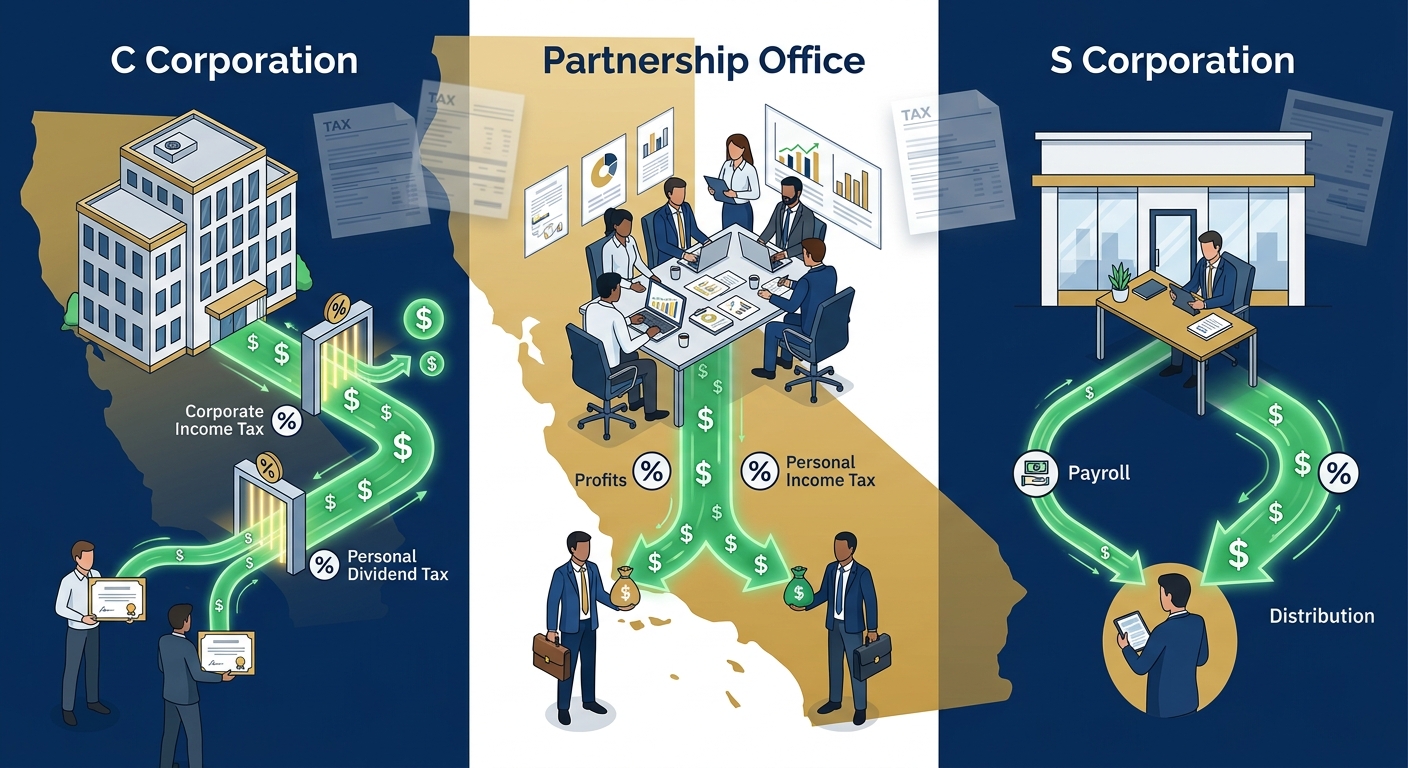
Your Entity Choice Determines Whether the IRS Takes One Bite or Two
A Sacramento marketing agency owner pulled $200,000 in profit from her business last year. She paid $42,000 in federal taxes on that money. Her neighbor, running a nearly identical agency at the same revenue, paid $73,800. Same city. Same income. Same industry. The $31,800 difference came down to one decision: how each owner structured her entity and how dividends C corp partnership S corporation distributions actually get taxed at the federal and California level.
That gap is not a rounding error. Over five years, the owner in the wrong structure will hand the IRS and the FTB an extra $159,000 that could have stayed in her pocket, funded a retirement account, or hired two full-time employees.
Quick Answer
C corporation dividends get taxed twice: once at the 21% corporate rate and again at up to 23.8% when distributed to shareholders. S corporation distributions pass through to the owner’s personal return and avoid self-employment tax on the distribution portion. Partnership distributions also pass through but carry self-employment tax on guaranteed payments and a partner’s distributive share of ordinary trade or business income. For California business owners earning $150,000 or more in annual profit, the wrong entity choice creates a $15,000 to $48,000 annual tax gap that compounds every single year.
How Dividends C Corp Partnership S Corporation Distributions Actually Work in 2026
The IRS treats profit extraction differently depending on your entity type. Understanding the mechanics is not optional if you want to keep more of what you earn. Here is how each structure handles the money flowing from your business to your bank account.
C Corporation Dividends: The Double-Taxation Machine
A C corporation is a separate taxpaying entity. It files Form 1120 and pays a flat 21% federal corporate tax on net income under IRC Section 11. When the remaining after-tax profit is distributed to shareholders as dividends, the shareholders pay tax again on their personal returns.
Qualified dividends get preferential rates of 0%, 15%, or 20% depending on taxable income, plus the 3.8% Net Investment Income Tax (NIIT) under IRC Section 1411 for high earners. California adds its own layer: the state does not offer a preferential rate for qualified dividends. Every dollar of dividend income gets taxed at your marginal California rate, up to 13.3%.
Here is the math on $200,000 of C corp profit distributed as dividends to a California owner in the 24% federal bracket:
- Corporate tax: $200,000 x 21% = $42,000
- After-tax profit available for distribution: $158,000
- Federal dividend tax (20% + 3.8% NIIT): $158,000 x 23.8% = $37,604
- California tax on dividends (9.3% marginal): $158,000 x 9.3% = $14,694
- Total combined tax: $94,298
- Effective rate on original $200,000: 47.1%
That is nearly half the profit gone before the owner deposits a single dollar.
S Corporation Distributions: One Layer, One Tax
An S corporation files Form 1120S but does not pay entity-level federal income tax (with narrow exceptions like built-in gains tax under IRC Section 1374). Instead, all income passes through to the shareholder’s personal return on Schedule K-1. The owner pays tax once at individual rates.
The strategic advantage is the salary-distribution split. The S corp owner pays herself a reasonable salary, subject to payroll taxes (Social Security at 12.4% up to the $176,100 wage base in 2026, plus 2.9% Medicare). Any profit above that reasonable salary flows through as a distribution, which avoids the 15.3% self-employment tax entirely.
Same $200,000 profit, California S corp owner paying herself a $90,000 salary:
- Payroll taxes on $90,000 salary: $90,000 x 15.3% = $13,770
- Federal income tax on $200,000 pass-through (24% effective): $48,000
- QBI deduction under Section 199A (20% of $110,000 distribution): saves roughly $5,280
- California income tax (9.3% effective): $18,600
- California 1.5% S corp franchise tax on net income: $3,000
- Total combined tax: approximately $78,090
- Effective rate: 39.0%
The S corp owner keeps $16,208 more per year than the C corp owner on the same $200,000. Many business owners operating as C corps do not realize this gap exists until they sit down and run the actual numbers. If you want to see how your specific profit level changes the calculation, plug your numbers into this small business tax calculator and compare the results side by side.
Partnership Distributions: Pass-Through With a Self-Employment Trap
A partnership files Form 1065 and issues K-1s to each partner. Like an S corp, the entity itself does not pay federal income tax. Profits pass through to the partners’ individual returns.
The catch is self-employment tax. A general partner’s distributive share of ordinary trade or business income is subject to self-employment tax under IRC Section 1402(a). Guaranteed payments are always subject to SE tax. Unlike an S corp, there is no salary-distribution split to shelter a portion of profits from the 15.3% payroll tax hit.
Same $200,000 profit, split equally between two general partners ($100,000 each):
- Self-employment tax per partner: $100,000 x 92.35% x 15.3% = $14,130
- Federal income tax per partner (22% effective): $22,000
- California income tax per partner (9.3%): $9,300
- Total per partner: $45,430
- Total for both partners: $90,860
- Effective rate on full $200,000: 45.4%
The partnership pays $12,770 more in total tax than the S corp structure and only $3,438 less than the C corp. For a two-owner business, that self-employment tax exposure on the full distributive share eliminates most of the pass-through advantage.
The Five-Year Cost of Choosing the Wrong Entity
One year of extra tax is painful. Five years compounds into a retirement account. Here is what the entity choice costs at three profit levels over a five-year horizon for a California owner:
$150,000 Annual Profit
| Entity | Annual Tax | 5-Year Total |
|---|---|---|
| C Corp (dividends) | $67,650 | $338,250 |
| Partnership (general) | $62,400 | $312,000 |
| S Corp (optimized) | $52,800 | $264,000 |
S Corp advantage over C Corp: $74,250 over five years.
$250,000 Annual Profit
| Entity | Annual Tax | 5-Year Total |
|---|---|---|
| C Corp (dividends) | $117,750 | $588,750 |
| Partnership (general) | $108,900 | $544,500 |
| S Corp (optimized) | $89,500 | $447,500 |
S Corp advantage over C Corp: $141,250 over five years.
$400,000 Annual Profit
| Entity | Annual Tax | 5-Year Total |
|---|---|---|
| C Corp (dividends) | $188,400 | $942,000 |
| Partnership (general) | $173,200 | $866,000 |
| S Corp (optimized) | $140,600 | $703,000 |
S Corp advantage over C Corp: $239,000 over five years. That is a house down payment in most California markets.
For a deeper breakdown of how these S Corp mechanics work across different income levels and industries, see our comprehensive S Corp tax strategy guide for California.
OBBBA Changes That Shift the Dividends C Corp Partnership S Corporation Equation in 2026
The One Big Beautiful Bill Act (OBBBA), signed into law in 2025, permanently altered several provisions that directly affect how dividends, distributions, and pass-through income get taxed. These are not temporary. They reshape the entity decision for every California business owner going forward.
Permanent QBI Deduction Under Section 199A
Before OBBBA, the Qualified Business Income deduction was scheduled to expire after 2025. It is now permanent. S corp owners and partners can deduct up to 20% of qualified business income, subject to income phase-outs and the W-2 wage limitation. C corp owners get zero QBI benefit because corporate income is not qualified business income.
On $200,000 of S corp pass-through income, the QBI deduction shelters up to $40,000 from federal tax. At a 32% marginal rate, that saves $12,800 annually. This single provision widened the gap between S corps and C corps permanently.
Permanent 100% Bonus Depreciation
OBBBA restored 100% bonus depreciation under Section 168(k), which had been phasing down from 80% in 2024 to 60% in 2025 under TCJA’s sunset schedule. All three entity types benefit from bonus depreciation, but pass-through entities (S corps and partnerships) get the deduction flowing directly to the owner’s personal return, creating immediate tax reduction. C corps get the deduction at the 21% corporate rate, a lower marginal benefit per dollar of depreciation.
$40,000 SALT Cap
The state and local tax deduction cap increased from $10,000 to $40,000 under OBBBA. This helps W-2 earners and individuals more than business owners directly, but it interacts with entity planning. California S corp owners using the AB 150 Pass-Through Entity Tax (PTE) election can bypass the SALT cap entirely by having the entity pay the state tax. C corp owners and partnership owners without a PTE election mechanism face the SALT cap on their personal returns.
$2.5 Million Section 179 Limit
The Section 179 expensing limit jumped to $2,500,000 under OBBBA. All entities can use Section 179, but California still caps it at $25,000 under R&TC Sections 17250 and 24356. This federal-state gap hits every California business owner regardless of entity type, but pass-through entities feel it more because the California limitation flows directly to the owner’s state return.
Five California-Specific Traps That Change the Entity Math
Federal tax treatment is only half the equation for California owners. The state adds layers that can flip the entity advantage entirely if you are not paying attention.
Trap 1: The C Corp Franchise Tax at 8.84%
California taxes C corporation net income at 8.84% under R&TC Section 23151. That is on top of the 21% federal corporate tax, pushing the combined corporate-level rate to nearly 30% before the owner even touches the money. S corporations pay just 1.5% on net income under R&TC Section 23802. That 7.34% state-level gap on $200,000 of profit is $14,680 per year that C corp owners hand directly to the FTB.
Trap 2: No Qualified Dividend Rate in California
Federally, qualified dividends get taxed at preferential rates (0%, 15%, or 20%). California treats all dividends as ordinary income. A C corp owner receiving $150,000 in qualified dividends pays up to 13.3% to California, whereas the federal rate is capped at 23.8%. This eliminates one of the few federal advantages C corp dividends offer.
Trap 3: LLC Gross Receipts Fee for Partnerships
Multi-member LLCs taxed as partnerships face California’s graduated gross receipts fee under R&TC Section 17942. This fee starts at $900 for LLCs with total California income of $250,000 and scales to $11,790 for income over $5,000,000. It is based on gross receipts, not net income, so a high-revenue, low-margin partnership can owe thousands in fees on top of franchise tax.
Trap 4: AB 150 PTE Election Timing
California’s elective pass-through entity tax under AB 150 allows S corps and partnerships to pay state tax at the entity level, generating a dollar-for-dollar credit on the owner’s personal return. This bypasses the federal SALT cap entirely. But the election must be made by June 15 of the tax year (or the original due date of the return for certain elections), and the first estimated payment is due by that date. Miss it, and you lose the SALT bypass for the entire year. C corps cannot use this election at all.
Trap 5: Bonus Depreciation Nonconformity
California does not conform to federal bonus depreciation under Section 168(k). This creates dual depreciation schedules for every business entity operating in California. A $500,000 equipment purchase that generates a full federal deduction in year one under OBBBA’s permanent 100% bonus depreciation will only produce a $25,000 California deduction under the state’s Section 179 cap, with the remainder depreciated over MACRS recovery periods. This affects all entity types equally, but the planning response differs: S corps and partnerships can layer the AB 150 PTE election to offset the California tax gap, while C corps cannot.
If you are weighing these entity options and need help structuring your business correctly from the start, our entity formation services walk you through every step so you avoid these California-specific pitfalls before they cost you money.
The Three Narrow Exceptions Where a C Corp or Partnership Wins
The S corporation wins the distribution tax fight in most scenarios. But there are three situations where a different entity legitimately makes sense.
Exception 1: Venture Capital or Private Equity Funding
S corporations cannot have more than 100 shareholders, cannot issue multiple classes of stock, and cannot have non-individual shareholders (like institutional funds). If you are raising outside capital from VCs or PE firms, a C corporation is the only practical option. The double taxation becomes a cost of accessing capital markets.
Exception 2: Section 1202 QSBS Exclusion
Qualified Small Business Stock under IRC Section 1202 allows C corp shareholders to exclude up to $10 million (or 10x their basis) in capital gains upon sale of stock held for five or more years. This is a massive tax break that only applies to C corporations. If your five-year plan includes selling the business for $5 million or more, the QSBS exclusion can save $1 million or more in capital gains tax, outweighing years of double taxation on dividends.
Exception 3: Loss Allocation in Partnerships
Partnerships offer flexible loss allocation under IRC Section 704(b) that S corporations cannot match. If your business expects significant early-year losses that partners want to use against other income, a partnership structure allows disproportionate loss allocation (as long as it has substantial economic effect). S corporations must allocate income and losses strictly per share, per day.
Outside these three scenarios, the S corporation wins the dividends C corp partnership S corporation comparison for California business owners earning $60,000 or more in annual profit.
KDA Case Study: Sacramento Digital Agency Owner Saves $38,400 Per Year After Entity Restructure
Rachel operated a digital marketing agency in Sacramento as a multi-member LLC taxed as a partnership. She and her business partner each earned $175,000 in annual distributive share income. Both paid full self-employment tax on their entire share, resulting in combined SE tax of nearly $49,000 per year. They also missed the AB 150 PTE election deadline, leaving $12,400 in SALT cap savings on the table.
KDA’s strategy team restructured the LLC to elect S corporation status using Form 2553. We set each owner’s reasonable salary at $95,000, ran payroll through a compliant provider, and converted the remaining $80,000 per owner into distributions free from self-employment tax. We filed the AB 150 PTE election by the June 15 deadline, generating a full SALT bypass credit. We also identified $18,000 in bonus depreciation that had not been claimed due to the previous preparer’s failure to maintain dual federal-California depreciation schedules.
Year one results: Rachel and her partner saved $38,400 in combined taxes, paid KDA $8,500 for entity restructuring, tax preparation, and payroll setup, and achieved a 4.5x first-year ROI. Projected five-year savings: $192,000.
Ready to see how we can help you? Explore more success stories on our case studies page to discover proven strategies that have saved our clients thousands in taxes.
Five Costliest Distribution Mistakes California Business Owners Make
Mistake 1: Staying in a C Corp Because “That Is How We Set It Up”
Inertia is not a tax strategy. Many business owners formed C corporations years ago on advice from an attorney who prioritized liability protection without considering tax efficiency. Converting to an S corporation is straightforward using Form 2553, and late election relief under Revenue Procedure 2013-30 is available for those who missed the March 15 deadline. Every year you delay costs thousands in unnecessary double taxation.
Mistake 2: Ignoring the Reasonable Salary Requirement
S corp owners who pay themselves zero salary and take 100% distributions are waving a red flag at the IRS. The agency uses data analytics to compare officer compensation across industries. If you underpay yourself, the IRS can reclassify distributions as wages, adding back payroll taxes plus penalties and interest. The reasonable salary must be defensible based on hours worked, industry norms, and business revenue.
Mistake 3: Missing the AB 150 PTE Election Deadline
The June 15 deadline for California’s pass-through entity tax election is non-negotiable. There is no late election relief. Missing it means you pay state tax on your personal return, subject to the $40,000 SALT cap, and lose the entity-level deduction that bypasses the cap entirely. On $200,000 of pass-through income, this mistake costs roughly $8,200 in lost federal savings.
Mistake 4: Forgetting Built-In Gains Tax After C-to-S Conversion
When you convert from C corp to S corp, any appreciated assets carry a five-year built-in gains (BIG) tax recognition period under IRC Section 1374. If you sell appreciated assets within that window, the S corp pays a 21% entity-level tax on the built-in gain, in addition to the pass-through tax on the shareholder’s personal return. Plan asset sales outside the recognition window or use net built-in loss offsets to minimize this trap.
Mistake 5: Running a Partnership Without Evaluating S Corp Election
Many multi-member LLCs default to partnership taxation and never revisit the decision. Once annual profit per partner exceeds $60,000, the self-employment tax savings from S corp election typically outweigh the payroll compliance costs. A simple comparison of SE tax on the full distributive share versus payroll tax on a reasonable salary reveals whether the switch makes sense.
Should You Restructure? A Decision Framework
Convert From C Corp to S Corp If:
- Annual profit exceeds $80,000
- You do not need multiple classes of stock
- You have 100 or fewer individual shareholders
- You are not pursuing VC or PE funding
- Your exit timeline is beyond five years (BIG tax management)
Convert From Partnership to S Corp If:
- Each partner’s distributive share exceeds $60,000
- Partners are actively involved in the business
- You do not need flexible loss allocation
- All partners are U.S. citizens or resident aliens
- The business does not require tiered partnership structures
Stay in a C Corp If:
- You are raising institutional capital
- You qualify for Section 1202 QSBS and plan to sell within 5-10 years
- You want to retain significant earnings at the 21% rate for reinvestment
- Your California effective rate difference is offset by QSBS savings
Stay in a Partnership If:
- You need special allocation of losses to specific partners
- Partners include other entities (trusts, corporations, foreign persons)
- The business consistently generates losses in early years
- You need flexibility for future partner additions with varying economic rights
Will Changing My Entity Trigger an Audit?
Entity conversions by themselves do not trigger IRS audits. The IRS sees thousands of Form 2553 elections every year. What triggers scrutiny is poor execution: unreasonable salary levels, missing payroll filings, inconsistent K-1 reporting, or failure to properly manage the built-in gains tax window after a C-to-S conversion.
The IRS Palantir SNAP system uses data analytics to flag returns with statistical anomalies. If your S corp shows $300,000 in net income and $30,000 in officer compensation, that ratio will generate a flag. If your partnership suddenly stops filing Form 1065 and a new 1120S appears without a corresponding Form 2553 on file, that creates a compliance gap the IRS notices.
The solution is clean execution: file Form 2553 properly, set defensible salary levels, maintain compliant payroll, and track basis meticulously on Form 7203. Do those four things, and an entity change actually reduces your audit risk because your returns become cleaner and more internally consistent.
Ready to Reduce Your Tax Bill?
KDA Inc. specializes in strategic tax planning for business owners, S Corps, LLCs, and high-net-worth individuals. Book a personalized consultation and walk away with a clear plan.
Frequently Asked Questions
Can I Convert My Entity Mid-Year?
S corporation elections under Form 2553 must be filed by March 15 to take effect for the current tax year under IRC Section 1362(a)(2). If you file between March 16 and December 31, the election takes effect January 1 of the following year. There is no true mid-year conversion for S corp elections. Late election relief under Revenue Procedure 2013-30 may apply if you missed the deadline due to reasonable cause.
Do S Corp Distributions Count as Income?
S corporation distributions are not separately taxed as income if you have sufficient stock basis. The income is taxed when it flows through on Schedule K-1, regardless of whether you actually distribute it. Distributions reduce your stock basis under IRC Section 1368. If distributions exceed your basis, the excess is taxed as capital gain.
Is the QBI Deduction Available for All Three Entity Types?
No. The QBI deduction under Section 199A applies only to pass-through entities: S corporations, partnerships, and sole proprietorships. C corporation income does not qualify for QBI. This is one of the most significant structural advantages pass-through entities have over C corps, especially now that OBBBA made the QBI deduction permanent.
What Happens to My C Corp’s Accumulated Earnings When I Convert to S Corp?
C corporation accumulated earnings and profits (AE&P) carry over to the S corporation and sit in a separate tracking account. Distributions from the S corp follow the ordering rules under IRC Section 1368: first from the Accumulated Adjustments Account (AAA), then from AE&P, then from remaining basis. Distributions from AE&P are taxed as dividends. Proper tracking is critical to avoid accidental dividend treatment on what you thought was a tax-free distribution.
Does California Tax S Corp Distributions Differently Than the Federal Government?
California does not tax S corp distributions separately, but it imposes a 1.5% entity-level franchise tax on S corporation net income under R&TC Section 23802 that the federal government does not. California also does not conform to federal bonus depreciation, creating different taxable income at the state level. And California does not offer a preferential rate for qualified dividends from C corps, so the state-level comparison between entities can differ significantly from the federal comparison.
This information is current as of April 10, 2026. Tax laws change frequently. Verify updates with the IRS or FTB if reading this later.
Book Your Entity Tax Strategy Session
If you are running a C corp, partnership, or LLC and you have never compared the distribution tax math across all three entity types, you are almost certainly overpaying. The difference between the right structure and the wrong one is $15,000 to $48,000 per year for California business owners. That is not a theoretical number. That is cash you are handing to the IRS and FTB every April. Book a personalized consultation with our strategy team, and we will model your specific income, entity options, and California tax exposure so you can stop guessing and start keeping more of what you earn. Click here to book your consultation now.
“The IRS does not care which entity you choose. It only cares that you pay what the structure requires. Choose the structure that requires less.”


