
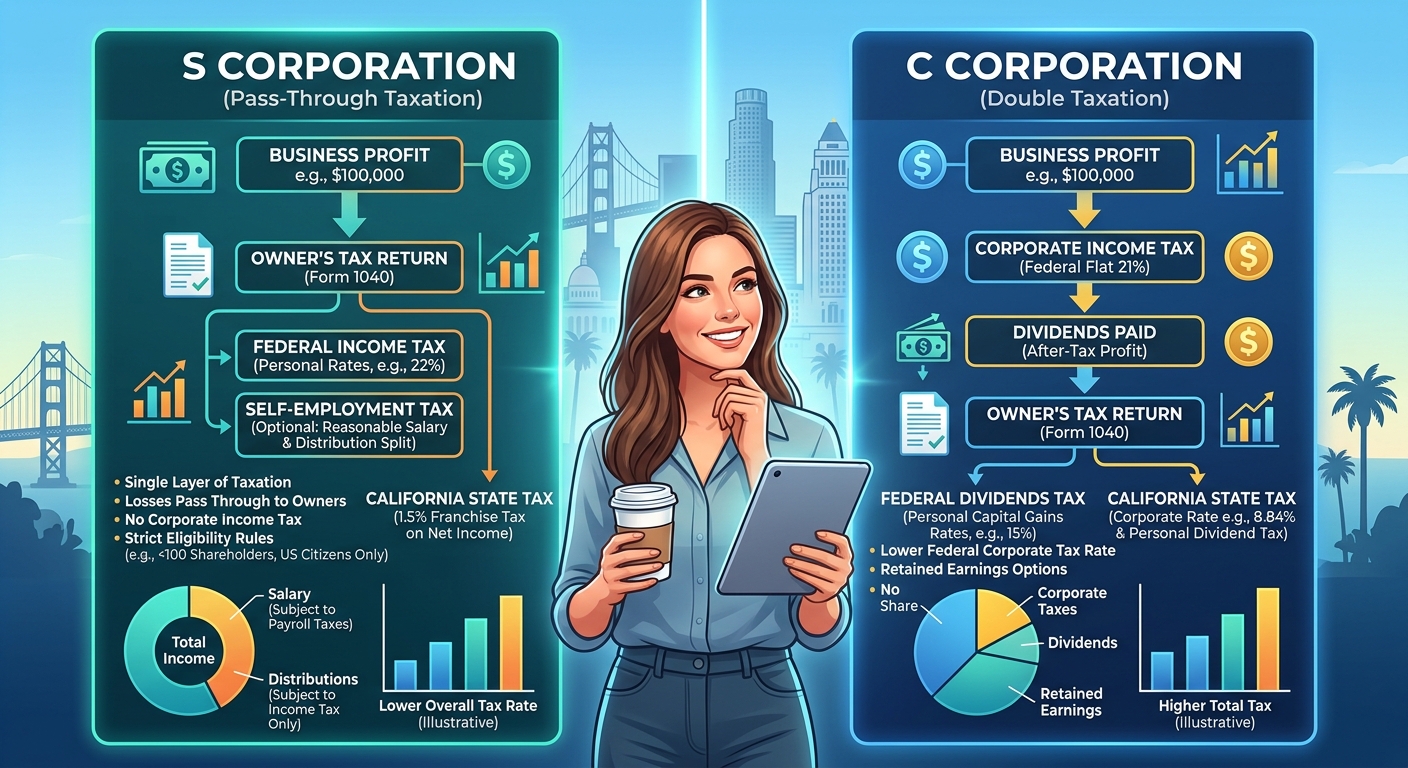
This blog compares the difference between S corp and C corp taxes in a way most owners have never seen. If you run profit through the wrong structure for even a few years, you can quietly burn through fifty thousand dollars or more in avoidable tax without realizing it. The goal here is not to sell you on one label but to show, with real numbers, how each choice behaves for federal and California tax so you can pick the structure that actually fits your income, exit plan, and risk tolerance.
Quick Answer
The difference between S corp and C corp taxes comes down to three levers. First, C corporations pay a 21 percent federal corporate tax on profits, and then shareholders pay tax again on dividends, creating double taxation. S corporations are pass through entities, so profits are taxed once on the owners personal returns, but owners must take reasonable W 2 salaries that are subject to payroll tax. Second, California charges S corporations a 1.5 percent franchise tax on net income (plus the 800 dollar minimum fee), while C corporations pay an 8.84 percent tax on California taxable income. Third, S corp owners can often trim thousands in self employment tax by splitting income between salary and distributions, while C corp owners use other tools like fringe benefits and retained earnings planning.
How S Corp Taxation Really Works
An S corporation is a corporation or LLC that has filed an election, usually on IRS Form 2553, to be treated as a pass through for federal tax. The entity still files its own return on Form 1120 S, but the tax calculation happens on the owners personal returns using Schedule E.
Here is the key behavior. The S corporation itself generally does not pay federal income tax. Instead, net profit flows through to shareholders based on ownership percentage. If your S corporation has 200,000 dollars of net profit and you own 100 percent, you will pick up 200,000 dollars of pass through income even if you only took 120,000 dollars of cash out during the year.
The IRS expects owner employees to take reasonable compensation as W 2 wages. That salary is subject to Social Security and Medicare tax, just like any other employee. The remaining profit can usually be distributed as a shareholder distribution that is not subject to self employment tax. This is where the payroll tax savings live, but it is also where many owners get careless and invite an audit.
If you are a California based owner with growing profits, it often makes sense to work with a specialist who understands entity planning as part of a broader strategy. That is one reason many business owners choose to partner with a firm that handles both planning and compliance so the structure and the numbers stay aligned over several years.
Simple S Corp Example
Consider Jasmine, a marketing consultant who expects 180,000 dollars of net profit in 2025. As a Schedule C sole proprietor, she would owe roughly 25,000 dollars in self employment tax alone. If she forms an S corporation and pays herself a defensible 110,000 dollar W 2 salary, the combined employer and employee payroll tax on that salary is around 16,800 dollars. The remaining 70,000 dollars of profit passes through without self employment tax, cutting her payroll tax bill by about 8,000 dollars before we even talk about income tax planning.
At the entity level, her California S corporation will owe the 1.5 percent franchise tax on net income, around 2,700 dollars, plus the 800 dollar minimum. Those amounts are deductible expenses on the federal return, which softens the impact. The real savings still come from repositioning how her profit shows up in the Social Security and Medicare system.
How K 1 Income Shows Up On Your Return
Each shareholder receives a Schedule K 1 from the S corporation. That document shows their share of ordinary business income, separately stated items like Section 179 depreciation, and any credits. The income flows to the owners Form 1040 and may qualify for the qualified business income deduction, sometimes called the 20 percent pass through deduction, under Section 199A. That deduction can be very meaningful for high earners, but it comes with income thresholds and limits that need to be modeled carefully. See IRS Publication 535 for more detail on business deductions that tie into this calculation.
How C Corp Taxation Really Works
A C corporation files its tax return on Form 1120 and pays tax at the flat 21 percent federal corporate rate on its taxable income. When that corporation distributes profits as dividends, shareholders report those dividends on their personal returns and pay tax again, generally at long term capital gain or qualified dividend rates. This is the classic double taxation structure people worry about.
In California, C corporations also pay the 8.84 percent state income tax on net income, with a higher 10.84 percent rate for certain financial corporations. That state tax is deductible on the federal corporate return. Even with that deduction, a mature C corporation can easily see a combined effective rate north of 30 percent on profits before dividends are issued.
So why would anyone choose a C corporation at all. The answer is that C corporations bring planning tools that are attractive for certain profiles, especially high growth companies that expect to reinvest profits or seek outside investors. They can retain earnings inside the entity at the 21 percent rate, offer certain fringe benefits more flexibly, and may qualify for Section 1202 qualified small business stock treatment on eventual sale, which can completely exclude a portion of the gain from federal tax if specific criteria are met.
If you are building a scalable company with plans for outside capital, your needs go well beyond simple tax reduction. That is when coordinated work with corporate counsel, tax planning pros, and an experienced accountant becomes critical. KDA often ties the tax strategy conversation into broader tax planning services so owners are not looking at entity type in isolation.
Real World C Corp Example
Take Daniel, a tech founder in California whose corporation earns 500,000 dollars of pre tax profit in 2025. The federal corporate tax at 21 percent is 105,000 dollars. California tax at 8.84 percent adds about 44,200 dollars. After taxes, the corporation keeps around 350,800 dollars. If Daniel leaves most of that cash inside the company to hire developers and expand marketing, he is taxed once at the corporate level. If the company later pays a 100,000 dollar dividend, Daniel will owe personal tax on that dividend, often at 15 or 20 percent, creating the second layer.
This structure can still be advantageous if most of the value comes from reinvesting profit and eventually selling stock. If the corporation qualifies for Section 1202 and Daniel meets the five year holding period and other requirements, a portion of his gain on selling shares can be excluded from federal tax. That potential exit benefit can outweigh the annual double tax cost for some founders.
Case Study: How The Choice Plays Out For A Real Owner
Consider Maria, a California based designer who shifted from a default single member LLC to an S corporation after working with a strategic advisory team. Before the change, her LLC reported 220,000 dollars of net income on Schedule C, triggering roughly 31,000 dollars of self employment tax in addition to federal and state income tax. She was writing five figure checks to the IRS each April and still felt behind.
After restructuring into an S corporation, Maria began paying herself a 120,000 dollar W 2 salary, supported by industry data and time spent in the business. Her payroll tax burden on that salary runs about 18,400 dollars. The remaining 100,000 dollars of profit flows through as S corporation income, free from self employment tax. Even after the 1.5 percent California S corp tax and the 800 dollar minimum, her total annual tax outlay dropped by about 9,000 dollars in the first year.
KDA then layered in retirement planning and multi year projections so Maria could time larger equipment purchases and solo 401k contributions to years when her tax bracket and business cash flow made the most sense. In the second year, with these extra moves, her total tax savings exceeded 16,000 dollars compared to staying a Schedule C sole proprietor.
Ready to see how we can help you. Explore more success stories on our case studies page to discover proven strategies that have saved our clients thousands in taxes.
Red Flag Alert: Common Mistakes That Trigger IRS Attention
Whenever you are weighing the difference between S corp and C corp taxes, it is not enough to chase theoretical savings. The IRS and California Franchise Tax Board both look for patterns that suggest abuse. A few issues come up repeatedly in examinations.
With S corporations, the number one trigger is paying the owner an unreasonably low salary while taking very high distributions. If an S corp earns 300,000 dollars and the owner only pays themselves 30,000 dollars in W 2 wages, that ratio will almost always look suspicious. The IRS has successfully reclassified distributions as wages in many court cases and assessed additional payroll tax, penalties, and interest. Using outside data and documenting how you set your salary is critical.
Another trap is failing to withhold and remit payroll tax on time. Once you have employees, including yourself, the corporation must follow employment tax rules outlined in IRS Publication 15. Late payroll deposits create steep penalties that can wipe out the savings of the S corp strategy for the year.
On the C corporation side, a common mistake is using the entity like a personal checking account, with loosely documented loans to shareholders and casual reimbursements. The IRS can treat these as constructive dividends or wages, creating back taxes and penalties. The Service also watches for unreasonable compensation in C corps, but in that setting the concern is usually that the corporation is paying too much salary to avoid corporate level tax, rather than too little.
When Does Each Structure Usually Win
No article can replace a tailored projection, but there are patterns. If you are a solo service provider in California with 100,000 to 400,000 dollars of expected profit, no plans to raise outside money, and you are comfortable running payroll, an S corporation often delivers the most efficient tax result. The ability to manage your salary level, trim self employment tax, and still keep things relatively simple is powerful.
For a W 2 employee with a side business earning 40,000 to 60,000 dollars, though, the compliance burden of an S corporation might outweigh the tax benefit. In these cases, staying a Schedule C filer for a while and focusing on clean bookkeeping and estimated tax payments may be wiser. You can always elect S corp status later when profits climb, as long as you file the election on time.
C corporations tend to win for businesses that fit one or more of these conditions. You expect to reinvest the majority of profits for growth rather than distributing them each year. You plan to seek venture or private equity investment. You may qualify for Section 1202 small business stock treatment on a later sale. Or you have a business model where certain fringe benefits offered through a C corporation, such as broader health coverage structures, are especially valuable.
As your situation grows more complex, it becomes important to work with professionals who focus on multi entity design, not just annual filing. That is the core of the premium advisory model at firms like KDA, especially for owners with multiple lines of business, real estate holdings, or high W 2 income layered on top of business activity.
How Federal And California Taxes Interact
Understanding the difference between S corp and C corp taxes means modeling how federal and California systems stack on top of each other. For S corporations, federal income tax occurs only at the shareholder level. California, though, collects at both levels, with the 1.5 percent entity tax and then personal state income tax on the pass through income.
For C corporations, California imposes the 8.84 percent corporate rate on the entity while shareholders also pay California tax on any dividends they receive. The state does not have a special qualified dividend rate, so those amounts generally get taxed at the same rates as other ordinary income on the individual return.
Here is a concrete comparison using simple assumptions. Assume a California business earns 250,000 dollars of pre tax profit before paying any owner salary in 2025.
- S corp scenario: The owner pays themselves a 130,000 dollar W 2 salary and takes the remaining 120,000 dollars as S corp profit. Payroll tax on the salary is roughly 19,900 dollars split between employer and employee. The 120,000 dollars of profit passes through free of self employment tax. The corporation pays 1.5 percent California tax on its 120,000 dollar net income, or 1,800 dollars, plus the 800 dollar minimum. The owner then pays federal and state income tax on both the wages and the pass through income.
- C corp scenario: The corporation pays the owner the same 130,000 dollar salary, incurring similar payroll tax. It then has 120,000 dollars of taxable income and pays 21 percent federal corporate tax (25,200 dollars) plus 8.84 percent California tax (about 10,608 dollars). If it distributes the remaining 84,192 dollars as a dividend, the owner pays federal dividend tax, often 15 percent or 20 percent, plus California income tax at their marginal rate.
When you run these scenarios side by side, the S corporation often yields lower combined tax outlay for an actively involved owner at this profit level, but it is not always a slam dunk. Details like other household income, retirement plan participation, medical expense strategies, and future exit plans all move the needle.
What If Your Profit Fluctuates Or You Add Real Estate
One frustration for owners is that their profit is not a straight line. You may have a 90,000 dollar year followed by a 300,000 dollar year. The difference between S corp and C corp taxes across those swings can be dramatic, and locking yourself into a structure without looking at a multi year picture can backfire.
This is where running scenarios with a professional helps. For some investors combining an operating company with rental property, a hybrid structure using an S corporation for the operating business and an LLC taxed as a partnership or disregarded entity for the real estate can keep liability protection strong while letting you use strategies like cost segregation and 1031 exchanges on the property side. For those building significant rental portfolios, it may make sense to review the firm special guidance for real estate investors and coordinate that with your operating entity choices.
If you are trying to forecast your overall bill under different structures, plugging rough numbers into a small business tax calculator can help you estimate effective rates before committing to a strategy discussion.
Will Switching Structures Trigger An Audit
Owners are often nervous that changing from an LLC to an S corporation or from one structure to another will paint a target on their backs. The reality is that entity changes are common and fully contemplated by the tax code. What raises risk is sloppy execution, not the simple fact of restructuring.
If you elect S corp status for an existing LLC, you need clean corporate records, a properly filed Form 2553, and a clear plan for how basis, previously taxed income, and distributions will be tracked going forward. Similarly, if you decide to revoke an S election and move back to C status, you must follow the rules in IRS Publication 542 around built in gains tax and timing.
From a California perspective, the Franchise Tax Board is more interested in whether you are paying the correct minimum tax, filing the right form each year, and reporting your income consistently than in punishing you for choosing a more efficient structure. Clean books, timely estimated payments, and proactive planning go a long way toward keeping you off the audit radar.
Key Questions To Ask Before You Choose
Before you lock in an entity structure, walk through a short diagnostic. How much profit do you expect over the next two to three years, not just this quarter. How comfortable are you with the administrative work of payroll, corporate minutes, and separate bank accounts. Do you have, or plan to have, partners or investors. Are you more focused on annual cash flow or on a future exit.
If your primary goal is reducing self employment tax on a growing service business where you are the main earner, modeling the S corp path is usually step one. If your vision centers on building a team, raising capital, or selling shares down the road, you need to weigh whether the C corporation ecosystem, with its double tax but powerful exit rules, better matches your objectives.
Whatever you decide, remember that the most expensive structure is the one chosen on autopilot. Building your choice around clear numbers and a documented plan will pay for itself many times over in avoided surprises.
Bottom Line
The difference between S corp and C corp taxes is not a trivia question, it is a lever that can redirect tens of thousands of dollars over a few short years. S corporations usually favor actively involved owners in the low to mid six figure profit range who want to keep things lean and harvest payroll tax savings. C corporations fit high growth ventures, multi investor structures, and exit focused strategies where the corporate shell and potential qualified small business stock treatment matter more than short term double tax friction.
This information is current as of 7/21/2026. Tax law for both federal and California systems changes frequently, so if you are reading this later, verify details against current guidance from the IRS or California Franchise Tax Board.
Ready to Reduce Your Tax Bill?
KDA Inc. specializes in strategic tax planning for business owners, S Corps, LLCs, and high-net-worth individuals. Book a personalized consultation and walk away with a clear plan.
Book Your Tax Strategy Session
If you are not sure which structure fits your next five years, do not guess. A focused strategy session can quantify the difference between S corp and C corp taxes for your exact situation, including California nuance, retirement goals, and exit plans. Book a personalized consultation with our team and leave with a clear, compliant roadmap. Click here to book your consultation now.
Key Takeaway: The IRS is not hiding tax savings inside entity choice, it is simply not their job to tell you that your current structure is leaking thousands per year.
The IRS is not hiding these write offs, you just were not taught how to find them.



