
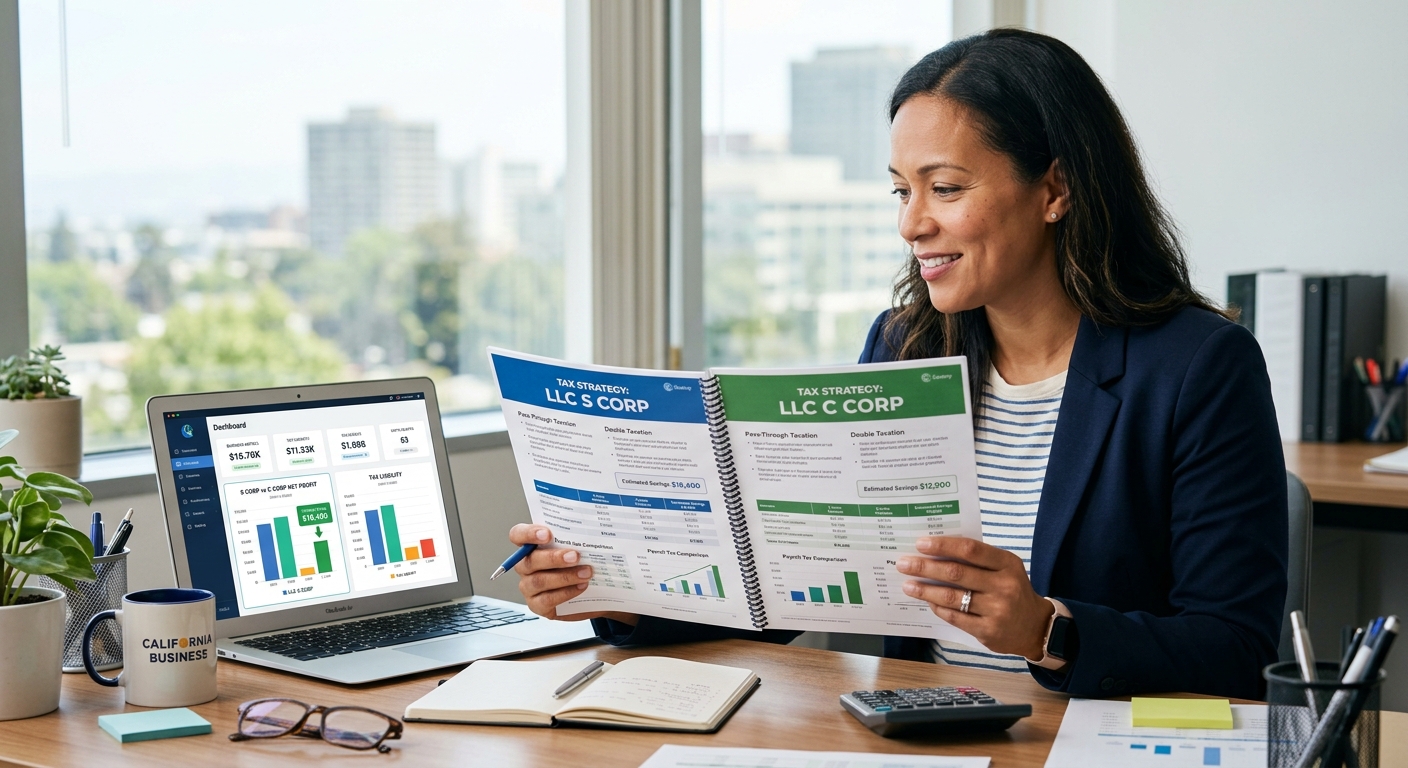
Meta description: Understand the real difference between LLC S Corp and LLC C Corp so you can stop guessing, cut self employment tax legally, and avoid surprise double taxation.
Plenty of owners form an LLC, assume they are protected and tax efficient, then get hit with a bill that feels like a second rent payment. A big reason is simple confusion about the difference between llc s corp and llc c corp and how each one actually puts money in your pocket or hands it to the IRS.
The labels sound technical, but what is really changing is who gets taxed, when, and how many times. Once you see the cash flow in each structure using real numbers, the better choice for your situation becomes a lot clearer.
Quick Answer
Both structures start with the same legal shell, your LLC. If you elect S corporation status, profits generally pass through to your personal return and you can split income between W 2 salary and distributions, which can reduce self employment tax when set up correctly. If you elect C corporation status, the LLC pays its own corporate tax, and then you pay tax again on dividends, which is classic double taxation. C corp status can still make sense in some higher growth or reinvestment heavy scenarios, but the wrong choice can easily cost a growing owner five figures per year in avoidable tax.
How An LLC Taxed As An S Corp Really Works
Start with the baseline. An LLC by default is a disregarded entity if you are solo, or a partnership if there are multiple owners. In those default modes, all net profit is subject to both income tax and self employment tax. For a California owner netting 160,000, that extra 15.3 percent on most of the profit is painful.
Electing S corporation status tells the IRS to treat your LLC as a corporation for some purposes, but then pass most income through to you and any co owners. You make the election using IRS Form 2553. Once approved, the business files Form 1120 S each year instead of a Schedule C, and you receive a Schedule K 1 reporting your share of profit.
Here is the important twist. In an S corp, you must pay yourself a reasonable W 2 salary for the work you do in the business, subject to payroll tax. Profit left after salary can be distributed as S corp dividends, which are not subject to self employment tax. That is where the tax savings live when the numbers are structured correctly.
Example. Maria runs a marketing LLC in California that nets 200,000 before owner pay. As a default LLC, she simply reports 200,000 of Schedule C profit. Rough math: she could see roughly 30,600 of self employment tax alone, before income tax.
If Maria instead treats her LLC as an S corp and pays herself a 110,000 W 2 salary, with 90,000 left as S corp profit, only the 110,000 is hit with payroll tax. The 90,000 keeps income tax, but avoids the 15.3 percent self employment layer. That can easily be 10,000 to 12,000 per year in savings, depending on her exact bracket and deductions. According to IRS Publication 535, you still must follow the reasonable compensation rules, which is why you cannot simply set salary at 10,000 and call the rest distributions.
At the California level, an S corp generally pays a 1.5 percent franchise tax on net income with an 800 minimum. So in Maria’s case, a 200,000 profit could create about 3,000 of California franchise tax inside the S corp. You have to weigh that against the federal self employment savings, but in many cases the S corp still comes out ahead.
If you run a multi owner operation, this structure lets several business owners allocate salary and distributions based on their roles and equity, which can be powerful if some partners are active and some are more passive.
Choosing and maintaining the right election is not just about one form. It affects payroll setup, bookkeeping, and your entire compliance calendar. That is why many clients lean on our entity formation services to get the structure correct and avoid nasty surprises in year two or three.
If you want a bigger picture view of how S corp planning works specifically in California, our firm has a dedicated resource in the form of a complete guide to S corp tax strategy in California that dives even deeper on salary, distributions, and state level quirks.
How An LLC Taxed As A C Corp Really Works
By contrast, an LLC that elects to be treated as a C corporation takes on a completely different tax profile. The entity files Form 1120, pays its own federal corporate income tax, and then you owe tax again when the company distributes cash as dividends. That is where the double taxation shows up.
Imagine the same 200,000 profit, but this time in an LLC taxed as a C corp. At the federal level, the corporation pays 21 percent corporate income tax on its taxable income. On 200,000, that is 42,000. If the corporation then distributes the remaining 158,000 to you as a qualified dividend, you might pay, for example, 15 percent federal tax on that dividend. That is another 23,700. Combined, you are now around 65,700 of federal tax on the same 200,000, before any state impact.
California stacks on top. C corporations in California pay 8.84 percent franchise tax on net income, subject to an 800 minimum. On 200,000, that is another 17,680 of state corporate tax. Dividends received on your personal return are then taxed again at California personal rates. The result is that it is easy for a C corp owner taking profits out every year to see an effective blended rate well north of what is necessary.
So why would anyone choose C corp status at all? In certain situations it can still make strategic sense, especially for high growth companies planning to reinvest profits for years before significant distributions, or where qualified small business stock is in play. When profits are left in the company and used for expansion, only that 21 percent corporate layer applies for now. You delay personal level tax until an exit or future distributions.
According to IRS Publication 542, C corporations have more flexibility in some fringe benefits and losses, but they also bring more complex filing and record keeping expectations. For most closely held service businesses under roughly 400,000 of annual profit, especially in California, the extra cost of double taxation usually outweighs the benefits.
Before you get too deep into hypothetical math, plug your expected profit and owner pay into a simple small business tax calculator so you can see, in dollars, how much cash might be at stake under each structure.
Side By Side: The Real Difference Between LLC S Corp And LLC C Corp
Owners do not really care about terminology. They care about what happens to 100,000 of profit in their pocket. So let us walk through the core difference between llc s corp and llc c corp in practical terms.
Assume a California based consultant LLC with 180,000 of true net profit before any owner pay. The owner wants to take out most of the cash each year to live on, so this is a lifestyle business, not a venture backed startup.
Scenario 1: LLC Taxed As S Corp
The owner pays a 110,000 W 2 salary and takes 70,000 as S corp distributions. Payroll on 110,000 runs roughly 8,415 of Social Security and 3,190 of Medicare on the employee side, with a similar amount on the employer side. Some of the employer side payroll tax is deductible to the corporation, but the key point is that the 70,000 distribution is not subject to self employment tax.
Ignoring deductions beyond the basics, that move alone could trim self employment or payroll taxes by roughly 10,000 compared to taking all 180,000 as Schedule C profit. The S corp pays 1.5 percent California franchise tax on 180,000, or 2,700, plus the 800 minimum, for a total state entity level hit of 3,500.
Scenario 2: LLC Taxed As C Corp
Now take the same 180,000 profit in a C corp. Federal corporate tax at 21 percent is 37,800. California corporate tax at 8.84 percent is 15,912. That leaves 126,288 inside the corporation. If the owner distributes that full amount as a dividend and is in the 15 percent federal dividend bracket with around 9.3 percent California personal rate, that is another 30,187 of tax.
Total federal and California tax between the entity and the owner is now around 83,899 on the same 180,000 of profit. The effective combined tax rate drifts toward 47 percent. By comparison, the S corp arrangement, while still subject to individual income tax, usually lands noticeably lower for an owner who pulls most cash out each year.
That is the heart of the difference. In real life, the difference between llc s corp and llc c corp often comes down to whether you are ok with paying tax twice on the same profit in exchange for certain growth and planning perks, or whether you prefer to optimize current year cash flow and self employment tax.
Pro Tip: If you are taking out almost all profits each year, C corp status rarely wins on pure tax math. If you are leaving large amounts in the company for expansion and may qualify for advanced strategies like qualified small business stock, C corp can be worth modeling.
KDA Case Study: California LLC Owner Escapes Double Taxation
A few years ago, our team met David, a California based software consultant who had formed an LLC on the advice of a friend but elected to be treated as a C corporation because someone told him it looked more impressive to big clients. His company was netting around 260,000 per year, and he pulled out roughly 220,000 annually to support his family and invest personally.
On paper, the company looked strong. In reality, it was bleeding tax from both sides. The C corp paid federal corporate tax, California corporate tax, and then David paid federal and state tax again on large dividends. When we reconstructed the prior year, the effective tax bite on that 220,000 of distributed profit was running north of 45 percent after stacking both corporate and personal layers.
We walked David through the same side by side math you are seeing here and helped him understand the practical difference between llc s corp and llc c corp in his situation. Because he did not plan to raise outside capital and was drawing out most of the profit, we recommended converting his LLC’s tax classification to S corp using a late election relief strategy where appropriate and restructuring his pay into a salary plus distributions model.
In the first full year after the change, David’s company paid him a 130,000 W 2 salary and 90,000 in S corp distributions. After payroll tax, entity level California franchise tax, and his personal income tax, his combined tax on the cash he took home dropped by roughly 22,000 compared to the prior C corp structure. His professional fees for the analysis, election, and new payroll and bookkeeping setup totaled around 5,500, which meant a first year after tax ROI of about four times his investment, with similar savings projected each year going forward.
Ready to see how we can help you? Explore more success stories on our case studies page to discover proven strategies that have saved our clients thousands in taxes.
Red Flag Alert: Common Mistakes When Choosing Your Tax Classification
When owners first study the difference between llc s corp and llc c corp, they often latch onto a single talking point and ignore the traps. Here are a few of the problems we correct most often.
Electing S Corp Too Early Or With Too Little Profit
S corp status adds payroll, separate corporate returns, and California franchise tax. If your business is netting 35,000, the compliance costs can eat most of the potential savings. For a solo owner, we usually want to see stable net profit above roughly 60,000 before seriously considering an S corp, although the exact threshold depends on your industry and growth path.
Choosing C Corp For A Lifestyle Business
C corp status has its place. But if you are a consultant, agency owner, or small professional practice in California taking out nearly all profits each year, choosing C corp status purely because it sounds bigger is almost always a mistake. The double taxation you saw in the earlier example is not theoretical. We regularly see owners lose 15,000 to 30,000 per year this way.
Ignoring California Specific Rules
California adds its own twist with separate entity level taxes for S corps, C corps, and LLCs taxed as partnerships. If you assume that federal rules are the whole story, you can miss thousands in state level costs or opportunities. Even the LLC fee based on gross receipts can change the math if your margins are thin.
Red Flag Alert: If you changed your structure in the last two years and nobody walked you line by line through how federal and California tax interact for your exact numbers, there is a good chance money was left on the table or risk was added without you realizing it.
How To Decide Which Path Fits Your Business
There is no one answer that fits every owner. Instead, think through these questions and what they say about your situation.
How Much Profit Do You Expect Over The Next Three Years?
If your profit is under about 60,000 and fluctuating, the simplicity of the default LLC treatment might be worth keeping, at least for now. Once you are consistently above that level and trending upward, the S corp savings on self employment tax start to outweigh the extra compliance.
Are You Pulling Out Most Of The Cash Or Reinvesting?
Owners who distribute most profits each year usually find S corp more favorable. Owners who reinvest heavily inside the business and are building toward a larger sale or qualified small business stock may still consider C corp, but the modeling needs to be done carefully under current law.
Do You Plan To Bring In Outside Investors?
Institutional investors often prefer C corp structures for technical reasons, especially in the startup world. If raising outside capital is central to your plan, C corp status can be part of that conversation. For many privately owned service companies, however, that trade off is not worth the additional tax friction.
For a deeper strategic look at S corp planning in particular, including California quirks, you can dig into our California S corp tax strategy guide, then come back to this article to evaluate C corp status with a clearer baseline.
Ready to Reduce Your Tax Bill?
KDA Inc. specializes in strategic tax planning for business owners, S Corps, LLCs, and high-net-worth individuals. Book a personalized consultation and walk away with a clear plan.
Frequently Asked Questions About LLC S Corp And C Corp Choices
Will Switching From C Corp To S Corp Trigger A Big Tax Bill?
Sometimes, but not always. There can be built in gains tax and other technical items when a C corp converts to S corp status, particularly if there are appreciated assets on the books. That is why you never want to flip a switch without reviewing your balance sheet and the rules in IRS Publication 542 with an advisor.
Is It Difficult To Elect S Corp Status For My LLC?
The mechanics are straightforward, but the timing and details matter. You generally file Form 2553 within two months and fifteen days of the start of the tax year you want the election to take effect. If you miss that deadline, there are late election relief procedures in the IRS instructions for Form 2553. The more important part is making sure S corp status is actually a fit before you file.
Can I Change My Mind Later?
You can, but you do not want to bounce back and forth casually. Changing from S corp back to C corp or to default LLC treatment has waiting periods and tax consequences. This is another reason to model the long term difference between llc s corp and llc c corp rather than making a quick decision based on one tax year.
How Does All Of This Affect My Payroll And Bookkeeping?
An S corp requires proper payroll with regular paychecks, filings, and year end Forms W 2. A C corp may or may not pay wages to owners depending on their roles, but it brings its own layer of corporate reporting. If you want help keeping the books and payroll aligned with your chosen entity type, our team handles this as part of ongoing support so you can stay focused on running the business instead of wrestling with forms.
This information is current as of 6/26/2026. Tax laws change frequently. Always confirm current thresholds and rules with the IRS, the California Franchise Tax Board, or a qualified advisor if you are reading this at a later date.
Book Your Tax Strategy Session
If you are unsure whether your current setup is using the right structure, or if the real world difference between llc s corp and llc c corp could put thousands of dollars back into your pocket, now is the time to review it. A targeted review of your last return, your profit trend, and your goals can reveal whether a change makes sense and how to implement it with minimal disruption.
Our team works every day with LLC owners, consultants, and real estate and professional service businesses across California who want clear, specific guidance, not generic advice. We will walk through your numbers, model the impact of different choices, and lay out a concrete plan so you know exactly what to do next and when.
If you are ready to move from guesswork to a structure that matches your actual business, book a personalized strategy session with our tax team and leave with actionable steps, not theory. Click here to book your consultation now.



