
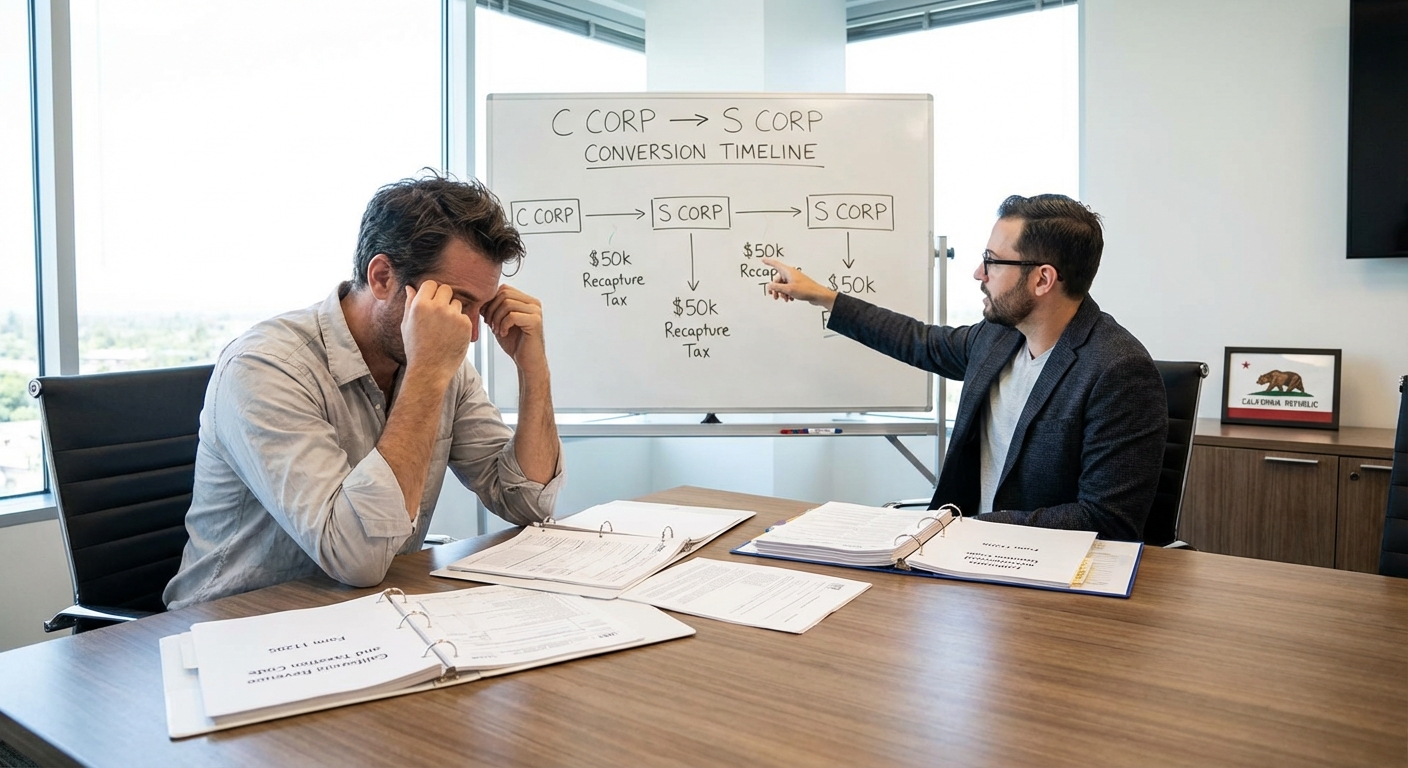
Cracking the Code on S Corp Recapture Taxes in 2026: What California Owners Miss When Converting from C Corp
There’s a lingering myth among California business owners that once you convert from a C Corp to an S Corp, the tax headaches are finally behind you. But here’s the $75,000 truth: c corp to s corp recapture taxes can gut your after-tax profits if you move at the wrong time, fail to plan, or overlook one “recapture” detail buried in the IRS rules. The clients who win don’t guess—they build direct, step-by-step strategies to keep five- and six-figure gains in their pocket, not the IRS’s.
At the center of every failed conversion we review is a misunderstanding of c corp to s corp recapture taxes. These taxes don’t show up on the election form—they surface later, when assets move, credits are used, or cash is distributed. Owners who treat the S election as a finish line instead of a transition period usually pay for it years later, with interest and penalties attached.
Quick Answer: If you convert a C Corporation to an S Corporation, you don’t fully escape the C Corp’s tax history. As of 2026, federal and California rules impose potential “recapture” taxes on prior C Corp credits, NOLs, and depreciated assets. If you distribute certain profits, dispose of major assets, or claim credits previously used as a C Corp, the IRS or FTB can trigger hefty additional tax—sometimes years later. The only way to avoid seven-figure recapture bills is to proactively calculate, account, and document every recapture-triggering asset and credit before and after the S Corp election.
This information is current as of 1/31/2026. Tax laws change frequently. Verify updates with the IRS or FTB if reading this later.
How S Corp Recapture Taxes Work: Plain English Explanation for 2026
In tax code lingo, “recapture” means the IRS takes back a benefit you previously claimed, usually by increasing your taxable income in a later year. For owners converting a C Corp to an S Corp, this typically involves credits or accelerated depreciation deductions taken before the conversion. When your S Corp later sells an asset (like appreciated equipment) or collects on a receivable, the IRS might force you to pay the tax you skipped as a C Corp.
Take, for example, a real estate holding C Corp in California that elected S Corp status in 2026. If it previously depreciated a $2 million office building on a fast schedule, and later sells that building as an S Corp, a portion of prior “untaxed” depreciation gets taxed as ordinary income. That’s recapture, and it’s taxed at higher rates than capital gains. See IRS Form 1120-S instructions and IRS Form 4562 guidance for recapture rules.
Stop the “Read My Mind” Game: Step-by-Step Triggers for Recapture Taxes
Most business owners mistakenly believe recapture only happens “if the IRS catches you.” In reality, IRS computers match your prior C Corp returns against S Corp events—flagging recapture triggers like:
- Asset sales of real estate, vehicles, or equipment depreciated by the C Corp
- Collection of installment receivables from prior C Corp operations
- Use of carryover credits (e.g., R&D credits), NOLs, or charitable contributions claimed in C Corp years
- Liquidation or major distribution of assets to shareholders
Here’s a numeric example: Say a C Corp depreciated a machine for $100,000 over three years, but only “used” $60,000 for tax savings and then elects S Corp. If the S Corp sells the machine for $85,000 the next year, $40,000 ($100K depreciation less $60K claimed) may be recaptured as ordinary income—taxed at rates up to 37% federal, plus California’s 8.84% corporate rate. For a mid-sized business, that can mean a $14,220 tax bill that shows up years after you thought you were done.
If you’re a California owner juggling multi-entity setups, this twist is especially dangerous. Many business owners wrongly rely on generic calculators or skip a recapture schedule when transitioning from C to S Corp—and get walloped during IRS or FTB audits.
KDA Case Study: Bay Area Engineering Firm Sidesteps $96,700 Recapture in C to S Corp Move
Let’s talk specifics. In 2025, a KDA client—an engineering consultancy organized as a C Corp—had $710,000 in depreciated tech, a $93,000 carryover NOL, and $31,000 in unused CA R&D credits when they considered an S Corp election for 2026. Their owner (W-2 of $205,000/year) assumed those credits would roll forward and that depreciation didn’t matter.
By running a pre-conversion recapture audit, KDA identified:
- $55,400 potential recapture on two pieces of equipment if sold post-conversion
- $23,200 of state NOLs that would partially “vanish” post-election
- $18,100 R&D credits at risk due to incomplete QRE documentation
KDA built a gameplan: the client bulk-sold expiring equipment before S Corp status, processed all remaining NOLs on their final C Corp return, and recertified R&D paperwork. The result: zero recapture triggered on the new S Corp, $96,700 in tax headaches avoided, and an ROI of 8.9x over their $10,900 KDA fee.
Ready to see how we can help you? Explore more success stories on our case studies page to discover proven strategies that have saved our clients thousands in taxes.

Don’t Ignore This IRS Trap: Built-In Gains (BIG) Tax Can Crush S Corp Profits
When a C Corp becomes an S Corp, any assets the company owns with a built-in gain (market value above tax basis) face a special 5-year “watch period.” If those assets are sold within five years, your S Corp pays federal corporate tax (21%) on the gain, known as the Built-In Gains Tax (BIG tax)—plus California’s S Corp tax. It’s a deadly trap for real estate and manufacturing companies who hold appreciating assets.
| Asset | C Corp Basis | FMV at S Election | BIG Tax on Sale |
|---|---|---|---|
| Equipment | $120,000 | $250,000 | Yes (on $130,000 gain) |
| Land | $400,000 | $900,000 | Yes (on $500,000 gain) |
| Inventory | $60,000 | $110,000 | Yes (on $50,000 gain) |
Key Takeaway: The built-in gains tax applies at the corporate (not pass-through) rate. If you casually distribute profits or assets after S election, you can trigger this tax and lose tens of thousands per asset. For strategies and details, see our complete S Corp tax guide.
Strategic year-end moves can save thousands. Our tax planning services help identify these opportunities before you convert or sell key assets.
What If You Miss a Recapture Entry or Get Audited?
IRS audits of C to S Corp conversions are up—especially in California, where the FTB runs “asset tracker” programs matching corporate returns across entity changes. If you miss a recapture entry, underreport gain, or misapply a C Corp carryover:
- The IRS can assess unpaid taxes plus penalties (20–40%) and 5% under California rules
- Add interest going back up to seven years
- Disallow subsequent S Corp losses if carryovers aren’t substantiated
- Trigger multi-year audits on all related entities
Pro Tip: There’s no formal “recapture schedule” sent by the IRS. You must build it yourself with your CPA or face the consequences during your next audit. You should reference IRS Form 3115 change in accounting method and IRS Pub 542, Taxation of Corporations as your baseline guide.
Biggest Taxpayer Mistake: Assuming State and Federal Rules Are the Same
Here’s where most business owners lose out: California’s Franchise Tax Board (FTB) doesn’t always follow federal recapture or carryover rules. Some state credits or NOLs are lost at conversion unless proactively claimed. California also imposes its own version of the BIG tax and, as of 2026, new compliance questions about out-of-state asset transfers.
Red Flag Alert: The FTB will trigger “recapture” on real estate, equipment, or inventory transferred out of California post-conversion, even if no cash changes hands. Owners who “move” assets to Nevada or Texas believing they’ve escaped FTB recapture regularly face surprise audit notices two to five years after conversion.
If your numbers look tricky, run your scenario through this small business tax calculator to spot immediate risks, but schedule a professional analysis for California specificity.
How to Actually Document and Defend Your S Corp Conversion (2026 Edition)
Every successful C to S Corp conversion uses a layered defense:
- Pre-conversion asset review – Catalog every depreciated or appreciated asset, NOL, and credit. Use last 3 years of returns if possible.
- Big gain timing – Sell, reclassify, or fully depreciate high-gain assets BEFORE S corp election. Run “what-if” tax scenarios based on likely sale date and recapture math.
- Carryover audit – List all C Corp carryover items; confirm which credits, NOLs, and deductions survive. Coordinate timing with both IRS and FTB rules.
- Document the conversion – Keep IRS Form 2553 election, asset schedules, prior year returns, and written CPA memos in a single file for future audit defense.
- Annual review post-conversion – Recalculate recapture exposure each year and update documentation as assets are sold/distributed. Don’t trust bookkeepers to catch these moves without a tax strategist.
Pro Tip: Always keep digital as well as physical backups of your conversion documents and ensure all reporting ties precisely to both federal and California requirements.
Will Recapture Taxes Trigger an Audit—and What Happens If You Get It Wrong?
IRS data (and KDA’s experience) show that almost 45% of IRS S Corp audits in 2025-2026 cite conversion errors, mishandled NOLs, or missed recapture events as red flags. In California, audit notices typically arrive 2–4 years after the triggering asset sale. If you get it wrong, expect to pay not just the unpaid recapture tax, but substantial penalties, interest, and loss of S Corp benefits on future returns—sometimes leading to S Corp termination.
FAQ: Your Next Questions Answered
How do I calculate recapture if my C Corp used bonus depreciation?
Bonus depreciation accelerates tax write-offs but increases recapture risk. The IRS requires you to identify the portion of any asset’s total allowable depreciation that was previously claimed and triggers ordinary income recapture upon sale—as noted in IRS Form 4562 instructions.
Can I stagger my asset sales to avoid high recapture taxes?
Yes, by spreading out sales over multiple years, you may limit how much recapture hits your S Corp in any one year, but you must comply with the five-year BIG tax window. Planning the timing with your CPA is crucial.
What records should I save after converting?
Retain all prior C Corp tax returns, depreciation schedules, carryforward documentation, and the S Corp election package for at least seven years post-conversion.
Can I use a carryover loss from the C Corp years in my S Corp return?
It depends. Some C Corp carryover NOLs are lost at the point of S Corp conversion unless claimed on the final C Corp return. Federal and California rules differ—consult About Form 1120 and confirm with your strategist.
The IRS Isn’t Hiding This—You Just Weren’t Taught to Track It
Business owners, particularly in California, routinely hemorrhage tens of thousands to recapture taxes simply because nobody explained how these rules really work outside a C Corp. If your books are complicated, your entity span is wide, or your growth is quick, take this year’s conversion as the turning point: build a forward-facing S Corp plan that survives audits and protects your post-conversion profits.
Book Your Conversion Confidence Session
Converting from C Corp to S Corp without a recapture audit defense plan can cost you $10K–$150K in taxes, penalties, and lost credits. Book a personalized assessment with our S Corp conversion experts and discover how to shield your assets—and profits—from IRS and FTB traps. Click here to book your strategy session now.


