
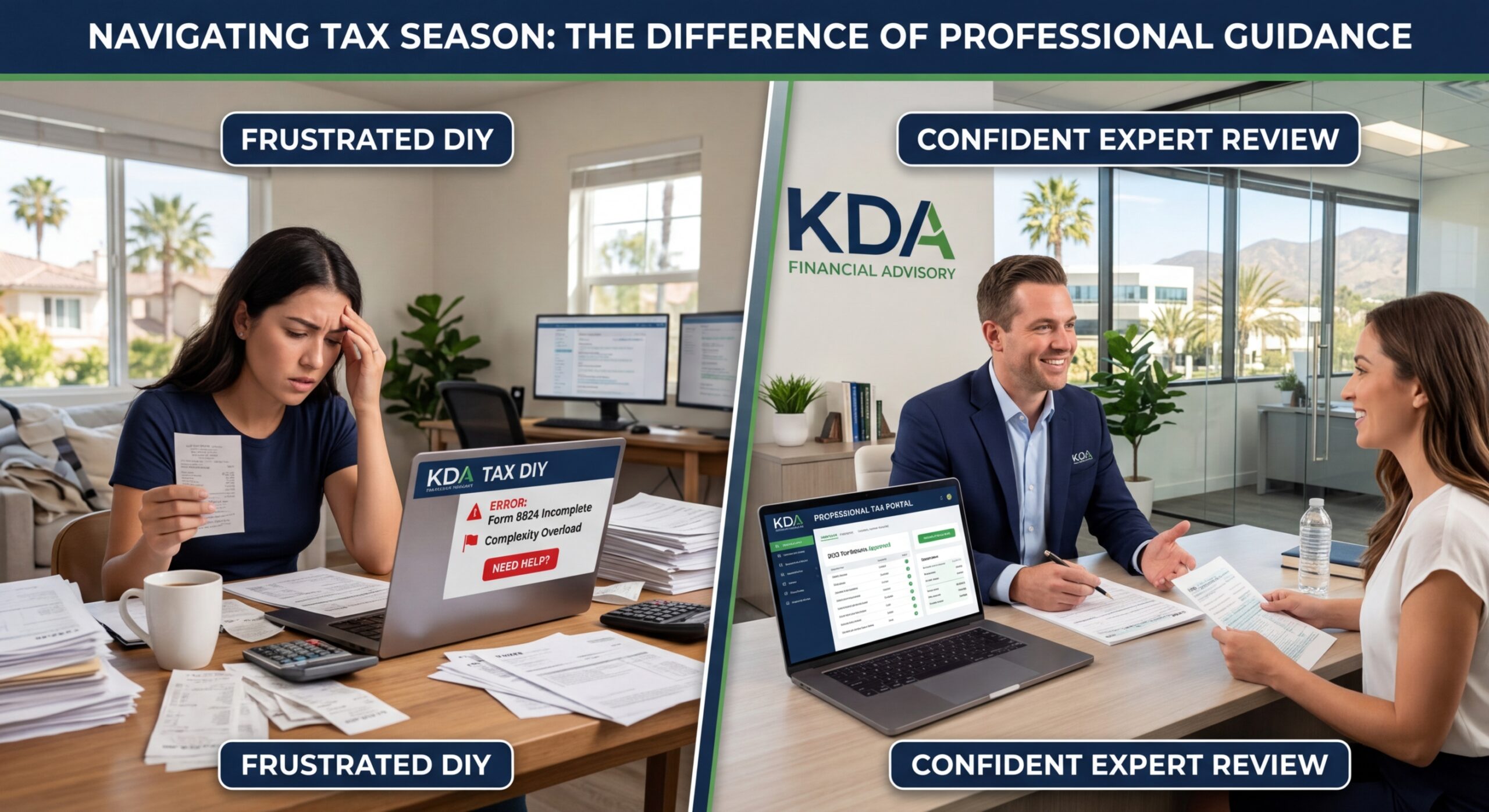
The Question Every Orange County Taxpayer Asks Every Year
It shows up in every February. Should you buy TurboTax, go to H&R Block, hire a CPA, or work with a local tax firm? Every year, Orange County taxpayers make this decision without a clear framework for what actually matters, and it costs some of them thousands of dollars in missed strategies or expensive mistakes.
This is not a generic comparison. This is a breakdown built specifically for the Orange County taxpayer in 2026, written for people with real complexity in their financial lives: W-2 earners with side income, small business owners, rental property investors, and high earners navigating California’s top-tier tax rates. If your return is simple, any option works fine. If your return has moving parts, the choice matters enormously.
This information is current as of 3/27/2026. Tax laws and software capabilities change. Verify current options before making your selection this tax season.
Quick Answer
For most Orange County taxpayers with W-2-only income and no major life changes, DIY tax software is sufficient and cost-effective. For anyone with self-employment income, rental property, an S Corp, equity compensation, or significant life events in the past year, a qualified local tax professional will almost always save more than they cost. The break-even point is lower than most people think.
Option 1: DIY Tax Software (TurboTax, H&R Block, FreeTaxUSA, Cash App Taxes)
Tax software has improved significantly over the past decade. The major platforms now handle most common tax situations with reasonable accuracy when used correctly. But “reasonable accuracy” is not the same as “optimal outcome,” and that distinction is where Orange County taxpayers lose real money.
What Tax Software Does Well
DIY software excels at straightforward situations. If you have one or two W-2 forms, standard deductions or simple itemized deductions like mortgage interest and property taxes, and no business income, software will produce an accurate return at a fraction of what a professional charges. TurboTax Free Edition and similar products from competing platforms handle basic returns at zero cost.
Software also forces you to answer questions you might otherwise forget, which helps capture common deductions like student loan interest, educator expenses, and the Child Tax Credit. For the uncomplicated Orange County taxpayer, this guided process works.
Where Tax Software Falls Short for Orange County Filers
Software follows the answers you give it. It does not ask about strategies you have never heard of. It will not suggest a backdoor Roth IRA conversion, a Section 199A deduction optimization, a cost segregation study on your rental property, or an S Corp election that could save you $12,000 per year in self-employment taxes. It cannot tell you that your entity structure is wrong.
California-specific issues compound this problem. Software handles the California return mechanically, but it does not flag FTB compliance risks, missed California credits, or the interaction between federal and state depreciation differences. Orange County taxpayers with even moderate complexity routinely leave $3,000 to $15,000 on the table using software alone.
Software also does not represent you in an audit. If you receive an IRS notice or an FTB inquiry, you handle it yourself or hire someone at that point, which costs more than getting professional help from the start.
Cost of Tax Software in 2026
Basic software: Free to $50 for simple federal returns. With state: $40 to $70 additional. Self-employed or business editions: $130 to $220. Add-on audit protection packages: $40 to $60 per year. Total realistic cost for a moderately complex Orange County return: $150 to $300.
KDA Case Study: Orange County Software User Discovers 3 Years of Missed Deductions
Diana was a graphic designer in Fountain Valley who had been using TurboTax Self-Employed for three years. She thought she was getting everything because she answered every question the software asked. Her annual tax bill was running around $14,200 on roughly $98,000 in gross 1099 income.
When Diana came to KDA, the first review revealed that she had never been advised to contribute to a SEP-IRA, which would have allowed her to deduct up to 25% of net self-employment income, approximately $22,000 per year. She had also never separated her design studio workspace, which qualified as a home office, and she was not deducting her professional subscriptions, software licenses, or industry conference travel as fully as she should have been. Her vehicle, used for client meetings, had never been tracked.
KDA rebuilt her return structure, established a SEP-IRA contribution of $19,500 for the current year, properly documented her home office at 180 square feet of a 1,400 square foot home, and captured the full mileage and software deductions. Her tax bill dropped from $14,200 to $8,900. That is a $5,300 annual reduction on a situation that looked completely ordinary from the outside. Her fee with KDA was $1,400. First-year net savings: $3,900.
Ready to see how we can help you? Explore more success stories on our case studies page to discover proven strategies that have saved our clients thousands in taxes.
Option 2: National Franchise Tax Preparers (H&R Block, Jackson Hewitt, Liberty Tax)
National franchise preparers occupy a middle ground: more human interaction than software but not the strategic depth of an independent professional. For Orange County taxpayers, this option has specific strengths and limitations worth understanding.
What National Franchise Preparers Do Well
Franchise preparers are accessible, often have extended hours during tax season, and are generally well-trained on standard returns. They handle W-2 income, basic itemized deductions, education credits, and straightforward Schedule C situations competently. Many locations offer audit assistance programs, though these vary significantly in what they actually cover.
Franchise preparers are also reliable on compliance. They know the deadlines, the forms, and the mechanical requirements of filing. For a first-time filer or someone transitioning from DIY software who wants a human to review their return, a franchise preparer is a reasonable step up.
Where Franchise Preparers Fall Short
The franchise model is built around volume and speed. A preparer handling 300 to 400 returns in a season does not have the bandwidth to develop deep expertise in any single client’s financial situation. They are unlikely to identify entity restructuring opportunities, proactively suggest retirement contribution strategies, or guide you through a cost segregation analysis on your Orange County rental property.
Staff turnover at franchise locations is high. The person who prepared your return last year may not be there this year, which means continuity of strategy is inconsistent. Franchise preparers are also not typically equipped to handle business returns, S Corp filings, or multi-state returns with California-specific nuances, the types of complexity that are common among Orange County’s business-owning and investment-active taxpayer population.
Cost of Franchise Preparers in 2026
Simple federal and state return: $150 to $300. Itemized deduction returns: $250 to $450. Self-employed with Schedule C: $350 to $600. Business returns (1120S, 1065): Some locations do not offer this. Total realistic cost: $200 to $600 for most Orange County taxpayers.
Option 3: Local CPA (Certified Public Accountant)
A CPA is a licensed professional with 150 credit hours of education, a four-part examination, and continuing education requirements. CPAs can represent clients before the IRS, sign audit reports, and provide a full range of financial and tax services. In California, CPAs are licensed through the California Board of Accountancy.
What a CPA Brings to an Orange County Tax Return
A CPA brings professional accountability and a broader base of technical knowledge than either software or a franchise preparer. They can handle complex returns, represent you in an audit, advise on entity structuring, and provide proactive planning rather than reactive filing.
For Orange County business owners and investors, a CPA with real estate or small business specialization is significantly more valuable than a generalist. The credential alone does not guarantee specialty knowledge, but it does guarantee a minimum standard of technical competence and professional ethics oversight that the other options do not.
CPA Limitations
Not all CPAs specialize in individual or small business taxes. Many CPAs in Orange County work primarily in audit, corporate accounting, or financial statement preparation. A CPA who spends 80% of their time on corporate audits may be less current on individual tax strategies than a non-CPA who specializes exclusively in personal and small business returns.
CPA fees can also be higher than necessary for returns that do not require the full breadth of CPA services. If your primary need is tax planning and filing rather than financial statement audits or SEC compliance work, a specialized tax professional firm may offer equivalent or better tax expertise at a more competitive fee.
Cost of a CPA in 2026
Individual returns: $300 to $800 depending on complexity. Business returns (S Corp, partnership): $800 to $2,500. Combined individual and business returns: $1,200 to $4,000. Orange County CPAs in specialized practices may charge toward the higher end.
Option 4: Specialized Tax Professional Firm (KDA-Style)
A specialized tax professional firm focuses exclusively on tax strategy, planning, and compliance, without the diversification into audit, bookkeeping cleanup, or generalist accounting services. This model allows for deeper expertise in specific taxpayer types and proactive strategy development rather than annual compliance-only service.
What a Specialized Tax Firm Offers That Others Cannot
The primary differentiator is proactive strategy, not just accurate filing. A specialized firm is asking, before you even submit your documents: What entity structure are you using and is it optimal? Are you maximizing retirement contributions? Do you own real estate that could benefit from a cost segregation study? What is your plan for the next five years?
This forward-looking orientation is where Orange County taxpayers with genuine complexity, particularly those earning $150,000 or more, owning businesses, holding rental property, or receiving equity compensation, capture returns that are 5x to 20x their fee. The strategies are not theoretical. They are specific, implementable, and tracked from year to year.
Our tax planning services are built around exactly this model: building a multi-year strategy, not just filing last year’s numbers accurately.
Representation and Audit Defense
A specialized tax firm handles IRS and FTB correspondence directly. When you receive a CP2000 notice, an audit appointment letter, or a California FTB inquiry, your tax professional responds on your behalf, often resolving issues you would have no idea how to navigate alone. This coverage alone can be worth thousands in a single audit year. See our audit representation services for more detail.
Cost of a Specialized Tax Firm in 2026
Individual returns with moderate complexity: $500 to $1,200. Business owner combined returns: $1,500 to $3,500. Full-service annual advisory packages: $2,500 to $8,000+. The fee range is wider because the service scope varies significantly based on portfolio complexity.
Head-to-Head Comparison: Which Option Is Right for You?
| Factor | DIY Software | Franchise Preparer | CPA (Generalist) | Specialized Tax Firm |
|---|---|---|---|---|
| Cost (typical OC filer) | $0 – $300 | $200 – $600 | $500 – $2,500 | $800 – $4,000+ |
| Strategic tax planning | None | Minimal | Moderate | Comprehensive |
| California expertise | Mechanical only | Basic | Varies | High |
| Business / S Corp returns | Limited | Rarely | Yes | Yes |
| Real estate strategies | None | None | Varies | Specialty strength |
| Audit representation | No (add-on) | Limited add-on | Yes | Yes |
| Year-round accessibility | Software only | Seasonal | Year-round | Year-round |
| Ideal for | Simple W-2 returns | Standard filers | Complex filers | Business owners, investors |
Who Should Use What: Decision Framework for Orange County Taxpayers
Use DIY Tax Software If:
- Your only income is W-2 wages from one or two employers
- You take the standard deduction or have simple itemized deductions
- You have no business income, rental properties, or equity compensation
- Your AGI is under $60,000 with no significant life changes
- You are comfortable with technology and willing to verify your own accuracy
Use a Franchise Preparer If:
- You want human review but have a straightforward return
- You are uncomfortable with software but do not have complex financial situations
- You had a simple life change like getting married or having a child
- You want affordable audit protection and basic filing support
Use a CPA If:
- You need financial statement services alongside tax preparation
- Your business is growing and approaching the complexity of multi-state filings
- You need the formal CPA credential for lending, licensing, or professional compliance reasons
- You have complex investment accounts requiring Form 8949 and related forms
Use a Specialized Tax Firm If:
- You own a business, LLC, S Corp, or partnership with $100,000+ in annual revenue
- You own Orange County rental property and have not had a tax strategy review
- Your income exceeded $150,000 in the past year and you are not actively planning
- You received equity compensation, RSUs, or stock options from your employer
- You had a major financial event: property sale, business sale, inheritance, or divorce
- You want to build a tax strategy, not just file last year’s numbers
The Real Cost of Getting This Wrong in Orange County
The difference between using the wrong option and the right one is not a matter of a few hundred dollars. For an Orange County taxpayer earning $200,000 with self-employment income, rental properties, and no active tax strategy, the annual overpayment can easily run $8,000 to $20,000.
Here is a concrete example. A consultant in Costa Mesa earning $185,000 in 1099 income uses TurboTax Self-Employed every year. He deducts his home office, vehicle, and software. His annual tax bill runs $52,000 between federal and California. A specialized tax firm review reveals he has never elected S Corp status, which at his income level would reduce self-employment taxes by approximately $11,200 per year. He also has not been maximizing his solo 401(k), which would allow him to contribute up to $70,000 in 2026, reducing his taxable income by $70,000 and saving another $16,000 in combined taxes. Total annual savings from professional guidance: $27,200. Annual fee for the specialized firm: $2,800. First-year net: $24,400 ahead.
Want to estimate your own potential savings before making a decision? Run your numbers through this self-employment tax calculator to get a baseline for what you’re currently paying on your 1099 income.
California-Specific Factors That Change the Calculus
Orange County taxpayers face tax complexity that most other states simply do not have. California’s top individual income tax rate of 13.3% applies to income over $1 million, but the 9.3% rate kicks in at just $68,350 for single filers. For most successful Orange County professionals and business owners, California taxes are a significant line item that requires active management, not just accurate reporting.
California also does not conform to federal bonus depreciation, does not allow S Corp basis adjustments in all the same ways as the federal treatment, and has its own set of form requirements (Form 568, Schedule K-1 variations, Form 3885, FTB 3526) that are easy to miss for preparers who are not California-specific specialists. DIY software handles these mechanically, but it cannot tell you whether your strategy is optimized for the California environment.
Ready to Reduce Your Tax Bill?
KDA Inc. specializes in strategic tax planning for business owners, S Corps, LLCs, and high-net-worth individuals. Book a personalized consultation and walk away with a clear plan.
Frequently Asked Questions: Tax Help Options for Orange County
Is TurboTax audit protection worth it?
TurboTax’s MAX service provides audit representation from a tax professional if you are audited. It costs $40 to $60 per year. For most simple returns, it provides peace of mind at a reasonable price. For complex returns, the representation included in professional preparation fees is more comprehensive and begins before you ever file, which is where audit risk is actually managed.
Can I switch from software to a professional firm mid-year?
Yes, and many Orange County taxpayers do this after a major life change. A professional firm can review prior years if needed, correct ongoing strategies, and take over all filings going forward. The earlier in the year you make the switch, the more planning opportunities are available.
Do I need a CPA specifically, or is an Enrolled Agent (EA) acceptable?
An Enrolled Agent is a federally licensed tax professional who specializes exclusively in taxation. EAs can represent clients before the IRS at the same level as CPAs. For tax-only services, an EA’s qualifications are equivalent to a CPA’s in tax matters. For broader accounting, financial statement, or audit services, a CPA’s credential is specifically required.
What questions should I ask before hiring a tax professional in Orange County?
Ask about their experience with your specific situation (small business, real estate, equity comp, etc.), how many clients they actively manage, whether they offer year-round planning or only annual filing, how they handle audits, and what their fee structure looks like. A professional who struggles to answer these questions clearly is giving you useful information about whether they are the right fit.
Is there a free option for Orange County taxpayers?
Yes. The IRS Free File program allows taxpayers with AGI below $84,000 to file federal returns at no cost through approved software partners. Additionally, the IRS Volunteer Income Tax Assistance (VITA) program provides free in-person help for filers earning $67,000 or less. These are solid options for straightforward returns at lower income levels. See the IRS Free File page for current eligibility details.
Making the Right Call for Your 2026 Orange County Tax Return
The right choice is not the cheapest option or the most expensive one. It is the option that is appropriately matched to your actual financial complexity and the value of getting it right. For the majority of Orange County taxpayers who have moved beyond simple W-2 filing, that match points toward a professional with real expertise in your specific situation.
Tax software is a remarkable tool for the right use case. It is not, however, a substitute for strategic guidance when your financial life has real complexity. The cost of the wrong choice is not measured in preparation fees. It is measured in the strategies you never knew about and the taxes you paid that you did not have to.
Get the Right Tax Help for Your Orange County Situation
If your tax situation has grown beyond what software can handle effectively, or if you suspect you are overpaying but do not know exactly where, the answer is a conversation with a professional who specializes in exactly your type of complexity. Our team works with Orange County taxpayers across every profile: W-2 employees with side income, 1099 consultants, small business owners, real estate investors, and high-income earners navigating California’s top rates. Click here to book your consultation now and find out exactly what you have been leaving on the table.


