
Quick Answer
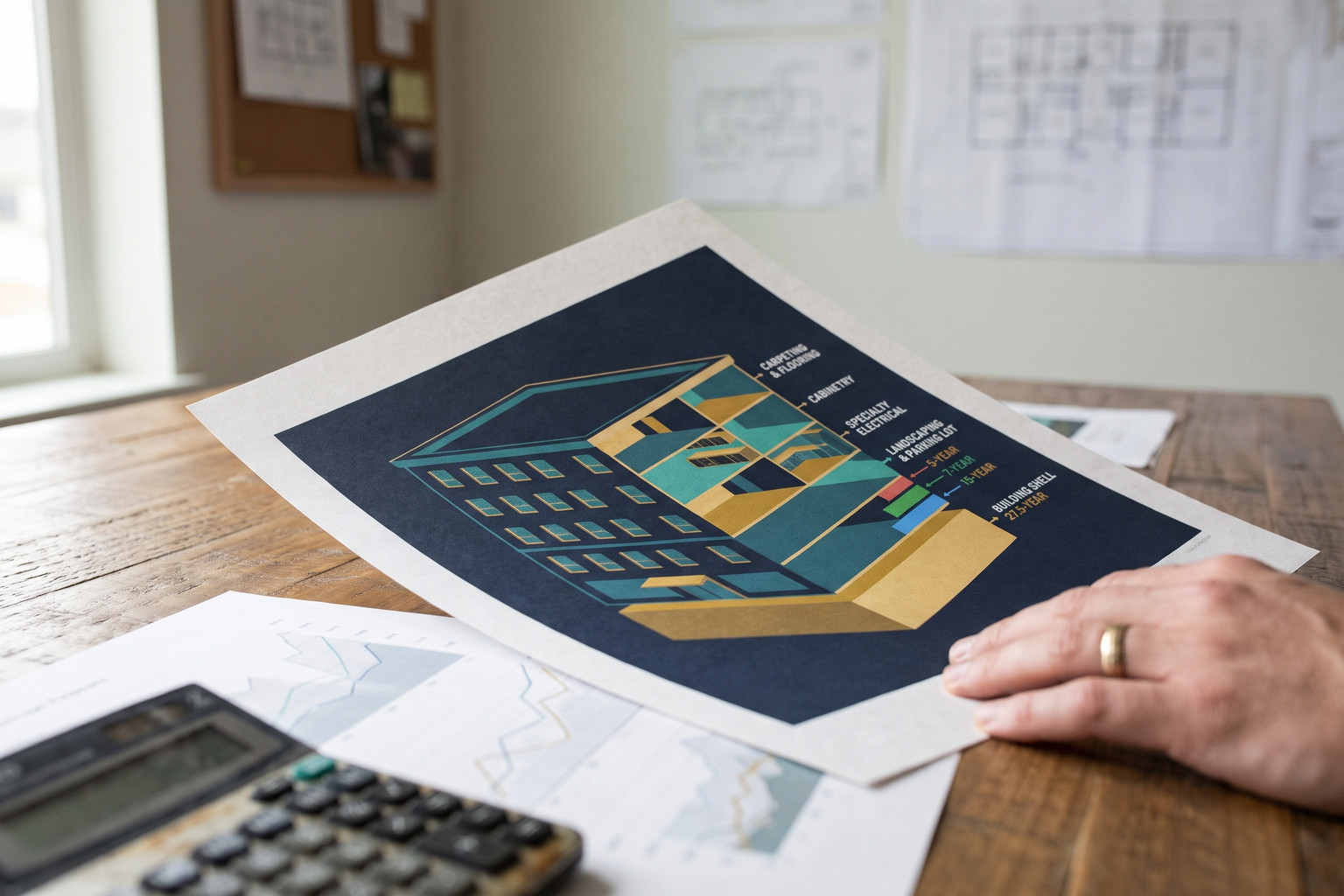
A cost segregation study reclassifies parts of a building from 27.5-year or 39-year depreciation into 5-year, 7-year, and 15-year property. On a $1.2 million rental property with roughly $960,000 of depreciable basis, a typical study moves 20 to 30 percent of that basis into short-life categories, which can produce $190,000 to $280,000 of accelerated deductions in the first year once bonus depreciation is applied. The study itself usually costs $4,000 to $15,000 depending on property type and size. It pays off when you have enough passive income or real estate professional status to actually use the deductions, and it backfires when you sell in two years and hand most of it back through depreciation recapture.
This information is current as of 11/27/2026. Tax laws change frequently. Verify updates with the IRS or FTB if reading this later.
What Cost Segregation Actually Does to Your Depreciation Schedule
Most property owners think of a building as one thing. The IRS does not. A building is a bundle of assets with different legal lives, and the default treatment lumps nearly all of them into the slowest possible bucket.
When you buy a residential rental, your accountant typically allocates the purchase price between land and building, then depreciates the building over 27.5 years straight line. Commercial property gets 39 years. That is the lazy path, and it is technically correct. It is also leaving money sitting on the table for years or decades.
Here is the thing the default method ignores: that building contains carpet, cabinetry, specialty electrical, dedicated plumbing for appliances, decorative lighting, removable flooring, and millwork. It sits on a lot with paving, landscaping, fencing, site lighting, and drainage. Under existing tax law, those items are not 27.5-year property. They are 5-year personal property or 15-year land improvements.
A cost segregation study is an engineering-based analysis that identifies those components, assigns them a defensible cost, and reclassifies them into their correct recovery periods. The IRS has published an entire Cost Segregation Audit Techniques Guide explaining exactly how it expects these studies to be performed and what it looks for during examination. The agency is not hostile to the practice. It is hostile to sloppy versions of it.
The Four Buckets Your Property Gets Split Into
| Asset Class | Recovery Period | Typical Items | Share of Basis |
|---|---|---|---|
| Personal property | 5 years | Carpet, appliances, cabinetry, decorative lighting, window treatments | 8% to 18% |
| Land improvements | 15 years | Paving, curbs, fencing, landscaping, site utilities, exterior lighting | 5% to 15% |
| Building structure | 27.5 or 39 years | Foundation, framing, roof, HVAC core, structural plumbing | 65% to 85% |
| Land | Not depreciable | Raw dirt value | Varies by market |
Key Takeaway: The goal is not to create new deductions. It is to pull deductions you were already entitled to from year 20 into year one, where a dollar is worth considerably more.
The Real Math: What a Cost Segregation Study Produces on a $1.2 Million Property
Abstract percentages do not help anyone make a decision. Let me run actual numbers.
Assume you bought a 12-unit apartment building in 2026 for $1,200,000. Your allocation puts $240,000 on land, leaving $960,000 of depreciable basis.
Without a study: $960,000 divided by 27.5 years equals $34,909 of annual depreciation. In year one, with mid-month convention applied for a mid-year purchase, you get roughly $18,200.
With a study that reclassifies 14 percent to 5-year property and 11 percent to 15-year property:
- 5-year property: $134,400
- 15-year property: $105,600
- 27.5-year structure: $720,000
Apply bonus depreciation to the 5-year and 15-year buckets, and you immediately expense $240,000 instead of spreading it across decades. Add the first-year structural depreciation of roughly $13,600 and your year-one deduction lands near $253,600 instead of $18,200.
That is a swing of $235,400 in deductions. At a combined federal and California marginal rate of 45 percent, that is roughly $105,930 of tax deferred into later years. The study might have cost you $9,500.
What That Deferral Is Actually Worth
Deferral is not forgiveness. You will give back most of that depreciation later through smaller deductions or through recapture on sale. What you gain is time value and optionality.
If you reinvest $105,930 of freed-up cash at an 8 percent return for ten years, it becomes roughly $228,700. You still owe the deferred tax eventually, but you captured the spread. That is the entire economic case, and anyone selling you a study on the promise of permanent savings is overselling it.
If you want to pressure-test how accelerated deductions change your overall federal position before committing, run your projected numbers through a federal tax calculator at both the default and accelerated depreciation figures. The gap is usually larger than owners expect.
KDA Case Study: Real Estate Investor With $340,000 of Trapped Passive Losses
A client came to us in early 2026 owning four properties across Riverside and San Bernardino counties, with a combined basis of $3.1 million. She had been filing her own returns using default straight-line depreciation on everything. Her W-2 income from a hospital administration role was $215,000, and her husband was retired.
The problem was not that she lacked deductions. It was that she had no mechanism to use them. Her rental portfolio generated $41,000 of net taxable income annually, and her depreciation was so slow that she was paying tax on rental profit while her properties were objectively cash-flow machines.
We did two things. First, her husband qualified as a real estate professional under the material participation tests, documented through a contemporaneous time log showing 834 hours of property management and rehab oversight. That unlocked the ability to treat rental losses as nonpassive. Second, we commissioned engineering-based studies on three of the four properties, skipping the fourth because its basis was too small to justify the fee.
The studies reclassified $611,000 into 5-year and 15-year categories. Combined with a Form 3115 change in accounting method to capture missed depreciation from prior years without amending returns, the first-year deduction came to $694,000.
Her federal and California tax reduction in year one measured $172,400. Our fee for the strategy work, the real estate professional documentation framework, the Form 3115 filing, and coordination with the engineering firm was $21,800, with the three studies costing an additional $27,500. Total investment of $49,300 against $172,400 of first-year savings is a 3.5x return, before counting the years of reduced tax that follow.
Ready to see how we can help you? Explore more success stories on our case studies page to discover proven strategies that have saved our clients thousands in taxes.
Do You Actually Qualify for the Benefit? The Three Gates
This is where most online content goes quiet, because the honest answer is that a large share of property owners who pay for a study cannot use the result in the year they buy it.
Gate One: Passive Activity Loss Rules
Rental real estate is passive by default under Section 469. Passive losses can only offset passive income. If you are a W-2 earner with $180,000 of wages and one rental, a $90,000 accelerated loss does not reduce your wage tax. It suspends and carries forward until you have passive income or you sell the property in a fully taxable disposition.
The study still has value in that case, but the value is delayed, and the fee is paid today. That changes the math considerably.
Gate Two: The $25,000 Active Participation Allowance
If you actively participate in the rental and your modified adjusted gross income is under $100,000, you can deduct up to $25,000 of rental losses against ordinary income. That allowance phases out completely at $150,000 of MAGI. Most people considering a study on a seven-figure property are well past the phaseout.
Gate Three: Real Estate Professional Status
This is the gate that makes cost segregation genuinely powerful. Under Section 469(c)(7), if you spend more than 750 hours and more than half of your total working time in real property trades or businesses in which you materially participate, your rentals stop being passive. Review the material participation standards in IRS Publication 925 before you assume you qualify.
You likely qualify if:
- You or your spouse works full time in real estate, construction, brokerage, or property management
- You maintain contemporaneous time records, not reconstructed estimates
- You have filed a grouping election to treat all rentals as a single activity
You likely do not qualify if:
- You hold a full-time W-2 job outside real estate
- Your properties are managed by a third-party company and you review statements quarterly
- Your time log was created after the IRS asked for it
There is a fourth path worth mentioning: short-term rentals with an average guest stay of seven days or less are not treated as rental activities under the Section 469 regulations at all. That means material participation alone, without the 750-hour real estate professional test, can make losses nonpassive. We cover the mechanics in detail in our breakdown of the short-term rental qualification standard most owners fail.
The Recapture Problem Nobody Mentions Until You Sell
Here is the part that gets glossed over in most cost segregation pitches, and it is the single most common reason a study turns into a bad decision.
When you sell, depreciation comes back. But it does not all come back the same way.
| Asset Type | Recapture Treatment | Maximum Federal Rate |
|---|---|---|
| 5-year and 7-year personal property | Section 1245 ordinary income | Up to 37% |
| 15-year land improvements | Section 1245 ordinary income | Up to 37% |
| Building structure | Section 1250 unrecaptured gain | 25% |
| Appreciation above basis | Long-term capital gain | 20% plus 3.8% NIIT |
Read that table carefully. Depreciation you accelerated into 5-year and 15-year buckets recaptures as ordinary income, not at the friendlier 25 percent unrecaptured Section 1250 rate. If you are in the 37 percent federal bracket plus 13.3 percent California, you could be handing back accelerated deductions at nearly 50 percent that you claimed at 45 percent.
When Recapture Makes the Study a Losing Trade
Run this test before you commission anything:
- Estimate your hold period. Under three years, the time value rarely covers the fee plus the recapture rate differential.
- Compare your deduction-year rate to your projected sale-year rate. If you expect to be in a higher bracket when you sell, perhaps because of a large gain or a business exit, you are converting cheap deductions into expensive income.
- Check your 1031 intent. A properly executed like-kind exchange defers recapture entirely. If exchanging is your plan, recapture concern largely evaporates. Our walkthrough of 1031 exchange deadline math covers the 45-day and 180-day windows that kill most attempted exchanges.
- Model the estate planning angle. If the property passes at death, the step-up in basis under Section 1014 eliminates the recapture liability entirely. Hold until death and accelerate aggressively is a legitimate, if morbid, strategy.
Bottom Line: Cost segregation is a bet on your hold period and your future tax rate. Make that bet consciously.
Catching Up on Missed Depreciation Without Amending Returns
A question we get constantly: I bought this building in 2019 and never did a study. Is it too late?
No. And this is one of the most underused provisions in the entire code.
Under Revenue Procedure 2015-13 and the automatic method change procedures, you can file Form 3115, Application for Change in Accounting Method, and claim a Section 481(a) adjustment that captures every dollar of depreciation you should have taken in prior years. You take the entire catch-up in the current year. No amended returns, no three-year statute limitation on the lookback.
Step-by-Step: Executing a Look-Back Study
- Confirm the property was placed in service in a prior tax year. You cannot use Form 3115 for the year of acquisition; a study on a current-year purchase is simply a different depreciation election on the original return.
- Commission the engineering study with a look-back scope. The firm will calculate what depreciation should have been from the in-service date forward. Expect three to six weeks.
- Calculate the Section 481(a) adjustment. This is the cumulative difference between depreciation taken and depreciation allowable. A negative adjustment, meaning you under-depreciated, is taken entirely in the current year.
- File Form 3115 with your timely filed return and mail a duplicate copy to the IRS national office per the form instructions. Missing the duplicate copy is the most common procedural failure.
- Attach the study summary and asset detail to support the reclassification if examined.
A client who bought a $2.4 million medical office building in 2021 and filed straight-line through 2025 captured a $418,000 Section 481(a) adjustment in a single year. That is five years of missed acceleration delivered in one return.
California-Specific Considerations That Change the Numbers
If your property sits in California, the federal math is only half the story.
California does not conform to federal bonus depreciation. At all. The state allows Section 179 expensing only up to $25,000 with a $200,000 investment phaseout, far below the federal limits. This means your reclassified 5-year and 15-year property depreciates under MACRS for California purposes rather than being expensed immediately.
The practical effect: your California return will show significantly less depreciation than your federal return in year one, and significantly more in years two through fifteen. You will carry a permanent federal-to-state depreciation difference on Schedule CA that your preparer must track across the entire life of the asset. Sloppy tracking here produces errors that compound for a decade.
Does that kill the strategy in California? No. The federal benefit alone usually justifies the study, and the California timing difference is a deferral, not a loss. But if someone quotes you a tax savings number without separating federal from state, they are quoting you a number that does not exist.
Two other California items worth flagging for entity-held property:
- The $800 minimum franchise tax applies to every LLC holding property, regardless of whether the property generated income or a massive paper loss.
- The LLC gross receipts fee is calculated on total California receipts, not net profit. An LLC collecting $600,000 in rent that shows a $200,000 depreciation loss still owes the fee tier associated with $600,000.
For owners holding multiple properties across entities, the interaction between accelerated depreciation, entity-level fees, and the pass-through entity elective tax deserves its own planning session. Our overview of the four-layer California business tax stack explains how these pieces interact.
What a Defensible Study Actually Looks Like
The IRS does not require a specific methodology, but its audit guide makes clear which approaches hold up and which get unwound.
The Methodology Hierarchy
| Method | Reliability | Typical Cost | Best For |
|---|---|---|---|
| Detailed engineering from actual cost records | Highest | $10,000 to $25,000 | New construction with contractor invoices |
| Detailed engineering cost estimate | High | $6,000 to $15,000 | Acquired property without cost detail |
| Survey or letter method | Moderate | $3,000 to $7,000 | Smaller properties, limited components |
| Rule of thumb percentages | Not defensible | Under $1,500 | Nothing. Avoid. |
If a provider offers you a study for $900 based on a questionnaire and a satellite photo, understand what you are buying. You are buying a number with no engineering support, and in an examination you will have no documentation to defend the allocation.
What Your Study Report Must Contain
- A site visit record or detailed photographic documentation
- Line-item asset listing with quantities, unit costs, and total allocated cost
- Citation to the legal authority supporting each classification
- Reconciliation tying the total allocated cost back to your purchase price or construction cost
- Preparer credentials, meaning actual engineering or construction cost estimating background
Pro Tip: Ask the provider directly whether they will support the study under examination at no additional cost. The answer separates serious firms from report generators.
Common Mistakes That Turn a Good Strategy Into an Audit Problem
We have reviewed studies prepared by other firms for incoming clients. The failure patterns repeat.
Mistake one: reclassifying structural components. The central HVAC system serving the whole building is structural. A dedicated cooling unit for a server room is not. Studies that aggressively pull core building systems into 5-year property are the ones that get adjusted.
Mistake two: ignoring the land allocation. If your land allocation is too low, every downstream number is inflated. The IRS checks this first because it is easy to check against county assessor records.
Mistake three: no partial asset disposition election. When you replace a roof or renovate units, you can write off the remaining basis of what you removed. A study that identifies components but never gets paired with disposition elections leaves deductions stranded.
Mistake four: doing the study without checking usability. Covered above, but it bears repeating. Paying $12,000 to generate a suspended loss that sits unused for six years is a bad trade.
Mistake five: forgetting the net investment income tax interaction. Accelerated depreciation reduces net investment income, which can drop you below the 3.8 percent NIIT threshold. That is an additional benefit most projections omit entirely.
Ready to Reduce Your Tax Bill?
KDA Inc. specializes in strategic tax planning for business owners, S Corps, LLCs, and high-net-worth individuals. Book a personalized consultation and walk away with a clear plan.
Frequently Asked Questions About Cost Segregation
What size property justifies a study?
As a working threshold, $500,000 of depreciable basis. Below that, the fee consumes too much of the benefit. Above $1 million, the math almost always works if you can use the deductions.
Can I do a study on a property I inherited?
Yes. Inherited property takes a stepped-up basis at the date of death fair market value, and that fresh basis can be segregated like any purchase. This is frequently overlooked.
Does a study increase my audit risk?
A properly documented engineering-based study does not meaningfully raise audit risk. An aggressive study with unsupported allocations does. The risk is in the quality, not the practice.
What about properties held in an S Corp?
Rental real estate generally does not belong in an S Corp. Distributing appreciated property out of a corporation triggers gain as though you sold it at fair market value. Hold rentals in an LLC taxed as a partnership or as a disregarded entity.
Can I combine cost segregation with a 1031 exchange?
Yes, and it is a sophisticated pairing. The replacement property can be segregated while the deferred recapture from the relinquished property stays deferred. The carryover basis rules make the calculation more complex, so coordinate the study with the exchange from the start.
How long does a study take?
Three to eight weeks for most properties. Start before your filing deadline, not after. Extensions are available, but rushed studies are poor studies.
Do I need a new study if I make improvements?
Not a full new study, but improvements should be classified as they are placed in service. Ongoing component tracking is cheaper than a second full engagement later.
Your Decision Framework
Commission a study if:
- Depreciable basis exceeds $500,000
- You have real estate professional status, qualifying short-term rentals, or substantial passive income
- Your expected hold period exceeds five years, or you plan to exchange or hold until death
- Your current marginal rate is at or above your projected rate at sale
Wait or skip if:
- You are a W-2 earner above the $150,000 phaseout with a single passive rental and no other passive income
- You expect to sell within three years in a taxable transaction
- Your basis is under $400,000 and the fee would exceed 15 percent of the first-year benefit
Before you commit, read our deeper treatment of how acceleration interacts with first-year expensing in the analysis of cost segregation and bonus depreciation acceleration math, and review the full methodology in our cost segregation study guide. If your situation involves multiple entities or a planned exit, our premium advisory services handle the modeling across all of it.
Stop Guessing Whether a Study Pays for Itself
Most property owners get sold a cost segregation study before anyone checks whether they can use the deductions. That is backwards, and it costs people real money in fees that generate suspended losses they will not touch for years.
We run the feasibility analysis first. We model your passive activity position, your projected hold period, your recapture exposure, and the federal-to-California timing difference, and we tell you the number before you spend anything on an engineering firm. Sometimes the answer is no. That answer is worth having too.
Book your cost segregation feasibility review now and find out exactly what accelerating your depreciation is worth in your situation, down to the dollar.



