
Most Rental Property Owners Leave $120,000 on the Table by Depreciating Their Building the Wrong Way
The IRS gives every rental property owner a depreciation deduction. That part is well known. What is not well known is that the IRS also allows you to break that same property into dozens of smaller components and depreciate each one on a much faster timeline. The strategy is called cost segregation rental property IRS reclassification, and it can shift six figures of deductions into the first year of ownership instead of spreading them evenly across 27.5 or 39 years. Most California landlords have never heard of it. The ones who have often assume it only applies to commercial buildings or properties worth $5 million or more. Neither assumption is true, and both cost real money every single tax year they go uncorrected.
For the 2026 tax year, the One Big Beautiful Bill Act restored 100% bonus depreciation, which means every dollar reclassified through a cost segregation study can be written off immediately at the federal level. That changes the math dramatically for anyone who owns a rental property in California, whether it is a single-family home in Fresno, a fourplex in Oakland, or a 30-unit apartment building in Sacramento.
Quick Answer
Cost segregation is an IRS-approved engineering study that reclassifies parts of your rental property from 27.5-year or 39-year depreciation into 5-year, 7-year, or 15-year categories under the Modified Accelerated Cost Recovery System (MACRS). With 100% bonus depreciation restored under the OBBBA, those reclassified assets can be deducted in full during the year they are placed in service. A $600,000 rental property typically yields $90,000 to $150,000 in accelerated first-year deductions through a properly executed study.
How Cost Segregation Rental Property IRS Rules Actually Work in 2026
Depreciation is how the IRS lets you deduct the cost of a building over its useful life. For residential rental property, that useful life is 27.5 years under IRC Section 168. For commercial property, it is 39 years. Under the standard straight-line method, a $500,000 residential building generates roughly $18,182 per year in depreciation. That is a decent deduction, but it barely scratches the surface of what is available.
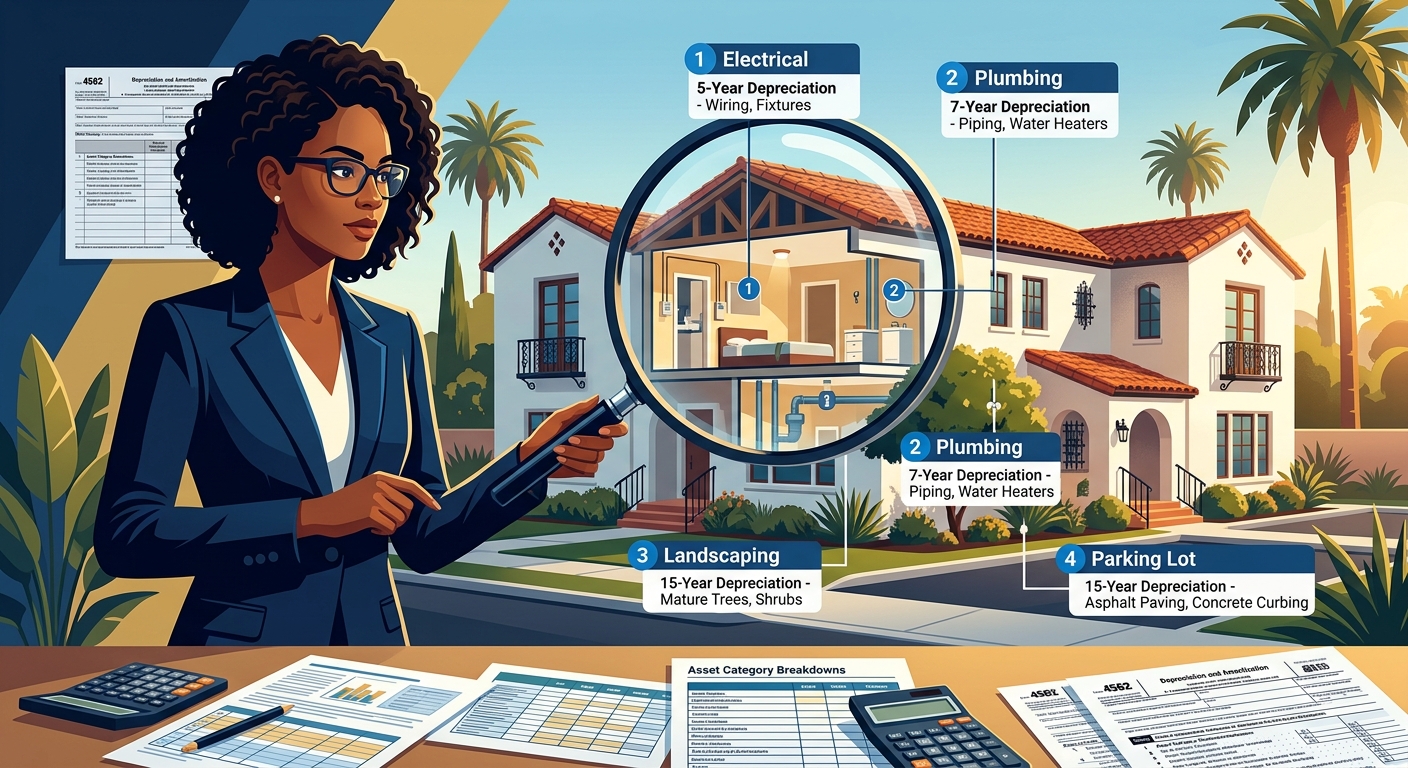
A cost segregation study uses an engineering analysis to identify components of the building that qualify for shorter recovery periods. Here is what gets reclassified:
- 5-year property: Carpeting, appliances, certain electrical outlets, decorative lighting, window treatments, and specialized plumbing fixtures
- 7-year property: Office furniture, security systems, certain communication wiring, and specialized equipment
- 15-year property: Landscaping, parking lots, sidewalks, fencing, exterior lighting, drainage systems, and retaining walls
The IRS outlined the framework for these reclassifications in the Cost Segregation Audit Techniques Guide, originally published in 2004 and updated multiple times since. The guide establishes that engineering-based studies using qualified professionals are the gold standard. Desktop studies, while cheaper, lack the documentation depth that survives an audit.
Under the OBBBA, 100% bonus depreciation under IRC Section 168(k) is now permanent. That means every dollar reclassified into a 5-year, 7-year, or 15-year category can be written off entirely in the year the property is placed in service. California does not conform to federal bonus depreciation under Revenue and Taxation Code Sections 17250 and 24356, which means you must maintain dual depreciation schedules: one for federal and one for your California Form 540 or Form 100S.
What Reclassification Looks Like on a $600,000 Rental Property
| Component Category | Reclassified Amount | Recovery Period | Federal Year-One Deduction |
|---|---|---|---|
| 5-Year Property | $72,000 | 5 years | $72,000 (100% bonus) |
| 7-Year Property | $18,000 | 7 years | $18,000 (100% bonus) |
| 15-Year Property | $42,000 | 15 years | $42,000 (100% bonus) |
| 27.5-Year Property (remaining) | $408,000 | 27.5 years | $14,836 |
| Total Year-One Deduction | $146,836 |
Without the study, that same property generates only $21,818 in year-one depreciation. The cost segregation study creates an additional $125,018 in deductions during the first twelve months. At a combined federal and California marginal rate of 45% or higher for many real estate investors, that translates to more than $56,000 in tax savings from a single study.
The Five Costliest Mistakes California Rental Property Owners Make With Cost Segregation
Mistake 1: Assuming the Property Is Too Small
There is a persistent myth that cost segregation only makes financial sense on properties worth $1 million or more. That threshold made sense a decade ago when studies routinely cost $15,000 to $25,000. Today, engineering firms offer studies on properties as low as $250,000 for $3,000 to $6,000. A $400,000 single-family rental can yield $50,000 to $80,000 in reclassified assets, generating $22,500 to $36,000 in first-year tax savings. That is a 5x to 10x return on the study cost.
Mistake 2: Using a Desktop Study Instead of an Engineering-Based Study
Desktop studies rely on statistical estimates rather than physical inspection of the property. They cost less, often $1,500 to $2,500, but the IRS Cost Segregation Audit Techniques Guide explicitly flags them as lower-quality. If the IRS examines your return, a desktop study lacks the site-specific documentation, photographs, and engineering credentials that the IRS expects. The savings from a cheaper study evaporate the moment an auditor requests supporting documentation you cannot provide.
Mistake 3: Ignoring the California Depreciation Nonconformity
California does not recognize federal bonus depreciation. Every reclassified asset must be depreciated on its standard MACRS schedule for state purposes. If you claim 100% bonus depreciation on $132,000 in reclassified assets for federal purposes but fail to maintain a separate California depreciation schedule, your state return will contain errors. The FTB cross-references federal and state returns, and mismatches in depreciation trigger automated review notices. Our cost segregation services include dual depreciation schedule setup to prevent this exact problem.
Mistake 4: Failing to Coordinate With Your Exit Strategy
Accelerated depreciation is not free money. When you sell the property, the IRS recaptures the depreciation under IRC Sections 1245 and 1250. Personal property reclassified into 5-year and 7-year categories faces recapture at ordinary income rates (up to 37% federally), while real property components face a maximum 25% recapture rate. If you plan to sell within two years and are not executing a 1031 exchange under IRC Section 1031, the recapture can offset a significant portion of the upfront savings. Coordinate your cost segregation timing with your hold period and exit plan.
Mistake 5: Not Filing Form 3115 for Properties Already in Service
If you already own rental property and never performed a cost segregation study, you do not need to wait until you buy your next property. IRS Form 3115, Application for Change in Accounting Method, allows you to claim the cumulative benefit of reclassification in a single year through an IRC Section 481(a) adjustment. This is called a “look-back” study, and it captures every dollar of accelerated depreciation you missed in prior years. There is no amended return required and no statute of limitations issue. The entire catch-up deduction hits your current-year return. If you want to estimate how a large deduction like this might affect your overall tax position, run the numbers through this capital gains tax calculator to see where you stand.
How to Execute a Cost Segregation Study on Your California Rental Property: 8 Steps
Here is the exact process from start to deduction, with timelines and documentation requirements at each stage:
- Evaluate the Property (Week 1): Determine the building’s adjusted basis, excluding land value. Land is never depreciable. Use your purchase closing statement, county assessor records, or an appraisal to separate land from building value.
- Select a Qualified Engineering Firm (Week 1-2): The firm must employ licensed engineers or construction professionals. Ask for sample reports, IRS audit defense track records, and confirmation they perform physical site visits. For a deeper understanding of how these studies fit into a broader investment strategy, review our complete guide to cost segregation in California.
- Schedule the Site Visit (Week 2-3): The engineering team visits the property, photographs every component, measures square footage, and documents asset conditions. This is non-negotiable for audit-defensible studies.
- Receive the Study Report (Week 4-6): The report breaks every identified component into its proper MACRS asset class (5-year, 7-year, 15-year, or 27.5/39-year). Each reclassification includes cost estimates, engineering rationale, and photographic documentation.
- Build Dual Depreciation Schedules (Week 6-7): Your tax preparer creates two schedules. The federal schedule applies 100% bonus depreciation to all reclassified assets. The California schedule uses standard MACRS rates for each asset class without bonus depreciation.
- File Form 3115 if Applicable (With Your Tax Return): If the property was placed in service in a prior tax year, file Form 3115 with your federal return to claim the IRC Section 481(a) catch-up adjustment. Attach the cost segregation report as supporting documentation.
- Activate the AB 150 PTE Election if Applicable: If your rental property is held through an S Corp or partnership, elect into California’s AB 150 Pass-Through Entity Tax to bypass the $40,000 SALT deduction cap at the federal level. This election is filed with the FTB and must be made by the original return due date.
- Monitor and Update Annually: As you make capital improvements (new roof, HVAC system, parking lot resurfacing), each improvement may qualify for its own cost segregation reclassification. Do not default to 27.5-year straight-line on improvements that contain 5-year or 15-year components.
KDA Case Study: Sacramento Rental Property Investor Unlocks $127,400 in First-Year Deductions
Marcus, a Sacramento-based investor, owned a 12-unit apartment complex purchased in 2023 for $1.8 million. He had been depreciating the entire building value of $1.44 million (after land allocation) on a straight-line 27.5-year schedule, generating $52,364 per year in depreciation. His annual rental income was $216,000, and he was paying roughly $67,000 per year in combined federal and California taxes on the net rental income after expenses.
KDA’s engineering partner performed a site visit and identified $396,000 in reclassifiable assets: $228,000 in 5-year property (appliances, carpeting, cabinetry, electrical fixtures), $36,000 in 7-year property (security system, specialty wiring), and $132,000 in 15-year property (parking lot, landscaping, fencing, exterior lighting). Because Marcus had owned the property since 2023, KDA filed Form 3115 to execute a look-back study, capturing three years of missed accelerated depreciation in a single IRC Section 481(a) adjustment.
The result: $127,400 in first-year federal deductions through the look-back adjustment, compared to the $52,364 he would have claimed under straight-line depreciation. At his combined marginal rate of 47.3% (federal plus California), the additional deductions saved him $35,513 in taxes for the current year alone. Over a projected five-year hold period, the cumulative tax savings reached $89,200. Marcus paid $8,400 for the engineering study and KDA’s implementation services, delivering a 4.2x first-year return and a 10.6x five-year return on investment.
KDA also set up dual depreciation schedules, activated the AB 150 PTE election through Marcus’s LLC (taxed as a partnership), and coordinated the depreciation strategy with his planned 1031 exchange timeline to defer recapture upon sale.
Ready to see how we can help you? Explore more success stories on our case studies page to discover proven strategies that have saved our clients thousands in taxes.
OBBBA Permanent Changes That Affect Cost Segregation Rental Property IRS Strategy in 2026
The One Big Beautiful Bill Act (OBBBA), signed into law in 2025, made several permanent changes that directly affect cost segregation planning for rental property owners:
- 100% Bonus Depreciation (Permanent): IRC Section 168(k) now provides permanent 100% first-year expensing for all MACRS property with a recovery period of 20 years or less. This includes 5-year, 7-year, and 15-year assets identified through cost segregation. The previous phase-down schedule (80% in 2023, 60% in 2024, etc.) has been eliminated retroactively.
- Section 179 Increased to $2.5 Million: The OBBBA raised the Section 179 expensing limit to $2.5 million with an investment ceiling of $4 million. While Section 179 is less common in rental property settings (it generally applies to trade or business property, not investment property held for rent), it benefits investors who also operate a business that uses rental property for business purposes.
- SALT Cap Set at $40,000: The state and local tax deduction cap is now $40,000, up from $10,000 under the original TCJA. For California rental property owners paying significant state income tax, the AB 150 PTE election remains critical to bypass this cap entirely.
- QBI Deduction Made Permanent: The 20% Qualified Business Income deduction under IRC Section 199A is now permanent. Rental income may qualify for QBI if the taxpayer meets the safe harbor requirements under Revenue Procedure 2019-38, which requires 250 hours of rental services per year and separate books and records for each property.
- Estate Exemption Raised to $15 Million: For high-net-worth investors with large rental portfolios, the increased estate tax exemption under IRC Section 2010 provides additional planning flexibility when combining cost segregation with estate transfer strategies.
Key Takeaway: The OBBBA permanently eliminated the bonus depreciation phase-down, which means cost segregation studies now deliver maximum value in every tax year going forward, not just during a temporary bonus window.
What Happens if the IRS Audits Your Cost Segregation Study?
The IRS audits cost segregation claims regularly, particularly on properties where the reclassification percentage exceeds 30% of the building’s total cost. The IRS Cost Segregation Audit Techniques Guide, available on the IRS Large Business and International division’s website, is the exact playbook examiners use when reviewing these deductions.
Here is what auditors look for:
- Qualified professional involvement: Was the study prepared by a licensed engineer, architect, or construction professional? Studies prepared by accountants without engineering credentials face heightened scrutiny.
- Physical site visit documentation: Did the preparer actually visit the property? Photographs, measurements, and site-specific observations are required. The Hospital Corporation of America v. Commissioner case established that engineering methodology is the most reliable approach.
- Asset classification accuracy: Are the reclassified assets properly categorized under the correct MACRS class lives? Misclassifying structural components as personal property is the number one audit adjustment.
- Cost allocation methods: Were costs allocated using recognized engineering cost estimating methods, not arbitrary percentages?
- Form 3115 compliance: For look-back studies, was Form 3115 filed correctly with the current-year return, and was the IRC Section 481(a) adjustment calculated properly?
The IRS now uses Palantir-powered SNAP AI to cross-reference depreciation claims across returns. Properties with unusually high reclassification percentages, inconsistent depreciation between federal and state returns, or missing Form 3115 attachments are flagged automatically. An audit-proof study with proper engineering documentation is your best defense.
Pro Tip: Request a copy of your engineering firm’s audit defense guarantee before hiring them. Reputable firms will represent you at no additional cost if the IRS examines the study.
Should You Do a Cost Segregation Study on Your Rental Property?
Not every rental property justifies a cost segregation study. Here is a decision framework based on property value and expected tax benefit:
| Property Value (Building Only) | Estimated Reclassifiable Assets | Estimated Year-One Tax Savings | Study Cost | ROI |
|---|---|---|---|---|
| $200,000 | $40,000 – $60,000 | $14,000 – $21,000 | $3,000 | 4.7x – 7.0x |
| $500,000 | $100,000 – $150,000 | $35,000 – $52,500 | $5,000 | 7.0x – 10.5x |
| $1,000,000 | $200,000 – $300,000 | $70,000 – $105,000 | $8,000 | 8.8x – 13.1x |
| $2,000,000+ | $400,000 – $600,000 | $140,000 – $210,000 | $12,000 – $16,000 | 8.8x – 17.5x |
Yes, if:
- Your building basis exceeds $200,000
- You plan to hold the property for at least three years (or execute a 1031 exchange)
- You have sufficient income to absorb the accelerated deductions (or qualify as a real estate professional under IRC Section 469(c)(7))
- You have not previously performed a cost segregation study on this property
No, if:
- You plan to sell within 12 months without a 1031 exchange
- The property is land-heavy with minimal building improvements
- You already have significant passive losses suspended under IRC Section 469
Do I Need to Be a Real Estate Professional to Benefit?
No. Cost segregation benefits any rental property owner. However, the deductions are categorized as passive losses under IRC Section 469 unless you qualify as a real estate professional (750+ hours in real property trades or businesses, with more than half your working time in real estate). If you do not qualify, the deductions offset passive income from other rental properties or carry forward to offset gains when you sell.
If you do qualify as a real estate professional, the accelerated depreciation can offset W-2 income, 1099 income, and other active income categories. That is where cost segregation becomes a six-figure strategy rather than a timing shift.
Can I Do a Cost Segregation Study on a Property I Already Own?
Yes. The IRS specifically allows look-back studies through the Form 3115 change of accounting method process. You do not need to amend prior-year returns. The entire cumulative benefit of the reclassification hits your current-year return as an IRC Section 481(a) adjustment. There is no statute of limitations concern because you are changing your accounting method going forward, not correcting a prior-year error.
For California investors, the look-back study requires a separate state-level calculation because California does not recognize bonus depreciation. Your California catch-up adjustment will be smaller than the federal adjustment, but it still accelerates state depreciation into faster MACRS schedules.
Will a Cost Segregation Study Trigger an Audit?
A properly executed engineering-based study does not increase your audit risk. In fact, the IRS has publicly stated that cost segregation is an accepted tax planning strategy when performed by qualified professionals with proper documentation. What triggers audits is poor execution: desktop-only studies, inflated reclassification percentages, missing site visit documentation, or Form 3115 filing errors.
The IRS Palantir SNAP AI system flags returns where depreciation deductions spike suddenly without a corresponding Form 3115 attachment or where federal and California depreciation schedules show unexplained mismatches. Both issues are preventable with proper implementation.
This information is current as of April 25, 2026. Tax laws change frequently. Verify updates with the IRS or FTB if reading this later.
Ready to Reduce Your Tax Bill?
KDA Inc. specializes in strategic tax planning for business owners, S Corps, LLCs, and high-net-worth individuals. Book a personalized consultation and walk away with a clear plan.
Book Your Cost Segregation Strategy Session
If you own rental property in California and you have been depreciating the full building value on a 27.5-year straight line, you are almost certainly overpaying your taxes by thousands of dollars every year. A single cost segregation study can unlock five or six figures in first-year deductions, and a look-back study can capture every dollar you missed since you bought the property. Stop leaving money in the IRS’s pocket. Book your personalized cost segregation consultation now and find out exactly how much you can recover.
“The IRS built the rules for cost segregation into the tax code. They published the audit guide. They approved the deductions. The only question is whether you are going to use them.”



