
If you own investment property along the coast and you have never run a cost segregation La Jolla CA study, there is a strong chance you are handing the IRS money you were never required to pay. Cost segregation is one of the most powerful, most underused tax strategies available to real estate investors in 2026, and it is especially valuable in a high value market like La Jolla, where a single property can carry a purchase price of two million dollars or more. This guide breaks down exactly how the strategy works, who qualifies, what the numbers look like, and how to avoid the mistakes that trigger audits.
This information is current as of 7/3/2026. Tax laws change frequently. Verify updates with the IRS or California Franchise Tax Board (FTB) if reading this later.
Quick Answer: What Is Cost Segregation and Why Does It Matter in La Jolla?
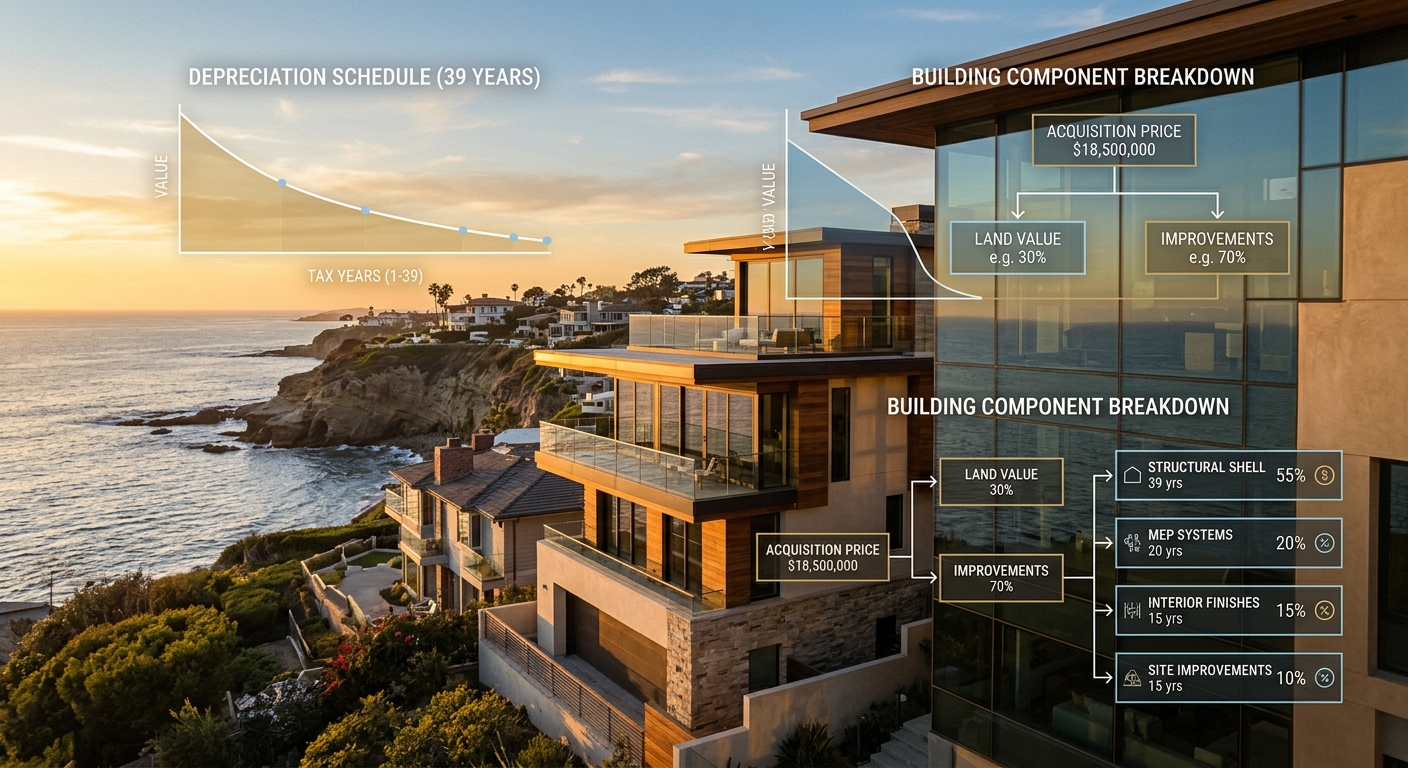
Cost segregation is an engineering based tax study that breaks a building down into its individual components and reclassifies many of them from a slow 27.5 or 39 year depreciation schedule into faster 5, 7, and 15 year schedules. In plain English: instead of writing off your property in tiny slivers over decades, you accelerate a large chunk of those deductions into the early years of ownership. On a two million dollar La Jolla rental, that can mean pulling forward $400,000 to $600,000 in deductions and, when paired with bonus depreciation, deducting a huge slice of it in year one.
Why La Jolla Real Estate Investors Have More to Gain
La Jolla is not an average market. Median property values here sit far above the national norm, and that matters enormously for depreciation math. Cost segregation savings scale with the depreciable basis of a property, and the depreciable basis scales with price. A $350,000 rental in a low cost state might produce a $110,000 reclassification. A comparable coastal property purchased at $2.1 million can produce a reclassification of $650,000 or more, because the building improvements, the specialized finishes, the landscaping, and the site work are all worth far more.
Investors who own or are buying property in the San Diego County coastal corridor should treat this as a core part of their acquisition strategy, not an afterthought. If you want a deeper look at how we support investors in this area, review our La Jolla tax and real estate services for a full breakdown of who we serve locally.
There is also a timing advantage in 2026. As of last year, 100 percent bonus depreciation was restored on a permanent basis. That single change turned cost segregation from a good idea into a wealth building engine, because the reclassified 5, 7, and 15 year property can now be fully expensed in the first year of service rather than stretched out.
How a Cost Segregation Study Actually Works
The federal framework for depreciation lives in the Modified Accelerated Cost Recovery System (MACRS). Residential rental structures normally depreciate over 27.5 years and commercial buildings over 39 years. A cost segregation study identifies the portions of the property that legally belong in shorter recovery categories. For the official rules and the government’s own guidance on how these studies are reviewed, see the IRS Cost Segregation Audit Techniques Guide.
A qualified engineer and tax team walk the property (or the plans and photos) and sort components into their proper class lives.
Typical Reclassification Categories
- 5 year property: carpeting, certain flooring, decorative lighting, appliances, cabinetry not part of the structure, and window treatments.
- 7 year property: specific fixtures and equipment tied to business use.
- 15 year property (land improvements): driveways, walkways, fencing, landscaping, retaining walls, and outdoor lighting, which are common and valuable on coastal La Jolla lots.
- 27.5 or 39 year property: the structural shell, roof, foundation, and permanent systems that stay on the long schedule.
Key Takeaway: A well executed study on a high value coastal property routinely reclassifies 25 to 35 percent of the building basis into accelerated categories, and in 2026 that reclassified portion can often be deducted immediately.
KDA Case Study: La Jolla Real Estate Investor Turns a Purchase Into a Six Figure Deduction
A client came to us after buying a $2.3 million duplex two blocks from the water in La Jolla. She is a high income physician earning roughly $520,000 a year, and she also qualified as a real estate professional because she and her spouse materially participated in managing their rental portfolio. Her previous preparer had simply set the property on a straight 27.5 year schedule, giving her about $67,000 in annual depreciation.
We ordered an engineering based cost segregation study. After removing the land value, the depreciable basis came to roughly $1.85 million. The study reclassified about $610,000 into 5, 7, and 15 year property. Because 100 percent bonus depreciation applied, she deducted that entire $610,000 in the first year on top of her normal structural depreciation. Against her marginal federal and California combined rate, that produced roughly $268,000 in first year tax savings.
She paid $8,500 for the study and our planning work. Her first year return on that fee was more than 30 times the cost, and because she qualified as a real estate professional, those losses offset her W-2 and practice income rather than sitting trapped as passive losses. That is the difference between guessing and strategy.
Ready to see how we can help you? Explore more success stories on our case studies page to discover proven strategies that have saved our clients thousands in taxes.
Do You Qualify to Use These Deductions?
Here is where most investors get tripped up. Generating a big paper loss is easy. Actually using that loss against your other income is the hard part, because of the passive activity loss rules in the tax code.
Yes, you can likely use the deductions if:
- You qualify as a real estate professional (more than 750 hours and more than half your working time in real property trades, per IRS rules) and materially participate.
- You run a short term rental with an average guest stay of seven days or less and you materially participate, which can sidestep the passive classification entirely.
- You have passive income from other rentals that the new losses can offset.
No, the deductions may be limited if:
- You are a passive investor with a full time non real estate job and no short term rental qualification.
- Your only income is W-2 wages with no passive income to absorb the loss.
The short term rental angle is especially relevant in La Jolla, where vacation demand is strong. If you materially participate in a property that averages seven day stays or less, those losses are generally not treated as passive, which means they can offset active income. For the technical foundation on passive activity limits, review IRS Publication 925.
Our team frequently helps real estate investors structure ownership and participation the right way so the deductions actually stick. If you want to model the tax on a future sale of the property, you can also run projected gains through this capital gains tax calculator before you commit to a strategy.
Cost Segregation vs. Straight Line Depreciation: A Side by Side Look
| Factor | Straight Line | Cost Segregation |
|---|---|---|
| Year 1 deduction | Small, evenly spread | Large, front loaded |
| Bonus depreciation | Not applied to structure | Applied to reclassified property |
| Cash flow impact | Slow | Immediate |
| Study cost | None | $5,000 to $15,000 typical |
| Best for | Passive holders, small basis | High value property, active investors |
Bottom Line: For a La Jolla property with a large basis and an owner who can use the losses, the study fee is almost always a rounding error compared to the tax saved.
Step-by-Step: How to Run a Cost Segregation Study
- Confirm eligibility – Review your participation status and income type with a tax strategist before spending a dollar on a study.
- Gather documents – You will need the closing statement, purchase price allocation, blueprints or plans if available, and photos of the property.
- Order the engineering study – A qualified firm performs a site visit or detailed remote analysis and assigns each component to its proper class life.
- Allocate land value – Land is never depreciable, so the study carves out land value first. In La Jolla, land can be a large share, so this step must be defensible.
- Apply bonus depreciation – The reclassified short life property is expensed under current 100 percent bonus rules.
- File correctly – The deductions flow onto your return, often via Form 4562. If the property was placed in service in a prior year, a Form 3115 change in accounting method lets you catch up without amending old returns.
This is not a DIY project. The IRS reviews these studies, and a sloppy or overly aggressive one is a fast track to a notice.
Special Situations and Edge Cases Most Guides Ignore
What About California State Conformity?
Here is a critical point competitors skip. California does not fully conform to federal bonus depreciation. For your federal return, the accelerated and bonus deductions apply as described. For your California return, the FTB requires you to use its own depreciation rules, which generally do not allow federal bonus depreciation. In practice, this means your federal savings will be larger than your state savings, and your California taxable income must be computed separately. Ignoring this creates a mismatch that the FTB catches. Always confirm current treatment with the California Franchise Tax Board.
What Happens When You Sell? Depreciation Recapture
Accelerated depreciation is not free money forever. When you sell, the IRS recaptures a portion of the depreciation you claimed, often taxed at up to 25 percent on real property gains attributable to depreciation. That is not a reason to skip the strategy. It is a reason to plan the exit, often through a 1031 exchange that defers the tax entirely. This is exactly where advance planning pays off.
Part Year and Mid Year Purchases
If you buy a La Jolla property in the middle of the year, MACRS conventions determine how much you can deduct in that first year. A skilled study accounts for placed in service timing so you do not overstate the first year benefit.
Common Mistakes La Jolla Investors Make
- Skipping the study on high value property. The larger the basis, the more you leave on the table by not doing it.
- Assuming losses are automatically usable. Without real estate professional status or short term rental treatment, big losses can sit locked and passive.
- Using a generic online calculator instead of an engineering study. The IRS expects a defensible methodology, not a guess.
- Forgetting California decoupling. Filing federal and state the same way produces incorrect returns.
- No exit plan for recapture. Failing to plan for the sale can erase part of the benefit.
How Cost Segregation Fits Into a Bigger Tax Strategy
A study is not a standalone trick. It works best inside a coordinated plan that considers entity structure, financing, and long term wealth goals. Many of our La Jolla clients pair cost segregation with proper entity structuring, retirement contributions, and 1031 planning to compound the benefit across an entire portfolio. Our cost segregation services are built to integrate with that broader plan rather than operate in isolation.
The 2026 environment rewards investors who document everything. With the IRS now leaning heavily on automated review and cross matching, a professionally prepared study with clean support is your best protection if a return ever gets flagged. Sloppy paperwork on a large deduction is precisely the profile these systems are trained to notice.
Ready to Reduce Your Tax Bill?
KDA Inc. specializes in strategic tax planning for business owners, S Corps, LLCs, and high-net-worth individuals. Book a personalized consultation and walk away with a clear plan.
Frequently Asked Questions
How much does a cost segregation study cost in La Jolla?
Most studies for single properties run between $5,000 and $15,000 depending on size, complexity, and property type. For a high value coastal property, the fee is typically a tiny fraction of the tax saved.
Can I do a study on a property I bought years ago?
Yes. Through a Form 3115 change in accounting method, you can capture the missed depreciation on a prior year purchase in the current year without amending old returns. This is called a catch up adjustment and it can be substantial.
Does cost segregation work on my primary residence?
No. It applies to income producing property, not your personal home. A portion of a mixed use property used for rental or business may qualify.
Will a cost segregation study increase my audit risk?
A properly documented, engineering based study performed by qualified professionals is a recognized and accepted strategy. Risk rises only with unsupported or exaggerated allocations, which is why methodology matters.
Do I need to be a real estate professional to benefit?
Not always. If you materially participate in a short term rental averaging seven day stays or less, or if you have other passive income to offset, you can benefit without formal real estate professional status.
How does bonus depreciation change the math in 2026?
With 100 percent bonus depreciation restored permanently, the 5, 7, and 15 year property identified in your study can generally be deducted in full in the first year, dramatically increasing the front loaded benefit.
Book Your La Jolla Cost Segregation Strategy Session
If you own or are about to buy a high value property in La Jolla and you are still depreciating it in slow, even slivers, you are almost certainly overpaying. A single study, done right, can convert a routine purchase into a six figure deduction while keeping you fully compliant with both IRS and FTB rules. Let our strategy team review your property, confirm your eligibility, and build the plan that keeps the maximum amount of cash in your hands. Click here to book your consultation now.



