
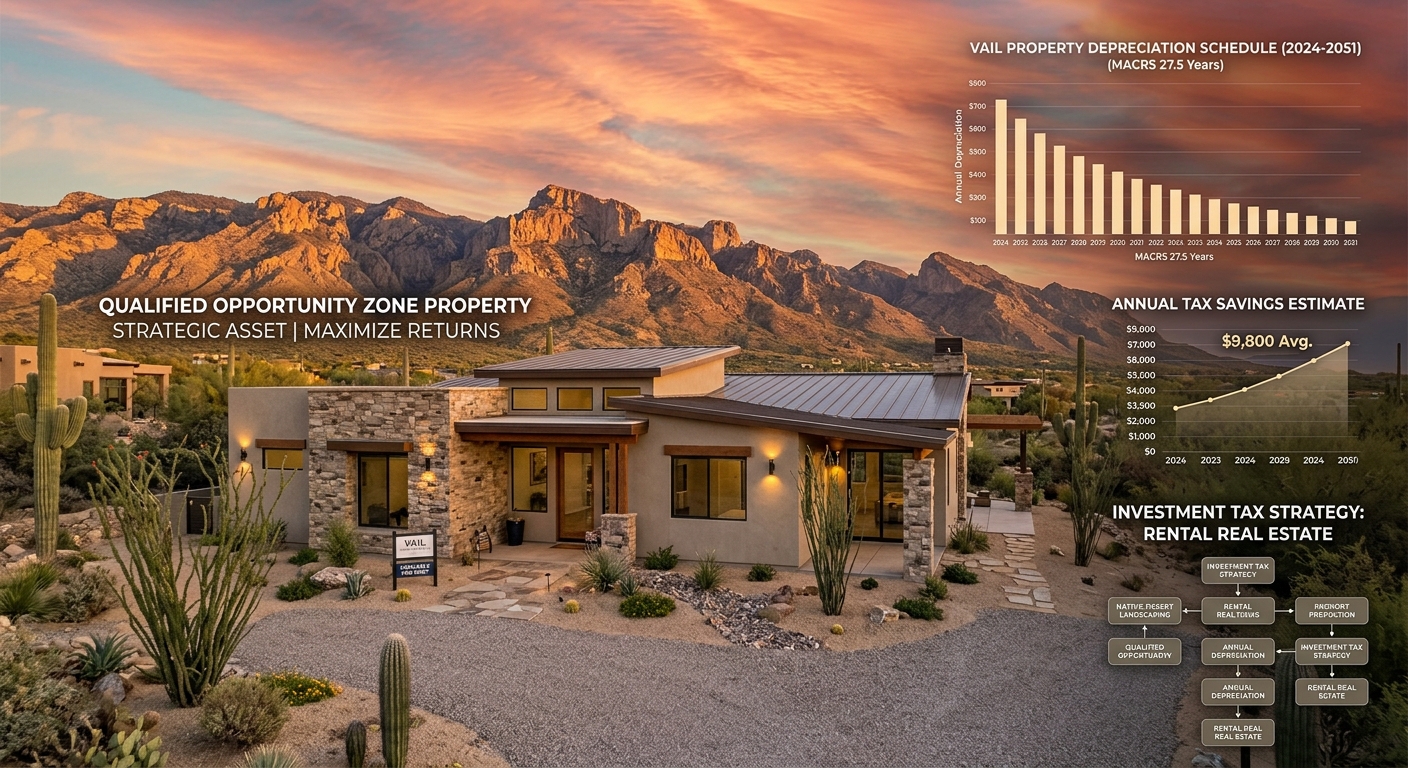
If you own rental property or commercial real estate in the Tucson metro area, cost segregation Vail AZ is one of the most powerful and most overlooked tax strategies available to you in 2026. Most investors depreciate their buildings slowly over 27.5 or 39 years and leave tens of thousands of dollars sitting on the table. Cost segregation flips that script, letting you front-load depreciation and unlock serious cash flow in the years you need it most. This guide breaks down exactly how it works, who qualifies, what it costs, and how much you can realistically save.
Quick Answer
Cost segregation is an IRS-recognized engineering study that reclassifies parts of a building into shorter depreciation categories (5, 7, and 15 years) instead of the standard 27.5 or 39 years. For a Vail, AZ investor with a $1 million property, a study can accelerate $150,000 to $300,000 of deductions into the first year, often producing $40,000 to $90,000 in real tax savings depending on your bracket. This information is current as of 8/31/2026.
What Is Cost Segregation?
Cost segregation is a tax planning method that separates the components of a building into different depreciation timelines. In plain English: instead of writing off your entire building over decades, you break it into pieces and write off the fast-depreciating pieces much sooner.
When you buy a rental or commercial building, the IRS normally makes you spread the depreciation deduction across 27.5 years for residential rentals or 39 years for commercial property. That is painfully slow. A cost segregation study uses engineering analysis to identify components that legitimately qualify for shorter recovery periods.
Think of it like this. A building is not one single asset. It is carpet, cabinetry, specialized electrical, landscaping, parking lots, decorative lighting, and dozens of other items. Many of those items wear out faster than the structure itself, and the tax code lets you depreciate them faster. Cost segregation simply proves which items belong in the faster buckets.
The categories generally look like this:
- 5-year property: Carpeting, certain appliances, decorative fixtures, and dedicated equipment wiring
- 7-year property: Certain furniture, fixtures, and specialty equipment
- 15-year property: Land improvements like driveways, sidewalks, fencing, and landscaping
- 27.5 or 39-year property: The core building structure that stays on the slow schedule
The authority for this approach traces back to court cases and IRS guidance summarized in the IRS Cost Segregation Audit Techniques Guide, which lays out exactly how these studies should be prepared and documented.
Why Cost Segregation in Vail, AZ Matters for Real Estate Investors
Vail sits in the growing eastern corridor of the Tucson metro in Pima County, and it has quietly become a hotspot for buy-and-hold rentals, short-term vacation properties, and small commercial development. Property values here have climbed steadily, which means investors are sinking real capital into buildings that generate slow, drawn-out depreciation under the default rules.
Arizona also gives real estate investors a favorable environment. There is no local city income tax layered on top, and the state conforms to federal depreciation rules in most respects, which means the federal acceleration from a cost segregation study flows through cleanly. That combination makes a cost segregation Vail AZ strategy especially attractive compared to high-tax coastal states.
For investors in the Vail and Pima County service area, the timing matters too. Bonus depreciation rules have shifted in recent years, and pairing a cost segregation study with the current bonus depreciation percentage can dramatically amplify your first-year deduction. Getting the study done in the right tax year is often the difference between a good result and a great one.
If you want a fast gut-check on how accelerated deductions might reshape your commercial building basis, our overview of cost segregation services walks through the engineering process in more detail.
KDA Case Study: Vail Rental Investor Unlocks $71,000 in Year-One Savings
One of our clients, a self-employed real estate investor with three rental properties across the Tucson metro, purchased a $1.15 million multi-unit residential building near Vail. Her income from a consulting business plus rental profits pushed her into a combined marginal bracket around 37 percent. Under the default 27.5-year schedule, her annual depreciation was roughly $41,800, a slow drip that barely dented her tax bill.
KDA ordered an engineering-based cost segregation study. The study reclassified approximately $218,000 of the building into 5, 7, and 15-year property. By pairing that reclassification with bonus depreciation available in the acquisition year, she was able to accelerate roughly $192,000 of deductions into year one instead of spreading them over decades.
At her marginal rate, that acceleration produced about $71,000 in first-year tax savings. The study itself cost $6,500. That is roughly a 10.9x first-year return on the cost of the study, and it freed up cash she immediately reinvested into a fourth property down payment. She also gained the flexibility to time future deductions against a large capital gain she expects when she sells another asset.
Ready to see how we can help you? Explore more success stories on our case studies page to discover proven strategies that have saved our clients thousands in taxes.
Who Qualifies for a Cost Segregation Study?
Yes, cost segregation likely makes sense if:
- You own residential rental or commercial property with a building basis of $500,000 or more
- You have taxable income the accelerated deductions can offset
- You plan to hold the property for at least a few years
- You purchased, built, or renovated the property recently, or even years ago (a look-back study can catch up missed depreciation)
It may not be worth it if:
- Your building basis is very small (under roughly $200,000)
- You plan to sell within a year and cannot use the deductions
- You have no income to offset and cannot benefit from passive loss rules
One important nuance for many owners: even if you have owned a property for several years, you do not have to amend old returns to benefit. The IRS allows a “catch-up” deduction using Form 3115, a change in accounting method, which lets you claim all the depreciation you missed in a single current-year adjustment. That is one of the most underused wins in the entire strategy.
Step-by-Step: How a Cost Segregation Study Works
- Feasibility analysis – A qualified firm reviews your purchase price, building type, and tax situation to estimate the potential benefit before you commit. This takes a few days.
- Document gathering – You provide the settlement statement, property records, blueprints or appraisals if available, and any renovation invoices.
- Engineering site review – Specialists analyze the physical components of the property, either on site or through detailed documentation and photos.
- Component classification – Each qualifying asset is assigned to its correct depreciation category (5, 7, 15, or 39-year) with supporting cost data.
- Report delivery – You receive an audit-ready report documenting every reclassification, which your tax preparer uses to adjust your depreciation schedule.
- Tax filing integration – The numbers flow onto your return, and if it is a look-back study, Form 3115 captures the catch-up deduction.
The full process typically takes 30 to 60 days from start to finish, which is why planning ahead of your filing deadline is critical.
Cost Segregation Depreciation Categories at a Glance
| Asset Type | Recovery Period | Example Components |
|---|---|---|
| Personal property | 5 years | Carpet, appliances, decorative lighting |
| Specialty items | 7 years | Certain fixtures and equipment |
| Land improvements | 15 years | Driveways, fencing, landscaping |
| Residential structure | 27.5 years | Core building, framing, roof |
| Commercial structure | 39 years | Core building, framing, roof |
Key Takeaway: Moving even 20 percent of a building’s value from the 39-year bucket into the 5 and 15-year buckets can shift six figures of deductions into the current tax year.
Special Situations and Edge Cases Competitors Ignore
Passive Activity Loss Limitations
This is the trap that surprises investors. Rental real estate is generally treated as a passive activity, and passive losses can normally only offset passive income. If you are a high-W-2 earner with no other passive income, your accelerated deductions might be suspended and carried forward rather than used immediately. The workaround is real estate professional status under IRS Publication 925, or qualifying for the short-term rental exception. Getting this classification right is where a strategist earns their fee.
Depreciation Recapture on Sale
Accelerated depreciation is not free money, it is a timing benefit. When you sell, some of that depreciation gets recaptured and taxed. However, the recapture rate on personal property and the time value of having cash today usually make the strategy a clear net win, especially if you plan a 1031 exchange to defer the gain entirely.
Look-Back Studies on Older Properties
Many Vail investors do not realize they can run a study on a property they bought five or ten years ago. The catch-up deduction via Form 3115 can generate a massive one-time write-off without amending a single prior return.
Common Mistakes Vail Investors Make
- Using a non-engineering study. The IRS strongly prefers detailed engineering-based studies. Rule-of-thumb estimates from a general preparer invite audit risk.
- Ignoring passive loss rules. Ordering a study without a plan to actually use the deductions wastes the benefit.
- Poor timing. Running a study in the wrong year can miss favorable bonus depreciation windows.
- Skipping documentation. Without an audit-ready report, your reclassifications are vulnerable if the IRS asks questions.
Because these properties often sit inside LLCs or partnerships, coordinating the study with your entity structure matters. Our team frequently works alongside investors who also need real estate investor tax planning to make sure the deductions actually land where they help most.
How Much Can You Actually Save? A Real Calculation
Let us run the numbers on a $900,000 commercial building in Vail, with roughly $750,000 in depreciable basis after excluding land.
- Standard 39-year depreciation: about $19,230 per year
- Cost segregation reclassifies roughly $165,000 into faster categories
- With bonus depreciation, first-year deduction jumps to well over $150,000
- At a 32 percent marginal rate, that is roughly $48,000 in first-year tax savings
Compare that to the $6,150 of tax benefit you would get from the plain 39-year method in year one. The difference is dramatic, and it is money you can reinvest immediately. If you want to model the impact against your total picture, running your numbers through a small business tax calculator is a helpful first step before you commit to a study.
California and Arizona State Considerations
For KDA clients who own property in both Arizona and California, state conformity matters. Arizona largely conforms to federal depreciation, so the acceleration flows through cleanly. California, on the other hand, does not conform to federal bonus depreciation, which means your state and federal depreciation schedules can differ. If you hold property in multiple states, your preparer must track separate schedules to stay compliant. This is exactly the kind of multi-state nuance most generic tax blogs skip entirely.
Ready to Reduce Your Tax Bill?
KDA Inc. specializes in strategic tax planning for business owners, S Corps, LLCs, and high-net-worth individuals. Book a personalized consultation and walk away with a clear plan.
Frequently Asked Questions
Is cost segregation legal and IRS approved?
Yes. It is fully sanctioned when done through a proper engineering study, and the IRS publishes its own audit techniques guide describing how these studies should be prepared.
How much does a study cost?
Most studies for residential and small commercial properties in the Vail area run between $4,000 and $10,000 depending on complexity, and the tax savings almost always dwarf that cost.
Can I do a study on a property I bought years ago?
Yes. A look-back study combined with Form 3115 lets you claim missed depreciation as a current-year deduction without amending prior returns.
Does cost segregation trigger an audit?
A properly documented engineering study is not a red flag. Sloppy, undocumented estimates are. Quality documentation is your protection.
What happens when I sell the property?
A portion of the accelerated depreciation is recaptured on sale, but the time value of the deductions and strategies like a 1031 exchange usually preserve the net benefit.
Do I need real estate professional status to benefit?
Not always. Some investors use the short-term rental exception, and others have passive income to offset. But high earners with only passive rentals should plan carefully around the passive loss rules.
Book Your Cost Segregation Strategy Session
If you own property in the Vail or greater Tucson area and you are still depreciating your building the slow way, you are almost certainly leaving five or six figures of tax savings unclaimed. A cost segregation study, timed and structured correctly, can put that money back in your pocket this year. Let our strategists analyze your property, model the exact savings, and build an audit-ready plan tailored to your portfolio. Click here to book your consultation now.
This information is current as of 8/31/2026. Tax laws change frequently. Verify updates with the IRS or Arizona Department of Revenue if reading this later.



