
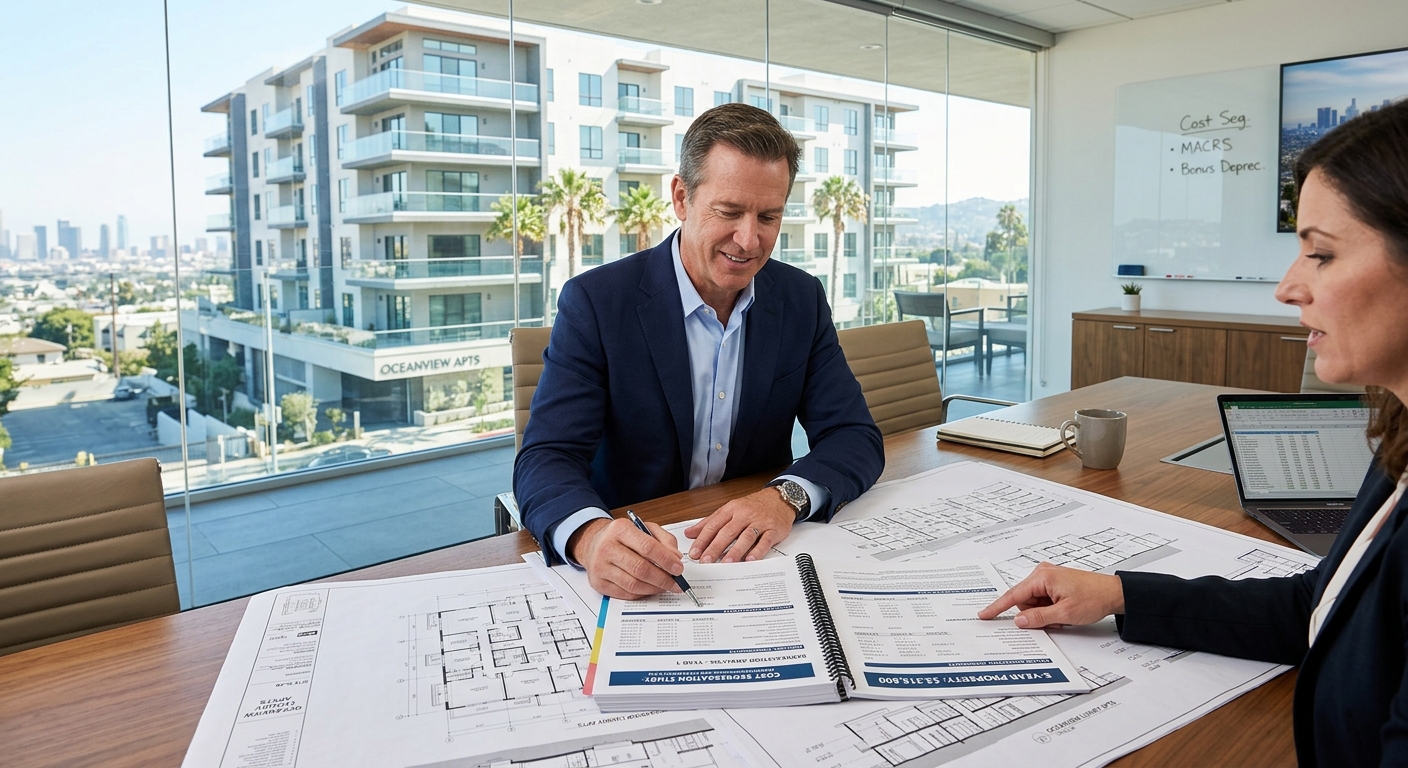
Many California landlords think depreciation is just a boring line on Schedule E that their software calculates in the background. That belief quietly costs some investors five figures in extra tax every year, because they never use cost segregation depreciation to pull those write offs forward.
Used correctly, this strategy lets you reclassify parts of a building into shorter lived assets, stack large first year deductions, and free up cash to buy the next property faster. Used sloppily, it creates messy records and ugly adjustments if the IRS ever looks at your file.
Quick Answer: How Cost Segregation Depreciation Actually Works
Here is the simple version. When you buy a rental, the default federal rule under IRS Publication 527 is to depreciate the building over 27.5 years for residential or 39 years for commercial. Cost segregation depreciation is the process of breaking that building into buckets like five year carpets, seven year cabinets, and 15 year land improvements so you can recover those costs much faster.
A formal study usually done by an engineer and tax professional looks at plans, invoices, and the property in person. They assign a portion of the purchase price to shorter life assets. Those assets are then depreciated using the rules in IRS Publication 946 and reported on Form 4562.
Bottom line. Instead of waiting nearly three decades to deduct that portion of your investment, you move a large slice into the first five to 15 years. For a million dollar apartment building, that can easily create 150,000 to 300,000 of extra deductions in the early years, which often translates into 50,000 or more in federal tax savings for high bracket investors.
Why Cost Segregation Depreciation Is So Powerful in California
California real estate investors sit at the intersection of high property values and high tax brackets. That is exactly where acceleration strategies matter most. If your wages and rental income already push you into the 35 or 37 percent federal bracket, every additional 100,000 of depreciation can mean 35,000 to 37,000 less sent to the IRS for that year.
Take a simple example. Maria owns a four unit building in Los Angeles that cost 1.6 million, with 1.3 million allocated to the building. Standard 27.5 year depreciation gives her about 47,000 per year. After a cost segregation study, 350,000 of that building cost is moved into shorter life assets. In year one, her total depreciation jumps to roughly 140,000. That extra 93,000 deduction cuts her federal tax by about 33,000 if she is in the 37 percent bracket, plus any net investment income tax reduction.
For active flippers or buy and hold investors building a portfolio, those savings can act like an interest free loan from the government. You keep more cash in the business now, then give some back later when depreciation slows or you eventually sell. That timing difference is exactly what sophisticated real estate investors use to compound faster than casual landlords.
One important California nuance. The state does not conform to federal bonus depreciation. That means you still get the acceleration for federal purposes, but your California return may continue to use slower schedules. That is not a reason to skip the study. It simply means you need careful tracking so your federal and state depreciation schedules stay reconciled and audit ready.
KDA Case Study: Real Estate Investor Accelerates Depreciation
A client we will call David came to KDA with three small apartment buildings in the East Bay held in an LLC. His combined purchase price was 4.2 million, with about 3.4 million allocated to buildings. His CPA had been using straight line 27.5 year depreciation for a decade. David was paying more than 120,000 per year in federal and California income taxes on his rental income and W 2 wages from his tech job.
Our team reviewed his returns and immediately saw that cost segregation depreciation had never been used. We coordinated an engineering based study across all three properties. The report identified roughly 1.1 million of components that could be treated as five, seven, or 15 year property, including parking lots, retaining walls, decorative lighting, appliances, and interior finishes.
After implementing new depreciation schedules through Form 3115 to change his accounting method, David generated about 420,000 of additional federal depreciation in the first year. That single year adjustment cut his federal tax bill by roughly 155,000. Our fees for the analysis, engineering report, filings, and planning totaled about 32,000.
David effectively received a first year after tax ROI of nearly five to one, while also cleaning up his records ahead of any potential IRS review. Going forward, he now has a playbook for each new acquisition, and we coordinate cost segregation studies early so his returns are filed correctly the first time.
Ready to see how we can help you? Explore more success stories on our case studies page to discover proven strategies that have saved our clients thousands in taxes.
Step by Step: Using Cost Segregation Depreciation on Your Next Deal
If you are considering cost segregation, treat it like any other investment decision. You want to know the cost, the expected tax savings, and the timing. Here is a practical sequence to follow for a California rental property.
Step 1: Confirm That Your Property Is a Good Candidate
As a rule of thumb, cost segregation starts to make sense once the building basis excluding land is at least 750,000 to 1,000,000 or you have multiple smaller properties you can group. The larger the building and the more complex the improvements, the more there is to reclassify. Newer construction often produces higher percentages of shorter life assets than older, fully depreciated buildings.
If your holdings are mostly single family rentals with modest finishes, the yield might be weaker yet still worthwhile for a high income investor who needs deductions now. This is where a short consult with a specialist beats guesswork.
Step 2: Coordinate With a Specialist Team
The IRS expects a defensible engineering based approach, not a back of the envelope spreadsheet. A solid team pairs tax professionals who understand Form 4562 guidance with engineers who can read plans and evaluate construction costs. KDA routinely brings those disciplines together for California investors, then handles the return side so the study actually translates into clean numbers on your returns.
Step 3: Gather the Right Documentation
At minimum, expect to provide closing statements, construction contracts, change orders, architectural drawings, and any cost breakdowns you have. The better your documentation, the more precisely the study can allocate costs. Sloppy or incomplete records are one of the biggest reasons investors leave money on the table.
Step 4: Model the Tax Impact Before You Commit
Before you sign an engagement letter, you should see an estimate of how much additional depreciation the study is likely to create and how that translates into tax savings over the next several years. Good advisors will run scenarios that show the impact on your projected tax liability and help you decide whether to accelerate now or preserve deductions for later years. A simple way to sanity check those projections is to run your expected profit through a small business tax calculator so you can see how incremental deductions flow through to actual tax owed.
Step 5: File the Returns Correctly
For new purchases placed in service this year, the study results flow directly into your depreciation schedules and Form 4562. For existing properties you already own, implementing cost segregation often requires filing Form 3115 to request a change in accounting method and claim a Section 481(a) adjustment. Done correctly, that allows you to catch up missed depreciation in a single year without amending prior returns.
For investors with more complex portfolios or multiple entities, this is also the point where you want proactive planning about passive activity loss limitations, grouping elections, and how the deductions interact with other parts of your return. That type of integrated planning is exactly what our cost segregation services are designed to deliver.
Red Flag Alert: Mistakes That Blow Up Cost Segregation Depreciation
Every powerful tax strategy has traps. Cost segregation is no exception. Here are the missteps that invite headaches with the IRS or wipe out the benefit you thought you were getting.
Relying on Cheap, Cookie Cutter Studies
If a provider promises huge deductions without reviewing your plans, walking the property, or asking many questions, be suspicious. The IRS has challenged studies that lacked credible methodology. In an audit, the agency can reclassify assets back to longer lives, which can trigger additional tax, interest, and potential penalties. Investing in a quality, defensible study is cheaper than fighting a bad one.
Ignoring California Nonconformity
Some investors let federal bonus depreciation drive all their decisions and forget that California does not follow those rules. On your state return, you often have to add back federal bonus and track separate California depreciation. If you fail to do that reconciliation, you may see unexpected state tax bills or notices later. This is a mechanics problem, not a reason to walk away from the federal benefit.
Not Planning for Exit Taxes
Accelerating depreciation is a timing play. When you sell a property, a portion of your gain will be taxed as depreciation recapture at higher rates than long term capital gains. A good cost segregation plan includes an exit strategy, such as potential 1031 exchanges, installment sales, or timing sales in years when you have capital losses elsewhere. For planning those combinations, tools like a capital gains tax calculator are helpful, but they are no substitute for tailored advice.
Failing to Coordinate With Your Overall Tax Picture
If you are a W 2 employee with limited passive income, you may not be able to use all the losses generated by cost segregation depreciation in the current year. That does not mean the strategy is bad, but it does mean you need to understand how passive loss rules under IRS Publication 925 apply. Many high earners combine cost segregation with real estate professional status or group their activities so more of the loss becomes currently usable.
Will Cost Segregation Depreciation Trigger an Audit?
Cost segregation by itself is not a red flag. Large depreciation deductions can attract attention if they look out of proportion to your rental income, but the IRS understands that new buildings and major renovations create big write offs. The key is documentation.
A high quality report lays out the engineering approach, lists the assets and costs assigned to each class life, and ties back to your total project basis. When that ties directly to the numbers on Form 4562 and your supporting schedules, an examiner has much less to argue with. Problems arise when there is a big deduction and no paper trail to support how you got there.
If you are already under audit for other reasons, a sloppy cost segregation study will not help your credibility. In that situation, having a firm that also offers real estate tax preparation and audit support in your corner can be the difference between a stressful experience and a manageable one.
Fast Tax Facts About Cost Segregation Depreciation
How Does Bonus Depreciation Interact With Cost Segregation?
Once you carve out shorter life assets, federal bonus depreciation rules can allow a portion to be deducted immediately. Under current law, bonus was 100 percent through 2022, dropped to 80 percent in 2023, 60 percent in 2024, and is scheduled to be 40 percent for property placed in service in 2025. That means a cost segregation study on a 2025 project still creates very large first year deductions, although not quite as dramatic as a few years ago.
Can You Use Cost Segregation on Residential Rentals?
Yes. Cost segregation depreciation applies to both residential and commercial property as long as it is used in a trade or business or held for the production of income. The mix of assets will differ. A twelve unit building with extensive common areas and amenities will usually yield a higher percentage of reclassified costs than a basic single family rental, but both can benefit.
What If You Already Filed Without Cost Segregation?
You do not have to amend multiple years of returns to start. In many cases, you can file a single Form 3115, calculate a catch up adjustment for prior years, and deduct that amount in the current year. The rules are explained in IRS guidance for Form 3115. This is a powerful tool for long time owners who are just now discovering the strategy.
Is There a Minimum Property Value for Cost Segregation?
There is no official minimum, but fees and complexity create a practical floor. For a stand alone single family rental worth 400,000, a full engineering study is often hard to justify. For a portfolio of similar homes or any building over seven figures, the math usually turns in your favor quickly, especially if you are in a high federal bracket and subject to the 3.8 percent net investment income tax.
Bottom Line and Next Steps for Investors
Cost segregation depreciation is one of the few strategies that can move the needle by tens of thousands of dollars for California real estate investors who already feel fully taxed. It turns slow, background deductions into a front loaded shield that can fund more acquisitions, pay down high interest debt, or simply stabilize your cash flow in volatile markets.
This information is current as of 7/23/2026. Rules for bonus depreciation and related planning change regularly, and California conformity has its own twists, so you should double check the latest federal and state guidance before acting if you are reading this at a later date.
The right way to decide whether this strategy belongs in your playbook is to look at your actual properties, your overall income mix, and your long term plans. Cost segregation does not live in a vacuum. It lives inside a broader plan for entity structure, financing, 1031 exchanges, and exit timing.
Ready to Reduce Your Tax Bill?
KDA Inc. specializes in strategic tax planning for business owners, S Corps, LLCs, and high-net-worth individuals. Book a personalized consultation and walk away with a clear plan.
Book Your Cost Segregation Strategy Session
If you own or are about to buy California rentals and suspect your current depreciation strategy is leaving serious money on the table, it is time to get a professional review. Our team at KDA works with W 2 high earners, 1099 professionals, and full time investors to design cost segregation approaches that fit real world goals, not just spreadsheets. Click here to book your consultation now.



