
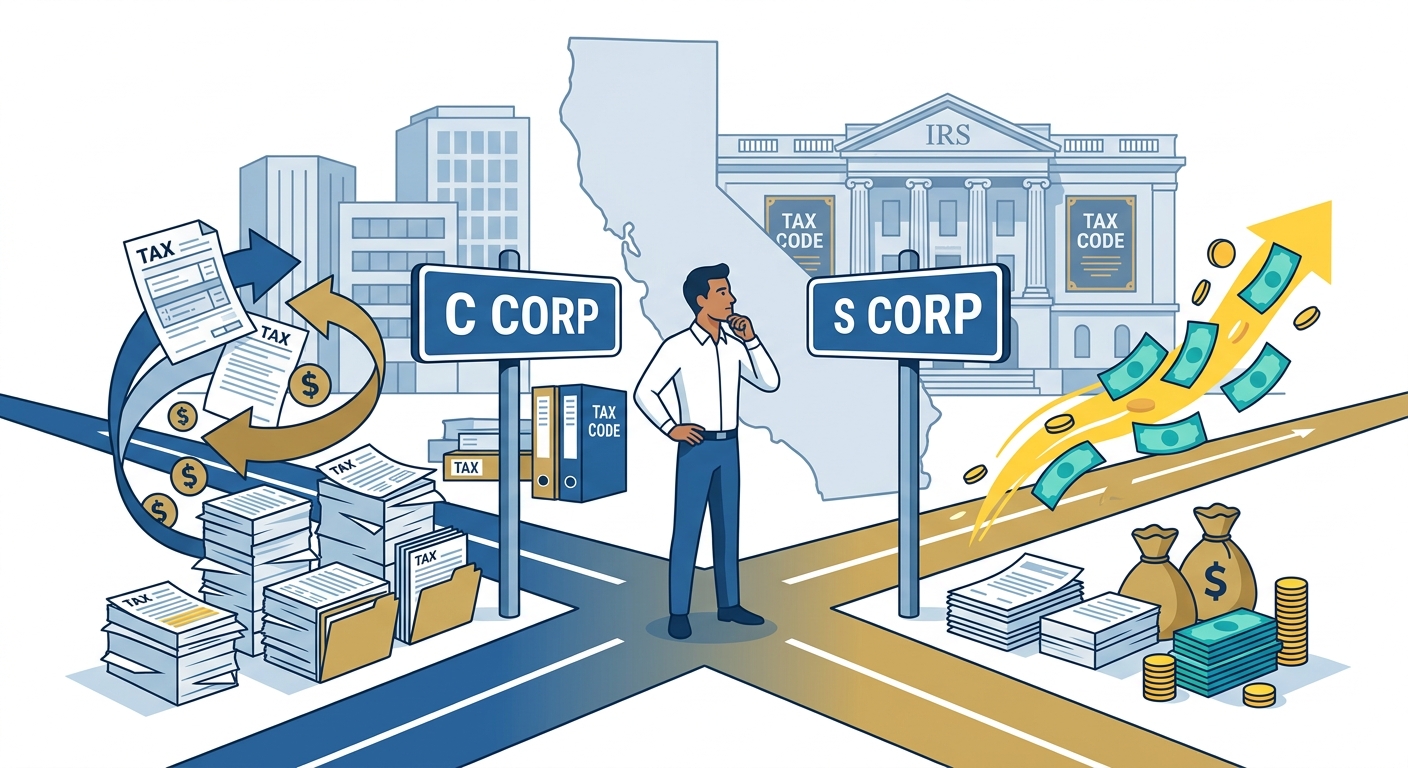
That 2018 S Corp Election You Skipped Is Still Costing You $12,000 to $48,000 Every Single Year
Thousands of California C Corp owners started thinking about converting c corp to s corp 2018 when the Tax Cuts and Jobs Act (TCJA) dropped the corporate rate to 21% and introduced the Section 199A qualified business income deduction. Many of them decided to wait. Some got bad advice. Others simply never filed Form 2553. And now, eight years later, they are still trapped in a double-taxation structure that bleeds $12,000 to $48,000 per year in unnecessary federal, state, and self-employment taxes.
If you were one of the business owners who considered converting c corp to s corp 2018 and never pulled the trigger, this is your wake-up call. The window did not close. The savings did not shrink. In fact, under the One Big Beautiful Bill Act (OBBBA) signed into law in 2025, the math has shifted even further in favor of S Corp status for the vast majority of California business owners earning between $80,000 and $500,000 in annual profit.
Quick Answer
Converting from a C Corp to an S Corp eliminates double taxation by passing profits directly to shareholders on their personal returns. Business owners who delayed their 2018 conversion have collectively lost tens of thousands in avoidable taxes. The conversion process requires Form 2553 filed with the IRS, and California business owners must navigate additional state traps including the 1.5% net income franchise tax, bonus depreciation nonconformity, and the built-in gains (BIG) tax under IRC Section 1374. The OBBBA made the QBI deduction permanent at 20% for qualifying S Corp income, making the conversion math even more favorable in 2026 and beyond.
Why Converting C Corp to S Corp 2018 Was the Right Call Then and an Even Better Call Now
The TCJA created a unique moment in tax planning history. Before 2018, the top corporate rate sat at 35%. After the TCJA passed, it dropped to 21%. That single change made C Corps look attractive on paper, because 21% is lower than the top individual rate of 37%. But that surface-level comparison ignores the second layer of taxation that hammers every C Corp owner who pulls money out of the business.
Here is the math on $200,000 in business profit for a California business owner:
C Corp Double Taxation (2026 Rules)
- Federal corporate tax at 21%: $42,000
- California franchise tax at 8.84%: $17,680
- Remaining after entity-level tax: $140,320
- Federal qualified dividend tax at 20%: $28,064
- Net Investment Income Tax (NIIT) at 3.8%: $5,332
- California personal tax on dividends at ~9.3%: $13,050
- Total combined tax: $106,126
S Corp Pass-Through Taxation (2026 Rules)
- Reasonable salary of $80,000 with payroll taxes (employer + employee): $12,240
- Federal income tax on $200,000 pass-through (after QBI deduction): ~$31,400
- California income tax at ~9.3%: $18,600
- California franchise tax at 1.5%: $3,000
- Total combined tax: $65,240
Annual gap: $40,886.
That gap has existed every year since 2018. A business owner who delayed their conversion has potentially left $245,000 to $325,000 on the table over eight years, depending on their profit level and distribution patterns. Many business owners simply did not realize how severely double taxation would compound over time, especially in a high-tax state like California.
The QBI Deduction Makes the S Corp Advantage Permanent
One of the biggest concerns in 2018 was whether the Section 199A qualified business income (QBI) deduction would survive past its original 2025 sunset. That deduction allows S Corp owners to exclude 20% of their qualified business income from federal taxation. Under the OBBBA, the QBI deduction is now permanent. That means the S Corp advantage is not going away.
On $200,000 in S Corp profit, the QBI deduction shelters $40,000 from federal income tax, saving roughly $8,800 to $14,800 depending on your marginal bracket. C Corp owners get zero QBI benefit. For a deeper breakdown of how the QBI deduction interacts with S Corp strategy, see our comprehensive S Corp tax strategy guide.
The Built-In Gains Tax Trap: What You Need to Know Before Converting
The single biggest obstacle to converting c corp to s corp 2018 or any other year is the built-in gains (BIG) tax under IRC Section 1374. This is the IRS mechanism that prevents C Corp owners from converting to S Corp status simply to dodge corporate-level tax on appreciated assets.
Here is how it works. When your C Corp converts to an S Corp, the IRS takes a snapshot of every asset’s fair market value on the conversion date. The difference between fair market value and tax basis is called the net unrealized built-in gain (NUBIG). If the S Corp sells any of those appreciated assets within five years of conversion, it owes a 21% entity-level BIG tax on the recognized gain, in addition to the regular pass-through tax the shareholders pay.
BIG Tax Math Example
Suppose your C Corp owns commercial real estate with a tax basis of $300,000 and a fair market value of $700,000 on the conversion date. The NUBIG is $400,000. If you sell that property within five years, here is the damage:
- BIG tax at 21%: $84,000
- California corporate-level tax at 1.5%: $6,000
- Federal pass-through tax on gain at ~32%: $128,000
- California personal tax on gain at ~13.3%: $53,200
- Total tax on the sale: $271,200
Without the BIG tax, you would owe approximately $181,200. That $90,000 difference is the penalty for selling appreciated assets too soon after conversion.
Five Strategies to Minimize or Eliminate BIG Tax Exposure
- Wait out the five-year recognition period. If you have no immediate plans to sell appreciated assets, the BIG tax becomes irrelevant after five years. This is the simplest and most common approach.
- Use C Corp NOL carryforwards to offset BIG tax. Under IRC Section 1374(b)(2), any net operating loss carryforwards from C Corp years can directly reduce the BIG tax. If your C Corp accumulated $150,000 in NOLs, that shelters $150,000 of built-in gains from the 21% entity-level tax.
- Apply the net built-in gain limitation. The BIG tax only applies up to the total NUBIG amount. If your NUBIG was $400,000 and you already triggered $300,000 in prior years, only $100,000 remains exposed.
- Defer gains using installment sales under IRC Section 453. Structuring the sale as an installment note can spread the gain recognition beyond the five-year window, reducing or eliminating BIG tax exposure.
- Use the taxable income limitation under Section 1374(d)(7). BIG tax cannot exceed the S Corp’s taxable income for that year. If your S Corp reports only $50,000 in taxable income during a year you sell an appreciated asset, the BIG tax is capped at 21% of $50,000 ($10,500), regardless of the actual built-in gain recognized.
Want to see how different profit levels affect your conversion math? Plug your numbers into this small business tax calculator to estimate the gap between C Corp and S Corp taxation at your income level.
The Five Costliest Mistakes Business Owners Make When Converting C Corp to S Corp
After reviewing hundreds of conversion cases over the past eight years, these are the errors that cost California business owners the most money.
Mistake 1: Ignoring Accumulated Earnings and Profits (AE&P)
When your C Corp converts to an S Corp, the retained earnings do not disappear. They become accumulated earnings and profits (AE&P) that follow the entity into its new S Corp life. Under IRC Section 1368, distributions from an S Corp with AE&P follow a three-layer ordering system: first from the accumulated adjustments account (AAA), then from AE&P (taxed as dividends), and finally as a return of basis. If your AAA balance runs dry before your AE&P is purged, every dollar distributed gets taxed as a qualified dividend at 20% federal plus 3.8% NIIT plus California’s rate.
The fix: file an AAA bypass election under IRC Section 1368(e)(3) to deliberately distribute from AE&P and purge it in a controlled, low-bracket year. Or execute a deemed dividend strategy to clear AE&P without moving cash.
Mistake 2: Missing the March 15 Filing Deadline for Form 2553
Form 2553, Election by a Small Business Corporation, must be filed by March 15 of the year you want the S Corp election to take effect. Miss this date, and you remain a C Corp for the entire calendar year. Many business owners who considered converting c corp to s corp 2018 missed the deadline and then never circled back. That single missed date has cost some owners $200,000 or more over the past eight years.
If you missed a prior deadline, late election relief under Revenue Procedure 2013-30 may still apply. The IRS grants simplified relief if you can demonstrate reasonable cause and the entity has been operating as an S Corp in practice.
Mistake 3: Failing to Set a Reasonable Salary
The IRS requires every S Corp owner who materially participates in the business to take a reasonable salary. “Reasonable” means comparable to what you would pay someone else to do your job. Setting the salary too low triggers reclassification of distributions as wages, plus back payroll taxes, penalties, and interest. Setting it too high eliminates the self-employment tax savings that make the S Corp election worthwhile.
For a business earning $200,000 in profit, a reasonable salary in the $70,000 to $90,000 range is defensible for most professional services. The remaining $110,000 to $130,000 passes through as distributions, free from the 15.3% self-employment tax.
Mistake 4: Not Accounting for California’s Bonus Depreciation Nonconformity
California does not conform to federal bonus depreciation rules under R&TC Sections 17250 and 24356. The OBBBA restored 100% bonus depreciation at the federal level, but California still requires standard MACRS depreciation schedules. This creates a dual depreciation tracking requirement that most business owners and their accountants miss entirely. The result: incorrect California taxable income, wrong franchise tax payments, and FTB audit exposure.
Additionally, California caps Section 179 at $25,000 with a $200,000 phase-out threshold, compared to the federal limit of $2,500,000 under OBBBA. If you purchased $150,000 in equipment and deducted the full amount federally under Section 179, California only allows $25,000 of that deduction. The remaining $125,000 must be depreciated over the standard MACRS recovery period on your California return.
Mistake 5: Converting Without Professional BIG Tax Analysis
Converting without a formal NUBIG analysis is like crossing a minefield blindfolded. You need a qualified tax professional to appraise every asset on the conversion date, document the fair market value, calculate the NUBIG, and create a five-year asset management plan. Skipping this step exposes you to surprise BIG tax bills that can reach six figures.
Our entity formation services include comprehensive BIG tax analysis and conversion planning to ensure you do not walk into avoidable traps.
KDA Case Study: Bakersfield Manufacturing Owner Recovers $187,000 in Lost Savings After Delayed Conversion
Carlos ran a precision machining company in Bakersfield as a C Corp since 2012. In early 2018, his previous CPA mentioned converting to an S Corp but warned about the BIG tax and suggested waiting. Carlos waited. And waited. For eight years, he paid double taxation on $175,000 to $240,000 in annual profit.
When Carlos came to KDA in late 2025, we ran the numbers. His C Corp had $380,000 in accumulated earnings and profits, $67,000 in net operating loss carryforwards from a rough year in 2020, and equipment with a total NUBIG of $142,000. His annual tax overpayment versus S Corp status: $34,200 per year.
Here is what we did:
- Filed Form 2553 with a January 1, 2026 effective date
- Applied the $67,000 NOL carryforward against the NUBIG to reduce BIG tax exposure by $14,070
- Created a five-year asset disposition plan to defer any asset sales beyond the recognition period
- Executed a controlled AE&P purge using the AAA bypass election, distributing $95,000 in AE&P as qualified dividends in a year Carlos had offsetting deductions
- Filed AB 150 PTE election to bypass the $40,000 SALT cap on Carlos’s California return
- Set reasonable salary at $82,000 based on BLS data for manufacturing executives in Kern County
Year one results: Carlos saved $38,400 in combined federal and California taxes. His KDA engagement cost $4,800. That is an 8.0x first-year ROI, with projected five-year savings of $187,000 after accounting for the AE&P purge and BIG tax navigation.
Ready to see how we can help you? Explore more success stories on our case studies page to discover proven strategies that have saved our clients thousands in taxes.
OBBBA Changes That Make the 2026 Conversion Even More Attractive
The One Big Beautiful Bill Act, signed in 2025, introduced several permanent changes that widen the gap between C Corp and S Corp taxation. Here is what matters most for business owners still stuck in C Corp status:
Permanent QBI Deduction
The Section 199A qualified business income deduction was scheduled to expire after 2025. Under OBBBA, it is now permanent. S Corp owners earning $200,000 in qualified business income deduct $40,000 before computing federal tax. C Corp owners get nothing.
100% Bonus Depreciation Restored
Bonus depreciation had been phasing down (80% in 2023, 60% in 2024, 40% in 2025). The OBBBA restored it to 100% permanently. S Corp owners can fully deduct qualifying asset purchases in year one on their federal returns. Remember, California does not conform, so you still need dual depreciation schedules.
$40,000 SALT Cap
The state and local tax deduction cap increased from $10,000 to $40,000 under OBBBA. For California S Corp owners filing the AB 150 pass-through entity (PTE) election, this cap can be bypassed entirely. C Corp owners do not have access to the PTE election because the franchise tax is already deductible at the entity level, but the interaction with personal state taxes is less favorable.
$2,500,000 Section 179 Limit
The federal Section 179 expensing limit doubled to $2,500,000 under OBBBA. S Corp owners who purchase qualifying equipment, vehicles, or machinery can deduct the full cost in year one federally. California’s $25,000 cap still applies, creating a significant state-level gap that requires careful planning.
California-Specific Traps That Catch Unprepared Converters
Converting c corp to s corp 2018 or 2026 in California requires navigating state-level complications that do not exist in most other states.
The 8.84% to 1.5% Franchise Tax Shift
C Corps pay California franchise tax at 8.84% of net income. S Corps pay 1.5% of net income, with a minimum of $800. On $200,000 in profit, that is $17,680 vs. $3,000. The $14,680 annual savings at the state entity level alone justifies the conversion for most profitable businesses.
AB 150 Pass-Through Entity Election
California’s AB 150 allows S Corps to elect to pay a 9.3% entity-level tax on qualified net income. This entity-level payment is fully deductible on the federal return, effectively bypassing the $40,000 SALT cap. For S Corp owners in high tax brackets, this election saves $8,000 to $25,000 per year in federal taxes. C Corp owners cannot use this election because the corporate franchise tax is not a pass-through entity tax.
Dual Depreciation Schedule Requirement
Because California does not conform to federal bonus depreciation or the expanded Section 179 limits, every S Corp in California must maintain two separate depreciation schedules: one for federal and one for state. Failing to track both leads to incorrect California taxable income, wrong FTB payments, and audit risk. Most off-the-shelf accounting software does not handle this automatically, which is why working with a California-focused tax firm matters.
The $800 Minimum Franchise Tax Timing Trap
California imposes an $800 minimum franchise tax on both C Corps and S Corps. During a conversion year, you could owe the C Corp franchise tax for the first part of the year and the S Corp franchise tax for the remainder, depending on your election effective date. Filing the S Corp election effective January 1 avoids this overlap entirely.
Step-by-Step: How to Convert Your C Corp to S Corp in California in 2026
If you have been putting this off since 2018, here is the exact process to execute the conversion now:
- Verify S Corp eligibility under IRC Section 1361. Your corporation must have 100 or fewer shareholders, only one class of stock, no nonresident alien shareholders, and no corporate or partnership shareholders. Most single-owner or family-owned C Corps qualify automatically.
- Conduct a NUBIG analysis. Hire a qualified tax professional to appraise all assets at fair market value and calculate the total net unrealized built-in gain. Document everything. This analysis is your defense against IRS challenges during the five-year recognition period.
- Evaluate and purge AE&P if possible. If your C Corp has significant accumulated earnings and profits, consider distributing them as qualified dividends before the conversion date. This avoids the complicated three-layer distribution ordering system under IRC Section 1368.
- File Form 2553 by March 15, 2026. For a January 1, 2026 effective date, the form must reach the IRS by March 15, 2026. If you have already missed this deadline, file with a reasonable cause statement under Revenue Procedure 2013-30 for late election relief.
- Notify the California Franchise Tax Board. File California Form 100S (S Corporation Franchise or Income Tax Return) for the first S Corp tax year. Also file Form 3560 to confirm the state-level S Corp election.
- Set up payroll for shareholder-employees. Every shareholder who materially participates must receive a reasonable salary with proper W-2 reporting, payroll tax withholding, and quarterly deposits.
- Establish dual depreciation schedules. Create separate federal and California depreciation tracking for all existing and future assets. Federal schedules will reflect 100% bonus depreciation under OBBBA. California schedules will use standard MACRS with the $25,000 Section 179 cap.
- File the AB 150 PTE election. If your S Corp’s California income exceeds $50,000, evaluate whether the pass-through entity election saves federal taxes by bypassing the SALT cap.
Should You Convert? The Decision Framework
| Factor | Convert to S Corp | Stay as C Corp |
|---|---|---|
| Annual profit | $60,000 to $500,000 | Under $40,000 or over $1M with retention |
| Distribution plans | Owner takes most profits out | Retaining earnings for long-term growth |
| Fundraising needs | No outside investors needed | VC/PE funding requiring preferred stock |
| Exit timeline | No sale planned within 5 years | QSBS Section 1202 exclusion possible |
| Shareholder count | Under 100 shareholders | Over 100 or includes foreign shareholders |
| NUBIG exposure | Low or manageable with planning | Massive appreciated assets with near-term sales |
| California presence | Saves 7.34% on franchise tax rate | Only if QSBS or VC exceptions apply |
Key Takeaway: If you are a California business owner earning $60,000 to $500,000 in annual profit and you plan to distribute most of that income to yourself, the S Corp election saves you $8,000 to $48,000 per year. Delaying another year adds that amount to the pile of money you have already lost.
What If You Missed the 2026 Deadline?
If March 15, 2026 has already passed and you did not file Form 2553, you are not necessarily stuck as a C Corp for the rest of the year. The IRS grants late election relief under Revenue Procedure 2013-30 if you meet four requirements:
- The entity intended to be classified as an S Corp as of the intended effective date
- The entity failed to qualify solely because it did not file Form 2553 on time
- The entity has reasonable cause for the late filing
- Less than three years and 75 days have passed since the intended effective date
Acceptable reasonable cause statements include: reliance on a tax professional who failed to file, lack of awareness of the filing requirement, death or serious illness of the shareholder or officer responsible for filing, and postal service errors. The IRS approval rate for reasonable cause filings under Rev. Proc. 2013-30 is high when the documentation is solid.
Ready to Reduce Your Tax Bill?
KDA Inc. specializes in strategic tax planning for business owners, S Corps, LLCs, and high-net-worth individuals. Book a personalized consultation and walk away with a clear plan.
Frequently Asked Questions
Can I still convert my C Corp to an S Corp in 2026 if I originally considered converting in 2018?
Yes. There is no statute of limitations on when you can elect S Corp status. The conversion process is the same whether you file in 2018 or 2026. File Form 2553 by March 15 of the year you want the election to take effect, or file with reasonable cause for late election relief if you have missed the deadline.
Will I owe BIG tax on assets my C Corp purchased after 2018?
The BIG tax applies based on the conversion date, not 2018. Only assets with built-in gains as of the date you actually convert are subject to the five-year recognition period under IRC Section 1374. Assets purchased after conversion have no BIG tax exposure.
Does California impose its own BIG tax?
California does not impose a separate BIG tax, but the 1.5% S Corp franchise tax applies to all net income, including built-in gains recognized during the recognition period. The combined federal BIG tax plus California franchise tax plus personal pass-through taxes can create a significant total burden if you sell appreciated assets within five years.
How much does the conversion process cost?
Professional fees for a straightforward C Corp to S Corp conversion typically range from $2,500 to $8,000, depending on the complexity of the NUBIG analysis, AE&P evaluation, and state filing requirements. Most California business owners recoup this investment within 60 to 90 days of the election taking effect through reduced tax payments.
What happens to my C Corp NOLs when I convert?
Net operating loss carryforwards from C Corp years become frozen under IRC Section 1371(b). They cannot offset S Corp pass-through income. However, they can offset BIG tax under Section 1374(b)(2), which makes them valuable during the five-year recognition period. They can also be used if you ever revert to C Corp status.
This information is current as of April 8, 2026. Tax laws change frequently. Verify updates with the IRS or FTB if reading this later.
Book Your C Corp to S Corp Conversion Strategy Session
If you have been running your California business as a C Corp since 2018 or earlier and you know the double taxation is draining your profits, stop waiting for a better time. There is no better time. Every month you delay costs you another $1,000 to $4,000 in unnecessary taxes. Book a personalized conversion strategy session with our team. We will analyze your NUBIG exposure, map your AE&P purge options, set your reasonable salary, and file every form correctly the first time. Click here to book your consultation now.


