
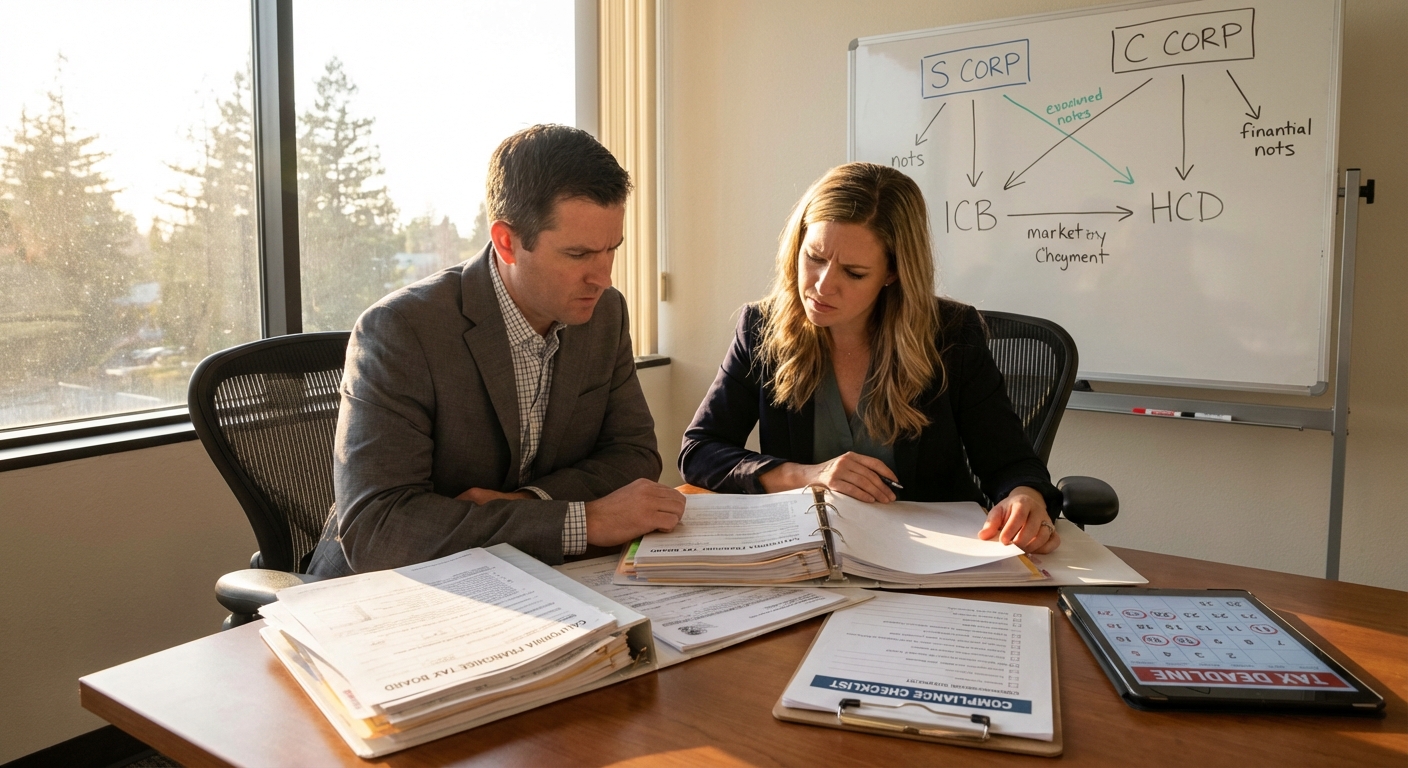
Conversion of S Corp to C Corp in 2026: The California Survival Blueprint for Founders, LLCs, and Investors
If you’re a California business owner or real estate investor, you’ve likely wondered when to trade your S Corp pass-through perks for the sheer scale (and risk) of a C Corp. Here’s the reality few advisors will spell out: mishandling this move can trigger six-figure tax bills, disqualify years of deductions, and attract an IRS audit in 2026. Yet, for the right entity, a well-timed conversion of S Corp to C Corp can accelerate exits, attract new capital, and create post-tax cash-outs unthinkable in any other structure—if you know the compliance landmines.
Quick Answer
The conversion of S Corp to C Corp is the process of revoking your S Corporation election and reverting to “C” (standard) corporation taxation, typically done via a written shareholder consent form and IRS notification. In 2026, you must coordinate this move precisely—meeting IRS deadlines, conforming with California FTB paperwork, and triggering built-in gains or accumulated adjustments taxes according to IRS Form 1120 rules. Miss a step or a deadline? Expect penalty interest, loss of critical deductions, or double taxation on current-year profits.
Why Do Companies Convert from S Corp to C Corp in 2026?
The reasons vary—a planned sale to private equity, need for multiple share classes, taking on new investors who aren’t U.S. citizens, or simply outgrowing S Corp limitations. For 2026, the main triggers our team sees include:
- California S Corps exceeding 100 shareholders (IRS S Corp limit)
- Ventures raising new capital from non-resident aliens or institutional investors
- Startups prepping for IPO (can’t use S Corp structure)
- Owners seeking to participate in the federal Qualified Small Business Stock (QSBS) exclusion for long-term C Corp gains
- Major business model changes: mergers, roll-ups with C Corps, or cross-border ops
If you’re an LLC or existing S Corp owner facing one of these triggers, understanding the compliance mechanics and timing is essential. Many business owners fail to anticipate the ripple effect of state taxes, double taxation, or the built-in gains period, resulting in tens of thousands in avoidable tax.
KDA Case Study: Tech Consultant’s S Corp to C Corp Flip Nets $38K in Fresh Deductions
Case: “Calvin,” a California tech consultant, operated a solo S Corp grossing $520,000 in 2024-2025. With new international VC funds circling, Calvin needed a structure that could issue preferred stock and handle non-U.S. shareholders. KDA mapped a phased S Corp-to-C Corp conversion for January 1, 2026.
Our approach:
- Filed shareholder revocation letters (unanimous consent)
- Coordinated IRS notification (per instructions for Form 1120) with confirmation receipt
- Reviewed CA FTB form changes for new 2026 transitions
- Ran built-in gains tax projections—$114K in appreciated assets, but no recognized gains since all assets had been acquired post-2023 (avoiding the 5-year BIG window per IRS Publication 542)
- Redrafted entity bylaws and shareholder agreements
Result: Calvin accessed $38,000 in new C Corp-only fringe benefit deductions in 2026, accelerated a $1.1M capital raise, and avoided $32,700 in built-in gains tax—all for a $6,200 advisory spend. ROI: over 6x in the first year, plus long-term IPO positioning for his sector.
Ready to see how we can help you? Explore more success stories on our case studies page to discover proven strategies that have saved our clients thousands in taxes.
How the Conversion of S Corp to C Corp Really Works in 2026: Step-by-Step
IRS compliance rules for converting from S Corp to C Corp rest on one fact: the S Corp election is simply a tax treatment, not a separate legal entity. Here’s how the switch works under current California and federal law:
- Draft a shareholder revocation statement. Must be signed by owners holding over 50% of outstanding shares. (IRS Reg. §1.1362-2(a))
- File revocation with the IRS. Send to the appropriate IRS Service Center. The timing determines your conversion date: submitted before March 15, 2026? C Corp treatment applies for the 2026 tax year.
- Prepare for built-in gains (BIG) tax period. If your S Corp holds appreciated assets, recognize a potential BIG tax for up to 5 years following conversion (see IRS Pub 542).
- Update California FTB filings. File as a C Corp using Form 100 from the effective year, comply with revised CA apportionment and minimum tax rules.
- Document shareholder notification and bylaw updates. Board resolutions, revised bylaws, and new agreements are mandatory for legal defensibility.
Pro Tip: Strategic year selection is critical. Converting at the wrong point in an appreciation or income cycle can turn tax deferral into a cash-flow crisis.
California Red Flags: What Triggers an Audit During S Corp to C Corp Conversion?
2026 brings a spike in FTB and IRS scrutiny for S-to-C conversions. Here are real audit triggers our team sees:
- Large asset appreciation and no BIG tax calculation attached to IRS or CA filings
- Failure to close payroll/tax accounts under S Corp before converting books to C Corp
- Missing shareholder consent (or incomplete documentation)
- Mismatched state and federal tax year designations
- No update to CA Secretary of State records after conversion
Red Flag Alert: Don’t rely on generic online templates—California’s reporting rules often require more detail and proof of compliance than the IRS minimums.
Key Tax Implications When You Convert from S Corp to C Corp in California
Few taxpayers realize these implications until it’s too late:
- Double taxation returns: C Corps pay tax at the entity level, then owners owe again on dividends (in contrast, S Corp income passes through only once)
- Accumulated Adjustments Account (AAA): Any S Corp distributions not paid out pre-conversion are treated as C Corp dividends—no current deduction or special handling
- Loss of S Corp fringe benefit restrictions: C Corps can deduct officer health insurance, group-term life ($50,000 cap), and other fringe benefits that S Corps cannot
- New compliance burden: More complex accounting, reporting, and risk of state/federal compliance mismatches for multi-entity owners
If you’re converting to fund a growth plan, our entity formation services guide you through CA FTB pitfalls, from minimum tax to apportionment and consolidated filings—often ignored in out-of-state CPA templates.
How Does This Affect Real Estate Investors and LLCs with S Corp Status?
LLCs electing S Corp status are hit hardest because their “S” election is a tax overlay, not a change in entity type. Common real estate investor issues in 2026 include:
- Transferring appreciated property: triggers potential double taxation if held inside a C Corp after conversion
- Inability to “step up” basis like partnerships—profits are more easily trapped in the C Corp
- Loss of some eligibility for QBI (Qualified Business Income) deduction on flow-through real estate earnings
For a full comparative analysis on S Corp, C Corp, and LLC strategies for both California and federal purposes (including detailed tables and checklists for 2026), see our California S Corp tax strategy guide.
What Happens If You Miss the Deadline or Compliance Step?
Timing mistakes are the costliest error we see. If you:
- Miss the March 15, 2026, deadline to file with the IRS, you remain an S Corp through year end (unless the IRS grants retroactive relief—rare and document-intensive)
- Neglect shareholder consent, you risk retroactive penalties and possible IRS/FTB rejection of your conversion
- Don’t report gains as required, IRS may impose interest and penalties on unreported built-in gains
Consult the IRS C Corp filing instructions for correct transition filings and consult California FTB Form 100 instructions for state-specific deadlines and nuances.
Pro Tips for Smooth 2026 Conversions*
- Start stakeholder discussions six months before needed conversion
- Run a complete asset and gain analysis to pre-pay or model built-in gains
- Use a CPA familiar with both CA and federal rules to prepare IRS and FTB notices—don’t use a fill-in-the-blank “conversion template”
- Review old S Corp payroll, health benefits, and state filings to avoid documentation gaps
Key Takeaway: The best conversions are led, not rushed. Every successful S-to-C transition we’ve handled included dedicated pre-planning, forensic compliance checklists, and jet-speed filings during Q1 of the conversion year.
FAQs: S Corp to C Corp Conversion in 2026
Can I convert mid-year or do I have to wait for January 1st?
While you can convert at any time, a mid-year conversion splits your tax year, complicating accounting and causing partial-year pass-through/taxable events. Most experts recommend January 1st conversions to keep your books clean unless a business emergency dictates.
What documentation must I keep?
All shareholder resolutions, IRS/FTB filings, updated bylaws, and proof of notification must be retained for a minimum of seven years per IRS recordkeeping rules.
Will this make me more likely to get audited?
Historically, entity conversions are higher audit-risk events because they involve gain/loss recaps, distribution tracking, and multiple agencies (IRS, FTB, CA Secretary of State). Meticulous paperwork minimizes risk.
What if I don’t want double taxation?
Careful S Corp-to-C Corp planning can harvest last pass-through profits pre-conversion, but from the conversion date on, all future profits face double taxation until you change structure again.
Is the process reversible?
Not easily. After revoking S Corp status, you must generally wait five years before re-electing “S” status, per IRS guidelines.
What Business Owners Should Do Next
This information is current as of 2/8/2026. Tax laws change frequently. Verify updates with the IRS or FTB if reading this later.
If your company is considering a significant restructuring in 2026—or you’re even remotely thinking about the conversion of S Corp to C Corp—this decision demands forensic planning and IRS-grade documentation. The margin for error is razor-thin, but executed right, the potential upside for liquidity events, fundraising, or legacy business planning is unmatched.
Book Your Entity Conversion Strategy Session
Don’t let a compliance mistake or mistimed conversion wipe out your hard-earned gains. Book a private strategy session with KDA’s advanced entity team and get a clear, step-by-step roadmap—customized to your exit, investment, or growth goals. Click here to schedule your session now.


