
This information is current as of 5/14/2026. It covers federal rules and key California issues for closely held corporations.
Plenty of profitable C corporations made a quick decision in 2018, stayed put, and have been leaking cash to double taxation ever since. If your company is still taxed as a C corporation, the rules that pushed owners toward S corporation status in 2018 may be quietly costing you five figures every year.
The good news is that the core mechanics that drove many owners to consider a conversion from c corp to s corp 2018 are still available today. With the right timing and structure, you can often shift future profits into a more favorable S corporation regime and keep more of what you earn, while staying on the right side of the IRS and the California Franchise Tax Board.
Quick answer: what changing from a C corporation to an S corporation really does
Switching from C to S status is not about forming a brand new entity. It is a federal tax election that tells the IRS to stop taxing the company at the corporate level and to start taxing shareholders directly through Schedule K 1 on Form 1120 S.
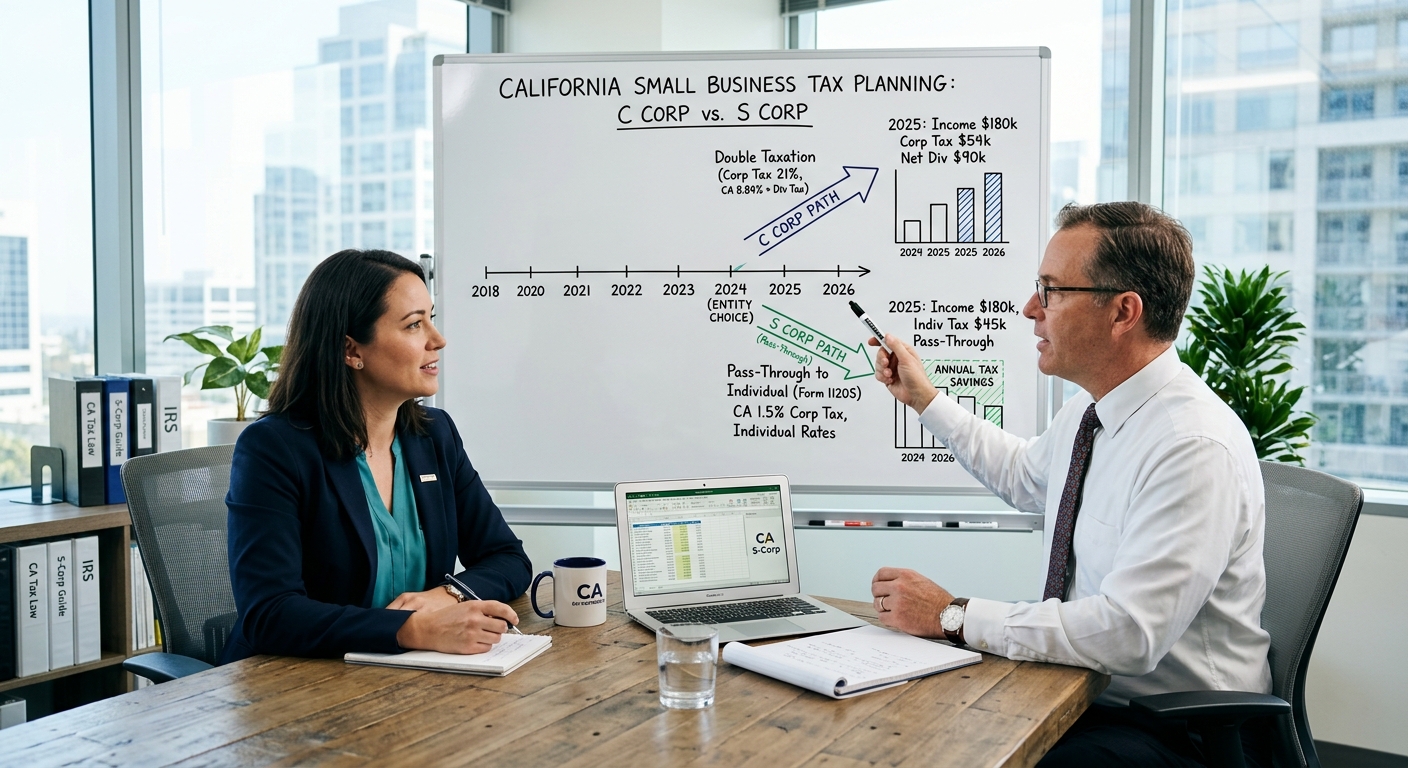
For a typical California owner operator with 300,000 dollars in annual profit, staying a C corporation often means a 21 percent federal corporate tax plus 8.84 percent California corporate tax before you even look at shareholder dividends. An S corporation can instead push most of that profit through to you once, often with a mix of W 2 salary and shareholder distributions. Salary is subject to payroll tax, but distributions are generally not, which reduces exposure to Social Security and Medicare tax and eliminates federal double taxation.
Bottom line: if your corporation is consistently profitable and you plan to pull cash out for yourself, remaining a C corporation after 2018 is rarely the most tax efficient answer.
Why the conversion from C corp to S corp 2018 rules still matter in 2026
In 2018, two things happened at the same time. First, the Tax Cuts and Jobs Act made the flat 21 percent corporate rate permanent for C corporations until Congress changes it. Second, the qualified business income deduction under section 199A gave many pass through owners a deduction of up to 20 percent of their business income. That combination forced serious conversations about whether a C corporation still made sense for closely held businesses.
The IRS did not create a brand new process in 2018. The same basic S election framework has existed for decades. What changed was the math. Since then, owners who stayed C corporations have often watched more cash leave the business in taxes than their S corporation peers with similar revenue and profit profiles.
For example, compare two California companies each with 400,000 dollars of pre tax profit owned by a single shareholder. The C corporation might pay roughly 120,000 dollars combined in federal and California corporate income tax, then the shareholder pays another layer of tax on dividends. The S corporation might pay the owner a 150,000 dollar salary and treat 250,000 dollars as distributions. Payroll tax applies only to the salary. Federal and California income tax still apply, but there is no second corporate layer, and the owner may qualify for a section 199A deduction. The difference in annual after tax cash can easily exceed 30,000 dollars.
If you are an established corporation, you do not need to guess whether S status is better. For California based business owners, we often model both scenarios over a five year window and compare cash flow, owner compensation, and exit planning goals before filing anything with the IRS.
For a deeper dive into California specific S corporation strategy, see our comprehensive S Corp tax guide for California owners, then come back to this article for the conversion details.
Step by step: how to convert from a C corporation to an S corporation today
The federal conversion process is more paperwork and timing than magic. At a high level, you are telling the IRS that the existing corporation wants to be treated as an S corporation as of a specific effective date.
Step 1: confirm that you are eligible for S corporation status
The IRS sets strict eligibility rules. According to IRS Publication 542 and the Form 2553 instructions, your corporation must:
- Be a domestic corporation
- Have no more than 100 shareholders
- Have only allowable shareholders, such as individuals, certain trusts, and estates
- Have only one class of stock
- Not be an ineligible corporation such as certain financial institutions or insurance companies
If you have multiple share classes, foreign shareholders, or complex investor structures, you need clean up work before an election is realistic. That is where specialized entity formation and restructuring services become critical, especially in California where state level rules add another layer.
Step 2: choose the effective date and coordinate with your tax calendar
Most owners want the S election to start on the first day of a tax year so that the entire year is reported as S corporation activity. For calendar year corporations, that means an effective date of January 1. You generally file Form 2553 no later than two months and 15 days after that date. For a 2026 election, that deadline is March 15, 2026, unless you qualify for late election relief.
If your facts require a mid year switch, you may need to file a separate return as a C corporation for the early part of the year and then an 1120 S for the rest. That can be worth it in limited cases but requires precise bookkeeping on earnings, distributions, and built in gains.
Step 3: file Form 2553 correctly the first time
Form 2553 is only four pages long, but it requests detailed shareholder information, consents, and an explanation if you are filing late. The IRS expects signatures from all shareholders and specific language if you want the election to be effective for a prior year.
Red flag alert: sloppy or incomplete Form 2553 filings are one of the fastest ways to delay your election or invite IRS questions. If you are trying to make your election effective back to 2018 or another prior year, you will lean heavily on the late election rules and you do not want to improvise this explanation.
Step 4: update your state and local filings
California generally respects the federal S election, but it still imposes its own S corporation tax. As of this writing, most California S corporations pay a 1.5 percent tax on net income with an 800 dollar minimum franchise tax. You also need to start filing Form 100 S instead of Form 100, and possibly update payroll registrations and estimated tax schedules.
According to the Franchise Tax Board, missing or incorrect California elections can lead to penalties or a default back to C corporation treatment at the state level. That is why we always coordinate federal and state elections together when we handle a conversion.
Step 5: rework your compensation and distribution strategy
Once you are an S corporation, you have two main levers for cash to the owner: W 2 wages and shareholder distributions. The IRS wants you to pay a reasonable salary for the work you perform. Pay too little, and you risk payroll tax adjustments and penalties. Pay too much, and you give up the payroll tax savings that make the S corporation attractive in the first place.
Pro tip: before you finalize an S election, model your new salary and distribution mix using a small business tax calculator that compares self employment tax, payroll tax, and income tax outcomes across structures.
KDA case study: C corp owner stops double taxation with an S election
Consider Maria, who owns a marketing agency in Los Angeles that has operated as a C corporation since 2012. By 2018, the business was generating around 450,000 dollars per year in pre tax profit. Her prior accountant told her that the new 21 percent corporate rate meant she should stay a C corporation. She paid herself a 180,000 dollar salary and took irregular dividends when cash allowed.
By 2024, Maria felt like she was working harder and keeping less. When she came to KDA, we reviewed the last several years of returns and modeled what life would have looked like with an S election effective in 2018 versus staying C. On average, she was losing about 28,000 dollars per year in combined federal and California tax when you included both corporate and personal level taxes.
We helped Maria clean up her shareholder ledger, confirm eligibility, and file a late S election with an effective date of January 1, 2025, supported by the relief provisions in Revenue Procedure 2013 30. We also recalibrated her compensation package. Instead of a 180,000 dollar salary and random dividends, she moved to a 150,000 dollar salary plus 250,000 dollars in planned distributions.
Result in the first full S year: roughly 19,000 dollars in reduced overall tax, even after accounting for California S corporation tax and updated payroll. Our advisory fee for the planning and implementation work was about 6,500 dollars, giving Maria almost a 3 to 1 first year return on investment, with similar savings projected each year going forward.
Ready to see how we can help you? Explore more success stories on our case studies page to discover proven strategies that have saved our clients thousands in taxes.
Common mistakes that create problems when you convert from C to S
Converting from C to S status is not just a form. There are ongoing accounting and reporting rules that many owners and even some preparers miss. Here are three traps that often cause headaches.
Ignoring built in gains tax and appreciated assets
If your C corporation owns appreciated assets such as real estate, equipment, or intangible property, the IRS may impose a built in gains tax if you sell those assets within a specified recognition period after converting to S status. Historically this period has been around five years, although Congress has adjusted it at times. Failing to plan around that window can wipe out part of the expected benefit of the election.
Not tracking C corporation earnings and profits
After you become an S corporation, the tax character of distributions can depend on your accumulated adjustments account and your C corporation level earnings and profits. Distributions that exceed your S corporation basis and accumulated adjustments account can still be taxed as dividends if you have old C corporation earnings and profits.
In plain language, that means you cannot just flip a switch and assume every dollar you take out is a clean S corporation distribution. Someone needs to maintain the C corporation earnings and profits schedule and track basis going forward, or you risk misclassifying distributions.
Forgetting California requirements and minimum tax
California S corporations continue to owe the 800 dollar minimum franchise tax, even in loss years. They also owe the 1.5 percent tax on net income. Some owners are surprised that their total California liability does not drop as much as their federal bill after the conversion. The planning still often makes sense, but you need realistic expectations before you file.
Red flag alert: a poorly planned C to S conversion can trigger IRS or FTB scrutiny if distributions spike, salaries look unreasonably low, or built in gains rules are ignored. A strategic plan plus clean documentation is what separates successful conversions from audit bait.
How the 2018 timing rules and late election relief work now
Many owners heard about making an S election effective as of 2018 but either missed the deadline or filed Form 2553 incorrectly. The IRS has long allowed certain late elections when the corporation can show reasonable cause and meets specific requirements outlined in Revenue Procedure 2013 30 and related guidance.
In practice, that means you may still have a path to treat earlier years as S corporation years, but the window is not unlimited. The statute of limitations on older returns and the details of your shareholder changes, stock classes, and distributions all matter. The further you get from 2018, the more surgical the analysis needs to be.
If you are thinking about retroactive treatment, expect your advisor to:
- Review all corporate returns filed since the year you want as the effective S year
- Analyze shareholder changes, stock issuances, and redemptions
- Rebuild financial statements and distribution history to support reasonable cause
- Draft a narrative that fits within the late election relief framework rather than a generic story
This is not a do it yourself letter. The dollar amounts involved with multiple years of double taxation and payroll tax can be large enough that a detailed professional submission is worth every penny.
How much can a C to S conversion really save you
Rules and forms matter, but what most owners care about is cash. Here is a simplified example that captures the order of magnitude.
Assume your California corporation has 350,000 dollars in pre tax profit and you want to pull out 250,000 dollars per year for personal use.
- C corporation scenario: The corporation pays roughly 21 percent federal corporate tax and 8.84 percent California corporate tax. On 350,000 dollars of profit, that is about 104,740 dollars in combined corporate level tax. If the remaining cash is distributed as dividends, you pay another layer of federal and California tax at your individual rates, often 15 to 23.8 percent federally plus state. Your combined bill can easily land north of 140,000 dollars.
- S corporation scenario: The corporation pays you a 140,000 dollar W 2 salary and treats 210,000 dollars as distributions. Payroll tax applies to the salary, and you pay federal and state income tax on all 350,000 dollars of pass through income. There is no federal corporate level tax, and California tax is limited to the 1.5 percent S corporation rate plus your personal California income tax. Total combined taxes might land closer to 110,000 to 115,000 dollars depending on your bracket and section 199A deduction eligibility.
The difference in this simplified example is in the range of 25,000 to 30,000 dollars per year. Multiply that over five years, and you are talking about six figure savings, before even considering exit planning or selling the company.
Key takeaway: the C versus S decision is not theoretical. It shows up as very real cash flow every year. Getting the structure wrong can easily cost more than any advisory fee to analyze and fix it.
Will converting from C to S increase your audit risk
Any structural change attracts a bit more attention than filing the same return year after year. That said, a well executed conversion does not automatically place a target on your back. The IRS and California are far more interested in abusive patterns than legitimate tax planning.
Staying within the lines looks like this:
- Paying a defensible salary backed by market data and job duties
- Documenting the business reasons for the election in corporate minutes
- Tracking built in gains and C corporation earnings and profits carefully
- Keeping consistent books that reconcile to filed returns
- Filing Form 2553 and California forms correctly and on time
According to IRS enforcement statistics discussed in various reports, small corporations are more often flagged for unreported income or extreme deductions than for simply being S corporations. Where owners get into trouble is treating S status as a license to ignore payroll tax or to run personal spending through the business, not for making the election itself.
If you structure the conversion with those realities in mind, you can enjoy the tax benefits while keeping audit risk manageable.
Ready to Reduce Your Tax Bill?
KDA Inc. specializes in strategic tax planning for business owners, S Corps, LLCs, and high-net-worth individuals. Book a personalized consultation and walk away with a clear plan.
Frequently asked questions about converting from C to S status
Do I need to dissolve my existing C corporation to become an S corporation
No. In most cases you keep the same legal entity, EIN, bank accounts, and contracts. You are changing how the IRS and California tax that entity, not forming a brand new company. Your attorney may still recommend updating bylaws or shareholder agreements to align with the new structure.
What if I missed the S election deadline for this year
You still have options. If you are within two months and 15 days of the start of the tax year you want, you can usually file a timely Form 2553. If you are later than that, late election relief under Revenue Procedure 2013 30 or similar guidance may be available if you meet specific criteria. The sooner you address it, the more options you generally have.
Can a corporation with prior losses benefit from an S election
Yes, but the analysis is different. If your corporation has net operating losses as a C corporation, you need to evaluate how those losses carry forward and how an S election affects them. Sometimes it is better to use up C corporation losses first, then elect S status once you are solidly profitable. This is where scenario modeling and coordination with your overall tax plan become essential.
Is an S corporation always better than a C corporation after 2018
No. High growth businesses that plan to reinvest profits or seek outside investors may still prefer C corporation status, especially in industries where venture capital expects that structure. The owner operator with steady profits and a plan to distribute cash is the classic S corporation candidate. The right answer depends on your exit strategy, investor base, and time horizon.
How does this affect my personal tax return
As a C corporation shareholder, you typically report only wages and dividends on your Form 1040. As an S corporation shareholder, you report wages plus your share of corporate income, deductions, and credits on Schedule E via the Schedule K 1 from Form 1120 S. That often increases the complexity of your individual return but can significantly reduce your total tax burden when planned correctly.
The IRS is not hiding these savings. The rules are in public view, but most owners were never taught how to line up the math, the forms, and the timing so the structure actually works for them.
Book your S corp conversion strategy session
If you are still carrying a C corporation that probably should have elected S status in 2018, the cost of doing nothing compounds every year. A focused review can quantify your potential savings, map out timing, and flag any built in gains or California issues before you pull the trigger.
If you want a clear, action oriented plan tailored to your numbers, income goals, and exit timeline, our team can run the scenarios and guide the filings. Click here to book your consultation now.



