
Quick Answer
Real estate tax planning Clarkdale AZ is the process of legally structuring how you buy, hold, depreciate, and sell property in Clarkdale and the greater Yavapai County so you keep more of your rental and appreciation income. In plain English, it means using depreciation, cost segregation, entity structuring, and 1031 exchanges to shrink your tax bill before April rather than reacting after the fact. Done right, a typical Clarkdale investor with two rentals can defer or eliminate $8,000 to $30,000 in taxes per year.
If you own income property in the Verde Valley or you are eyeing your first short-term rental near the wine trail, smart real estate tax planning Clarkdale AZ is what separates investors who build lasting wealth from those who hand a third of their profit to the IRS and the Arizona Department of Revenue. If you are searching for professional real estate tax preparation services in Clarkdale, this guide walks you through every lever available to you in 2026, with real dollar figures and the exact IRS forms involved.
This information is current as of 8/4/2026. Tax laws change frequently. Verify updates with the IRS or the Arizona Department of Revenue if you are reading this later.
Why Clarkdale Real Estate Investors Need a Tax Strategy, Not Just a Tax Preparer
Clarkdale sits in a sweet spot. It is a former copper-smelting town turned tourism draw, wedged between Cottonwood, Jerome, and Sedona. That location fuels three property types that each carry different tax treatment: long-term rentals for the local workforce, short-term vacation rentals aimed at Sedona-area tourists, and land or fix-and-flip opportunities riding the Verde Valley appreciation wave.
Most investors treat taxes as a once-a-year event. They hand a shoebox of receipts to a preparer in March and hope for the best. That approach leaves money on the table. Tax preparation records what already happened. Tax planning changes what happens. The difference can be five figures a year.
Arizona helps you here. There is no state-level estate tax and no separate capital gains rate, so your Arizona gains are taxed at the flat state income rate of 2.5 percent for 2026. That is dramatically friendlier than neighboring California, which is exactly why so many California investors are shifting capital into Yavapai County. But friendly state rates do not erase your federal exposure, and that is where planning earns its keep.
Key Takeaway: Arizona’s 2.5 percent flat income tax makes Clarkdale property attractive, but your largest bill is still federal. That is where depreciation and structuring create the biggest savings.
The Three Clarkdale Property Types and Their Tax Profiles
- Long-term residential rentals: Reported on Schedule E, depreciated over 27.5 years, and eligible for the passive activity loss rules.
- Short-term rentals (average stay 7 days or less): Often not “passive” under IRS rules, which can unlock active loss treatment and even self-employment considerations.
- Fix-and-flip properties: Treated as inventory, not investment, meaning ordinary income and self-employment tax rather than capital gains.
Depreciation: The Clarkdale Investor’s Most Overlooked Deduction
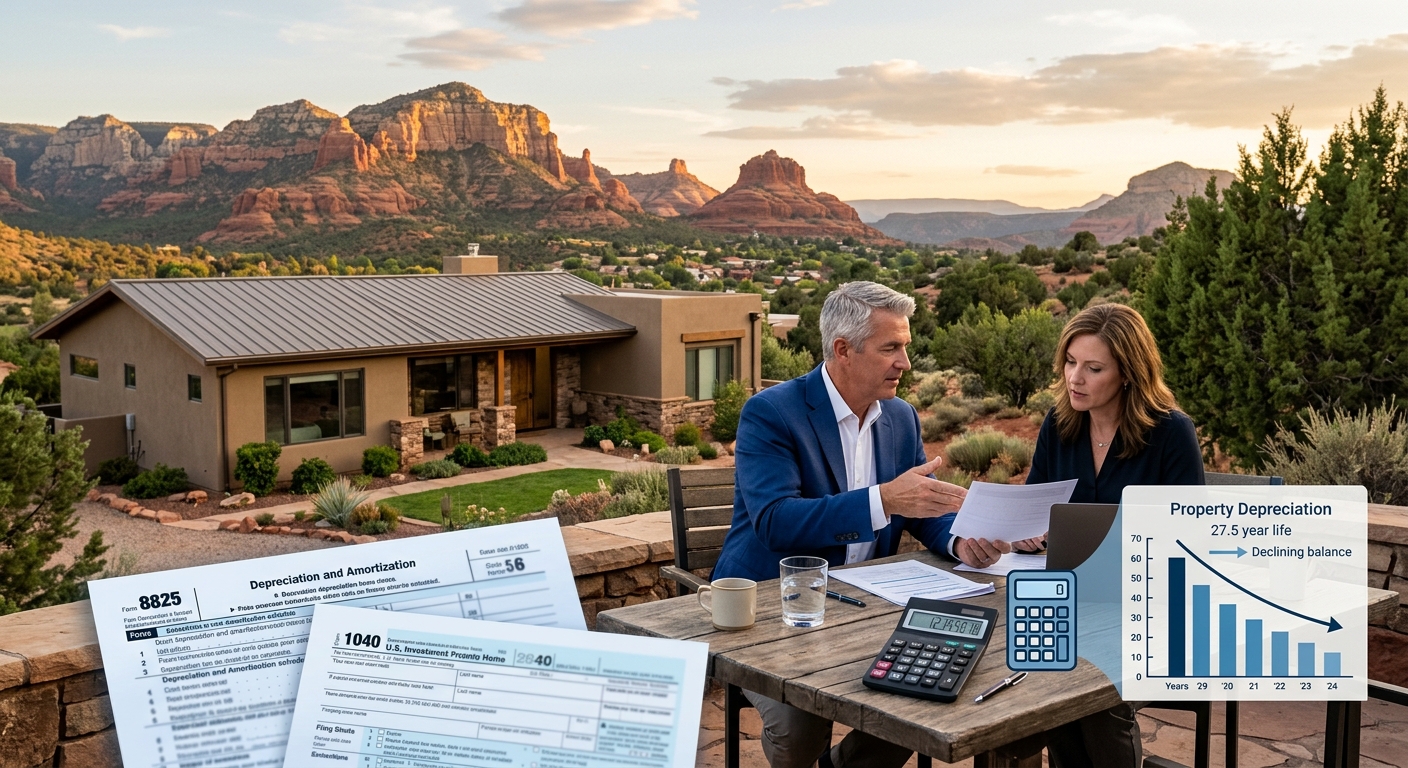
Depreciation is a non-cash deduction that lets you write off the wear and tear of your building over time even while the property appreciates. It is the single most powerful tool in real estate tax planning, and most investors underuse it.
Here is the math. Say you buy a Clarkdale duplex for $460,000. The land is worth roughly $92,000, so your depreciable building basis is $368,000. Divide that over 27.5 years and you get a $13,381 annual depreciation deduction. If you are in the 24 percent federal bracket, that paper loss saves you about $3,211 in federal tax every single year, plus another $334 in Arizona tax, without spending a dollar. Over a decade that is more than $35,000 in savings from one building.
For the mechanics of the deduction and property classifications, see IRS Publication 527 on residential rental property. Depreciation is reported on Form 4562 and flows to your Schedule E.
Cost Segregation: Accelerating Your Deductions
Standard depreciation spreads your deduction evenly over 27.5 years. A cost segregation study reclassifies parts of the property, appliances, flooring, landscaping, driveways, into 5, 7, and 15-year buckets. That front-loads your deductions into the early years when you often need the tax relief most.
On that same $368,000 building, a cost segregation study might reclassify 25 percent, roughly $92,000, into shorter-life categories. With bonus depreciation rules in 2026, a large chunk of that can be deducted immediately rather than over decades. For a higher-income Clarkdale investor, that first-year deduction can wipe out $15,000 to $22,000 of taxable income in year one. Learn more about how this works through our cost segregation services.
Pro Tip: Cost segregation makes the most sense on properties valued above $300,000 that you plan to hold at least three to five years. Below that threshold, the study cost may outweigh the benefit.
KDA Case Study: Verde Valley Short-Term Rental Owner Saves $19,400
A married couple, both W-2 engineers earning a combined $268,000, bought a short-term rental in Clarkdale to serve Sedona-bound tourists. They paid $540,000 for the property and were on track to owe roughly $12,000 in federal tax on the rental profit plus their W-2 income. They had never heard of the short-term rental loophole and assumed rental losses were locked away as passive.
Our Clarkdale real estate tax team reviewed their situation. Because the average guest stay was under seven days and one spouse materially participated in managing the property, the activity qualified as non-passive. That meant the losses generated by a cost segregation study could offset their W-2 income directly. We commissioned a cost segregation study, accelerated $118,000 in deductions into year one, and documented material participation with a contemporaneous time log.
The result: their taxable income dropped enough to save $19,400 in combined federal and Arizona tax in the first year. Our fee for the planning and study coordination was $6,200, delivering a 3.1x first-year return. Just as important, we built a multi-year plan so they would not trigger depreciation recapture surprises when they eventually sell.
Ready to see how we can help you? Explore more success stories on our case studies page to discover proven strategies that have saved our clients thousands in taxes.
Entity Structuring for Clarkdale Property Owners
How you hold title matters. Many investors default to owning property in their personal name, which offers zero liability protection and limited tax flexibility. Others over-engineer with entities they do not need. The right answer depends on your portfolio size and goals.
Should You Use an LLC for Your Clarkdale Rental?
Yes, if:
- You own two or more rental properties and want liability separation
- You have significant personal assets to shield from tenant lawsuits
- You plan to bring in partners or investors
Maybe not, if:
- You own a single rental and carry strong landlord insurance
- The Arizona LLC filing and maintenance costs outweigh your risk exposure
Arizona is one of the more affordable states for LLCs. There is no annual report fee for Arizona LLCs, which is a genuine advantage over California’s $800 minimum franchise tax. A single-member LLC is a disregarded entity for tax purposes, meaning your rental still flows to Schedule E with no extra federal return. You get the liability protection without added tax complexity. Our team can walk you through entity formation options tailored to your portfolio.
When an S Corp Enters the Picture
Rental income is generally not subject to self-employment tax, so an S Corp is usually the wrong choice for buy-and-hold rentals. But if you are running an active fix-and-flip operation in the Verde Valley, that income is ordinary and hit with self-employment tax. In that scenario, an S Corp election can save real money on the payroll tax side. Flippers benefit from S Corp structuring the way rental holders benefit from depreciation. Match the structure to the activity.
The 1031 Exchange: Deferring Tax on Clarkdale Gains
When you sell an appreciated property, you normally owe capital gains tax plus depreciation recapture. A 1031 exchange lets you defer all of that by rolling the proceeds into another like-kind investment property. This is one of the most powerful wealth-building tools available to real estate investors.
Imagine you bought a Clarkdale rental for $300,000 years ago and it is now worth $520,000. On a straight sale, you could face capital gains on the $220,000 appreciation plus recapture on the depreciation you claimed, potentially $50,000 or more in combined tax. A properly executed 1031 exchange defers all of it, letting your full equity work for you in the next property.
The rules are strict. You have 45 days from closing to identify replacement property and 180 days to close. The rules and requirements are detailed in IRS like-kind exchange guidance. Miss a deadline and the entire deferral collapses. This is not a do-it-yourself project.
Key Takeaway: A 1031 exchange can defer $50,000+ in tax on an appreciated Clarkdale property, but the 45-day and 180-day clocks are absolute. Plan the exchange before you list, not after you close.
Estimating Your Gain Before You Sell
Before you list a property, it helps to model the tax hit under different scenarios. If you want a rough estimate of what a sale might cost you, run the numbers through this capital gains tax calculator to see whether a 1031 exchange or an installment sale makes more sense for your situation.
Passive Activity Losses and the Real Estate Professional Status
Here is where many Clarkdale investors get tripped up. Rental losses are generally “passive,” meaning they can only offset passive income, not your wages or business income. That limits their immediate value.
There are two major exceptions. First, if your modified adjusted gross income is under $100,000, you can deduct up to $25,000 of rental losses against other income, phasing out completely at $150,000. Second, if you or your spouse qualify as a real estate professional, spending more than 750 hours and the majority of your working time in real estate, your rental losses become fully deductible against any income.
For a Clarkdale couple where one spouse manages several rentals full-time, qualifying for real estate professional status can be transformative. Combined with a cost segregation study, it can shelter a high earner’s entire income in a strong acquisition year. The requirements are documented in IRS Publication 925 on passive activity and at-risk rules. Documentation is everything here, contemporaneous time logs are your defense in an audit.
Common Real Estate Tax Mistakes Clarkdale Investors Make
What Happens If You Get This Wrong?
- Skipping depreciation: The IRS assumes you took it whether you did or not. When you sell, you owe recapture on depreciation you were “allowed or allowable,” even if you never claimed it. Never skip depreciation.
- Misclassifying a flip as a capital gain: Frequent flippers are dealers. Their profit is ordinary income plus self-employment tax, not the lower capital gains rate.
- Ignoring the short-term rental distinction: Treating a true short-term rental as passive when it qualifies as active means leaving powerful loss offsets unused.
- Poor recordkeeping on material participation: Without a time log, the IRS will disallow your active loss claims in an audit.
- Failing to plan the exit: Selling without a 1031 or installment strategy can trigger an avoidable five-figure tax bill.
These mistakes are common precisely because generic preparers do not catch them. A dedicated real estate tax strategy does. Our team specializes in helping investors avoid these traps while staying fully compliant. Explore how we help real estate investors keep more of their passive income.
California-to-Arizona Investors: Special Considerations
A large share of new Clarkdale investors relocate capital from California. If you still hold California residency or property, you may owe California tax on California-source income even while your Clarkdale rentals enjoy Arizona’s lighter treatment. Establishing genuine Arizona residency, and documenting it, matters if you want the full benefit of the 2.5 percent flat rate.
Multi-state investors also need to file returns in both states in transition years, coordinate credits to avoid double taxation, and track the character of income carefully. This is exactly the kind of edge case generic preparers stumble over. Getting it right can save thousands and prevent an unwelcome notice from the Franchise Tax Board.
Ready to Reduce Your Tax Bill?
KDA Inc. specializes in strategic tax planning for business owners, S Corps, LLCs, and high-net-worth individuals. Book a personalized consultation and walk away with a clear plan.
Frequently Asked Questions About Real Estate Tax Planning in Clarkdale
Do I pay Arizona capital gains tax when I sell a Clarkdale rental?
Arizona does not have a separate capital gains rate. Your gain is taxed at the flat 2.5 percent state income rate for 2026. Your larger exposure is federal capital gains plus depreciation recapture.
Can I deduct rental losses against my W-2 salary?
Generally only up to $25,000 if your income is under $100,000, or fully if you qualify as a real estate professional or run a qualifying short-term rental with material participation. Otherwise losses are suspended until you have passive income or sell.
Is a cost segregation study worth it for a Clarkdale rental?
Usually yes for properties above $300,000 held at least three to five years. The accelerated deductions often deliver a strong return relative to the study cost.
Should short-term rental income be reported on Schedule E or Schedule C?
It depends on the services you provide. Basic lodging with average stays over seven days is Schedule E. Substantial services or very short average stays can push it to Schedule C with self-employment tax implications.
How much does professional real estate tax planning cost?
Planning engagements typically range from a few thousand dollars depending on portfolio complexity, and they routinely return several times that in first-year tax savings.
Do I need an LLC for a single Clarkdale rental?
Not necessarily. Strong landlord insurance may suffice for one property, but an Arizona LLC adds liability protection at low cost since there is no annual report fee.
Work With a Clarkdale Real Estate Tax Team That Plans Ahead
The investors who win in the Verde Valley are the ones who treat taxes as a year-round strategy. Depreciation, cost segregation, entity structuring, passive loss planning, and 1031 exchanges are not one-time tricks. They are an integrated system that compounds over time.
Ready to work with a tax professional who understands Clarkdale investors and Yavapai County property? Explore our Clarkdale tax services or book a strategy session below to build a plan tailored to your portfolio.
Book Your Clarkdale Real Estate Tax Strategy Session
If you own property in Clarkdale or the greater Verde Valley and you are not sure whether depreciation, a cost segregation study, or a 1031 exchange could cut your tax bill, let’s find out together. Our strategy team will model your specific numbers and show you exactly where the savings are hiding. Click here to book your consultation now.



