
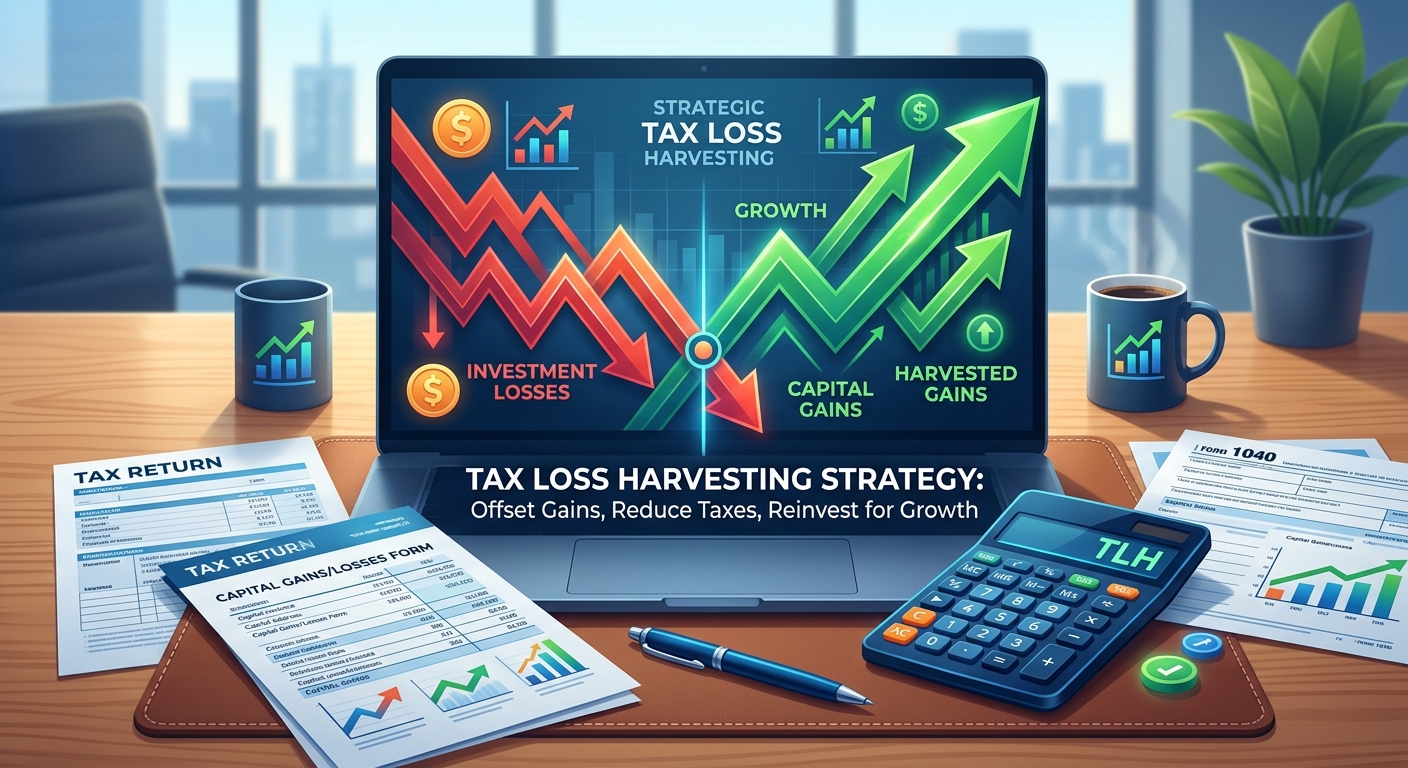
Here’s the uncomfortable truth: You sold investments this year. Some went up. Some tanked. And if you’re like most investors, you’re sitting on a tax bill for the winners while ignoring the losers completely. That’s a $3,000-per-year mistake at minimum, and for high-income earners, it can mean tens of thousands left on the table.
The IRS lets you use capital gains loss to offset your taxable gains, cut your ordinary income by up to $3,000 annually, and carry forward unlimited losses into future years. But most taxpayers don’t harvest losses strategically, don’t time their sales correctly, and don’t understand how to layer short-term and long-term losses for maximum impact.
Quick Answer
Capital gains loss refers to the deduction you can claim when you sell an investment for less than you paid for it. You can use these losses to offset capital gains dollar-for-dollar, reduce ordinary income by up to $3,000 per year, and carry forward any remaining losses indefinitely. This strategy, called tax-loss harvesting, can save high-income investors $5,000 to $25,000 or more annually when executed properly.
What Is Capital Gains Loss and Why It Matters
Capital gains loss is the realized loss you incur when you sell a capital asset such as stocks, bonds, real estate, or cryptocurrency for less than your original purchase price. Under IRS rules, these losses are not just paper losses. They become powerful tax tools the moment you sell the asset and recognize the loss on your tax return.
Here’s how the IRS categorizes capital losses:
- Short-term capital loss: You held the asset for one year or less before selling
- Long-term capital loss: You held the asset for more than one year
- Net capital loss: Your total capital losses exceed your total capital gains for the year
The reason this matters: capital losses offset capital gains first, which are taxed at rates up to 20% federally (plus 3.8% Net Investment Income Tax for high earners). If your losses exceed your gains, you can deduct up to $3,000 against ordinary income taxed at rates up to 37%. Any remaining losses carry forward indefinitely.
For a California resident in the top state bracket (13.3%), a $10,000 capital loss used to offset long-term gains could save $3,380 in federal and state taxes combined. Scale that strategy across multiple years and accounts, and you’re looking at five-figure annual savings.
The Netting Process: How the IRS Calculates Your Capital Gains Loss
The IRS uses a specific netting order to calculate your taxable capital gains or deductible capital losses. Understanding this process is critical because it determines whether your losses deliver maximum value.
Step 1: Net short-term gains and losses against each other
Step 2: Net long-term gains and losses against each other
Step 3: If both categories have net gains, you pay tax on each separately
Step 4: If one category has a net loss, offset it against the net gain in the other category
Step 5: If you still have a net loss, deduct up to $3,000 against ordinary income
Step 6: Carry forward any remaining net loss to future tax years
This netting process creates strategic opportunities. Short-term losses are more valuable because they offset short-term gains taxed at ordinary income rates (up to 37%), not the preferential long-term capital gains rates (0%, 15%, or 20%).
Tax-Loss Harvesting: Your Year-Round Strategy
Tax-loss harvesting is the deliberate practice of selling investments at a loss to offset taxable gains and reduce your overall tax liability. This is not a “set it and forget it” activity. Smart investors harvest losses continuously throughout the year, not just in December.
Here’s why timing matters: If you wait until December to review your portfolio, you may have already missed opportunities to harvest losses when the market dipped in March, July, or October. Volatility creates harvesting windows, and those windows close when prices recover.
Step-by-Step: How to Execute Tax-Loss Harvesting
- Review your portfolio quarterly (minimum) – Identify positions trading below your cost basis by at least 5% to 10%
- Calculate your year-to-date gains – Determine how much loss you need to harvest to offset realized gains
- Prioritize short-term losses first – These offset higher-taxed short-term gains
- Sell the losing positions – Execute the trade and document the sale date and loss amount
- Wait 31 days before repurchasing – Avoid the wash sale rule (more on this below)
- Reinvest immediately in a similar asset – Maintain market exposure while staying compliant
- Track carryforward losses – Maintain a multi-year loss ledger for future tax years
Let’s say you’re a W-2 engineer with $180,000 in salary and $40,000 in short-term capital gains from stock trading. You’re facing $15,200 in federal tax on those gains (38% effective rate including NIIT). By harvesting $40,000 in short-term losses from positions that declined, you eliminate the entire gain and the $15,200 tax bill. Your cost: $0 if you reinvest in similar assets after the wash sale window.
For investors looking to optimize their overall tax position, explore our comprehensive tax planning services designed specifically for active investors and high-income earners.
The Wash Sale Rule: What Kills Your Capital Gains Loss Deduction
The wash sale rule under IRS Publication 550 is the single biggest trap in tax-loss harvesting. If you sell a security at a loss and repurchase the same or substantially identical security within 30 days before or after the sale, the IRS disallows your loss deduction.
Here’s what triggers a wash sale:
- Selling Stock A at a loss and repurchasing Stock A within the 61-day window (30 days before + day of sale + 30 days after)
- Selling Stock A at a loss while your spouse buys Stock A in their account during the window
- Selling Stock A at a loss while your IRA automatically reinvests dividends in Stock A
- Selling a mutual fund at a loss and buying a substantially identical mutual fund (same index, same holdings)
The penalty: Your loss doesn’t disappear completely, but it gets added to the cost basis of the replacement security. This defers the tax benefit, sometimes for years, and reduces the present value of your tax savings.
How to Avoid Wash Sales While Staying Invested
You don’t have to sit in cash for 31 days and miss market gains. Instead, use these compliant alternatives:
- Sell an S&P 500 ETF, buy a Russell 1000 ETF – Different indexes, similar exposure
- Sell Apple, buy Microsoft – Different companies, same sector
- Sell Vanguard Total Stock, buy Schwab Total Stock – Different funds, nearly identical holdings but IRS treats them as different
- Use individual stocks instead of ETFs when possible – More flexibility to swap without triggering substantial identity test
Pro Tip: The wash sale rule does not apply to gains. You can sell a profitable position and immediately repurchase it to reset your cost basis higher, which creates future loss-harvesting opportunities.
Red Flag Alert: Common Mistakes That Cost Investors Thousands
Even sophisticated investors make critical errors when dealing with capital gains loss. Here are the four mistakes we see most often at KDA:
Mistake 1: Ignoring the $3,000 Ordinary Income Deduction
If you have no capital gains in a given year, you can still deduct up to $3,000 of net capital losses against ordinary income like wages, business income, or retirement distributions. For someone in the 35% federal bracket plus 13.3% California bracket, that’s $1,449 in tax savings from losses you’re already sitting on.
Yet many investors with large carryforward losses fail to use this deduction every year. If you have $50,000 in loss carryforwards and no gains, you should be deducting $3,000 annually until the losses are exhausted. That’s 16+ years of tax savings totaling over $23,000 in present value.
Mistake 2: Not Tracking Cost Basis Correctly Across Accounts
If you transfer stocks between brokerage accounts or inherit positions, your cost basis determines your gain or loss. Many investors rely on their broker’s cost basis tracking, but brokers aren’t required to track basis for securities purchased before 2011.
This creates phantom gains. You think you bought a stock at $50, but your broker shows $30 as the basis because they don’t have complete records. When you sell at $60, you’re taxed on a $30 gain instead of a $10 gain, costing you hundreds or thousands in unnecessary taxes.
Action Step: Maintain your own cost basis spreadsheet, especially for positions held longer than 10 years, inherited assets, or stocks transferred from old 401(k) plans.
Mistake 3: Harvesting Long-Term Losses When You Have Short-Term Gains
Remember the netting order. Long-term losses offset long-term gains first, then short-term gains. If you have $20,000 in short-term gains (taxed at 37%) and you harvest $20,000 in long-term losses, you eliminate gains that would have been taxed at only 20% after netting.
The smarter move: Harvest short-term losses to offset short-term gains, preserving your long-term losses for future long-term gains or the $3,000 ordinary income deduction.
Mistake 4: Forgetting About State Tax Treatment
California follows federal tax treatment for capital gains and losses, but not all states do. If you moved from California to Texas mid-year, or if you’re a part-year resident, your state capital loss deduction may differ from your federal deduction.
Additionally, some states like Pennsylvania don’t tax capital gains at all, which means capital losses provide zero state benefit. In these states, the federal benefit is your only consideration, which changes the math on whether harvesting makes sense.
KDA Case Study: Real Estate Investor
Marcus T., a 48-year-old real estate investor in Orange County, came to KDA in late 2025 after selling two rental properties at a significant gain. He realized $185,000 in long-term capital gains and faced a federal tax bill of $37,000 plus $24,605 in California state tax, totaling $61,605.
Marcus also held a brokerage account with $420,000 in individual stocks, several of which had declined 20% to 40% since purchase. He had never harvested losses because he “didn’t want to sell good companies at a loss.”
Our strategy: We identified $95,000 in unrealized long-term losses across eight positions in his taxable brokerage account. We harvested $95,000 in losses by selling declining positions and immediately reinvesting in similar sector ETFs to maintain market exposure. This offset $95,000 of his $185,000 real estate gain.
Tax savings year one: $32,110 (federal and California combined on the $95,000 offset)
What Marcus paid KDA: $4,200 for tax planning and execution
ROI: 7.6x first-year return
Ongoing benefit: Marcus still carries forward $3,000 annually against future income, creating an additional $1,449 in annual savings for years to come.
Ready to see how we can help you? Explore more success stories on our case studies page to discover proven strategies that have saved our clients thousands in taxes.
Advanced Strategy: Layering Losses Across Tax Years
Sophisticated investors don’t just harvest losses reactively. They build multi-year loss banks to strategically offset future liquidity events like business sales, RSU vestings, or real estate exits.
Here’s how it works: In years when your income is low or you have minimal capital gains, you intentionally harvest losses and carry them forward. Then, when you have a high-income year or a major capital event, you use those banked losses to offset the gain.
Example: Tech Employee Preparing for IPO
Sarah works at a pre-IPO startup and holds $800,000 in stock options. When the company goes public, she’ll exercise and sell, creating $800,000 in ordinary income (ISOs held less than two years) or long-term gains (NSOs or qualified ISOs).
Starting three years before the expected IPO, Sarah harvests $30,000 to $50,000 in losses annually from her brokerage accounts. By IPO year, she has $120,000 in loss carryforwards. When she sells her startup shares for a $400,000 gain, she uses $120,000 of losses to offset the gain, saving $40,800 in federal and California taxes.
If Sarah had waited until IPO year to think about tax strategy, those loss-harvesting opportunities would have already passed. Markets recovered. Stocks rebounded. The losses that existed in prior years were no longer available.
Key Takeaway: Loss harvesting is not a reaction to gains. It’s a proactive, multi-year strategy that creates optionality for future tax years.
How Capital Gains Loss Applies to Cryptocurrency
The IRS treats cryptocurrency as property under Notice 2014-21, which means every crypto sale triggers a capital gain or loss calculation. This creates enormous loss-harvesting opportunities in volatile crypto markets.
Unlike stocks, cryptocurrency trades 24/7/365, and the wash sale rule does not currently apply to crypto. That means you can sell Bitcoin at a loss on Monday and repurchase it on Tuesday without waiting 31 days. Your loss is fully deductible, and you maintain your crypto position.
Crypto Loss Harvesting in Action
Let’s say you bought 2 Bitcoin at $60,000 each ($120,000 total cost basis). Bitcoin drops to $45,000, creating a $30,000 unrealized loss. You sell both Bitcoin for $90,000, realizing the $30,000 loss. The next day, you repurchase 2 Bitcoin at $45,500. Your new cost basis is $91,000.
Result: You harvested $30,000 in losses (worth $10,200+ in tax savings for a high earner), and you still own nearly the same amount of Bitcoin. If Bitcoin recovers to $60,000, you’ll have a $29,000 gain when you sell, but you’ve already locked in $30,000 of loss deductions.
Red Flag Alert: Congress has repeatedly proposed extending the wash sale rule to cryptocurrency. If this passes, the strategy above becomes illegal. Until then, it remains one of the most powerful tax moves available to crypto investors. Always consult current IRS guidance before executing crypto tax strategies, and consider consulting with tax professionals who specialize in cryptocurrency transactions.
What Happens If You Don’t Use Your Capital Gains Loss?
If you realize a capital loss and don’t report it on your tax return, you forfeit the deduction permanently. The IRS does not automatically track your losses and apply them to future years. You must claim the loss on Schedule D and carry forward any unused losses on Form 1040.
Here’s what you lose by ignoring capital losses:
- Immediate tax savings: $3,000 deduction against ordinary income this year ($1,110+ in tax savings for top earners)
- Future offset capacity: Losses that could eliminate gains on stock sales, business exits, or real estate transactions in future years
- Compounding benefits: Using losses to reduce taxes frees up cash to reinvest, creating long-term wealth compounding
We regularly see new clients who realize they’ve been sitting on $50,000, $100,000, or even $200,000 in unrealized losses for years, paying full taxes on gains in other accounts while ignoring the losses. That’s real money left on the table.
Special Situations and Edge Cases
Not every capital loss scenario is straightforward. Here are the edge cases that require specialized planning:
Worthless securities: If a stock becomes completely worthless (company bankrupt, delisted, liquidated), you can claim the loss even without selling. The loss is treated as occurring on the last day of the tax year. You’ll need documentation proving the security is worthless.
Inherited assets: When you inherit stocks or real estate, your cost basis steps up to the fair market value on the date of death. This means most inherited assets have little or no built-in gain or loss. You cannot claim losses that occurred before you inherited the asset.
Gifts: If someone gifts you stock at a loss, your cost basis for calculating losses is the lower of the donor’s basis or the fair market value at the time of the gift. This creates a “dual basis” situation where your basis for gains differs from your basis for losses.
Married filing separately: If you’re married filing separately, your capital loss deduction drops to $1,500 per spouse instead of $3,000. Loss carryforwards also remain separate. This is one of many reasons MFS is rarely optimal for high-income couples.
California-Specific Considerations
California conforms to federal tax treatment of capital gains and losses with one major exception: timing differences. If you take a federal capital loss deduction in 2026 but California has different recognition rules due to conformity date mismatches, you may need to adjust your California return separately.
Additionally, California’s top marginal rate of 13.3% means that capital losses are significantly more valuable for California residents than for residents of no-income-tax states like Texas or Florida. A $10,000 capital loss offsets income taxed at up to 50.3% (37% federal + 13.3% state), creating $5,030 in combined tax savings.
For high earners considering relocation, this creates planning opportunities. If you have large unrealized losses, consider realizing them while you’re still a California resident to maximize the state tax benefit. Conversely, if you have large gains, accelerate your move to a no-tax state before selling.
FTB scrutiny: The California Franchise Tax Board has become increasingly aggressive in auditing part-year resident returns, especially for high-income taxpayers claiming they moved out of state before realizing large gains. Maintain clear documentation of your residency status, including lease agreements, utility bills, vehicle registration, and voter registration, if you’re claiming part-year status.
Ready to Reduce Your Tax Bill?
KDA Inc. specializes in strategic tax planning for business owners, S Corps, LLCs, and high-net-worth individuals. Book a personalized consultation and walk away with a clear plan.
Frequently Asked Questions
Can I deduct more than $3,000 in capital losses per year?
Yes, but only against capital gains. You can offset unlimited capital gains with capital losses in the same year. The $3,000 limit only applies to deducting losses against ordinary income like wages or business income. Any losses exceeding your gains and the $3,000 deduction carry forward to future years indefinitely.
Do capital losses expire or have a time limit?
No. Capital loss carryforwards never expire. You can carry losses forward for your entire life. When you die, however, your carryforward losses disappear and cannot be transferred to your heirs. This makes it critical to use losses strategically during your lifetime rather than hoarding them indefinitely.
Can I use capital losses from my IRA or 401(k)?
No. Losses inside retirement accounts are not deductible. When you sell a stock at a loss inside your IRA, you cannot claim that loss on your tax return. This is the flip side of retirement accounts being tax-deferred. Just as gains inside the account aren’t taxed until withdrawal, losses inside the account provide no immediate tax benefit. The only exception: if your entire IRA or 401(k) balance becomes worthless (extremely rare), you may be able to claim a miscellaneous itemized deduction, but this was largely eliminated by the Tax Cuts and Jobs Act.
Book Your Tax Loss Harvesting Strategy Session
If you’re sitting on unrealized losses and you’re not sure how to harvest them without triggering wash sales, missing market rebounds, or running afoul of IRS rules, let’s fix that. Book a personalized tax strategy session with KDA’s investment tax team and get a clear, compliant roadmap to cutting your tax bill this year and beyond. Click here to book your consultation now.
This information is current as of 5/13/2026. Tax laws change frequently. Verify updates with the IRS or a qualified tax professional if reading this later.



