
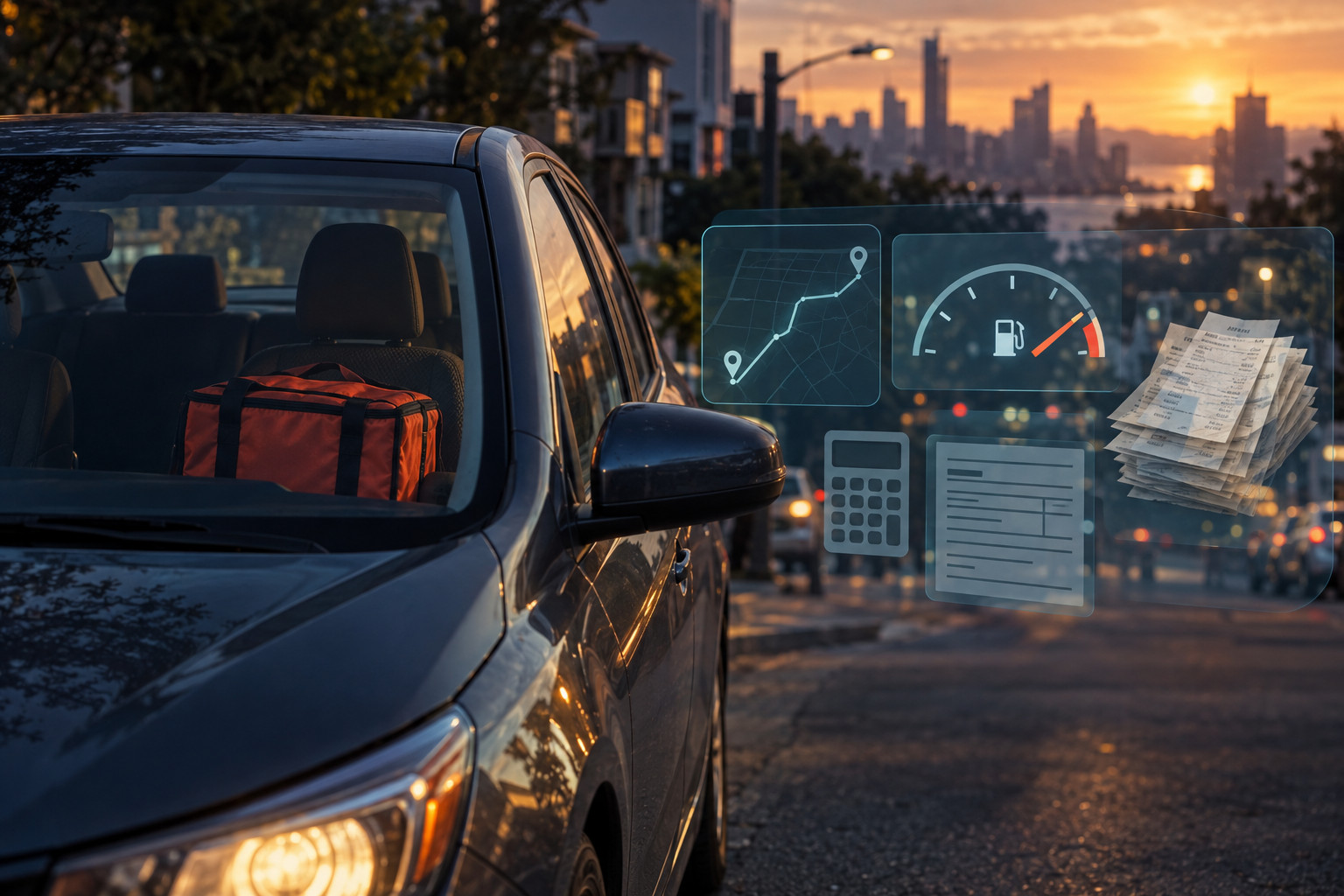
Most DoorDash drivers do their taxes backwards. They save every gas receipt in a shoebox, hand the pile to a preparer in April, and walk away with a deduction worth a fraction of what they were legally entitled to claim. Meanwhile, the driver down the street who tracked nothing but miles on a free app walks away with a write-off three times larger. Same car. Same routes. Same number of deliveries. Wildly different tax bills.
So can you write off gas for DoorDash? Yes, but only under one of two methods, and picking the wrong one is one of the most expensive mistakes gig drivers make. This guide breaks down both methods with real numbers, shows you which one usually wins, and walks through the documentation the IRS actually expects when it asks questions.
Quick Answer
Yes, you can write off gas for DoorDash, but only if you use the actual expense method, and only for the business-use percentage of your driving. If you use the standard mileage rate instead, gas is already baked into the per-mile deduction and cannot be claimed separately. For most DoorDash drivers, the standard mileage method produces a larger deduction than tracking gas receipts.
That is the whole answer in three sentences. The rest of this article is about how to make sure you are on the winning side of that choice, because the gap between the two methods on a typical delivery year runs between $1,800 and $4,500 in deductions.
Can You Write Off Gas for DoorDash? The Two Methods Explained
DoorDash does not withhold taxes. You are an independent contractor, which means you receive a Form 1099-NEC if you earned $600 or more, and you report that income on Schedule C, the form sole proprietors use to report business profit or loss. Every legitimate business expense reduces the profit you pay tax on. Vehicle costs are, by far, the biggest one for delivery drivers.
The IRS gives you two ways to deduct vehicle costs. You pick one. You cannot mix them in the same year for the same car.
Method 1: The Standard Mileage Rate
The standard mileage rate is a flat per-mile deduction that covers gas, oil, maintenance, repairs, tires, insurance, registration, and depreciation. All of it. Bundled. For the 2025 tax year the business rate is 70 cents per mile, and the IRS adjusts the figure annually (see IRS standard mileage rates for the current year’s number).
Under this method, gas is not a separate line item. If you deduct 70 cents a mile and then also deduct $4,200 in fuel, you have double-dipped, and that is the kind of math error that turns a routine notice into a full examination.
Here is why most drivers win with mileage. A Honda Civic getting 32 miles per gallon at $4.60 per gallon in California burns about 14.4 cents of fuel per mile. The standard rate pays you 70 cents. The other 55.6 cents covers wear, depreciation, and everything else, whether you spent it this year or not.
Method 2: Actual Expenses
The actual expense method is where you genuinely write off gas. You total every vehicle cost for the year, then multiply by your business-use percentage.
- Gasoline and oil changes
- Repairs, tires, brakes, and routine maintenance
- Auto insurance premiums
- Registration fees and smog checks
- Car washes and detailing
- Lease payments, or depreciation if you own the vehicle
- Interest on an auto loan, business portion only
If you drove 24,000 total miles and 18,000 were for deliveries, your business-use percentage is 75 percent. Spend $9,800 on the vehicle for the year and your deduction is $7,350.
Side by Side: Which Method Wins
| Factor | Standard Mileage | Actual Expenses |
|---|---|---|
| Gas deducted separately | No, included | Yes |
| Recordkeeping burden | Mileage log only | Every receipt, all year |
| Best for fuel-efficient cars | Yes | No |
| Best for trucks and SUVs | No | Often yes |
| Can switch later | Yes, if used first year | Locked in on leased cars |
| Typical driver result | Larger deduction | Smaller deduction |
Key Takeaway: If you drive a sedan or hybrid, the standard mileage rate almost always beats writing off gas. If you deliver in a full-size truck or an older vehicle with heavy repair bills, run both calculations before you choose.
KDA Case Study: The Weekend DoorDash Driver Who Recovered $3,140
Marcus, a 34-year-old warehouse supervisor in Riverside, drove for DoorDash on nights and weekends. His W-2 job paid $58,000. His delivery income came in at $21,400 on a 1099-NEC, and he figured his taxes were simple enough to handle alone.
His first self-prepared return claimed $4,620 in gas receipts and nothing else. No mileage log. No phone expense. No insulated bag deduction. He owed $4,980 at filing and paid a $260 underpayment penalty on top of it.
When he came to us the following year, we rebuilt his records from his DoorDash delivery history and his phone’s location data, which reconstructed 16,900 business miles. At the mileage rate in effect, that produced a vehicle deduction of roughly $11,830, compared to the $4,620 in fuel he had been claiming. We added his cellphone business percentage at $648, hot bags and phone mounts at $185, parking and tolls at $312, and a SEP IRA contribution of $2,900 to shelter profit.
His adjusted self-employment profit dropped from $16,780 to $5,225. Combined federal income tax and self-employment tax savings came to $3,140 in year one. We also amended the prior year, which recovered an additional $1,870. He paid $1,100 for planning and preparation. That is a 4.6x first-year return, and the system we set up costs him about four minutes a week to maintain. Drivers in his position often benefit from ongoing tax planning services rather than once-a-year filing, because the decisions that matter happen in March, not April.
Ready to see how we can help you? Explore more success stories on our case studies page to discover proven strategies that have saved our clients thousands in taxes.
Which Miles Actually Count as Business Miles?
This is where most drivers lose money, and where a few lose an audit. The IRS cares about the purpose of each trip, not just the odometer.
Deductible: Driving from your home to the first restaurant after you go online, every mile between pickups and drop-offs, miles spent driving to a hotspot while the app is on and you are available, miles returning home at the end of a shift if you stayed online, and trips to buy delivery supplies.
Not deductible: Any driving with the app off, personal errands squeezed between orders, and the detour you took to grab your own dinner.
DoorDash’s in-app mileage summary only captures a slice of this. It typically tracks from acceptance to delivery and ignores the driving you do between orders and while waiting. Drivers who rely only on the app number routinely understate their miles by 25 to 40 percent. On 18,000 real miles, a 30 percent shortfall costs roughly $3,780 in lost deductions.
Step-by-Step: Building a Mileage Log the IRS Will Accept
- Record your odometer on January 1 and December 31. Takes 30 seconds. Establishes total annual miles, which is the denominator for your business-use percentage.
- Run an automatic tracking app every shift. Turn it on when you go online, off when you go offline. One tap each way.
- Log the purpose, not just the distance. The IRS wants date, miles, destination, and business purpose. “DoorDash deliveries, Riverside zone” is sufficient.
- Export monthly. Download a CSV each month so a lost phone does not erase your year.
- Keep the records for three years from the filing date, which is the standard assessment window for most returns.
Beyond Gas: Eight Deductions DoorDash Drivers Routinely Miss
Vehicle costs dominate, but they are not the whole return. These are separate from the mileage rate and can be claimed alongside it.
- Cellphone and data plan. Business-use percentage only. A $95 monthly plan at 60 percent business use yields a $684 annual deduction.
- Parking and tolls. Fully deductible on top of mileage. Urban drivers often hit $300 to $700 a year.
- Insulated bags, drink carriers, phone mounts, and chargers. Typically $150 to $300 annually.
- Roadside assistance membership. Business portion deductible.
- Health insurance premiums. If you are self-employed and not eligible for an employer plan, premiums may be deductible above the line. See IRS Publication 535 on business expenses.
- Retirement contributions. A SEP IRA or solo 401(k) lets you shelter a meaningful share of net profit.
- Bank and payment processing fees tied to your delivery account.
- Tax preparation fees allocable to Schedule C.
Pro Tip: Open a separate checking account and debit card used only for delivery driving. It converts your bank statement into a ready-made expense log and cuts your preparation time in half.
Red Flags: What Gets DoorDash Drivers Audited
Red Flag Alert: Claiming 100 percent business use on your only vehicle is the fastest way to draw scrutiny. The IRS knows you buy groceries. A single-car household claiming zero personal miles is not credible, and examiners have seen it thousands of times. Realistic business-use percentages for part-time drivers land between 40 and 70 percent, and full-timers often reach 75 to 85 percent.
Two other patterns draw attention. The first is deducting both the standard mileage rate and gas receipts in the same year, which is a clean mathematical contradiction. The second is reporting less gross income than the 1099-NEC shows. DoorDash files that form with the IRS, and the matching program flags the gap automatically, usually through a CP2000 notice proposing additional tax.
Reconstructing records after a notice arrives is possible but expensive. Contemporaneous logs, meaning records you created at the time rather than in a panic later, carry far more weight. If a notice has already landed, audit representation is worth the cost long before you respond on your own.
Self-Employment Tax: The Part That Surprises New Drivers
Self-employment tax is the 15.3 percent levy covering Social Security and Medicare that W-2 employees split with an employer. As a contractor, you pay both halves on net profit. It applies from the first dollar of profit, with no standard deduction cushion.
On $16,000 of delivery profit, self-employment tax alone runs about $2,261, before any income tax. That is why vehicle deductions matter so much: every dollar of legitimate deduction reduces both income tax and the 15.3 percent. If you want to see what your own numbers produce before the bill arrives, run them through this self-employment tax calculator.
You are also expected to make quarterly estimated payments using Form 1040-ES if you will owe $1,000 or more. Miss them and the penalty accrues by quarter, not at filing. A practical rule is to set aside 25 to 30 percent of every deposit in a separate savings account. Broader strategies for contractors are covered in our guide for self-employed taxpayers, and entity-level planning questions are addressed in the California business owner tax strategy hub.
California-Specific Considerations
California does not follow the federal treatment in every respect, and delivery drivers feel it in three places.
First, the Franchise Tax Board requires its own estimated payments on a different quarterly schedule than the IRS, with 30 percent due in the first installment. Drivers who budget only for federal payments get caught short in April.
Second, if you register your delivery activity as an LLC for liability protection, California charges an $800 annual franchise tax regardless of profit, plus a gross receipts fee above $250,000. For a driver netting $18,000, that $800 usually outweighs the benefit, which is why most delivery drivers should remain sole proprietors unless there is a specific liability reason to incorporate.
Third, California’s own mileage and depreciation conformity rules can differ from federal in specific years. Your state deduction is not automatically identical to the federal figure, and software defaults do not always catch the difference.
Special Situations and Edge Cases
What if I drive for DoorDash, Uber Eats, and Instacart in the same shift?
All of it is business mileage, but you need to allocate it. Most multi-app drivers report everything on a single Schedule C if the activity is substantially the same, which delivery driving generally is. Keep separate income records per platform since each issues its own 1099.
What if I lease my car?
You may still choose the standard mileage rate, but if you do, you must use it for the entire lease term. Switching mid-lease is not permitted. Run the comparison before your first filing year, because that choice locks.
What if I used actual expenses in year one?
You generally cannot switch to the standard mileage rate later for that vehicle. The reverse is allowed: start with mileage, switch to actual expenses in a later year using straight-line depreciation. This is why the first-year decision deserves more than five minutes of thought.
What happens if I kept no records at all?
You are not automatically out of luck. Delivery history exports, bank statements, phone location timelines, and oil change invoices showing odometer readings can support a reasonable reconstruction. It is weaker than a contemporaneous log and it will not survive every examination, but claiming nothing is strictly worse than claiming a defensible reconstruction.
Ready to Reduce Your Tax Bill?
KDA Inc. specializes in strategic tax planning for business owners, S Corps, LLCs, and high-net-worth individuals. Book a personalized consultation and walk away with a clear plan.
Frequently Asked Questions
Can I write off gas for DoorDash if I also use the car for commuting to my W-2 job?
Yes, but commuting miles to your regular job are never deductible. Only the delivery portion counts, and you must be able to separate the two. This is precisely why odometer readings and a tracking app matter for drivers holding a day job.
Do I need receipts if I use the standard mileage rate?
You do not need gas receipts, but you absolutely need a mileage log. You also still need receipts for anything claimed outside the mileage rate, including parking, tolls, phone, and supplies.
What if I earned less than $600 and never got a 1099?
You still report the income. The $600 figure is the platform’s filing threshold, not your reporting threshold. All net self-employment income of $400 or more also triggers self-employment tax.
Is DoorDash income worth it after taxes?
It depends entirely on whether you claim your mileage. A driver grossing $24,000 who logs 19,000 business miles has a materially different outcome than one who claims $5,000 in gas. The work is identical. The tax result is not.
The drivers who keep the most money are not the ones who find exotic loopholes. They are the ones who tap a button twice per shift.
This information is current as of 11/2/2026. Tax laws change frequently. Verify updates with the IRS or FTB if reading this later.
Book Your Tax Strategy Session
If you have been deducting gas receipts and guessing at your miles, you are almost certainly overpaying, and you may be able to amend prior returns to recover it. Our team builds a documented, audit-ready deduction system for gig drivers that takes minutes a week and holds up under scrutiny. Click here to book your consultation now.



