
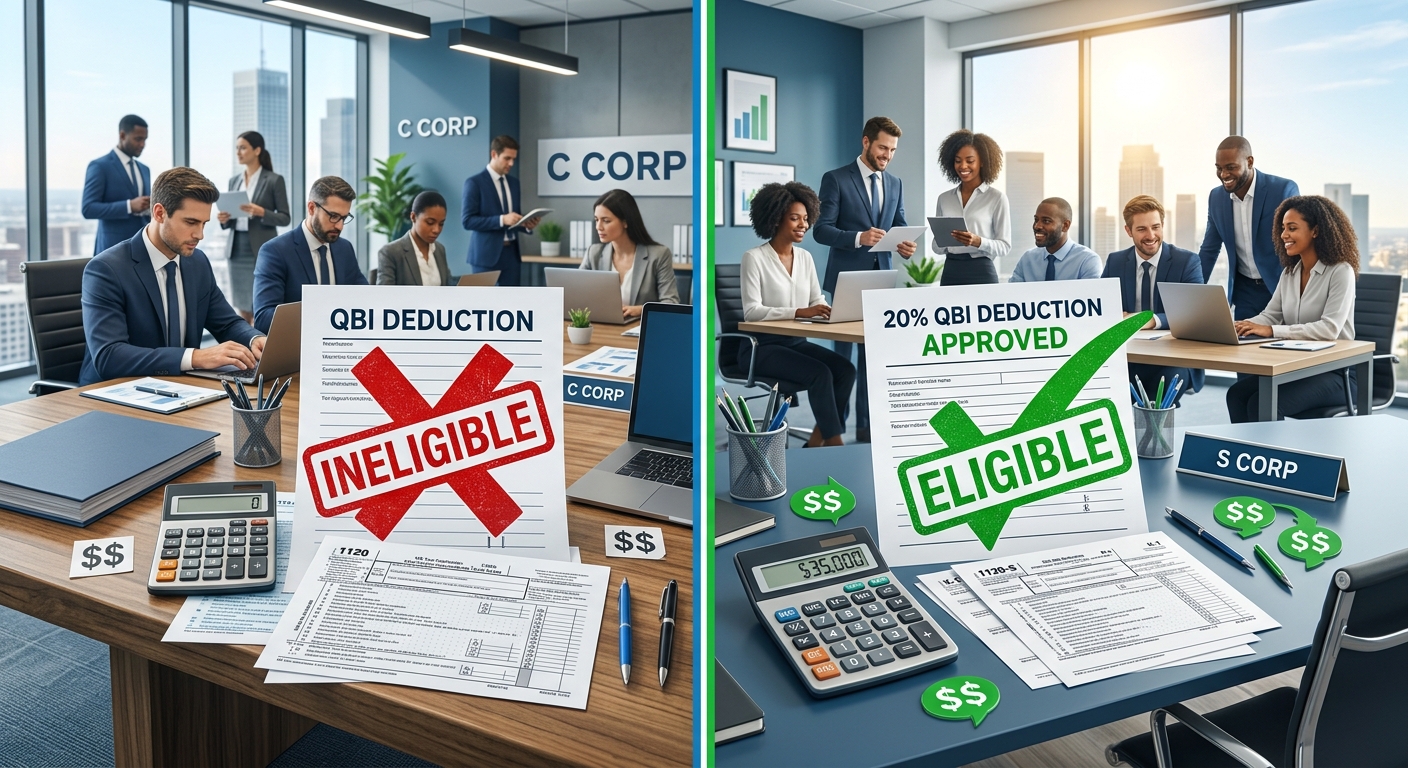
The QBI Deduction Is Worth $37,000 a Year, and Your Entity Type Decides Whether You Get It
A C Corporation shareholder earning $200,000 in profit pays corporate tax, then dividend tax, and walks away with zero dollars in Qualified Business Income deduction. An S Corporation owner earning the exact same amount pockets up to $37,000 in QBI savings over the next tax year. Same revenue. Same industry. Same state. The only difference is the box they checked on one IRS form.
The question of whether a C Corp or S Corp can get the QBI deduction is not hypothetical. It is the single largest annual tax variable for California business owners earning between $100,000 and $500,000 in profit. Get the entity wrong, and you forfeit a permanent 20% deduction that Congress locked in through the One Big Beautiful Bill Act. Get it right, and you keep thousands every single year for as long as your business operates.
Here is the short answer: S Corporations qualify for the QBI deduction under IRC Section 199A. C Corporations do not. The deduction flows through to individual shareholders on Schedule K-1, which means the business itself never claims it. The shareholder does, on their personal Form 1040. If your business is structured as a C Corp, the income never reaches your 1040 as qualified business income, and the deduction is permanently off the table.
What the QBI Deduction Actually Is and Why Entity Type Locks You In or Out
The Qualified Business Income deduction, created by IRC Section 199A, allows eligible taxpayers to deduct up to 20% of their qualified business income from pass-through entities. That includes S Corporations, partnerships, sole proprietorships, and certain trusts and estates. The deduction reduces taxable income, not adjusted gross income, which means it sits on your 1040 after the standard or itemized deduction and directly lowers the amount of income subject to federal tax.
For a California business owner earning $200,000 in S Corp profit with a $70,000 reasonable salary, the math works like this. The $130,000 in distributions passes through on Schedule K-1. The QBI deduction is 20% of qualified business income, subject to the W-2 wage limitation and the qualified property limitation. Assuming the owner pays themselves $70,000 in W-2 wages, the greater of 50% of W-2 wages ($35,000) or 25% of W-2 wages plus 2.5% of unadjusted basis of qualified property sets the cap. The deduction lands at roughly $26,000 to $37,000 depending on property basis and total income.
C Corporations are taxed at the entity level under IRC Section 11 at a flat 21% federal rate. The income never passes through to the shareholder’s 1040. Instead, it sits inside the corporation until distributed as dividends, which are then taxed again at the shareholder level at 0%, 15%, or 20% depending on income. Because QBI only applies to income reported on individual returns from pass-through entities, C Corp shareholders are structurally excluded. There is no workaround. There is no election. There is no form to file. The exclusion is baked into the statute itself.
The W-2 Wage Limitation Most S Corp Owners Miscalculate
The QBI deduction is not simply 20% of net income. For taxpayers above the income threshold ($191,950 single, $383,900 married filing jointly in 2025), the deduction is limited to the greater of:
- 50% of W-2 wages paid by the qualified business, or
- 25% of W-2 wages plus 2.5% of the unadjusted basis immediately after acquisition (UBIA) of qualified property
This means your reasonable salary directly impacts how much QBI deduction you can claim. Set your salary too low, and you cap your own deduction. Set it too high, and you pay unnecessary payroll tax. The sweet spot requires modeling both sides of the equation, which is exactly where many business owners stumble without professional guidance.
Side-by-Side: C Corp vs S Corp QBI Impact at Three Income Levels
The numbers below assume a California-based single-member entity, owner as sole employee, with no qualified property basis. For a deeper breakdown of S Corp mechanics, see our comprehensive S Corp tax strategy guide for California.
| Factor | $100K Profit | $200K Profit | $350K Profit |
|---|---|---|---|
| C Corp Federal Tax (21%) | $21,000 | $42,000 | $73,500 |
| C Corp Dividend Tax (15%) | $11,850 | $23,700 | $41,475 |
| C Corp CA Franchise Tax (8.84%) | $8,840 | $17,680 | $30,940 |
| C Corp Total Tax | $41,690 | $83,380 | $145,915 |
| C Corp QBI Deduction | $0 | $0 | $0 |
| S Corp Reasonable Salary | $45,000 | $70,000 | $110,000 |
| S Corp Payroll Tax (Salary Only) | $6,885 | $10,710 | $14,217 |
| S Corp Federal Income Tax | $14,200 | $32,400 | $64,800 |
| S Corp CA Franchise Tax (1.5%) | $1,500 | $3,000 | $5,250 |
| S Corp QBI Deduction Value | $2,200 | $5,200 | $9,600 |
| S Corp Total Tax (After QBI) | $20,385 | $40,910 | $74,667 |
| Annual S Corp Advantage | $21,305 | $42,470 | $71,248 |
At $200,000 in profit, the S Corp owner keeps $42,470 more per year. Over five years, that gap exceeds $212,000. The QBI deduction alone accounts for $5,200 of annual savings at that level, but the compounding effect of pass-through taxation, lower franchise tax, and payroll tax optimization multiplies the total advantage dramatically.
Want to see how these numbers shift with your specific revenue? Plug your business profit into this small business tax calculator to estimate your effective tax rate under both structures.
Five QBI Deduction Mistakes That Cost California Business Owners Thousands
Knowing that your S Corp qualifies for QBI is only half the equation. Claiming it correctly is where most owners leave money behind. Our tax planning services routinely uncover these five errors in client returns.
Mistake 1: Staying in a C Corp Without Realizing QBI Is Unavailable
Many owners formed C Corps years ago based on outdated advice or default state filing. They never filed Form 2553 to elect S Corp status, which means they have been paying double taxation and forfeiting QBI every single year since 2018 when the deduction became available. At $200,000 in annual profit, that is $5,200 per year in QBI alone, or $41,600 over eight years of eligibility they will never recover.
Mistake 2: Setting Salary Too Low and Triggering the W-2 Wage Limitation
The IRS requires S Corp owner-employees to pay themselves a “reasonable salary” under the guidelines established in cases like Watson v. Commissioner. But many owners go too far in the other direction, paying themselves $30,000 on $200,000 in profit to minimize payroll tax. The problem is that once taxable income exceeds the threshold ($191,950 single in 2025), the QBI deduction gets capped at 50% of W-2 wages. A $30,000 salary caps QBI at $15,000, even if 20% of qualified business income would be $34,000. That miscalculation costs $3,800 in lost QBI deduction value.
Mistake 3: Operating a Specified Service Trade or Business Without Planning
Doctors, lawyers, accountants, consultants, financial advisors, and other professionals fall into the Specified Service Trade or Business (SSTB) category under IRC Section 199A(d)(2). For SSTBs, the QBI deduction phases out entirely once taxable income exceeds $241,950 (single) or $483,900 (married filing jointly) in 2025. If you are in an SSTB and your income is near the threshold, strategic deferrals, retirement contributions, or income splitting with a spouse can preserve the full deduction. Failing to plan around the SSTB phase-out is one of the most common errors we see in high-income professional returns.
Mistake 4: Ignoring California Bonus Depreciation Nonconformity
California does not conform to federal bonus depreciation under Revenue and Taxation Code Sections 17250 and 24356. This means your federal QBI calculation may include depreciation deductions that California disallows, creating a different qualified business income figure at the state level. While QBI itself is a federal deduction, the mismatch affects your overall California tax liability and can create unexpected state tax bills if you rely solely on your federal return for planning. Maintain dual depreciation schedules to avoid surprises.
Mistake 5: Failing to Elect AB 150 PTE and Stack It With QBI
California’s AB 150 Pass-Through Entity tax election allows S Corps and partnerships to pay a 9.3% entity-level state tax that generates a dollar-for-dollar federal tax credit for shareholders. This effectively bypasses the $40,000 SALT deduction cap made permanent under OBBBA. When combined with the QBI deduction, the AB 150 election creates a powerful two-layer tax reduction. Missing the election deadline (which must be made on a timely filed return) means leaving both the SALT bypass and the QBI optimization on the table.
KDA Case Study: Sacramento Consulting Firm Owner Recovers $38,700 by Switching From C Corp to S Corp
Rachel, a management consultant in Sacramento, had operated as a C Corporation since 2019. Her CPA at the time told her that the 21% corporate rate was “the lowest it had ever been” and recommended she stay put. What he never mentioned was that the QBI deduction, pass-through taxation, and AB 150 PTE election were unavailable to C Corp shareholders.
When Rachel came to KDA with $210,000 in annual profit, we ran a five-layer entity analysis. Her C Corp was generating $88,410 in combined federal corporate tax, dividend tax, and California franchise tax annually. She had zero QBI deduction, zero SALT bypass, and was paying 8.84% California franchise tax instead of 1.5%.
KDA executed an eight-step conversion: BIG tax evaluation (zero built-in gains exposure due to service-based business with no appreciated assets), AE&P cleanup through a final qualifying dividend under IRC Section 1371(e), Form 2553 filing with Rev. Proc. 2013-30 late election relief, FTB Form 3560 submission, payroll setup with $75,000 reasonable salary, Solo 401(k) establishment with $23,500 employee deferral plus $16,250 employer contribution, AB 150 PTE election activation, and dual depreciation schedule creation for California nonconformity.
Year-one results: Rachel’s total tax dropped to $49,710, a savings of $38,700. Her QBI deduction alone saved $5,400 at the federal level. The AB 150 PTE election saved $4,100 in effective SALT. The Solo 401(k) sheltered $39,750 from current taxation. KDA’s engagement fee was $5,800, producing a 6.7x first-year ROI. Over five years, projected savings exceed $187,000.
Ready to see how we can help you? Explore more success stories on our case studies page to discover proven strategies that have saved our clients thousands in taxes.
OBBBA Made the QBI Deduction Permanent: What That Means for Your Entity Decision
Before the One Big Beautiful Bill Act passed, the QBI deduction under IRC Section 199A was set to expire after December 31, 2025. Business owners faced uncertainty about whether to restructure their entities for a deduction that might disappear. OBBBA removed that uncertainty entirely. The QBI deduction is now permanent, which fundamentally changes the entity selection calculus for every California business owner.
Permanent QBI Changes the Five-Year ROI on S Corp Conversion
When QBI was temporary, the payback period for conversion costs (legal fees, payroll setup, accounting restructuring) had to be compressed into a shorter window. Now that the deduction is permanent, even modest QBI savings of $3,000 to $5,000 per year compound indefinitely. A business owner earning $150,000 in S Corp profit who claims $4,000 annually in QBI deduction will accumulate $40,000 in QBI savings alone over the next decade, on top of the payroll tax and franchise tax advantages.
Other OBBBA Changes That Amplify the S Corp QBI Advantage
OBBBA also made permanent several provisions that compound the S Corp advantage over C Corp:
- 100% Bonus Depreciation: Restored to full immediate expensing for qualified assets. S Corp owners deduct this on their personal returns through Schedule K-1. C Corp owners deduct it at the entity level, but the savings are trapped inside the corporation until distributed as taxable dividends. California does not conform to bonus depreciation under R&TC 17250/24356, so maintain dual schedules.
- $2.5 Million Section 179 Expensing: Doubled from the previous $1.25 million limit. S Corp owners get pass-through treatment. California caps Section 179 at $25,000.
- $40,000 SALT Cap: Made permanent (increased from $10,000). S Corp owners bypass this entirely through the AB 150 PTE election. C Corp owners cannot use AB 150.
- $15 Million Estate Exemption: Relevant for S Corp shareholders planning succession, as S Corp stock can receive a stepped-up basis at death. C Corp stock faces potential double taxation on appreciated assets.
Three Narrow Scenarios Where a C Corp Still Makes Sense Despite Losing QBI
The QBI deduction is a powerful argument for S Corp status, but it is not the only factor in entity selection. There are three narrow circumstances where forfeiting QBI may still be the right move.
Scenario 1: Venture Capital Funding With Multiple Share Classes
S Corporations are limited to one class of stock under IRC Section 1361(b)(1)(D). If your business requires preferred stock, convertible notes, or different voting rights to attract venture capital investors, you need a C Corp structure. The trade-off is real: you lose QBI permanently, but you gain access to institutional capital. This scenario applies primarily to high-growth tech startups pursuing Series A or later funding rounds.
Scenario 2: Qualified Small Business Stock Exclusion Under Section 1202
C Corp shareholders who hold qualified small business stock for five or more years can exclude up to $10 million in capital gains (or 10 times their basis) from federal tax upon sale. This exclusion is only available to C Corporations. For founders planning a significant exit, the Section 1202 exclusion can dwarf the cumulative QBI savings. However, the stock must be acquired at original issuance, the corporation must have gross assets under $50 million, and the business must be in an active trade (not investment, real estate, or certain service businesses).
Scenario 3: Full Profit Retention Below the Accumulated Earnings Tax Threshold
If your business retains all profits for growth and you never take distributions, the 21% flat corporate rate with zero additional tax on retained earnings can be lower than the individual rates that apply to S Corp pass-through income. This advantage disappears the moment you distribute profits (triggering dividend tax) and evaporates if accumulated earnings exceed $250,000 without a documented business purpose, triggering the accumulated earnings tax under IRC Section 531 at an additional 20%.
How to Claim the QBI Deduction Correctly as an S Corp Owner in California
Claiming the QBI deduction requires precision across multiple forms and calculations. Here is the step-by-step process for California S Corp shareholders.
- File Form 1120-S: Your S Corporation files this federal return reporting total income, deductions, and each shareholder’s allocable share. The K-1 (Form 1065, Schedule K-1 equivalent for S Corps) reports qualified business income to each shareholder.
- File California Form 100S: California requires a separate S Corp return with the 1.5% franchise tax ($800 minimum). This is filed independently from the federal return.
- Report K-1 Income on Schedule E: Each shareholder reports their pass-through income on Schedule E of their personal Form 1040.
- Calculate QBI on Form 8995 or 8995-A: If your taxable income is below $191,950 (single) or $383,900 (MFJ), use the simplified Form 8995. If above, use Form 8995-A, which accounts for W-2 wage limitations, UBIA calculations, and SSTB phase-outs.
- Apply the W-2 Wage Limitation: Calculate 50% of W-2 wages OR 25% of W-2 wages plus 2.5% of UBIA. Use the greater amount as your deduction cap if above the income threshold.
- Track Basis on Form 7203: Shareholders must track their stock and debt basis annually on Form 7203. Distributions exceeding basis trigger capital gains, and losses exceeding basis are suspended. This form is now mandatory for all S Corp shareholders (see IRS Form 7203 instructions).
- Maintain Dual Depreciation Schedules: Because California does not conform to federal bonus depreciation under R&TC 17250 and 24356, you need separate federal and California depreciation records. This affects your qualified business income calculation at the state level.
- Elect AB 150 PTE Tax: File the election on a timely filed California return to activate the entity-level state tax and generate the federal SALT credit, stacking it with QBI for maximum savings.
Pro Tip: The QBI deduction does not reduce self-employment income, adjusted gross income, or net investment income. It reduces taxable income only. This means it does not affect your Medicare surtax calculation under IRC Section 1411 or your AGI-based phase-outs for other deductions and credits. Plan accordingly.
What If You Are Currently a C Corp and Want QBI Access?
Converting from C Corp to S Corp is possible, but it requires careful execution to avoid hidden tax traps. The process involves filing Form 2553 with the IRS (due by March 15 for calendar-year corporations wanting current-year effectiveness), filing FTB Form 3560 with California, evaluating Built-In Gains tax exposure under IRC Section 1374, cleaning up accumulated earnings and profits under IRC Section 1368, and restructuring payroll.
If you have already missed the March 15 deadline, Rev. Proc. 2013-30 provides late election relief for corporations that can demonstrate reasonable cause. KDA has successfully obtained late S Corp elections for dozens of California business owners using this procedure.
The conversion is not free. Expect to invest $4,000 to $8,000 in professional fees for a clean conversion. But at $42,470 in annual tax savings at the $200,000 profit level, the payback period is measured in weeks, not years.
Will Converting Trigger an Audit?
The IRS Palantir SNAP AI system cross-references Form 2553 elections against prior-year returns. A sudden shift from C Corp (Form 1120) to S Corp (Form 1120-S) filing does flag for review, but the review is primarily automated and focuses on two things: whether the election was timely filed and whether reasonable salary is being reported. As long as both boxes are checked, the conversion itself does not increase audit risk. What increases audit risk is filing an S Corp return while paying zero salary, or claiming QBI without proper documentation of W-2 wages.
Ready to Reduce Your Tax Bill?
KDA Inc. specializes in strategic tax planning for business owners, S Corps, LLCs, and high-net-worth individuals. Book a personalized consultation and walk away with a clear plan.
Frequently Asked Questions About QBI for C Corps and S Corps
Can a C Corp shareholder claim the QBI deduction on dividends received?
No. Dividends from a C Corporation are not qualified business income. QBI only includes income from pass-through entities reported on Schedule K-1 or Schedule C. C Corp dividends are reported on Schedule B and are taxed as ordinary or qualified dividends, with no QBI eligibility regardless of amount.
Does the QBI deduction apply to California state taxes?
No. The QBI deduction is a federal-only deduction under IRC Section 199A. California does not recognize or allow the QBI deduction on your state return (Form 540). This means your California taxable income will be higher than your federal taxable income by the amount of QBI claimed. This is a common source of confusion when California taxpayers see different refund or balance-due amounts on their federal versus state returns.
What happens if my S Corp income exceeds the QBI threshold?
If your taxable income exceeds $191,950 (single) or $383,900 (MFJ), the QBI deduction becomes subject to W-2 wage and UBIA limitations. If you operate a Specified Service Trade or Business, the deduction phases out completely between $191,950 and $241,950 (single) or $383,900 and $483,900 (MFJ). For non-SSTB businesses above the threshold, the deduction is capped but not eliminated.
Can I have both a C Corp and an S Corp to get QBI on part of my income?
Yes. Some business owners operate a C Corporation for one line of business (particularly if seeking VC funding or QSBS eligibility) and an S Corporation for another. The S Corp income qualifies for QBI while the C Corp income does not. This multi-entity structure requires careful segregation of income, expenses, and management activities to withstand IRS scrutiny, but it is a legitimate planning tool when properly implemented.
Is the QBI deduction permanent after OBBBA?
Yes. The One Big Beautiful Bill Act made the Section 199A QBI deduction permanent. It will not expire. This removes the sunset risk that previously discouraged long-term entity planning around QBI eligibility. Every year you operate as a C Corp when you could be an S Corp is a year of QBI deduction you permanently forfeit.
How much does the QBI deduction actually save in real dollars?
The QBI deduction saves roughly $0.44 to $0.74 per dollar of deduction, depending on your marginal tax bracket. For example, if your QBI deduction is $20,000 and your marginal federal rate is 32%, the cash savings is $6,400. Combined with the absence of self-employment tax on distributions and lower California franchise tax, the total S Corp advantage ranges from $21,305 at $100,000 profit to $71,248 at $350,000 profit annually.
This information is current as of April 19, 2026. Tax laws change frequently. Verify updates with the IRS or FTB if reading this later.
“The IRS is not hiding the QBI deduction from you. Your entity structure is.”
Book Your QBI Strategy Session
If you are operating as a C Corporation and forfeiting thousands in QBI deduction every year, that leak compounds permanently now that OBBBA made Section 199A permanent. Stop guessing whether your entity structure is costing you money. Book a one-on-one strategy session with KDA’s team, and we will model your exact tax position across both entity types, identify every dollar you are leaving on the table, and build a conversion roadmap that pays for itself in weeks. Click here to book your consultation now.



