
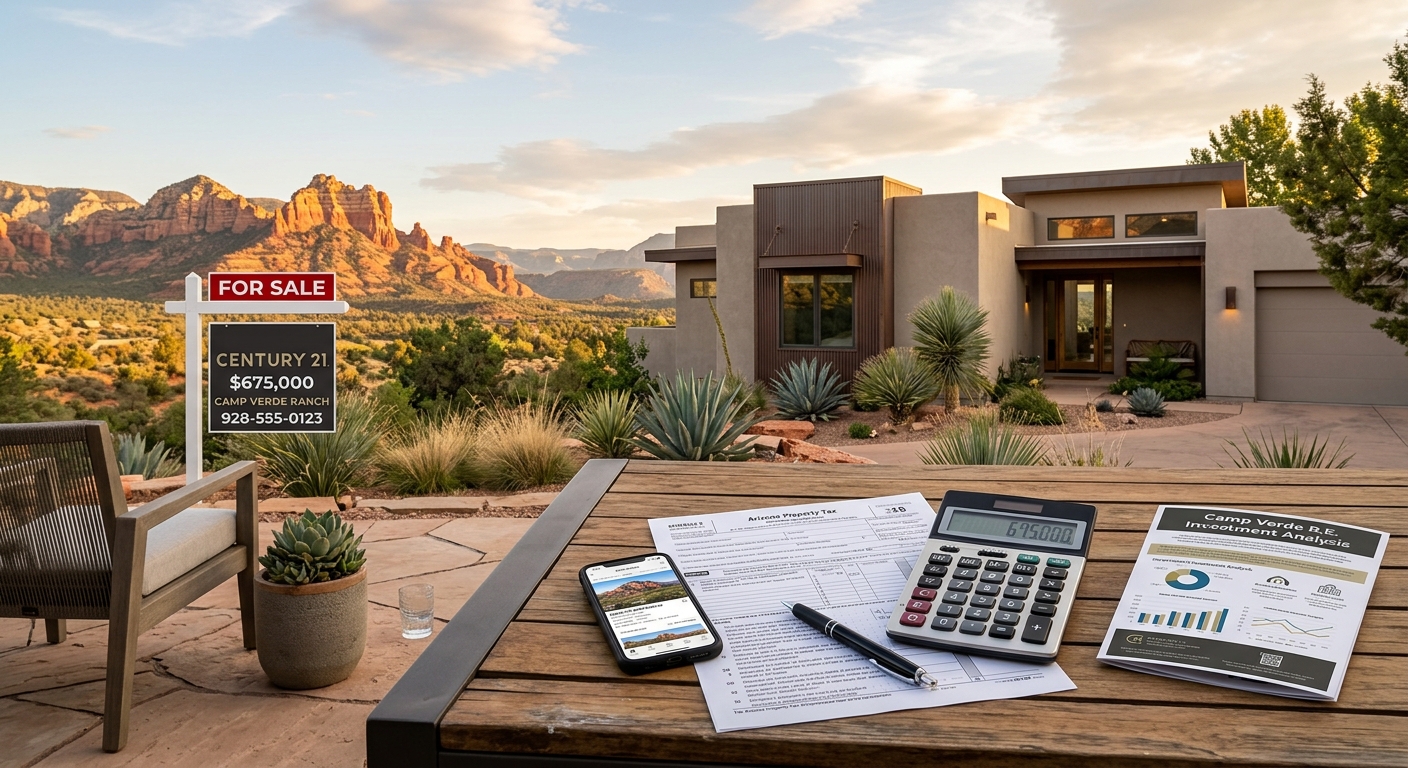
Why Real Estate Tax Planning in Camp Verde, AZ Matters More Than Ever
If you own rental property, flip homes, or hold land in Yavapai County, you already know the market has shifted. But here is what most Camp Verde property owners miss: the tax code shifted right alongside it. And if you are not adjusting your strategy, you are leaving real money on the table.
Real estate tax planning Camp Verde AZ is not some abstract exercise reserved for Wall Street investors. It is a concrete, dollars-and-cents discipline that separates profitable property owners from those who hand the IRS more than they owe. Whether you are a buy-and-hold landlord with a vacation rental on Montezuma Castle Highway or a contractor flipping homes near the Verde River, the 2026 tax landscape has rules you need to understand right now.
If you are searching for professional tax planning services in Camp Verde, you are in the right place. This guide breaks down every deduction, strategy, and compliance checkpoint that matters for Camp Verde real estate investors this year.
Quick Answer
Camp Verde, AZ real estate investors can save thousands in 2026 by combining depreciation strategies, the updated $40,000 SALT deduction cap, proper rental activity classification, and Arizona-specific property tax rules. The key is matching each property’s use case to the right IRS treatment and filing accordingly.
What Changed for Arizona Real Estate Investors in 2026
The One Big Beautiful Bill Act reshaped several areas of the tax code that directly affect property owners. Here is what you need to know about the changes that hit hardest in Camp Verde and surrounding Yavapai County.
The New SALT Cap: $40,000 for 2026
The state and local tax (SALT) deduction cap jumped from $10,000 to $40,000 for individual filers in 2026. For married couples filing separately, the cap sits at $20,000. This is significant for Camp Verde property owners who pay both Arizona state income tax and property taxes on personal residences. If you own a primary home and a vacation property, you can now deduct substantially more of those combined state and local taxes than you could last year.
For context, the average property tax bill in Yavapai County runs around $1,200 to $2,500 per year on a median-value home. That is relatively low compared to states like California or New York. But when you combine Arizona income tax (a flat 2.5% rate) with property taxes on multiple parcels, the new $40,000 cap gives Camp Verde investors room to breathe.
Working Families Tax Cuts Impact
During the 2026 filing season, approximately 45% of individual tax returns claimed one or more of the new deductions branded as the Working Families Tax Cuts, including tax breaks on tips, overtime, and car loan interest. The average refund on returns claiming these deductions topped $3,200 as of late May 2026. If you are a Camp Verde real estate investor who also holds a W-2 job or earns overtime income, these new deductions stack on top of your property-related write-offs.
IRS Enforcement Is Escalating
The IRS closed 987,460 cases through its Automated Underreporter Program in fiscal year 2025, generating $5.9 billion in additional assessments. Another 592,773 cases under the Automated Substitute for Return Program yielded $2.9 billion. That is nearly $9 billion in additional taxes collected through automated matching alone. Camp Verde landlords who underreport rental income or overstate deductions are squarely in the crosshairs. Real estate tax planning is not optional anymore. It is defensive.
Core Deductions Every Camp Verde Property Owner Should Claim
Let us get into the specifics. Here are the deductions that Camp Verde real estate investors leave on the table most often.
Depreciation: Your Largest Non-Cash Deduction
Residential rental property depreciates over 27.5 years under IRS Publication 946. If you purchased a rental home in Camp Verde for $350,000 and the land value is $70,000, your depreciable basis is $280,000. That gives you roughly $10,182 per year in depreciation deductions, money that offsets your rental income without costing you a dime out of pocket.
But here is where Camp Verde investors trip up: they forget to separate land value from improvement value, or they fail to account for capital improvements made after purchase. A new roof, HVAC system, or kitchen renovation gets its own depreciation schedule. Miss that, and you are paying tax on income that the IRS itself says you should not be taxed on.
Mortgage Interest
For rental properties, mortgage interest is fully deductible against rental income on Schedule E. There is no $750,000 cap like there is for personal residences. If you carry a $300,000 mortgage at 7% on a Camp Verde rental, that is roughly $21,000 in first-year interest deductions. Combined with depreciation, you could easily eliminate your taxable rental income entirely.
For your personal residence, the $750,000 acquisition debt limit still applies for itemizers. If you bought your Camp Verde home before December 2017, you may qualify under the grandfathered $1 million limit. Run the numbers. This matters.
Property Management and Maintenance
Every dollar you spend managing your Camp Verde rental is deductible: property management fees (typically 8% to 10% of gross rent in the Verde Valley), maintenance and repair costs, landscaping (especially important in the desert climate), pest control, and cleaning between tenants. These add up fast, and they directly reduce your taxable rental income.
Travel Expenses
If you do not live in Camp Verde full-time and you travel to inspect, maintain, or manage your properties, those travel costs are deductible. That includes mileage at the 2026 IRS standard rate, airfare, lodging, and meals (subject to the 50% limitation on meals). If you drive from Phoenix to Camp Verde to check on a rental, that is roughly 200 miles round trip. At $0.70 per mile, each trip generates a $140 deduction.
KDA Case Study: Camp Verde Rental Investor Saves $14,200 with Restructured Tax Plan
A Camp Verde property owner came to KDA with three rental units spread across Yavapai County, producing $96,000 in gross rental income annually. He had been filing his own taxes for years, claiming basic deductions but missing several key strategies. His effective tax rate on rental income was 28%, and he was paying roughly $26,880 in federal and state taxes on that income.
KDA performed a full property analysis and discovered he had never conducted a cost segregation study on his most recently purchased property, a $420,000 duplex. We accelerated $63,000 in first-year depreciation through a cost segregation breakdown, reclassifying components like appliances, flooring, landscaping, and cabinetry into shorter depreciation schedules (5, 7, and 15 years instead of 27.5). We also restructured his entity setup, moving his properties into a properly managed LLC taxed as a partnership, which gave him better liability protection and cleaner expense tracking. Finally, we identified $4,800 in travel and home office deductions he had never claimed.
The result: his taxable rental income dropped from $96,000 to $58,400, saving him $14,200 in combined federal and Arizona state taxes in the first year alone. KDA charged $3,800 for the full engagement, including the cost segregation study. That is a 3.7x return on investment in year one, with ongoing benefits from the accelerated depreciation over the next several years.
Ready to see how we can help you? Explore more success stories on our case studies page to discover proven strategies that have saved our clients thousands in taxes.
Real Estate Tax Planning Camp Verde AZ: The 14-Day Rule and Vacation Rentals
Camp Verde sits in one of Arizona’s most popular recreation corridors. Montezuma Castle National Monument, the Verde River, and Sedona’s red rocks are all within a short drive. That makes Camp Verde properties prime candidates for short-term vacation rentals. And that is where the IRS rules get tricky.
How the 14-Day Rule Works
If you rent your Camp Verde home for fewer than 15 days during the year, the rental income is completely tax-free. You do not even report it. This is sometimes called the “Masters exemption” or the Augusta Rule (referencing IRS Publication 527 and Section 280A of the Internal Revenue Code).
But once you cross the 15-day threshold, everything changes. You must report all rental income, and your deductions are subject to allocation between personal and rental use days. If your personal use exceeds the greater of 14 days or 10% of rental days, the property is classified as a personal residence, which severely limits your ability to take rental losses.
Strategic Implications for Camp Verde Owners
Say you rent your Camp Verde cabin on Airbnb for 60 days a year at $200 per night. That is $12,000 in gross income. If you personally use the cabin for 20 days, you have exceeded the 10% threshold (10% of 60 = 6 days). The property is now a personal residence for tax purposes, and your rental deductions cannot exceed your rental income. No loss deduction for you.
Contrast that with a Camp Verde investor who rents for 60 days but limits personal use to just 5 days. Now the property qualifies as a rental activity, and losses (if any) can offset other income, subject to passive activity rules. The difference between 5 personal days and 20 personal days can mean thousands of dollars in tax savings.
Passive Activity Rules: The Hidden Trap for Camp Verde Landlords
Most Camp Verde rental property owners are classified as passive investors under IRC Section 469. That means your rental losses can only offset other passive income, not your W-2 salary or business income. There are two critical exceptions.
The $25,000 Special Allowance
If your modified adjusted gross income (MAGI) is under $100,000 and you actively participate in managing the rental (approving tenants, setting rent, authorizing repairs), you can deduct up to $25,000 in rental losses against non-passive income. The allowance phases out between $100,000 and $150,000 of MAGI. Above $150,000, it disappears entirely.
For Camp Verde investors with day jobs earning $120,000, that phase-out hits hard. You lose $1 of the $25,000 allowance for every $2 of MAGI above $100,000. At $120,000, your allowance is only $15,000. At $140,000, it is $5,000. Know your number before you count on this deduction.
Real Estate Professional Status
This is the gold standard for real estate tax planning in Camp Verde and everywhere else. If you qualify as a Real Estate Professional under IRS rules, your rental losses become non-passive, meaning they can offset any type of income, including W-2 wages, business income, and investment gains.
To qualify, you must spend more than 750 hours per year in real property trades or businesses, and more than half of your total working hours must be in real estate activities. For a Camp Verde investor who also works a full-time job, this is extremely difficult to achieve. But if your spouse does not work outside the home and manages your rental properties, he or she may qualify. This single designation can unlock five-figure tax savings annually.
Our Camp Verde tax planning team specializes in helping real estate investors navigate these complex passive activity rules and identify the most effective filing strategies.
Cost Segregation: Accelerating Depreciation in Camp Verde
Standard depreciation spreads your deduction over 27.5 years. Cost segregation compresses it. A qualified cost segregation study breaks your property into component parts and assigns each one to its correct depreciation class:
| Component | Depreciation Class | Example Items |
|---|---|---|
| Personal Property | 5 or 7 years | Appliances, carpeting, decorative fixtures |
| Land Improvements | 15 years | Landscaping, fencing, parking areas, driveways |
| Building Structure | 27.5 years (residential) | Foundation, walls, roof framing |
| Building Systems | 27.5 years (residential) | HVAC, plumbing, electrical (structural) |
On a $400,000 Camp Verde property (excluding land), a cost segregation study typically reclassifies 20% to 35% of the building’s value into shorter-life categories. That means $80,000 to $140,000 of accelerated deductions in the early years of ownership instead of the standard $14,545 annual deduction. If you are in the 32% federal bracket, that acceleration can put $20,000 to $40,000 back in your pocket over the first five years compared to straight-line depreciation.
If you want to see how that impacts your bottom line, run your numbers through this federal tax calculator to estimate the savings.
Arizona-Specific Tax Considerations for Camp Verde Investors
Real estate tax planning Camp Verde AZ requires understanding both federal and state rules. Arizona has its own quirks.
Arizona’s Flat Income Tax Rate
Arizona charges a flat 2.5% income tax rate. That applies to your rental income, capital gains from property sales, and any other taxable income. Compared to California (up to 13.3%) or Oregon (up to 9.9%), Arizona is extremely favorable for real estate investors. But 2.5% on a $50,000 capital gain is still $1,250. It adds up across multiple transactions.
Property Tax Structure in Yavapai County
Yavapai County assesses property taxes based on two values: full cash value and limited property value. The limited value is used for primary tax calculations and cannot increase by more than 5% per year (or the rate of inflation, whichever is greater). This benefits long-term Camp Verde property holders whose market values have risen faster than the 5% annual cap.
If you purchased a Camp Verde home in 2019 for $250,000 and it is now worth $380,000, your limited assessed value is likely still well below market. That keeps your annual property tax bill lower than it would be in a state without assessment caps. But when you sell, the new buyer’s assessed value resets to full cash value, which is an important consideration for investors evaluating acquisition costs.
Arizona Capital Gains Subtraction
Arizona allows a 25% subtraction of net long-term capital gains from the sale of assets held for at least one year. If you sell a Camp Verde rental for a $100,000 long-term gain, only $75,000 is taxed at the state level. At the 2.5% flat rate, that saves you $625 per transaction. Not massive, but across multiple property sales over a career, it compounds.
Should You Hold Camp Verde Property in an LLC?
This is one of the most common questions Camp Verde investors ask, and the answer depends on your situation.
Yes, if:
- You own multiple rental properties and want liability protection between them
- Your net rental income exceeds $60,000 and you want to explore S Corp election for management fee income
- You plan to bring in partners or investors
- You want cleaner books and a dedicated business bank account
No, if:
- You own a single rental and your total equity is under $200,000
- You already carry adequate umbrella insurance
- The annual cost of maintaining the LLC ($300 to $800 per year in Arizona) outweighs the benefit
- You have no partners and no plans to add any
An LLC taxed as a disregarded entity (the default for single-member LLCs) adds no extra tax forms beyond Schedule E. But if you elect partnership or S Corp treatment, you are filing additional returns (Form 1065 or 1120-S) and the complexity goes up. Work with a tax strategist who understands entity formation before making this call.
1031 Exchanges: Deferring Capital Gains on Camp Verde Properties
Selling a Camp Verde investment property and buying another? A 1031 like-kind exchange lets you defer all capital gains taxes on the sale, provided you follow the rules precisely.
The Timeline
- Day 0: Close on the sale of your Camp Verde property. Proceeds go to a qualified intermediary (never to you directly).
- Day 1 through 45: Identify up to three replacement properties in writing to your intermediary.
- Day 46 through 180: Close on at least one identified replacement property.
Miss either the 45-day identification window or the 180-day closing deadline, and the entire exchange fails. You owe full capital gains tax. There are no extensions and no exceptions (see IRS Publication 544 for details).
Common 1031 Mistakes in Camp Verde
The biggest error Camp Verde investors make is touching the sale proceeds. If even $1 of the sale price hits your personal bank account, the exchange is disqualified. Always use a qualified intermediary. Second, investors sometimes identify replacement properties that do not qualify as like-kind. Remember: any real property held for investment or business use qualifies. A Camp Verde duplex can be exchanged for raw land in Prescott, or a commercial building in Flagstaff, or an apartment complex in Tucson. It does not have to be the same type of property.
Ready to Reduce Your Tax Bill?
KDA Inc. specializes in strategic tax planning for business owners, S Corps, LLCs, and high-net-worth individuals. Book a personalized consultation and walk away with a clear plan.
Frequently Asked Questions About Real Estate Tax Planning in Camp Verde, AZ
Do I have to pay Arizona state tax on rental income from Camp Verde?
Yes. Arizona taxes rental income at its flat 2.5% rate. Non-residents who own Camp Verde rentals must file an Arizona non-resident return (Form 140NR) reporting the rental income sourced to Arizona.
Can I deduct home office expenses if I manage Camp Verde rentals from home?
Yes, if you use a dedicated space in your home regularly and exclusively for rental management activities. The simplified method allows a $5-per-square-foot deduction up to 300 square feet ($1,500 maximum). The regular method calculates actual expenses proportionally.
What is the deadline for filing a 1031 exchange identification?
You have exactly 45 calendar days from the closing date of your relinquished property to identify replacement properties in writing. This deadline is absolute and cannot be extended.
Does Camp Verde have any local taxes beyond Yavapai County property tax?
Camp Verde imposes a Transaction Privilege Tax (TPT) on certain business activities, including short-term rentals. If you rent your Camp Verde property for fewer than 30 consecutive days, you may owe the local TPT. Check with the Town of Camp Verde for current rates.
How does bonus depreciation apply to Camp Verde rental properties in 2026?
Bonus depreciation has phased down under current law. For assets placed in service in 2026, the bonus depreciation rate is 40% (down from 60% in 2025 and 80% in 2024). This applies to the short-life components identified through cost segregation, not the building structure itself. Even at 40%, the acceleration remains powerful for Camp Verde investors acquiring new properties.
Can I use rental losses from Camp Verde to offset my salary?
Only if you qualify for the $25,000 special allowance (MAGI under $150,000) or meet Real Estate Professional status. Otherwise, rental losses are suspended until you have passive income to offset or until you sell the property in a fully taxable transaction.
Step-by-Step: Building Your 2026 Camp Verde Tax Plan
- Inventory all properties with current market values, mortgage balances, and depreciation schedules. Estimate 30 minutes per property.
- Classify each property as active rental, vacation rental, personal use, or land held for appreciation. This determines which tax rules apply.
- Run your MAGI projection to determine if you qualify for the $25,000 special rental loss allowance or if the phase-out reduces your benefit.
- Evaluate cost segregation candidacy for any property purchased within the last 5 years or any property where you have made substantial improvements. Properties valued above $300,000 typically generate enough savings to justify the study fee.
- Track personal use days meticulously, especially on vacation-style properties. Log every day you or family members use the property, even partial days.
- Review entity structure annually. As your portfolio grows, the right entity setup changes. A single LLC may evolve into a series LLC or a holding company structure.
- Set quarterly estimated payments for both federal (Form 1040-ES) and Arizona (Form 140ES) taxes. Underpayment penalties apply if you owe more than $1,000 at filing.
- File on time, every time. Extensions give you more time to file, not more time to pay. If you owe, penalties and interest start accruing on April 15 regardless of extensions.
This information is current as of 6/9/2026. Tax laws change frequently. Verify updates with the IRS or Arizona Department of Revenue if reading this later.
Ready to work with a tax professional who understands Camp Verde real estate investors? Explore our Camp Verde tax services or book a consultation below.
Book Your Real Estate Tax Strategy Session
If you own rental property in Camp Verde, Yavapai County, or anywhere in Arizona and you are not sure whether your depreciation strategy, entity structure, or filing approach is costing you thousands, let us fix that. Book a personalized consultation with our real estate tax strategy team and get a clear, actionable plan built around your portfolio. Click here to book your consultation now.



