
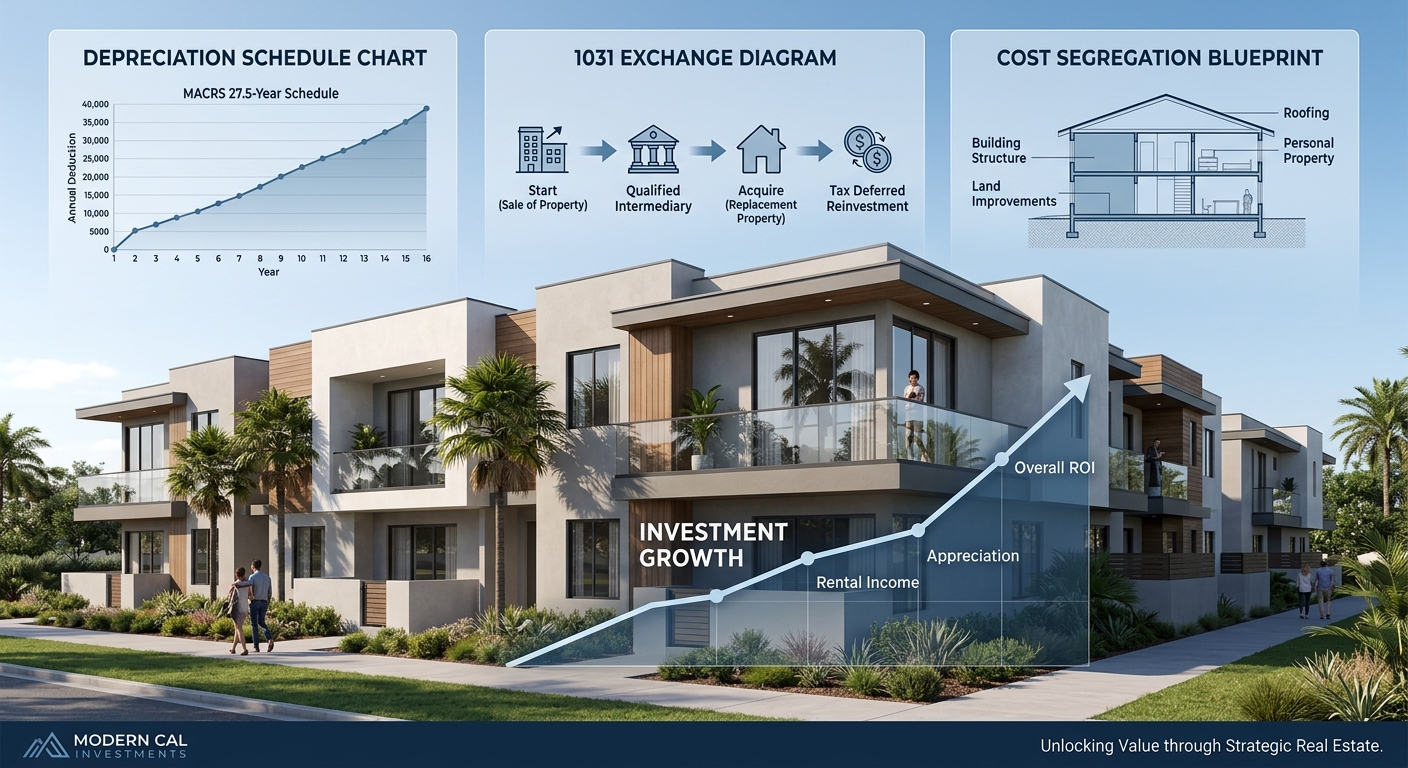
Most California landlords leave thousands on the table every year because they think depreciation is their only play. Meanwhile, investors who understand how California tax brackets 2026 interact with federal passive income rules are offsetting 30-40% of their rental profits through strategies their accountants never mentioned. If you own rental property in California and your CPA hasn’t walked you through cost segregation, real estate professional status, or the Augusta Rule for short-term rentals, you are paying far more than you legally owe.
Quick Answer
California tax brackets for 2026 range from 1% to 13.3% on ordinary income, with the top bracket kicking in at $1,000,000 for married filers and $500,000 for single filers. Real estate investors face these state brackets on top of federal tax rates, but they can use depreciation, cost segregation, and passive loss planning to substantially reduce taxable rental income. The key is timing your strategies to avoid income spikes that push you into higher brackets in high-earning years.
Understanding California’s 2026 Tax Bracket Structure for Rental Income
California operates one of the most aggressive progressive tax systems in the United States. In 2026, the state imposes nine separate tax brackets, with rates climbing from 1% on the first dollars of income to 13.3% on amounts exceeding $1,000,000 for married couples filing jointly. For single filers, that top bracket applies to income over $500,000.
Here is what matters for rental property owners: every dollar of net rental income reported on your California return gets stacked on top of your W-2 wages, 1099 income, or business profits. If you are a tech professional earning $250,000 in salary and your rental properties generate $80,000 in net income, that rental profit is taxed at California’s 9.3% and 10.3% brackets, not the lower rates.
The 2026 California Tax Brackets Breakdown
| Tax Rate | Single Filer Income Range | Married Filing Jointly Income Range |
|---|---|---|
| 1% | $0 – $10,412 | $0 – $20,824 |
| 2% | $10,413 – $24,684 | $20,825 – $49,368 |
| 4% | $24,685 – $38,959 | $49,369 – $77,918 |
| 6% | $38,960 – $54,081 | $77,919 – $108,162 |
| 8% | $54,082 – $68,350 | $108,163 – $136,700 |
| 9.3% | $68,351 – $349,137 | $136,701 – $698,274 |
| 10.3% | $349,138 – $418,961 | $698,275 – $837,922 |
| 11.3% | $418,962 – $698,271 | $837,923 – $1,000,000 |
| 12.3% | $698,272 – $1,000,000 | $1,000,001+ |
| 13.3% | $1,000,001+ | N/A (Top bracket applies) |
Notice the massive jump at the 9.3% bracket. This is where most California real estate investors with multiple properties land, and it is exactly where strategic tax planning becomes critical.
How Rental Income Stacks With Other Income
California does not separate passive income into lower tax buckets like the federal government does with capital gains. Your rental profit is treated as ordinary income and taxed at your marginal rate. If you are already earning $400,000 from your day job, an additional $100,000 in rental income pushes you into the 11.3% and 12.3% state brackets. Combined with federal taxes, you are looking at an effective rate near 50% on that rental profit unless you deploy offsetting deductions.
This is why real estate investors need year-round tax planning strategies, not just annual filing. Your goal is to keep taxable income below key threshold points by maximizing depreciation, deferring gains through 1031 exchanges, and timing property improvements to offset high-income years.
Depreciation: The Foundation of Real Estate Tax Strategy
Depreciation is the IRS-approved method of writing off the cost of your rental property over time. Residential rental properties are depreciated over 27.5 years, while commercial properties use a 39-year schedule. The land itself is not depreciable, only the structure and improvements.
Let’s say you purchased a single-family rental in San Diego for $850,000. The land is valued at $250,000, leaving $600,000 in depreciable basis. Divide $600,000 by 27.5 years, and you get roughly $21,818 in annual depreciation. That deduction reduces your taxable rental income every year without requiring any cash outlay.
Bonus Depreciation and the 2026 Phase-Out
In prior years, real estate investors could take advantage of 100% bonus depreciation on qualifying property improvements and certain short-term rental assets. However, bonus depreciation is phasing out under current tax law. In 2026, bonus depreciation has dropped to 40%, and it continues to decline by 20% each year until it reaches zero in 2027.
If you placed rental property improvements in service during 2025 when bonus depreciation was at 60%, you could deduct a significant portion of new HVAC systems, roofs, or appliances immediately. In 2026, that percentage is lower, which makes cost segregation studies even more important for accelerating deductions.
Key Takeaway: Depreciation is non-optional. Even if you forget to claim it, the IRS still requires you to reduce your cost basis when you sell the property. Always claim the deduction, or you will pay tax on phantom depreciation recapture later.
Cost Segregation: Accelerating Depreciation to Lower Your Tax Bracket
Cost segregation is an engineering-based tax strategy that breaks down your property into components with shorter depreciation schedules. Instead of depreciating the entire building over 27.5 years, a cost segregation study identifies assets like carpeting, lighting, cabinetry, and landscaping that qualify for 5-year, 7-year, or 15-year depreciation.
This front-loads your deductions, creating massive paper losses in the early years of ownership. Those losses can offset other rental income, W-2 wages (if you qualify as a real estate professional), or be carried forward to future tax years.
Example: Cost Segregation on a $1.2 Million Fourplex
Maria owns a fourplex in Sacramento that she purchased for $1.2 million. Without cost segregation, her annual depreciation would be roughly $40,000 per year ($1,100,000 depreciable basis divided by 27.5 years). With a cost segregation study, the engineer identified $350,000 in assets that qualify for accelerated depreciation.
In year one, Maria’s depreciation deduction jumped to $95,000, creating a $30,000 paper loss even though the property generated positive cash flow. That $30,000 loss offset income from her other rental properties, saving her approximately $9,900 in California state taxes alone (at the 9.3% bracket) and an additional $7,200 in federal taxes.
Cost segregation studies typically cost between $5,000 and $15,000 depending on property complexity. For properties valued above $500,000, the return on investment is almost always favorable. Explore how KDA helps investors maximize depreciation through our cost segregation services.
When Does Cost Segregation Make Sense?
Cost segregation is most effective when:
- You purchased or constructed a property valued above $500,000
- You have significant taxable income to offset in the current year
- You plan to hold the property for at least 5-7 years
- You recently completed a major renovation or addition
It is less beneficial for properties you plan to flip quickly, as the recaptured depreciation upon sale can eliminate the tax advantage.
Real Estate Professional Status: Unlocking Passive Loss Limitations
Under normal IRS rules, passive losses from rental real estate can only offset passive income. If your rentals generate a $40,000 loss due to depreciation and expenses, but you have no other passive income, that loss is suspended and carried forward to future years. It does not reduce your W-2 wages or business income.
However, if you qualify as a real estate professional under IRS guidelines, your rental losses become non-passive and can offset any type of income, including your salary, 1099 earnings, or business profits.
How to Qualify as a Real Estate Professional
To meet the IRS definition under IRC Section 469(c)(7), you must satisfy two tests:
- More than 50% of your working time must be spent in real estate trades or businesses in which you materially participate
- You must work at least 750 hours per year in those real estate activities
Real estate trades or businesses include property management, leasing, development, brokerage, and construction. Passive investing in syndications or triple-net lease properties does not count.
Additionally, you must materially participate in each rental property individually, or elect to aggregate all rental activities into a single activity. Most investors file the aggregation election to simplify the tracking process.
Real Estate Professional Strategy in Action
David is a software engineer earning $280,000 annually. His wife Elena manages their five rental properties full-time. She spends 1,200 hours per year handling tenant communications, coordinating repairs, marketing vacancies, and overseeing renovations. She tracks her hours in a detailed log and qualifies as a real estate professional.
Their rental properties generated $65,000 in net rental income before depreciation. After claiming $110,000 in depreciation (boosted by cost segregation), they show a $45,000 rental loss. Because Elena qualifies as a real estate professional, that $45,000 loss offsets David’s W-2 income.
At California’s 9.3% bracket and federal rates around 24%, they saved approximately $14,985 in combined taxes in one year. Over a decade, this strategy compounds into six-figure tax savings.
Pro Tip: Keep a contemporaneous log of all real estate activities. The IRS audits real estate professional status claims frequently, and you must prove your hours with credible documentation. Use time-tracking apps, calendars, or spreadsheets to maintain records throughout the year.
The $25,000 Special Allowance and Modified Adjusted Gross Income Limits
Even if you do not qualify as a real estate professional, the IRS provides a limited passive loss deduction for active participants in rental real estate. If you actively participate in managing your rentals (approving tenants, setting rents, approving repairs), you can deduct up to $25,000 in rental losses against your ordinary income.
However, this allowance phases out for taxpayers with modified adjusted gross income (MAGI) above $100,000 and disappears entirely at $150,000. For every dollar of MAGI above $100,000, you lose $0.50 of the allowance.
Example: Active Participation Phaseout
Jenna is a single filer with $120,000 in W-2 income. Her duplex generated a $30,000 loss after depreciation. She actively manages the property herself, so she qualifies for the $25,000 special allowance.
However, her MAGI of $120,000 exceeds the $100,000 threshold by $20,000. The phaseout reduces her allowance by $10,000 ($20,000 excess × 50%). She can only deduct $15,000 of the loss in the current year, and the remaining $15,000 is suspended and carried forward.
This is why high-earning California professionals hit the passive loss wall quickly. If your household income exceeds $150,000, you need to either qualify as a real estate professional or use strategies like short-term rental material participation to unlock suspended losses.
Short-Term Rentals and Material Participation Loopholes
Properties rented for an average stay of seven days or less are not subject to passive activity loss rules, provided you materially participate in the rental activity. This means short-term vacation rentals listed on Airbnb or VRBO can generate losses that offset your W-2 income without needing real estate professional status.
What Counts as Material Participation for Short-Term Rentals?
You must meet one of the seven IRS tests for material participation. The most common test is working more than 100 hours in the rental activity and ensuring no one else works more hours than you (including property managers).
If you hire a property management company that handles all guest communications, cleanings, and maintenance, you likely will not meet the material participation standard. However, if you personally manage bookings, coordinate turnovers, handle guest issues, and oversee repairs, you can meet the threshold.
Short-Term Rental Case Study
Ryan owns a cabin in Lake Tahoe that he rents on Airbnb for an average of 4 nights per stay. He works 180 hours per year managing the listing, coordinating cleaners, restocking supplies, and handling maintenance. The property generated $95,000 in rental income but showed a $22,000 loss after deducting mortgage interest, depreciation, and operating expenses.
Because the average rental period is under seven days and Ryan materially participates, the $22,000 loss is non-passive and offsets his $180,000 consulting income. He saved approximately $7,260 in combined California and federal taxes in one year.
Red Flag Alert: The IRS scrutinizes short-term rental losses closely. Document your hours with detailed logs showing dates, tasks performed, and time spent. Do not round your hours or estimate retroactively. Contemporaneous records are essential if you face an audit.
1031 Exchange: Deferring Capital Gains to Preserve Wealth
When you sell a California rental property, you face federal capital gains tax, California state capital gains tax (taxed as ordinary income), and depreciation recapture. For a property sold at a $400,000 gain, the combined tax bill can exceed $150,000.
A 1031 exchange allows you to defer all capital gains and depreciation recapture by reinvesting the proceeds into a like-kind replacement property. You pay no tax at the time of sale, and your cost basis carries forward into the new property.
How a 1031 Exchange Works
The process follows strict IRS timelines and rules:
- Sell your relinquished property and transfer proceeds to a qualified intermediary (you cannot touch the money)
- Identify replacement properties within 45 days of the sale (you can identify up to three properties of any value, or unlimited properties if their total value does not exceed 200% of the relinquished property value)
- Close on the replacement property within 180 days of the original sale
- Reinvest all proceeds and maintain equal or greater debt to defer 100% of the gain
If you receive any cash or reduce your debt, the IRS treats that as taxable boot and you pay tax on the portion not reinvested.
1031 Exchange Example
Linda sold a rental condo in Los Angeles for $900,000. She originally purchased it for $400,000 and claimed $120,000 in depreciation over the years. Her adjusted basis is $280,000 ($400,000 purchase price minus $120,000 depreciation), giving her a taxable gain of $620,000.
Without a 1031 exchange, she would owe approximately $93,000 in federal capital gains tax (15% on $500,000 long-term gain plus 25% on $120,000 depreciation recapture) and an additional $81,260 in California state tax (13.3% on $620,000). Total tax bill: $174,260.
Instead, Linda used a 1031 exchange to purchase a fourplex in Riverside for $1,100,000. She deferred the entire $620,000 gain and now owns a larger income-producing asset with higher cash flow. Her $280,000 basis carried into the new property, and she will continue deferring taxes until she either sells without exchanging or passes the property to her heirs (who receive a stepped-up basis at death).
Explore how KDA guides investors through 1031 exchanges and property swaps on our real estate tax preparation page.
KDA Case Study: Real Estate Investor
Marcus owned three single-family rentals in Orange County generating $140,000 in annual rental income. He was paying over $48,000 in combined federal and California taxes each year because he was not utilizing any advanced strategies beyond standard depreciation.
KDA performed cost segregation studies on all three properties, identifying $285,000 in accelerated depreciation. We also helped his spouse establish real estate professional status by documenting her property management hours. The result: a $92,000 first-year tax loss that offset Marcus’s $175,000 software sales income.
In the first year alone, Marcus saved $31,600 in taxes. Over five years, his cumulative tax savings exceeded $110,000. The cost of the cost segregation studies and tax planning services totaled $18,000, delivering a 6.1x return on investment.
Ready to see how we can help you? Explore more success stories on our case studies page to discover proven strategies that have saved our clients thousands in taxes.
California-Specific Considerations for Real Estate Investors
California imposes additional tax rules and compliance requirements that do not exist in other states. Understanding these nuances prevents costly mistakes and missed opportunities.
California Does Not Conform to All Federal Tax Laws
California follows its own tax code and does not automatically adopt federal tax changes. For example, California did not conform to the federal 100% bonus depreciation rules in recent years, forcing investors to make basis adjustments on their state returns.
When preparing your California return, you must add back federal bonus depreciation and follow California’s slower depreciation schedules. This creates a temporary difference that reverses over time, but it complicates tax reporting and requires detailed tracking.
Mental Health Services Tax on High Earners
California imposes an additional 1% Mental Health Services Tax on income exceeding $1,000,000. This brings the top marginal state tax rate to 13.3%, the highest in the nation. Real estate investors who experience large capital gains in a single year (from property sales or refinances that trigger debt forgiveness income) can be pushed into this bracket unexpectedly.
Strategies to avoid the Mental Health Services Tax include spreading gains over multiple years through installment sales, deferring gains with 1031 exchanges, or using opportunity zone investments to defer and reduce capital gains.
Vacancy Deduction Controversy
California allows landlords to deduct property taxes and mortgage interest during vacancy periods, even when no rental activity occurs. However, the Franchise Tax Board (FTB) has challenged aggressive vacancy deductions in recent audits, particularly when properties remain vacant for extended periods without documented marketing efforts.
If you have a property sitting vacant while you renovate or search for tenants, document your marketing activities, show listings, renovation invoices, and communications with prospective tenants. This creates an audit trail proving you intended to rent the property and were actively seeking tenants.
Common Mistakes California Real Estate Investors Make
Failing to Track Basis Adjustments
Every improvement you make to a rental property increases your cost basis and affects future depreciation and capital gains calculations. If you install a new roof for $25,000, that amount gets added to your basis and depreciated over 27.5 years. When you sell the property, that $25,000 reduces your taxable gain.
Many investors lose track of improvements over time, resulting in overpaid capital gains tax at sale. Maintain a spreadsheet or use accounting software to track every capital improvement, along with supporting invoices and receipts.
Not Separating Personal Use from Rental Use
If you use your rental property for personal purposes for more than 14 days per year (or 10% of the days it is rented, whichever is greater), the IRS treats it as a mixed-use property and limits your deductions. You can only deduct expenses proportional to the rental use percentage.
For vacation rentals, this becomes a trap. If you rent your Tahoe cabin for 100 days and use it personally for 20 days, you exceed the personal use threshold and lose the ability to deduct a portion of your expenses. Plan your personal use carefully and track every day the property is used for rental versus personal purposes.
Ignoring the Augusta Rule for Short-Term Rentals
Under IRC Section 280A(g), you can rent your primary residence for up to 14 days per year and keep the rental income completely tax-free. This is commonly called the Augusta Rule (named after homeowners in Augusta, Georgia who rent their homes during the Masters golf tournament).
If you live in a desirable area and can rent your home for $1,500 per night during peak events, you can generate $21,000 in tax-free income by renting for 14 days. You do not report the income, and you still deduct your mortgage interest and property taxes as itemized deductions.
The catch: you cannot claim any rental expenses for those 14 days. No depreciation, no repairs, no cleaning costs. But for high-value short-term rentals, the tax-free income often outweighs the lost deductions.
Red Flags That Trigger California FTB Audits for Real Estate Investors
The California Franchise Tax Board closely monitors rental real estate activity. Certain reporting patterns increase your audit risk:
- Consistently reporting rental losses year after year without showing material participation or real estate professional status documentation
- Claiming 100% business use on mixed-use vacation properties without adequate proof of rental intent and marketing activity
- Large cost segregation deductions in the first year without attaching engineering reports or detailed asset classifications
- Deducting travel expenses for out-of-state rental property inspections without supporting documentation showing the trips were ordinary and necessary
- Reporting real estate professional status without filing a written election or maintaining contemporaneous time logs
If the FTB audits your rental real estate activity, they will request detailed records including lease agreements, bank statements, receipts, mileage logs, and time-tracking documentation. Maintaining organized records throughout the year is your best audit defense.
Ready to Reduce Your Tax Bill?
KDA Inc. specializes in strategic tax planning for business owners, S Corps, LLCs, and high-net-worth individuals. Book a personalized consultation and walk away with a clear plan.
Frequently Asked Questions
How do California tax brackets interact with federal tax brackets for rental income?
California tax brackets and federal tax brackets are calculated independently. Your rental income is added to your total income for both federal and state purposes, but the rates and thresholds differ. Federal long-term capital gains receive preferential rates (0%, 15%, or 20%), but California taxes all capital gains as ordinary income at rates up to 13.3%. Rental income is taxed as ordinary income at both levels, so you face combined marginal rates approaching 50% at higher income levels.
Can I use passive losses from California rentals to offset W-2 income?
Only if you qualify as a real estate professional under IRS Section 469(c)(7) or if your rental qualifies as a short-term rental with material participation. Otherwise, passive losses can only offset passive income and any excess is suspended and carried forward. The $25,000 special allowance for active participants phases out completely at $150,000 MAGI, so high earners cannot use it.
What happens to suspended passive losses when I sell the property?
When you sell a rental property in a fully taxable transaction, all suspended passive losses from that specific property are released and can offset the capital gain from the sale. This prevents you from losing the benefit of those deductions permanently. However, if you sell the property using a 1031 exchange, the suspended losses remain suspended and carry forward to the replacement property.
Does California conform to federal bonus depreciation rules?
No. California does not conform to federal bonus depreciation provisions. If you claim bonus depreciation on your federal return, you must add it back on your California return and follow California’s standard depreciation schedules. This creates a timing difference that requires careful tracking and eventual reversal when the property is sold or fully depreciated.
How does the 2026 California billionaire tax proposal affect real estate investors?
The proposed one-time 5% wealth tax targets individuals with over $1.1 billion in worldwide assets. It does not affect typical rental property investors. However, it signals California’s willingness to impose aggressive taxes on high earners, which may influence future tax policy for upper-income real estate investors. Stay informed on legislative developments and consider structuring strategies that provide flexibility if California expands wealth or property taxation.
Planning for 2026 and Beyond
California’s tax environment will remain one of the most aggressive in the nation. Real estate investors who thrive in this environment are those who treat tax planning as an ongoing strategy, not an annual filing obligation.
Your action plan for 2026 should include:
- Reviewing your current rental properties for cost segregation opportunities
- Evaluating whether you or your spouse can qualify as a real estate professional
- Tracking all property-related hours and activities in real-time
- Documenting every capital improvement and maintaining organized records
- Projecting your income for the year and planning property sales or 1031 exchanges to avoid bracket creep
- Consulting with a tax strategist before making major property purchases or sales
The difference between paying 13.3% on your rental income and offsetting it entirely with depreciation strategies is not luck. It is intentional planning backed by expert guidance.
Key Takeaway: California tax brackets punish passive investors who fail to implement active tax strategies. Real estate investors who combine cost segregation, real estate professional status, and 1031 exchanges can legally reduce their effective tax rate to single digits while building long-term wealth.
Stop Overpaying California Taxes on Your Rental Income
If you own rental property in California and your current tax strategy begins and ends with standard depreciation, you are leaving five figures on the table every year. The tax code rewards investors who understand the rules and apply them strategically, but those opportunities disappear if you wait until April to think about taxes.
Book a personalized tax strategy session with KDA and get a clear action plan for maximizing your rental property deductions, lowering your California tax bracket exposure, and building wealth without handing half your profits to the state. Click here to book your consultation now.
This information is current as of 5/1/2026. Tax laws change frequently. Verify updates with the IRS or FTB if reading this later.



