
What’s the California State Tax Filing Deadline in 2026?
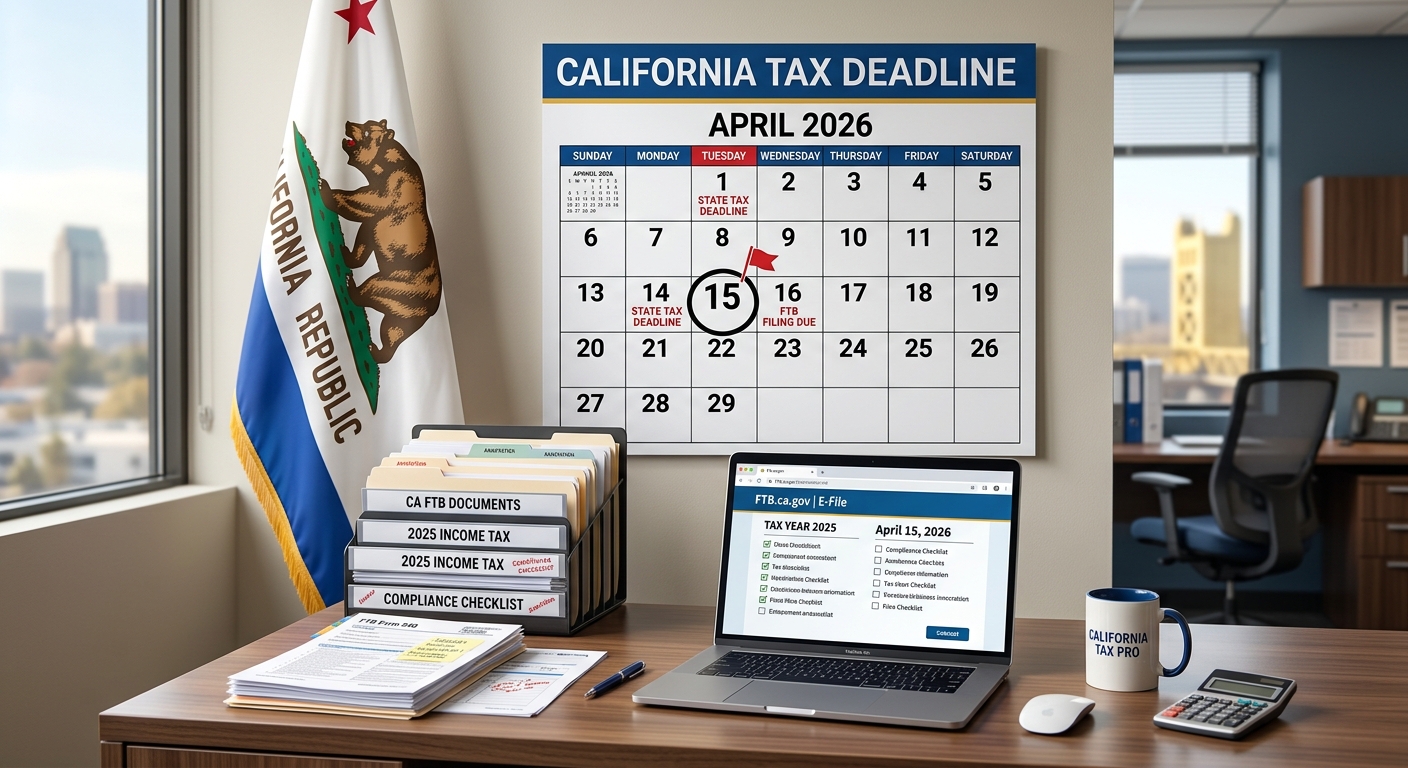
The California state tax filing deadline for 2026 is April 15, 2026. If you’re filing both federal and California state returns, you’re working with the same baseline deadline. But here’s what most taxpayers miss: California doesn’t automatically grant extensions just because you filed for one federally. You need to file separate extension paperwork with the Franchise Tax Board (FTB) if you want until October to submit your California return without penalty.
If you own a business, work as a 1099 contractor, or manage rental properties in California, this deadline isn’t just a formality. It’s a hard stop. Miss it, and you’re looking at penalties that compound fast, plus interest that accrues daily from the original due date. The FTB doesn’t send friendly reminders. They send notices with dollar amounts attached.
Quick Answer
The California state tax filing deadline is April 15, 2026 for individual returns. Extensions move the filing deadline to October 15, 2026, but they do not extend the time to pay taxes owed. Payments must still be submitted by April 15 to avoid penalties and interest charges from the FTB.
Why the California State Tax Filing Deadline Matters More Than You Think
Most taxpayers assume that if they file their federal return on time, they’re covered. Not in California. The FTB operates independently from the IRS, and their enforcement is aggressive. Here’s what happens when you miss the deadline:
- Late filing penalty: 5% of unpaid tax per month, up to 25% maximum
- Late payment penalty: 0.5% per month on unpaid balance
- Interest: Compounds daily from April 15 at current FTB rate (approximately 5% annually as of 2026)
- Demand notices: FTB begins collections process within 60 days of missed deadline
Let’s say you owe $12,000 in California state tax and file three months late. You’re looking at $1,800 in late filing penalties (5% × 3 months), $180 in late payment penalties, plus roughly $150 in accrued interest. That’s $2,130 in avoidable costs because you missed one date.
Real-World Scenario: Maria runs a consulting LLC in San Diego. She filed her federal return on time in April but forgot to file her California return until July. Her tax owed was $8,500. By the time she submitted her California return, she had incurred $1,275 in late filing penalties, $127.50 in late payment penalties, and $106 in interest. Total cost of the delay: $1,508.50.
Who Needs to File by the California State Tax Filing Deadline?
You’re required to file a California state tax return if you meet any of these conditions:
- You’re a California resident with income from any source
- You’re a nonresident with California-source income exceeding $18,218 (single) or $36,436 (married filing jointly) for tax year 2025
- You’re a part-year resident with income while living in California
- You received a 1099 for work performed in California, regardless of where you live
- You sold California real estate or received rental income from California properties
If you’re a W-2 employee who moved to California mid-year, you need to file a part-year resident return. If you’re a remote worker living in California but working for an out-of-state company, you still owe California tax on that income. The FTB tracks these situations aggressively.
How to File Your California State Tax Return Before the Deadline
Filing your California return requires specific forms and documentation that differ from federal requirements. Here’s the step-by-step process:
Step 1: Gather Your California-Specific Documents
You’ll need your federal return as a starting point, but California requires additional documentation:
- Form 540 (residents) or Form 540NR (nonresidents/part-year residents)
- All W-2s showing California wages
- 1099 forms for California-source income
- Schedule CA for reporting differences between federal and California adjustments
- Prior year California tax return for carryover deductions or credits
California doesn’t conform to all federal tax laws. For example, California has its own standard deduction amounts, doesn’t allow certain federal deductions, and calculates depreciation differently for business assets. You can’t just copy numbers from your federal return.
Step 2: Calculate California-Specific Adjustments
Schedule CA is where most taxpayers make costly mistakes. This form reconciles federal and California tax treatment for items like:
- State and local tax (SALT) deductions (California has no $10,000 cap)
- Business deductions (California uses different depreciation rules)
- Retirement contributions (California treats some retirement accounts differently)
- Capital gains (California taxes all capital gains as ordinary income)
Example: You claimed $25,000 in SALT deductions on your federal return, but the federal cap limited you to $10,000. On your California return, you can deduct the full $25,000, reducing your California taxable income by an additional $15,000. At California’s 9.3% tax rate, that’s a $1,395 tax savings you’d miss without Schedule CA.
Step 3: Submit Payment by April 15 (Even If You File an Extension)
This is the biggest misconception about extensions. Filing Form 3519 gives you until October 15, 2026 to submit your California return, but it does not extend your payment deadline. You must estimate your California tax liability and pay by April 15 to avoid penalties.
Use this quick calculation to estimate your payment:
- Take your 2025 California tax liability
- Add 10% if your income increased in 2026
- Subtract any estimated tax payments or withholding you’ve already made
- Pay the difference by April 15
If you underpay, you’ll owe interest from April 15. If you overpay, you’ll get a refund when you file in October. The key is making a good-faith estimate to minimize penalties.
Step 4: File Electronically Through CalFile or Approved Software
California offers free e-filing through CalFile for simple returns. For more complex situations (business income, rental properties, stock sales), you’ll need tax software that supports California returns or professional assistance.
Electronic filing provides immediate confirmation that the FTB received your return. Paper returns can take 8-12 weeks to process, and there’s no proof of filing if your return gets lost in the mail. Given California’s strict enforcement, electronic filing is the safer choice.
Need help navigating California’s complex filing requirements? Our tax preparation services ensure your California return is filed correctly and on time, maximizing deductions while maintaining full FTB compliance.
What Happens If You Miss the California State Tax Filing Deadline?
The FTB’s collections process moves fast. Here’s the typical timeline after you miss the April 15 deadline:
30 Days After Deadline: First Notice
The FTB sends a “Demand for Tax Return” notice. This is your warning shot. You have 15 days to respond with either your completed return or an explanation for the delay. Ignoring this notice triggers the next phase.
60 Days After Deadline: Estimated Assessment
If you haven’t filed, the FTB will file a return for you based on their records. This is called a “proposed assessment,” and it’s always higher than what you actually owe because the FTB doesn’t include deductions you’re entitled to claim.
They’ll estimate your income based on W-2s, 1099s, and other third-party reports, then calculate tax using the highest possible rate with zero deductions. You’ll receive a bill with penalties and interest already added.
90 Days After Deadline: Collections Action
The FTB can place liens on your property, levy your bank accounts, or garnish your wages without going to court first. California law gives the FTB broader collection powers than the IRS has at the federal level.
Once a lien is filed, it appears on your credit report and can prevent you from selling property, refinancing loans, or obtaining business credit. The lien stays in place until you pay the full amount owed plus penalties and interest.
Special Situations and Edge Cases
If you’re in any of these situations, standard deadline rules may not apply:
Military personnel on active duty: You may qualify for automatic extensions if you’re deployed outside California. File Form 3519 and attach deployment orders.
Disaster area residents: If you live in a federally declared disaster area, the FTB typically grants automatic extensions matching federal relief. Check the FTB website for current disaster declarations.
Nonresidents selling California property: You may need to file a California return even if you don’t owe tax, to document withholding credits from the property sale. Missing this filing can delay your refund by months.
Dual-state residents: If you split time between California and another state, you need to determine your domicile for tax purposes. California uses factors like driver’s license location, voter registration, and days present in state. Getting this wrong can mean double taxation.
California-Specific Considerations for the 2026 Filing Deadline
California tax law diverges from federal law in critical ways that affect your April 15 deadline strategy:
Conformity Date Differences
California conforms to the Internal Revenue Code as of a specific date (currently January 1, 2025 for the 2026 tax year). Federal tax law changes after that date don’t automatically apply to California returns. You need to track which deductions and credits apply to each return separately.
For example, if Congress passes a new federal deduction in February 2026, you can claim it on your federal return but not on your California return for tax year 2026. This creates planning opportunities and traps depending on your situation.
Mental Health Services Tax (MHST)
High-income earners pay an additional 1% tax on income over $1 million. This isn’t included in the standard California tax rate tables. If your income crosses the $1 million threshold, you need to calculate this separately and include it in your April 15 payment to avoid underpayment penalties.
Example: You earned $1.2 million in 2026. Your base California tax is calculated on the full amount, but you also owe MHST on the $200,000 over $1 million. That’s an additional $2,000 in tax beyond the standard calculation. If you don’t include this in your April 15 payment, you’ll owe penalties even if you paid your estimated base tax correctly.
Passthrough Entity Tax (PET) Election
California allows S corporations and partnerships to elect entity-level taxation to work around the federal SALT cap. If your business made this election, the entity pays California tax directly, and you receive a credit on your personal return.
The filing deadline for PET returns is March 15, 2026 (one month before the individual deadline). If your business missed that deadline, you can’t claim the credit on your personal return, potentially costing you thousands in federal tax savings.
Red Flag Alert: Common Mistakes That Trigger FTB Audits
The FTB’s audit selection process flags certain return characteristics. Avoid these common triggers:
Mismatched residency status: Claiming nonresident status while maintaining a California driver’s license, California voter registration, or California health insurance will trigger a residency audit. The FTB cross-references state databases to catch these inconsistencies.
Unreported 1099 income: The FTB receives copies of all 1099 forms issued to California residents or for California-source income. If your return doesn’t include income that appears on a 1099 in the FTB’s system, you’ll receive an automated notice within 90 days.
Excessive business losses: Claiming business losses that exceed your business income for three consecutive years flags your return for Schedule C audit. The FTB looks for hobby loss situations where you’re deducting personal expenses as business costs.
Round numbers on Schedule CA: If all your California adjustments are round numbers ($5,000, $10,000, $15,000), it suggests you’re estimating rather than calculating actual figures. The FTB interprets this as carelessness and may audit to verify your numbers.
Pro Tip: Keep contemporaneous records for all California-specific deductions. The FTB audit period is four years (one year longer than the IRS), and they routinely request documentation for items like moving expense deductions, educator expenses, and business use of home calculations that differ from federal treatment.
How to Request a California Tax Filing Extension
If you can’t complete your return by April 15, file Form 3519 to extend your filing deadline to October 15, 2026. Here’s what you need to know:
Extension Process Step-by-Step
- Calculate your estimated tax liability using last year’s return as a baseline plus any income increases
- Submit Form 3519 electronically through the FTB website or approved tax software by April 15, 2026
- Make payment for your estimated tax liability by April 15 using FTB Web Pay or check with Form 3519
- File your complete return by October 15, 2026 to avoid late filing penalties
The extension is automatic once you file Form 3519. You don’t need to wait for FTB approval. However, the extension only protects you from late filing penalties. If you underpay your estimated liability, you’ll still owe interest from April 15 on the unpaid amount.
When Extensions Make Strategic Sense
Extensions aren’t just for taxpayers who are disorganized. Strategic use of extensions can save money in these situations:
Complex investment transactions: If you made qualified opportunity zone investments, cryptocurrency trades, or had partnership K-1s that arrived late, you need accurate cost basis information. Filing an extension gives you time to gather correct documentation rather than amending later.
Estimated tax payment planning: If you made four estimated tax payments during 2026 but aren’t sure whether you overpaid or underpaid, extending gives you time to calculate your exact liability and adjust your final payment to match.
Residency determination: If you moved to or from California during 2026 and you’re calculating your part-year resident return, the allocation formulas are complex. An extension gives you time to determine the correct split of income between California and other states.
KDA Case Study: Small Business Owner
Rebecca owns a marketing agency structured as an S corporation in Sacramento. She handles her own bookkeeping but wasn’t sure how to properly file her California PET election or coordinate her personal and business filing deadlines. She came to KDA in early March 2026 after receiving an FTB notice about a missing 2025 return.
We discovered that Rebecca had filed her federal return but forgotten to file her California return because her tax software defaulted to federal-only filing. The FTB had issued a proposed assessment based on her 1099 income without crediting her legitimate business deductions. The assessment showed she owed $14,200 in tax plus $2,130 in penalties.
We immediately filed her correct California return showing actual business deductions for office rent, software subscriptions, contractor payments, and health insurance. Her actual California tax liability was $6,800. We also filed an abatement request for penalties based on reasonable cause (software error). The FTB accepted the abatement and eliminated all penalties.
Tax Savings Result: $7,400 in corrected assessment plus $2,130 in penalty relief = $9,530 total savings
What Rebecca Paid KDA: $1,850 for amended return preparation and penalty abatement representation
ROI: 5.1x first-year return on tax strategy investment
Rebecca now maintains a compliance calendar that tracks both federal and California deadlines separately, and she files her PET election by the March 15 deadline to maximize her SALT deduction strategy.
Ready to see how we can help you? Explore more success stories on our case studies page to discover proven strategies that have saved our clients thousands in taxes.
Ready to Reduce Your Tax Bill?
KDA Inc. specializes in strategic tax planning for business owners, S Corps, LLCs, and high-net-worth individuals. Book a personalized consultation and walk away with a clear plan.
Frequently Asked Questions About the California State Tax Filing Deadline
Do I need to file a California return if I only lived there for part of the year?
Yes. If you were a California resident for any portion of the tax year, you must file a part-year resident return (Form 540NR). You’ll pay California tax on income earned while you were a resident, plus any California-source income earned after you left (like rental property income or stock option exercises from a California employer).
Can I file my California return before I file my federal return?
Technically yes, but it’s not advisable. Your California return requires information from your federal return, and the FTB’s processing system expects consistency between the two. If you file California first with estimated federal numbers, then your actual federal return differs, you’ll need to amend your California return, which delays any refund and increases your audit risk.
What happens if I’m owed a California refund but file late?
If the FTB owes you a refund, there’s no late filing penalty. However, you must file within four years of the original deadline to claim your refund. After four years, you forfeit the money permanently. The FTB keeps unclaimed refunds totaling millions of dollars every year from taxpayers who file too late.
Does California accept federal extensions automatically?
No. Filing federal Form 4868 does not extend your California filing deadline. You must file California Form 3519 separately. Many taxpayers assume federal and state extensions are linked and end up with FTB penalties because they only filed the federal extension.
California vs Federal Filing Deadlines: Key Differences
| Factor | Federal (IRS) | California (FTB) |
|---|---|---|
| Filing Deadline | April 15, 2026 | April 15, 2026 |
| Extension Form | Form 4868 | Form 3519 |
| Extended Deadline | October 15, 2026 | October 15, 2026 |
| Late Filing Penalty | 5% per month, 25% max | 5% per month, 25% max |
| Late Payment Penalty | 0.5% per month | 0.5% per month |
| Interest Rate (2026) | Varies quarterly (~8%) | ~5% annually |
| Audit Period | 3 years standard | 4 years standard |
| Collection Powers | Requires court approval for liens | Can lien without court order |
What the California State Tax Filing Deadline Means for Your 2026 Tax Strategy
The April 15 deadline isn’t just about compliance. It’s a strategic checkpoint for your annual tax plan. Here’s how to use this deadline to your advantage:
Review Your Estimated Tax Payment Strategy
If you underpaid during 2026, you’ll owe penalties unless you meet safe harbor requirements (paying 90% of current year tax or 110% of prior year tax for high earners). Use the April 15 deadline to evaluate whether your 2027 estimated payments need adjustment.
California’s safe harbor rules differ slightly from federal rules. For California, if your prior year AGI exceeded $150,000, you must pay 110% of prior year tax to avoid underpayment penalties (compared to $75,000 threshold for federal). Missing this distinction can cost you hundreds in avoidable penalties.
Maximize Retirement Contributions Before the Deadline
You can make IRA contributions up until April 15, 2026 and claim them on your 2026 tax return. For California purposes, this reduces your taxable income dollar-for-dollar (California has no income phaseout for IRA deductibility if you meet federal requirements).
Quick calculation: Contributing $7,000 to a traditional IRA by April 15 saves you $651 in California tax (at 9.3% rate) plus federal tax savings. If you’re in the 24% federal bracket, that’s $1,680 in federal savings plus $651 in state savings = $2,331 total tax savings for a $7,000 investment.
Plan for Next Year’s Deadlines Now
Use your 2026 filing experience to set up systems for 2027:
- Set quarterly estimated payment reminders for April 15, June 15, September 15, and January 15
- Create a separate business bank account if you’re a 1099 contractor to simplify income tracking
- Implement monthly bookkeeping reviews instead of year-end scrambles
- Schedule a mid-year tax projection meeting to adjust estimated payments before underpayment penalties accrue
The taxpayers who win at California taxes aren’t the ones with the most complex strategies. They’re the ones who hit deadlines, maintain clean records, and plan ahead. It’s not exciting, but it’s worth thousands in avoided penalties and interest every year.
Key Takeaway
The California state tax filing deadline of April 15, 2026 is a hard stop with real financial consequences. Extensions provide filing flexibility but don’t extend payment deadlines. The FTB’s enforcement is aggressive, and their collection powers exceed the IRS. File electronically, pay on time, and maintain California-specific documentation to avoid penalties that can reach 25% of your tax liability plus daily compounding interest.
This information is current as of March 24, 2026. Tax laws change frequently. Verify updates with the IRS or FTB if reading this later.
Book Your California Tax Compliance Strategy Session
Missing the California state tax filing deadline costs more than money. It creates FTB notices, credit problems, and collection hassles that take months to resolve. If you’re unsure whether your California return is filed correctly, whether you qualify for extensions, or how to handle FTB notices, let’s eliminate the uncertainty. Book a personalized consultation with our California tax strategy team and get clear, compliant, and confident. Click here to schedule your consultation now.


