
Quick Answer
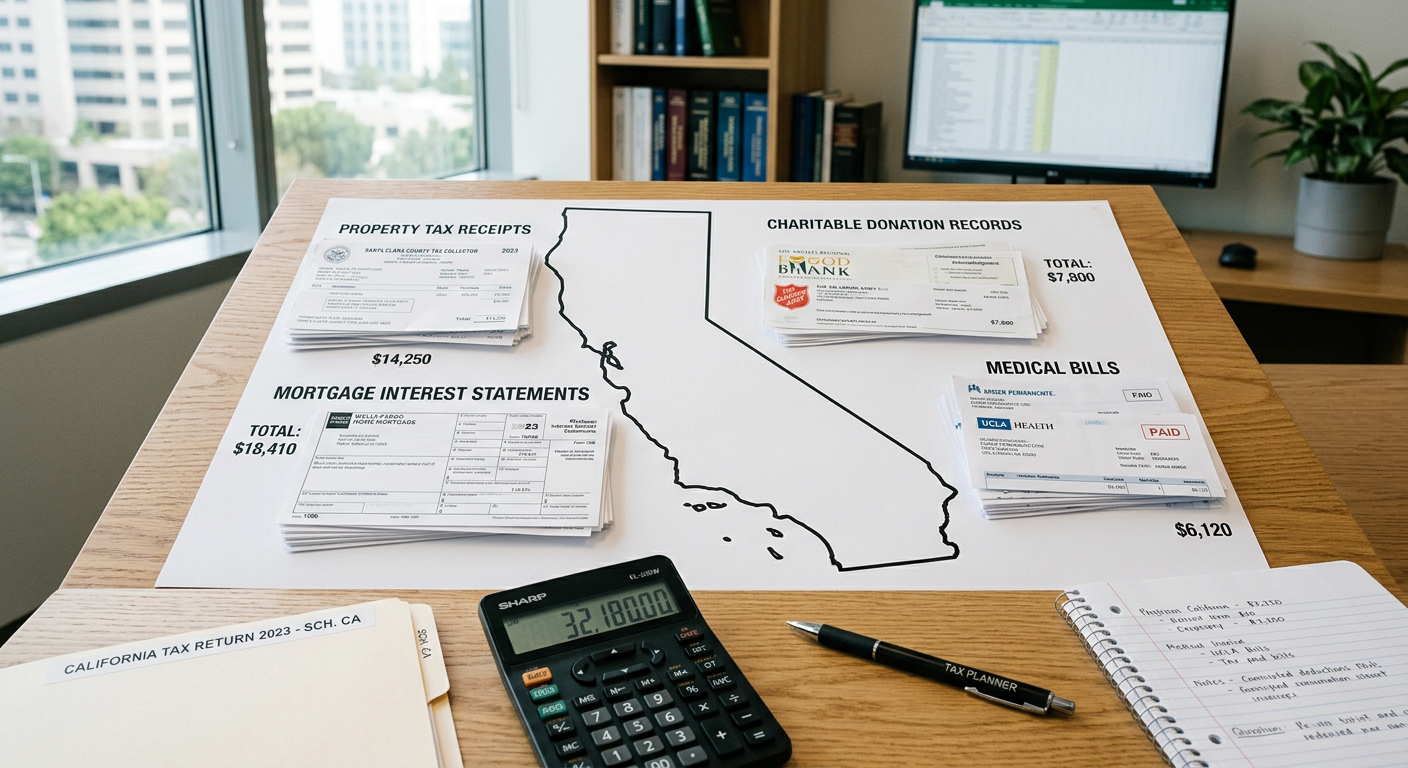
California itemized deductions let you write off state-specific expenses like property taxes, mortgage interest, and charitable contributions instead of taking the standard deduction. For 2025 tax year, you should itemize if your combined deductions exceed $15,750 (single) or $31,500 (married filing jointly). With the new $40,000 SALT cap in effect through 2029, California taxpayers with high property taxes can now deduct far more than the previous $10,000 limit, potentially saving thousands.
What Are California Itemized Deductions?
California itemized deductions are specific expenses you can subtract from your income to reduce your state tax liability. Unlike the standard deduction (a fixed amount everyone can claim), itemized deductions require documentation of actual expenses you paid during the tax year. California generally follows federal itemization rules with a few key differences.
Here is how it works: When you file your California return (Form 540), you must decide whether to take the standard deduction or itemize. If your total itemizable expenses exceed the standard deduction amount, you save money by itemizing. Common itemized deductions for California residents include:
- State and local taxes (property taxes, state income tax paid)
- Mortgage interest on primary and secondary residences
- Charitable contributions to qualified organizations
- Medical and dental expenses exceeding 7.5% of your adjusted gross income
- Casualty and theft losses from federally declared disasters
The math is straightforward. Maria, a San Diego homeowner, paid $18,000 in property taxes, $12,000 in mortgage interest, and gave $4,000 to charity in 2025. Her total itemized deductions equal $34,000. Since this exceeds the $15,750 standard deduction for single filers, she saves tax on an additional $18,250 of income by itemizing. At California’s 9.3% marginal rate, that is roughly $1,697 in state tax savings.
Key Takeaway: California itemized deductions work best for homeowners with mortgages and high property taxes, especially now that the federal SALT cap increased to $40,000 through 2029.
2025-2026 Standard Deduction vs Itemizing: The Real Numbers
The decision to itemize or take the standard deduction starts with understanding the threshold amounts for tax year 2025. These are the baseline numbers every California taxpayer needs:
2025 Standard Deduction Amounts
| Filing Status | Standard Deduction | When to Itemize Instead |
|---|---|---|
| Single | $15,750 | If itemized deductions exceed $15,750 |
| Married Filing Jointly | $31,500 | If itemized deductions exceed $31,500 |
| Head of Household | $23,625 | If itemized deductions exceed $23,625 |
| Married Filing Separately | $15,750 | If itemized deductions exceed $15,750 |
The standard deduction increased by nearly 8% for 2025 compared to 2024 levels, which means more taxpayers will find the standard deduction sufficient. However, California’s high cost of living creates unique opportunities to exceed these thresholds through property taxes and mortgage interest alone.
The $40,000 SALT Cap Game-Changer
Under the One Big Beautiful Bill Act signed in July 2025, the state and local tax (SALT) deduction cap temporarily increased from $10,000 to $40,000 for most filers through 2029. This change dramatically benefits California taxpayers who own property in high-tax counties like Los Angeles, San Francisco, Santa Clara, and Orange County.
Before this change, homeowners hit the $10,000 SALT cap quickly and received no additional federal benefit from property taxes above that amount. Now, you can deduct up to $40,000 in combined state income taxes and property taxes on your federal return. For married couples filing separately, the limit is $20,000.
James and Linda own a home in Palo Alto where they paid $28,000 in property taxes in 2025. They also paid $9,000 in California state income tax. Under the old rules, they could only deduct $10,000 on their federal return. Under the new $40,000 cap, they deduct the full $37,000, saving an additional $27,000 in deductible expenses. At a 24% federal tax bracket, that is $6,480 in federal tax savings they would have lost under the old cap.
Pro Tip: The enhanced $40,000 SALT cap phases out at higher income levels. Once your modified adjusted gross income exceeds certain thresholds, the benefit begins to shrink, but it will not fall below the original $10,000 cap.
Step-by-Step: How to Itemize California Deductions
Itemizing requires organized record-keeping and careful documentation. Here is exactly how to claim itemized deductions on both your federal and California returns.
Step 1: Gather Documentation (January-March)
Collect all documentation for the tax year. You will need:
- Property tax statements from your county assessor or mortgage servicer (Form 1098)
- Mortgage interest statements (Form 1098) showing interest paid on your primary and secondary residence
- Charitable contribution receipts for donations over $250 (must include organization name, date, and amount)
- Medical expense receipts for unreimbursed costs including premiums, prescriptions, and treatments
- State income tax paid from your W-2 (Box 17) or estimated tax payment records
Step 2: Complete Federal Schedule A (15-30 minutes)
Use IRS Schedule A (Form 1040) to calculate your federal itemized deductions. Enter each category:
- Lines 5a-5e: State and local taxes (property taxes + state income tax or sales tax, capped at $40,000 for 2025)
- Lines 8a-8e: Mortgage interest and points paid
- Lines 11-12: Charitable contributions (cash and non-cash)
- Line 4: Medical and dental expenses exceeding 7.5% of your AGI
Step 3: Complete California Schedule CA (10-20 minutes)
California requires Schedule CA (540) to adjust your federal itemized deductions for state purposes. Key differences include:
- California does not limit the state income tax deduction (no $40,000 cap on state return)
- Some federal deductions are not allowed for California (such as state income tax refunds)
- Mortgage interest limits may differ based on loan origination date
Step 4: Calculate and Compare (5 minutes)
Add up your total itemized deductions and compare to the standard deduction for your filing status. Use the larger amount. Most tax software (including TurboTax, H&R Block online, and professional tax preparers) will automatically calculate both and select the option that saves you more money.
Step 5: File by April 15, 2026 (or request extension)
Submit your federal Form 1040 with Schedule A attached, along with California Form 540 and Schedule CA. Keep all receipts and documentation for at least three years in case of audit.
Key Takeaway: Itemizing adds approximately 30-45 minutes to your tax preparation time but can save California homeowners $2,000-8,000 depending on income level and deductible expenses.
What Expenses Qualify as California Itemized Deductions?
Not every expense you pay during the year qualifies as an itemized deduction. Here is the complete breakdown of what you can and cannot deduct on your California return.
Deductible Expenses (What You CAN Claim)
1. State and Local Taxes (SALT)
You can deduct the greater of:
- State and local income taxes paid (from W-2 withholding or estimated tax payments), OR
- State and local sales taxes paid (use IRS tables or actual receipts)
Plus: Real estate property taxes on all properties you own (primary residence, vacation home, rental property). For federal purposes, the combined total is capped at $40,000 through 2029. California has no cap on the state return.
2. Mortgage Interest
Deduct interest paid on:
- Mortgage debt up to $750,000 for loans originated after December 15, 2017
- Mortgage debt up to $1 million for loans originated before December 16, 2017 (grandfathered)
- Home equity loan interest if proceeds were used to buy, build, or substantially improve your home
You will receive Form 1098 from your lender showing the exact amount of deductible mortgage interest paid during the year.
3. Charitable Contributions
Donations to IRS-qualified 501(c)(3) organizations are deductible. This includes:
- Cash donations (checks, credit cards, payroll deductions)
- Non-cash donations (clothing, furniture, vehicles) at fair market value
- Mileage driven for volunteer work at 14 cents per mile for 2025
Donations over $250 require written acknowledgment from the charity. Non-cash donations over $500 require Form 8283.
4. Medical and Dental Expenses
Only expenses exceeding 7.5% of your adjusted gross income are deductible. Qualified expenses include:
- Health insurance premiums (if not paid with pre-tax dollars)
- Co-pays, deductibles, and prescription medications
- Medical equipment and supplies
- Long-term care insurance premiums (subject to age-based limits)
- Mileage to medical appointments at 21 cents per mile for 2025
Example: Rachel has an AGI of $80,000 and paid $8,500 in unreimbursed medical expenses. Her threshold is $6,000 (7.5% of $80,000). She can deduct $2,500 ($8,500 minus $6,000) as an itemized deduction.
Non-Deductible Expenses (What You CANNOT Claim)
- Federal income taxes paid
- Social Security and Medicare taxes (FICA)
- Homeowners insurance premiums (except for rental properties)
- HOA dues and assessments
- Home repairs and maintenance (unless for rental property)
- Life insurance premiums
- Political contributions
- Commuting costs to work
If you need strategic guidance on maximizing your deductible expenses, explore our tax planning services to discover overlooked opportunities specific to California residents.
Key Takeaway: California itemized deductions mirror federal rules with few exceptions, so if an expense is deductible federally, it is almost always deductible on your state return as well.
Red Flag Alert: Common California Itemization Mistakes
The IRS and California Franchise Tax Board both scrutinize itemized deductions more closely than standard deduction returns. These mistakes trigger audits and cost taxpayers thousands in penalties.
Mistake 1: Deducting Property Taxes You Did Not Pay
You can only deduct property taxes actually paid during the tax year. If your mortgage servicer holds funds in escrow but has not yet paid the county, you cannot deduct those taxes until they are paid. Check your Form 1098 from your lender, which shows the exact amount paid, not the amount escrowed.
Mistake 2: Mixing State Income Tax with Sales Tax
You must choose between deducting state income tax OR sales tax, not both. For most California taxpayers, state income tax produces a larger deduction because California has high income tax rates (up to 13.3% for top earners). Only choose sales tax if you made major purchases like a vehicle and paid little state income tax that year.
Mistake 3: Overstating Charitable Contributions
Non-cash donations must be valued at fair market value, not original purchase price. A couch you bought for $2,000 five years ago might only be worth $200 today. The IRS provides valuation guides. Donations over $5,000 require a qualified appraisal. Missing this requirement can disallow the entire deduction.
Mistake 4: Deducting Medical Expenses Below the 7.5% AGI Threshold
Many taxpayers deduct all medical expenses without applying the 7.5% AGI floor. If your AGI is $100,000, only medical expenses above $7,500 are deductible. The first $7,500 provides zero tax benefit.
Mistake 5: Ignoring the Mortgage Interest Limitation
Mortgage interest is only deductible on acquisition debt up to $750,000 (or $1 million for pre-2018 loans). If you have a $900,000 mortgage originated in 2022, only the interest on $750,000 of that debt is deductible. Your lender does not make this adjustment on Form 1098, so you must calculate it yourself.
Pro Tip: Keep a dedicated tax folder (physical or digital) throughout the year where you store all receipts, statements, and documentation as they arrive. Recreating records after year-end is difficult and error-prone.
KDA Case Study: California Real Estate Investor
David, a 42-year-old real estate investor from Irvine, owns three properties: his primary residence and two rental properties. He came to KDA in early 2025 confused about whether to itemize and how the new $40,000 SALT cap affected him.
David’s Situation:
- Paid $22,000 in property taxes across all three properties
- Paid $18,000 in California state income tax
- Paid $14,000 in mortgage interest on his primary residence
- Donated $3,500 to his church and local charities
- Total potential itemized deductions: $57,500
What KDA Did:
We separated his rental property expenses (which are deductible on Schedule E regardless of itemizing) from his personal itemized deductions. For his federal return, we maximized his SALT deduction at the $40,000 cap by combining his state income tax and personal property taxes. We then allocated mortgage interest and charitable contributions properly, resulting in total federal itemized deductions of $57,500 on Schedule A.
On his California return, we itemized without the SALT cap limitation, allowing him to deduct the full amounts. We also identified $4,200 in overlooked medical expenses that exceeded his AGI threshold.
Tax Savings Result:
- Federal tax savings from itemizing vs standard deduction: $6,240
- California state tax savings from itemizing vs standard deduction: $2,380
- Total first-year savings: $8,620
What David Paid: $2,800 for comprehensive tax preparation and strategy consultation
ROI: 3.1x first-year return on his investment, plus ongoing annual savings of $7,000-9,000 with proper itemization strategy
Ready to see how we can help you? Explore more success stories on our case studies page to discover proven strategies that have saved our clients thousands in taxes.
Special Situations and Edge Cases
California’s unique tax environment creates itemization scenarios that require specialized knowledge. Here are situations most competitors avoid discussing.
Multi-State Taxpayers: Allocating Itemized Deductions
If you earned income in multiple states during 2025, you must allocate itemized deductions between your resident state (California) and non-resident states. This gets complex quickly.
Example: Jennifer lived in California for nine months and moved to Nevada for three months. She must file a California part-year resident return. Her mortgage interest and property taxes are allocated based on the time she lived in each state. If she paid $12,000 in mortgage interest for the full year, only $9,000 (9/12 of the total) is deductible on her California return.
Married Filing Separately: The $20,000 SALT Cap
If you are married but file separately, your SALT deduction caps at $20,000 (half the married filing jointly limit). This creates a planning opportunity: Sometimes one spouse should itemize while the other takes the standard deduction, but IRS rules require both spouses to use the same method. You cannot mix and match.
Alternative Minimum Tax (AMT) Considerations
California does not have an AMT, but the federal AMT can reduce or eliminate the benefit of certain itemized deductions including state and local taxes. High-income California taxpayers (especially those earning $500,000-2,000,000) frequently trigger AMT, which recalculates tax liability by adding back certain deductions.
If you are subject to AMT, your state income tax and property tax deductions provide zero federal benefit, even though they still reduce your California tax. This is why wealthy Californians often see a large federal tax bill despite high state tax payments.
Casualty Loss Deductions After Wildfires
California residents affected by federally declared disasters can deduct unreimbursed casualty losses. For losses occurring in 2025, you can deduct the amount exceeding $100 per casualty and 10% of your AGI. This only applies to losses in areas declared federal disaster zones by the President.
If your home in a wildfire zone lost $80,000 in value and insurance covered $50,000, your unreimbursed loss is $30,000. With an AGI of $120,000, your threshold is $12,100 (10% + $100). Your deductible casualty loss is $17,900 ($30,000 minus $12,100).
Key Takeaway: Edge cases require documentation beyond standard tax forms. Keep detailed records, allocation worksheets, and insurance claim documentation for at least four years.
California-Specific Itemization Rules You Must Know
While California generally conforms to federal itemized deduction rules, there are critical differences every taxpayer should understand.
State Tax Refund Received in 2025
If you itemized deductions on your 2024 federal return and received a California state tax refund in 2025, that refund may be taxable income on your 2025 federal return (reported on Line 1 of Schedule 1). However, California does not tax its own refunds, so you subtract this amount on California Schedule CA.
Mortgage Interest Credit
California offers a Mortgage Credit Certificate (MCC) program for first-time homebuyers in certain areas. If you have an MCC, you claim a credit (not a deduction) for a portion of your mortgage interest. The credit reduces your tax dollar-for-dollar, making it more valuable than a deduction. You must reduce your mortgage interest deduction by the amount of credit claimed.
California Does Not Allow Federal Deduction Limits
Some federal itemized deductions phase out at high income levels. California does not conform to these federal phase-outs, meaning you may get a larger deduction on your state return than your federal return for the same expense.
Disaster Loss Carryforward
If your casualty loss deduction exceeds your California taxable income, you can carry the excess loss forward to future tax years. This carryforward continues until fully used. The federal rules differ, requiring recalculation each year.
Pro Tip: Always prepare your federal return first, then your California return. Federal adjusted gross income flows to your California return, and many California adjustments are based on federal calculations.
Ready to Reduce Your Tax Bill?
KDA Inc. specializes in strategic tax planning for business owners, S Corps, LLCs, and high-net-worth individuals. Book a personalized consultation and walk away with a clear plan.
Frequently Asked Questions
Can I itemize on my federal return but take the standard deduction on my California return?
No. California requires you to use the same method (itemized or standard) that you used on your federal return. If you itemize federally, you must itemize for California. However, the amounts may differ due to California-specific adjustments made on Schedule CA.
What happens if I miss the April 15 filing deadline?
You can request an automatic six-month extension by filing federal Form 4868 and California Form 3519 by April 15, 2026. This extends your filing deadline to October 15, 2026. However, extensions to file are not extensions to pay. You must estimate and pay any tax owed by April 15 to avoid penalties and interest. Late payment penalties are 5% of unpaid tax plus 0.5% per month.
Are HOA fees or special assessments deductible?
No. Homeowner association dues, special assessments, and condo fees are not deductible on your personal tax return, even if you itemize. These are considered personal expenses. However, if you own rental property, HOA fees for that property are deductible as rental expenses on Schedule E.
Can I deduct mortgage interest on a vacation home or second property?
Yes, but with limitations. Mortgage interest is deductible on your primary residence plus one additional home (your second home or vacation property). The combined mortgage debt limit is $750,000 for loans originated after December 15, 2017. If you rent out the second home for part of the year, special allocation rules apply, and you may need to reduce your deductible interest based on personal use days versus rental days.
Do I need receipts for charitable contributions under $250?
You need a bank record or written communication from the charity showing the organization’s name and contribution date and amount. For contributions of $250 or more, you must have a written acknowledgment from the charity that includes the amount, whether you received goods or services in return, and a description and good faith estimate of the value of any benefits received. Do not attach receipts to your return, but keep them in your records for at least three years.
Book Your California Tax Strategy Session
Still wondering whether itemizing will actually save you money, or if you are missing deductions you qualify for? California’s complex tax rules combined with the new federal SALT cap changes create confusion even for experienced taxpayers. One overlooked deduction or miscalculated threshold can cost you thousands.
Book a personalized consultation with our California tax strategy team and get a clear itemization analysis customized to your specific situation. We will review your income, expenses, and tax profile to determine your optimal filing strategy and uncover savings opportunities you might be missing. Click here to book your consultation now.
This information is current as of 3/4/2026. Tax laws change frequently. Verify updates with the IRS or FTB if reading this later.


