
Quick Answer
CA Franchise Tax Board estimated payments are quarterly tax payments California business owners and self-employed individuals must make if they expect to owe $500 or more in state tax. Miss a payment or underpay, and you’ll face penalties starting at 5% plus interest. For someone owing $10,000 in annual tax, one missed quarter can cost $250 to $400 in avoidable penalties.
Why California Business Owners Get Hit With FTB Estimated Payment Penalties
Most business owners don’t realize California runs its own estimated tax system separate from the IRS. While federal estimated taxes follow the same quarterly schedule, the CA Franchise Tax Board estimated payments have unique calculation rules, penalty structures, and safe harbor provisions that catch taxpayers off guard every single year.
The FTB doesn’t wait until April to collect. They want their cut four times a year, and they penalize aggressively if you underpay by even $1. In 2026, the penalty rate sits at 5% annually, but it compounds quarterly. That means if you owe $5,000 and miss all four quarters, you’re looking at $250 in penalties before interest kicks in.
Here’s what triggers the estimated payment requirement. If your California tax liability exceeds $500 after withholding and credits, you must make quarterly payments. This applies to Schedule C income, rental properties, S Corp distributions, partnership K-1 income, and capital gains. The FTB doesn’t care if your federal liability is covered by withholding; California calculates separately. For detailed guidance on California-specific tax obligations, see our California business owner tax strategy hub.
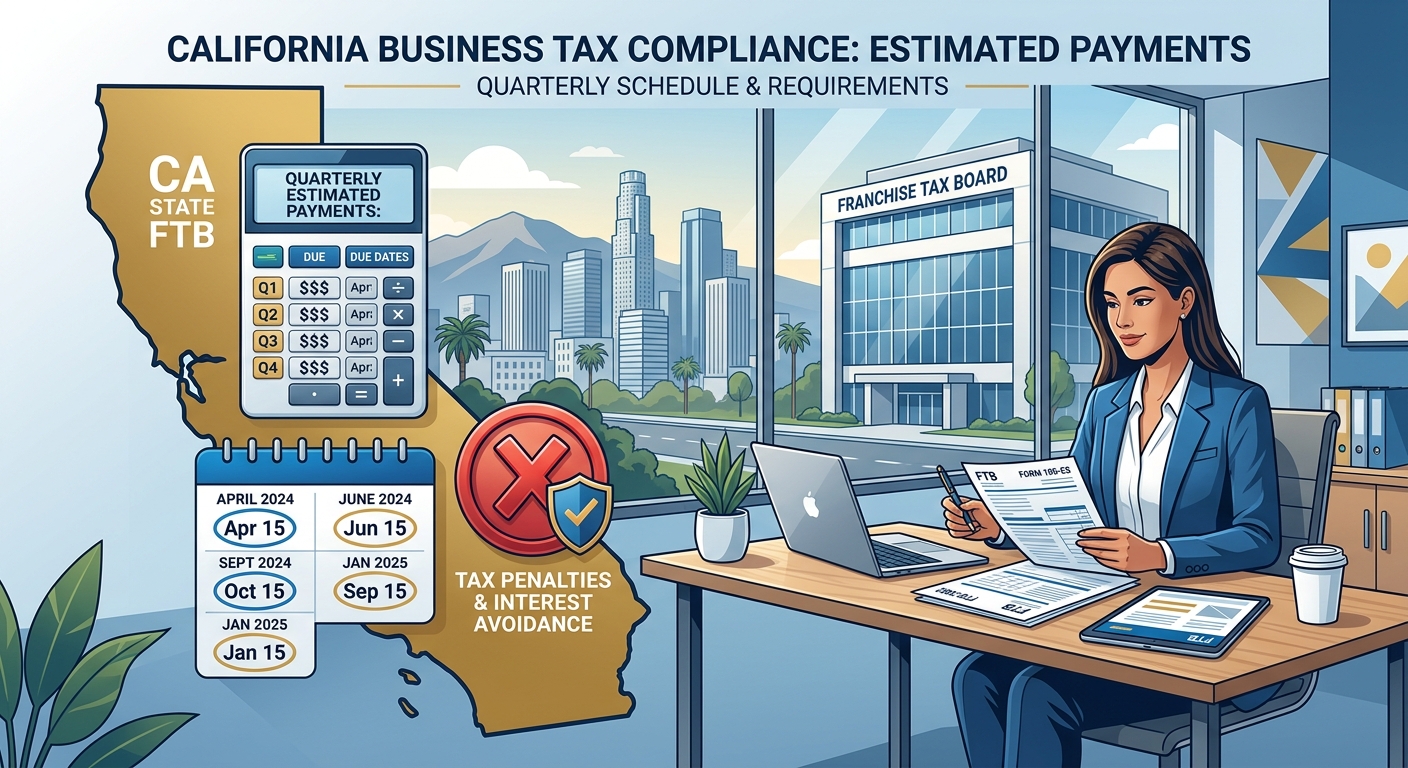
The 2026 quarterly deadlines are April 15, June 16, September 15, and January 15, 2027. Each payment should equal 25% of your annual liability, or you can use the safe harbor method: 100% of last year’s tax if your adjusted gross income was under $150,000, or 110% if you earned more.
The Safe Harbor Calculation That Saves You From FTB Penalties
California’s safe harbor rule protects you from estimated payment penalties even if your income jumps mid-year. If you pay 100% of your prior year’s California tax liability (110% if your AGI exceeded $150,000), the FTB cannot penalize you for underpayment, regardless of how much more you owe this year.
Here’s a real-world scenario. Maria, a Sacramento-based real estate agent, earned $95,000 in 2025 and paid $7,200 in California income tax. In 2026, her commission income exploded to $180,000, pushing her tax bill to $14,500. Because she paid $1,800 per quarter ($7,200 divided by 4) throughout 2026, she’s protected from penalties despite owing an additional $7,300 at year-end.
The safe harbor method requires consistent quarterly payments. You can’t skip Q1 and Q2, then make it up in Q3 and Q4. The FTB calculates penalties on a per-quarter basis, so even if your annual total hits the safe harbor threshold, late quarterly payments still trigger penalties for those specific periods.
Most business owners miss this detail: California’s safe harbor percentage is based on last year’s California tax only, not federal. If you moved to California mid-2025, you’d use 100% of your California-only liability, even if your federal tax was significantly higher. This distinction matters for tech workers relocating from states like Washington or Texas.
When Safe Harbor Doesn’t Protect You
The safe harbor method fails in three specific situations. First, if you had zero California tax liability last year, you can’t use the 100% rule because 100% of zero is still zero. Second, if you’re a first-time filer, you have no prior year to reference. Third, if your income drops significantly and you overpay using safe harbor, the FTB doesn’t automatically refund quarterly overpayments; you wait until you file your annual return.
For S Corp owners and LLC members taking distributions, the FTB doesn’t accept “I didn’t know how much I’d make” as an excuse. You’re expected to estimate conservatively. If your business profit fluctuates, calculate estimated payments at 110% of last year’s liability, then adjust your final quarter payment if needed. For comprehensive support with entity-specific tax planning, explore our tax planning services.
The Annualized Income Method: How to Avoid Penalties When Income Varies
If your income arrives unevenly throughout the year, the annualized income method lets you match estimated payments to actual earnings each quarter. This is critical for real estate investors who close deals sporadically, seasonal businesses, or consultants who land large contracts mid-year.
Here’s how it works. Instead of paying 25% of your annual tax each quarter, you calculate your cumulative income and deductions through each quarter, project your annual tax, and pay only what’s due for that period. The FTB requires Form 540-ES (worksheet method) to support this approach if audited.
Example: Robert, a San Diego-based e-commerce seller, earns most of his income during Q4 holiday sales. His quarterly income pattern looks like this:
- Q1: $15,000
- Q2: $20,000
- Q3: $18,000
- Q4: $97,000
Under the standard 25% method, Robert would pay the same amount each quarter, even though he doesn’t have the cash in Q1 through Q3. Using the annualized method, he pays based on actual cumulative income, avoiding penalties and preserving cash flow when revenue is low.
The math requires tracking cumulative income, allowable deductions, and California tax brackets by quarter. Most tax software handles this automatically if you input quarterly financial data, but manual filers must complete FTB Form 5805 (Underpayment of Estimated Tax by Individuals and Fiduciaries) to claim exception from penalties.
Documentation Requirements for the Annualized Method
The FTB scrutinizes annualized income calculations during audits. You must maintain quarterly profit and loss statements, bank statements showing income deposits, and documentation of deductible expenses by quarter. If you claim the annualized method but can’t produce quarterly records, the FTB will recalculate penalties using the standard method and assess back penalties plus interest.
One overlooked detail: California doesn’t allow you to mix methods mid-year. If you start with the standard 25% method in Q1 and Q2, then switch to annualized for Q3 and Q4, the FTB will reject your annualized calculation and assess penalties. You must commit to the annualized method from Q1 or stick with standard throughout the year.
KDA Case Study: Real Estate Investor Avoids $3,200 in FTB Penalties
Jason, a Bay Area real estate investor, came to KDA after receiving an FTB penalty notice for $3,200 related to 2024 estimated payments. He’d sold two rental properties that year, netting $65,000 in capital gains on top of his $85,000 W-2 income. His employer withheld California tax from his salary, so Jason assumed he was covered.
The FTB disagreed. Capital gains aren’t subject to withholding, and Jason’s rental sale pushed his total California tax liability to $12,800. His W-2 withholding only covered $6,400, leaving a $6,400 shortfall. Because he made no estimated payments, the FTB assessed underpayment penalties for all four quarters.
We filed FTB Form 5805 demonstrating reasonable cause: Jason sold both properties in Q4, couldn’t have anticipated the liability earlier in the year, and made a substantial estimated payment in January 2025 when he realized the issue. We also showed that his prior-year California tax was only $6,500, and he’d never been required to make estimated payments before.
The FTB abated $3,200 in penalties, saving Jason the full amount. He paid KDA $950 for representation and enrolled in our ongoing tax planning to project 2025 and 2026 estimated payments based on anticipated property sales. His return on investment: 3.4x in year one, with ongoing protection from future penalties.
Ready to see how we can help you? Explore more success stories on our case studies page to discover proven strategies that have saved our clients thousands in taxes.
Common FTB Estimated Payment Mistakes That Cost Thousands
The number one mistake California taxpayers make: confusing federal estimated tax rules with FTB requirements. The IRS and FTB use different tax brackets, different standard deductions, and different credit calculations. Paying enough federally doesn’t mean you’re safe from FTB penalties.
Second biggest mistake: failing to account for California’s Mental Health Services Tax. If you’re a high earner with taxable income over $1 million, you owe an additional 1% tax on income above that threshold. This catches S Corp owners and real estate investors who cross the $1 million mark mid-year and forget to increase Q3 and Q4 estimated payments.
Third mistake: ignoring the spouse’s income when filing jointly. California is a community property state, which means spousal income affects your combined estimated payment obligation even if only one spouse is self-employed. If your spouse gets a year-end bonus or stock option payout, your quarterly estimates may suddenly be insufficient.
Red Flag Alert: FTB Penalty Interest Compounds Quarterly
Unlike the IRS, which compounds interest daily, the FTB compounds quarterly at 5% annually. That sounds better, but the quarterly compounding means penalties grow faster than simple interest. A $2,000 underpayment held for a full year costs $100 in penalties, but if you don’t pay that penalty immediately, next quarter’s interest calculates on $2,100, not $2,000.
The FTB doesn’t send quarterly penalty notices. You discover the total damage when you file your annual return or when the FTB sends a billing notice months later. By then, interest has compounded for multiple quarters, and you’re stuck paying penalties on penalties.
Pro Tip: Use FTB Web Pay to Make Estimated Payments Instantly
Set up an FTB Web Pay account at ftb.ca.gov and schedule estimated payments in advance. The system confirms your payment date and amount, creating an electronic record that protects you in disputes. If the FTB later claims you missed a payment, you have instant proof of timely submission.
You can also make same-day payments up until 11:59 PM Pacific on the due date. If April 15 falls on a weekend, the FTB extends the deadline to the next business day automatically. Unlike mailing checks, which require 3-5 business days for processing, Web Pay credits your account immediately.
How FTB Calculates Penalties: The Formula That Determines What You Owe
The FTB uses a three-step formula to calculate estimated payment penalties. Step one: determine your required annual payment (100% or 110% of last year’s tax, or 90% of current year’s tax, whichever is less). Step two: calculate what you should have paid each quarter (25% of required annual payment). Step three: compare what you actually paid to what you should have paid, quarter by quarter.
If you underpaid any quarter, the FTB calculates the shortfall, multiplies it by the penalty rate (5% annually), and prorates it based on how many days you were short. The penalty compounds each quarter until you make up the difference or file your annual return.
Here’s a detailed example. Sarah, a Los Angeles consultant, owed $8,000 in California tax for 2026. Her required quarterly payments were $2,000 each. She paid:
- Q1 (April 15): $2,000 (on time)
- Q2 (June 16): $1,000 (short $1,000)
- Q3 (September 15): $2,000 (on time)
- Q4 (January 15, 2027): $3,000 (making up Q2 shortfall)
The FTB assesses penalties only on the Q2 shortfall. Sarah was $1,000 short from June 16 to January 15 (214 days). The penalty is $1,000 × 5% × (214 / 365) = $29.32. If Sarah doesn’t pay that $29.32 immediately, it compounds into the next quarter’s interest calculation.
Special Situations: First-Year Business Owners and New California Residents
If you started a business in 2026 and have no prior-year California tax, the FTB requires you to estimate current-year liability and pay 90% through quarterly payments. There’s no safe harbor protection for first-year filers. The best approach: estimate conservatively high to avoid underpayment penalties, then claim the overpayment as a refund when you file.
New California residents face a unique challenge. Your prior-year tax return was filed in another state, so California has no baseline for safe harbor calculations. The FTB instructs new residents to estimate their current-year California liability and pay 90% quarterly. If you moved mid-year, prorate your estimated payments based on how many months you were a California resident.
Part-year residents must split income between California-source and non-California-source. Wages earned while living in California are taxable to California. Wages earned in another state before moving are not (unless you worked remotely for a California-based employer). Capital gains from selling stock are taxable to your state of residence on the sale date, not where the company is headquartered.
California-Specific Considerations: What Makes FTB Different From the IRS
California doesn’t conform to federal tax law changes automatically. When Congress passes tax legislation, California must separately adopt or reject those provisions. This creates situations where a deduction allowed federally isn’t allowed in California, or vice versa.
For 2026, California has not conformed to several federal provisions, including:
- The federal Section 199A qualified business income deduction (California doesn’t allow it)
- Federal bonus depreciation rules (California phases them out differently)
- The federal $1 million mortgage interest deduction cap (California uses different limits)
This means your California estimated tax calculations must start from scratch, not from your federal AGI. If you claimed a $20,000 QBI deduction federally, add it back for California purposes. If you depreciated equipment using federal bonus depreciation, recalculate using California’s methods.
The FTB’s Automated Underreporter Program Targets Estimated Payment Shortfalls
The FTB receives copies of all 1099s, W-2s, K-1s, and 1098s issued to California taxpayers. Their automated system matches reported income against filed returns. If the FTB’s records show you received $150,000 in 1099 income but your return shows only $100,000, you’ll receive a Notice of Proposed Assessment (NPA) demanding the difference plus penalties and interest.
The FTB’s system also flags taxpayers who consistently underpay estimated taxes. If you’ve been assessed estimated payment penalties three years in a row, your return gets flagged for manual review. The FTB may require you to submit quarterly financial statements or increase your estimated payments to 120% of prior-year tax as a condition of avoiding future penalties.
How to Request FTB Penalty Abatement: The Reasonable Cause Exception
The FTB will waive estimated payment penalties if you prove reasonable cause for underpayment. Reasonable cause means circumstances beyond your control prevented accurate estimation or timely payment. Accepted reasons include:
- Serious illness or hospitalization during the quarter payment was due
- Natural disaster affecting your residence or business location
- Death of spouse or immediate family member
- Unavoidable absence (military deployment, extended business travel to areas without banking access)
- Reliance on erroneous written advice from FTB representative (you must have documentation)
What the FTB does not accept as reasonable cause: “I didn’t know I had to pay quarterly,” “I couldn’t afford the payment,” “My accountant didn’t tell me,” or “I was busy.” The FTB expects business owners to understand their filing obligations and plan accordingly.
To request abatement, file Form FTB 2924 (Reasonable Cause for Late Payment or Nonpayment of Tax) within 60 days of receiving your penalty notice. Include supporting documentation: medical records, insurance claims for disaster damage, death certificates, military orders, or written correspondence from the FTB if you’re claiming reliance on their advice.
Pro Tip: First-Time Abatement for Clean Compliance History
If you’ve never been assessed FTB penalties before and you’ve filed all required returns on time for the past three years, you may qualify for first-time abatement (FTA). The FTB adopted this policy in 2024, mirroring the IRS’s longstanding FTA program.
First-time abatement is administrative relief, meaning you don’t need to prove reasonable cause. Simply request FTA when you receive your penalty notice, confirm you meet the clean compliance criteria, and the FTB will remove the penalty automatically. You still owe the underlying tax and interest, but the penalty disappears.
FTA applies to failure-to-pay penalties and estimated payment penalties, but not to accuracy-related penalties, fraud penalties, or late-filing penalties. You can use FTA once every three years, so save it for situations where you don’t have documented reasonable cause.
Ready to Reduce Your Tax Bill?
KDA Inc. specializes in strategic tax planning for business owners, S Corps, LLCs, and high-net-worth individuals. Book a personalized consultation and walk away with a clear plan.
Frequently Asked Questions: CA Franchise Tax Board Estimated Payments
Do I owe California estimated taxes if I have a W-2 job and side income?
Yes, if your combined W-2 withholding doesn’t cover your total California tax liability, including side income. If your side income is from 1099 work, rental properties, or capital gains, calculate whether your W-2 withholding alone will cover the total tax on all income sources. If not, make quarterly estimated payments on the shortfall. A common threshold: if your side income generates more than $500 in California tax after your W-2 withholding, you’re required to make estimated payments.
Can I increase my W-2 withholding instead of making quarterly estimated payments?
Yes. If you have W-2 income, you can file a new Form W-4 with your employer to increase California withholding. This covers your estimated payment obligation without needing to make quarterly payments directly to the FTB. The FTB treats withholding as paid evenly throughout the year for penalty calculation purposes, even if your employer withholds more in later months. This strategy works well for taxpayers who dislike tracking quarterly due dates.
What happens if I overpay my CA estimated taxes?
The FTB holds your overpayment and applies it to your annual tax liability when you file. If you’re still overpaid after filing, you can request a refund or apply the overpayment to next year’s estimated tax. The FTB doesn’t pay interest on overpaid estimated taxes, so strategic underpayment (within safe harbor limits) is often smarter than significant overpayment.
Does California have an equivalent to the federal underpayment penalty waiver for 2026?
No. The IRS occasionally waives underpayment penalties during years with significant tax law changes or disasters. California rarely follows suit. The FTB maintains its penalty structure regardless of federal waivers. You must meet California’s safe harbor requirements or prove reasonable cause to avoid penalties, even if the IRS waived your federal underpayment penalty for the same year.
How do I calculate estimated payments for an S Corp owner taking distributions?
S Corp income flows through to your personal return via K-1. Calculate your California tax on total income (W-2 wages plus K-1 income plus any other sources), subtract your W-2 withholding, and divide the remaining liability by four for quarterly estimated payments. Many S Corp owners withhold California tax from their salary strategically to cover both wages and K-1 income, eliminating the need for separate quarterly payments. Run the numbers both ways to determine which approach minimizes penalties while preserving cash flow.
Action Items: What to Do Right Now to Avoid FTB Estimated Payment Penalties
First, pull your 2025 California tax return and identify your total tax liability (line 78 on Form 540). Multiply that number by 1.0 if your AGI was under $150,000, or by 1.1 if it exceeded $150,000. Divide the result by four. That’s your safe harbor quarterly payment for 2026.
Second, set up FTB Web Pay at ftb.ca.gov and schedule all four quarterly payments today. Even if you’re reading this in June, schedule September 15, and January 15 payments now so you don’t forget. The system sends email reminders three days before each due date.
Third, if your 2026 income has increased significantly compared to 2025, calculate whether 90% of your current-year liability exceeds the safe harbor amount. If so, increase your quarterly payments to avoid underpayment penalties. Better to overpay slightly and get a refund than underpay and owe penalties plus interest.
Fourth, if you’ve already missed Q1 or Q2 payments for 2026, make them up immediately. The FTB calculates penalties from the original due date, so the sooner you pay, the less interest compounds. Don’t wait until January 2027 to catch up on all four quarters; that maximizes your penalty exposure.
Fifth, if you’re a new business owner or new California resident, consult with a tax strategist before year-end. Estimating first-year California tax is complex, especially if you have multi-state income, and getting it wrong costs significantly more than getting it right from the start.
Book Your California Tax Compliance Strategy Session
If you’re unsure whether your CA Franchise Tax Board estimated payments are set up correctly, or if you’ve already received an FTB penalty notice, don’t guess. One miscalculation can cost thousands in avoidable penalties and interest. Our team specializes in California state tax compliance, FTB representation, and estimated payment optimization for business owners, real estate investors, and high-income professionals. Book a personalized consultation with our strategy team and get clear, compliant, and confident. Click here to book your consultation now.
Disclaimer: This information is current as of June 9, 2026. Tax laws change frequently. Verify updates with the IRS or FTB if reading this later.



