
Most California owners of closely held corporations suspect they are overpaying the IRS every year, but they are not sure which lever to pull without creating a headache with payroll, the Franchise Tax Board, or their bookkeeper. One of the most powerful levers is switching from a traditional C corporation to an S corporation, yet many keep delaying the decision because the rules sound technical and risky.
In this guide, we are going to dissect how a C corporation to S corporation conversion really works for small and mid sized California businesses. We will break down the tax math, timing rules, and filing traps using plain English and real numbers, so you can decide whether a conversion fits your situation and what to fix before you sign anything.
Quick Answer
Switching from a C corporation to an S corporation can reduce self employment tax on active profits and avoid double taxation on future earnings, especially once your company is consistently profitable. The tradeoff is dealing with reasonable shareholder salaries, built in gains exposure on appreciated assets, and California minimum franchise tax rules. If your corporation earns at least $80,000 to $100,000 in annual profit after expenses and you expect stable growth, a properly planned S status can often cut your combined federal and state tax bill by several thousand dollars per year.
How a C to S Corp Conversion Changes Your Tax Bill
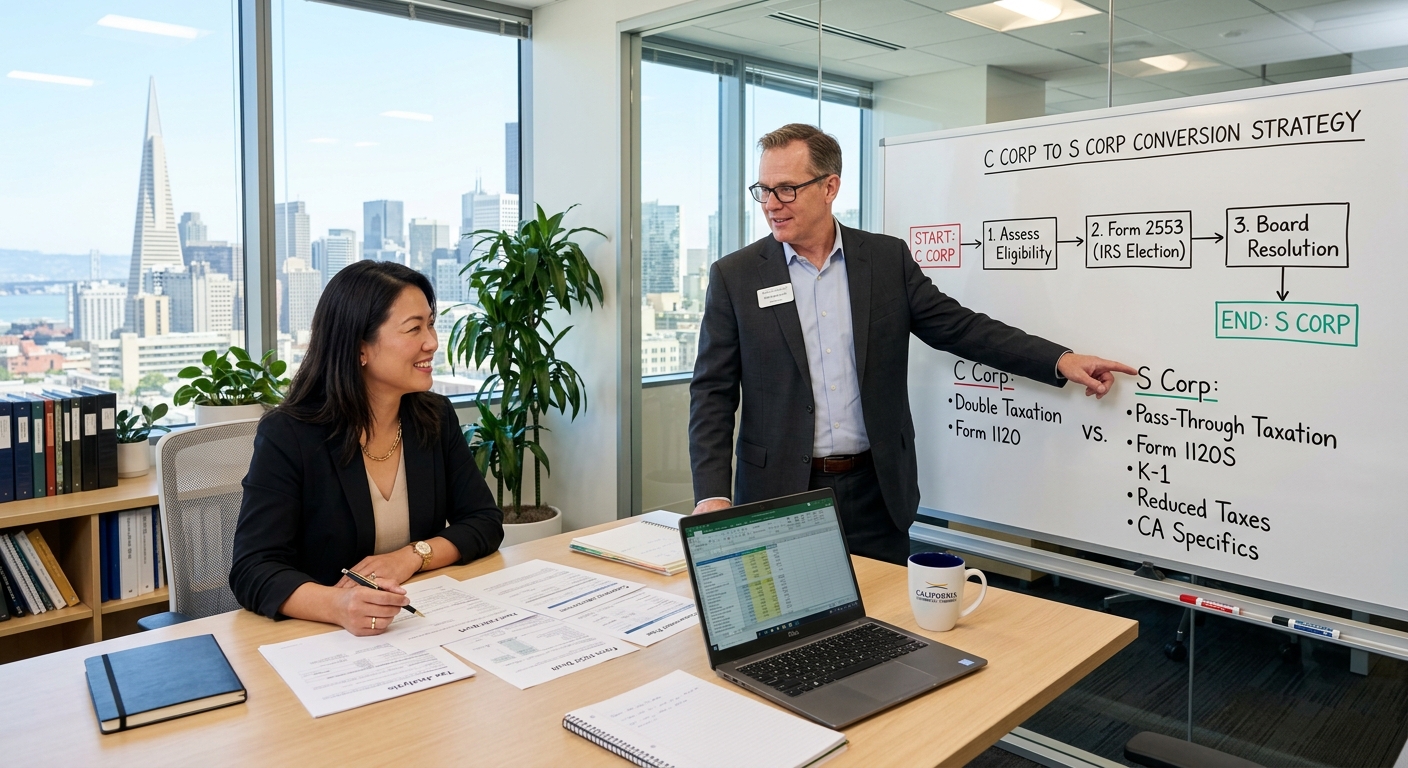
The core difference between a C corporation and an S corporation is how profits are taxed. A C corporation pays its own federal income tax on Form 1120, then owners pay another layer of tax on dividends. An S corporation is a pass through entity, so profits flow to your personal return and are taxed once, similar to a partnership, but with payroll rules on owner compensation.
Consider a California consulting corporation with $250,000 in revenue and $120,000 in deductible expenses, leaving $130,000 in profit before paying the owner. As a C corporation, if the owner takes $80,000 in W 2 wages and leaves $50,000 in corporate profit, that $50,000 is taxed at the corporate level, then any dividends are taxed again on the owner return.
After a **c to s corp** conversion, that same $130,000 of business profit is split into a reasonable W 2 salary and pass through profit. If the owner still takes $80,000 in wages and $50,000 as S corporation profit, there is no corporate income tax on that $50,000. It appears instead on the shareholder Schedule K 1 and then on their Form 1040. The savings often come from avoiding double taxation on retained profits and reducing exposure to Social Security and Medicare tax on the portion treated as profit rather than wages.
For details on pass through taxation mechanics, see IRS Publication 542, which explains corporate tax rules, and Form 1120 S instructions for S corporations.
Choosing the Right Time for a C to S Corp Conversion
Timing is not just about the calendar year it is also about where your business is in its growth curve. Early stage corporations with volatile or low profits often do not benefit as much, whereas mature businesses with stable income can see clear gains.
As a rough rule of thumb, once your corporation has at least $60,000 to $80,000 of profit after paying you a market based salary, an S election starts to look interesting. Below that range, the administrative overhead of running payroll, filing an S corporation return, and managing separate books may not justify the savings.
If your corporation already holds appreciated assets such as real estate, marketable securities, or valuable intellectual property, timing also determines whether you trigger built in gains tax exposure under Section 1374 rules discussed in the Form 1120 S instructions. Appreciated assets owned at the time of conversion remain subject to a corporate level tax if sold during the built in gains recognition period, which is generally five years under current law. This is where a simple looking c to S change can surprise owners with an unexpected tax bill.
If you run a closely held operating company or professional practice, you also need to think about California dynamics. California does not recognize federal S status in exactly the same way as the IRS, and S corporations still pay the 1.5 percent California franchise tax on net income, subject to minimums. Nevertheless, for profitable service businesses, the federal savings from S treatment often outweigh the California cost.
Structuring Compensation After a C to S Corp Conversion
For active shareholders, the pivot from C to S status changes how the IRS views your paycheck. As a C corporation, you can pay most of your income as salary, which generates payroll tax but avoids some accumulation of double taxed corporate profit. After the conversion, the agency will scrutinize whether your salary is reasonable compared with the total profit.
Imagine a solo software consultant with $220,000 in revenue and $70,000 in expenses, leaving $150,000 in profit. After S election, paying themselves only $30,000 in W 2 wages and taking $120,000 as profit is a red flag. The IRS expects a salary that reflects market pay for someone doing that job, often closer to $90,000 to $120,000 depending on the region and responsibilities. If auditors decide the wage is unreasonably low, they can reclassify part of the K 1 profit as wages and assess back payroll taxes and penalties.
If you are a California owner operator, this is where professional help pays off. Our team works closely with business owners to benchmark reasonable salaries using industry data and actual job duties, then model the tradeoff between payroll tax and income tax. In many cases, keeping wages at a realistic midpoint while treating the rest as S profit still saves several thousand dollars a year without picking a fight with the IRS.
Compensation also interacts with retirement plans. Higher wages may support bigger 401(k) or profit sharing contributions, which can further reduce current year taxable income. Owners need a holistic plan rather than simply chasing the lowest possible salary number.
KDA Case Study: California Consultant Restructures from C to S
Consider a Los Angeles based marketing consultant operating through a C corporation that has been in business for six years. The corporation generates roughly $300,000 per year in revenue and $140,000 in expenses, leaving $160,000 before the owner salary. Under the old C structure, the owner took $110,000 in W 2 wages and left $50,000 in corporate earnings each year to fund growth. Between the corporate tax on that $50,000 and dividend tax when distributions were needed, the total combined tax burden regularly exceeded $60,000 annually.
When this client engaged KDA, we mapped out a c to S conversion anchored around a more strategic split between wages and pass through profit. We recommended electing S status for the following tax year, setting a salary at $120,000 based on comparable roles in similar sized agencies, and allowing the remaining corporate profit to pass through as S income. Because the corporation did not hold significant appreciated assets and had minimal retained earnings, built in gains exposure was limited.
After the conversion, the client saw corporate level income tax on retained earnings disappear and payroll tax limited to the salary portion. In the first full year as an S corporation, total federal and state tax liability dropped by roughly $9,500 compared with the previous C structure, even after factoring in California franchise tax. The client paid KDA a planning fee of around $3,500, creating a first year return on investment near 2.7 times, with similar savings projected going forward as long as profits remain stable.
Ready to see how we can help you? Explore more success stories on our case studies page to discover proven strategies that have saved our clients thousands in taxes.
Coordinating Entity Changes with Bookkeeping and Payroll
A conversion is not just a tax form it also changes how your accountant and payroll provider operate. The election itself occurs on Form 2553, which must be filed within specific deadlines relative to the start of the tax year. But after the IRS accepts that form, you need clean books that track shareholder distributions, basis, and retained earnings correctly for S corporation purposes.
This is where many DIY conversions fall apart. Owners file Form 2553 on time but never realign their bookkeeping chart of accounts or coordinate with payroll to ensure the new wage and distribution structure is implemented. Six or twelve months later, we see S corporations with no recorded shareholder distributions, inconsistent payroll, and no basis tracking, making it painful to prepare Form 1120 S and individual returns.
If your goal is to simplify your life while reducing taxes, outsourcing the ongoing work matters as much as the election. Our bookkeeping and payroll services are built around entity structure, so when you adopt S status we simultaneously adjust your chart of accounts, owner compensation mix, and quarterly estimates. That integration reduces the risk that a well intended c to S restructuring actually creates errors that draw attention from the IRS or the California Franchise Tax Board.
Red Flag Alert: When a C to S Corp Conversion Backfires
Not every corporation should switch. Some owners convert for the wrong reasons or at the wrong time and end up worse off. You need to be honest about your company’s cash flow, growth prospects, and asset base before making the change.
One common trap involves corporations with large net operating loss carryforwards. C corporations can use these losses to offset future corporate income. If you convert to S status too early, you may strand those losses at the corporate level and forfeit part of their value. Another trap occurs when appreciated assets are held inside the C corporation at the time of election. Selling those assets during the built in gains period can trigger corporate tax under rules discussed in the 1120 S instructions, negating some of the intended savings.
There are also non tax considerations. If your business is preparing for outside equity investment, lenders or investors may insist on a C corporation structure, especially in the technology sector. Flipping back and forth between forms to accommodate financing can be expensive and confusing, so strategic planning is critical.
To understand your exposure, it can help to estimate your effective rate before and after conversion using a planning tool. If you are evaluating different profit levels or salary splits, consider running rough numbers through a small business tax calculator to get a feel for how your total tax burden shifts with each scenario.
What the IRS Expects from New S Corporations
Once your election is in place, the IRS expects ongoing compliance in several key areas. First, you need to file a complete and timely Form 1120 S each year and provide Schedule K 1s to all shareholders. Second, you need clean documentation of shareholder basis, which determines the order in which distributions are taxed and whether losses are currently deductible.
Third, you need consistent payroll treatment of shareholder employees. According to IRS Topic No. 751 on Social Security and Medicare withholding, wages for services performed are subject to FICA taxes. In the S corporation context, this means paying a salary that reasonably reflects the value of work performed and withholding payroll taxes accordingly, rather than disguising all earnings as distributions.
Finally, you need to respect corporate formalities. Even though S corporations are pass through entities for income tax purposes, they are still corporations under state law. That means maintaining separate business accounts, minutes where required, and consistent treatment of loans, capital contributions, and shareholder reimbursements. Sloppy recordkeeping can undermine the benefits of your c to S change if the IRS or a creditor argues that the corporation is not truly separate from its owners.
Will a C to S Corp Conversion Trigger an Audit?
Any time you change how income is reported, it is reasonable to worry about audit risk. The act of filing Form 2553 itself does not inherently trigger an audit, but a pattern of aggressive salary reductions or inconsistent reporting after the change can draw attention.
From a risk management standpoint, three factors matter most. First, whether your new salary level can be defended with market data and job descriptions. Second, whether there is a clear paper trail showing the timing and approval of the S election. Third, whether your first year 1120 S return is prepared in a way that reconciles cleanly with prior year C corporation returns, including the treatment of retained earnings and any built in gains exposure.
In our experience, corporations that treat the conversion as a thoughtful restructuring project rather than a quick form filing are far less likely to run into trouble. We look at prior year 1120s, your balance sheet, shareholder agreements, and planned distributions, then map a step by step transition plan that can be explained to an IRS agent if needed. According to IRS examination data, overall audit rates for S corporations remain low compared with individual returns, but those that are examined often face adjustments related to compensation and basis tracking.
Bottom Line: Who Should Consider a C to S Conversion?
For California based owner operators with consistent profits and modest retained earnings, a well planned c to S conversion can quietly improve after tax cash flow every year. If your corporation earns at least $80,000 of profit after covering a market salary for you, has limited built in gain on assets, and is not chasing venture style equity, you should at least run the numbers.
By contrast, corporations with heavy loss carryforwards, large appreciated real estate holdings, or near term plans for institutional investment may be better off staying C, or restructuring in a more complex way that might involve multiple entities or holding companies. That type of planning often overlaps with our premium advisory services, where we help multi entity clients coordinate tax, legal, and cash flow goals.
This information is current as of 6/18/2026. Tax laws change frequently. Verify updates with the IRS or the California Franchise Tax Board if you are reading this at a later date. For a broader view of S corporation strategy in California, including salary planning, QBI optimization, and reasonable comp ranges, explore our complete guide to S corporation tax strategy in California.
Will a C to S Change Help W 2 Owners or Only 1099s?
Many high income W 2 employees consider forming a corporation and electing S status solely to route their existing salary through an entity. This usually does not work the way they expect. If your employer controls your hours, provides tools, and directs your work, you are an employee under common law standards, and trying to interpose an S corporation generally does not change the underlying classification.
Where S status helps is when you are genuinely in business for yourself, with multiple clients or customers and control over your schedule and methods. In these cases, incorporating and then electing S treatment can both formalize your operation and create tax planning room. If you currently operate on Schedule C and are considering a move into corporate form, see our resources tailored for self employed professionals to compare options like LLCs, S corporations, and multi member entities.
Ready to Reduce Your Tax Bill?
KDA Inc. specializes in strategic tax planning for business owners, S Corps, LLCs, and high-net-worth individuals. Book a personalized consultation and walk away with a clear plan.
FAQ: Common Questions About C to S Corp Conversions
How do I know if my corporation qualifies for S status?
To qualify, your corporation must be a domestic corporation with only allowable shareholders, which typically means individuals who are U.S. citizens or resident aliens, certain trusts, and estates. You cannot have more than 100 shareholders, and you are limited to one class of stock, as summarized in IRS S corporation guidance. Certain financial institutions, insurance companies, and domestic international sales corporations are not eligible.
What deadlines apply for making the election?
Generally, to be effective for a given tax year, Form 2553 must be filed no later than two months and 15 days after the beginning of that tax year. For a calendar year corporation, that means March 15. There are late election relief provisions in some cases, but relying on these adds complexity, so planning ahead is better.
Can I undo an S election if circumstances change?
You can revoke an S election, but it is not something to do lightly. Once you terminate S status, you may be locked out of reelecting for several years unless special IRS consent is obtained. Any change back to C status also has its own tax consequences, especially if there are accumulated adjustments accounts and built in gains considerations.
Will banks or investors care if I am an S corporation?
Most traditional lenders are comfortable working with S corporations as long as financial statements are clean and consistent. Some institutional investors, particularly in the venture capital and private equity space, may prefer or require a C corporation structure, so if external equity is central to your strategy, discuss this with both your tax advisor and legal counsel before making any change.
Book Your Tax Strategy Session
If you are looking at your current C corporation numbers and wondering whether an S election would finally stop the bleeding from double taxation, it is time for a focused analysis. Our team will review your last two returns, model a c to S conversion using your real profit levels, and map out the salary and distribution structure that keeps you compliant while tilting the tax math in your favor. Click here to book your consultation now.



