
Most small business owners pick their business structure based on what their friend did, whatever their attorney defaulted to, or whatever the online filing site pushed first. Then they spend the next decade bleeding taxes without realizing how much that one decision cost.
Here is the bottom line: the gap between choosing a C corporation, S corporation, or LLC is not a few hundred dollars. For many owners it is five figures every single year. Understanding c corp versus s corp versus llc is one of the highest value tax decisions you can make if your business is already profitable or about to be.
Quick Answer: Which Entity Wins for Taxes?
If you want the shortest possible answer:
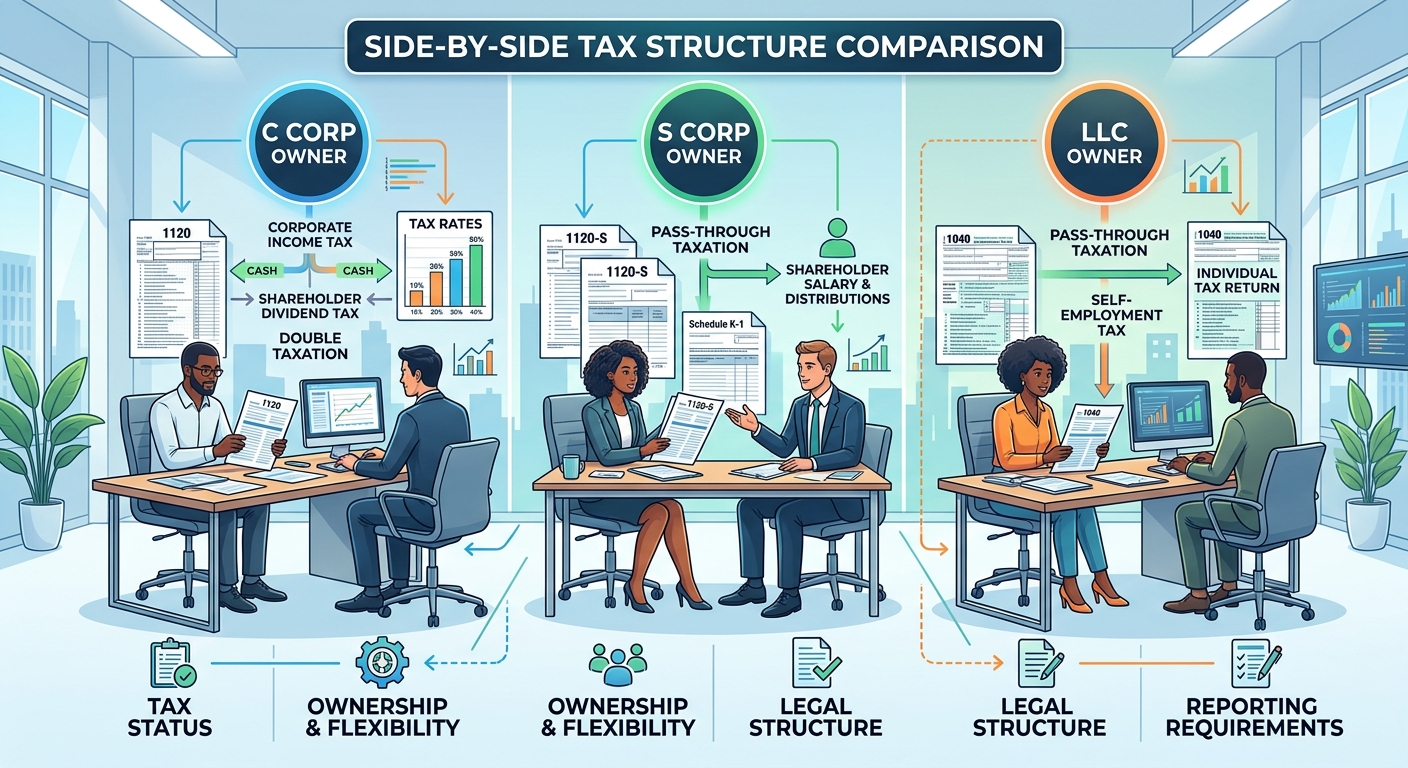
- C corporation: Flat 21% federal corporate tax rate, but owners face a second layer of tax on dividends and when they sell stock. Powerful for high growth and exit planning, but dangerous if you pull cash out every year.
- S corporation: Pass through entity where profits flow to your personal return, but only your W-2 salary is hit with payroll taxes. Often the sweet spot for active owners with $80,000 to $500,000+ in profit.
- LLC: Extremely flexible. By default, you are taxed like a sole proprietor or partnership, which means all profits are subject to self employment tax. With the right elections, an LLC can mimic an S corporation or even a C corporation.
There is no universally best choice. The winner depends on your profit level, how much cash you pull out, your exit plan, and your appetite for complexity and paperwork.
How Taxes Actually Work for C Corporations
A C corporation is a separate taxpayer. It files its own return on Form 1120 and pays a flat 21% federal income tax on its taxable income under current law. That sounds attractive compared to a high earning owner who might be in a 32% or 35% individual bracket, but you have to look one step further.
The Double Tax Problem
Once the C corporation pays 21% tax, the after tax profits are still sitting inside the company. If you distribute them as dividends, you personally pay tax again, usually at 15% or 20% plus the 3.8% net investment income tax. That second layer is what people mean when they talk about double taxation.
Example. Maria owns a marketing agency that nets $300,000 per year before owner compensation. As a C corporation, assume the full $300,000 is taxable income. The corporation pays 21% federal tax, or $63,000, leaving $237,000. If Maria wants to pull the full $237,000 out as a qualified dividend taxed at 15%, she owes $35,550 personally. Combined, the federal tax bill is $98,550. That is an effective rate of about 32.8% before you even look at state taxes.
When a C Corporation Can Still Make Sense
Despite the double tax, a C corporation can be powerful in a few situations:
- You plan to leave most profits inside the company to reinvest, not distribute.
- You are building toward a stock sale that might qualify for the qualified small business stock exclusion under section 1202.
- You want to use fringe benefit rules that are more favorable for C corporations, particularly for health coverage in some structures.
However, if you are a typical owner who wants to pull $150,000 or $200,000 per year out to live on, the second layer of tax erodes the benefit of the 21% corporate rate very quickly.
How S Corporations Cut Self Employment Tax
An S corporation is a pass through entity. It files Form 1120 S, but it does not pay federal income tax itself. Instead, the profit or loss flows through to the shareholders on Schedule K 1 and ultimately lands on their Form 1040. Where S corporations shine is in the way payroll taxes work.
Reasonable Compensation and Payroll Tax Savings
If you are an owner who works in the business, the IRS expects you to take a W 2 salary for the work you perform. That salary is subject to Social Security and Medicare taxes, just like any other employee. The remaining profit, however, can be distributed as a shareholder distribution that is not subject to self employment tax.
Example. Jason is a consultant who nets $220,000 after expenses. As a sole proprietor or a default taxed LLC, the entire $220,000 is subject to self employment tax of 15.3% up to the Social Security wage base and 2.9% for Medicare beyond that, plus income tax. Roughly speaking, his self employment tax bill alone is about $26,000.
If Jason instead uses an S corporation and pays himself a reasonable salary of $110,000, only that salary is subject to payroll tax. The remaining $110,000 flows through as S corporation profit. He still pays income tax on the full $220,000, but the Medicare and Social Security hit applies to half the income instead of all of it. His payroll tax bill is closer to $17,000. That is around $9,000 in annual savings just by changing the structure and running payroll correctly.
The Catch: Reasonable Compensation Rules
The IRS is very focused on underpaid S corporation salaries. If your wages look artificially low compared to your role, industry, and profit level, the Service can reclassify distributions as wages, assess back payroll tax, and add penalties and interest. IRS guidance points to factors like your duties, training, comparable salaries, and how much of the profit is really driven by your personal services. You can find more context in IRS discussions of reasonable compensation in materials tied to S corporation guidance.
Proper planning, documentation, and periodic reviews with a tax strategist are critical if you want to keep the savings without inviting payroll tax adjustments in an audit.
LLC Flexibility: Default Taxes Versus Elections
Limited liability companies are creatures of state law, described generally in IRS Publication 541. For federal tax purposes, an LLC is like a chameleon. A single member LLC defaults to disregarded status, so the IRS ignores it and you report income on Schedule C. A multi member LLC defaults to partnership treatment and files Form 1065. In both cases, active owners usually owe self employment tax on all their allocable share of operating income.
Where LLCs become interesting is elections. You can file Form 8832 and Form 2553 so that an LLC is taxed as an S corporation, combining the legal simplicity of an LLC with the payroll tax leverage of S corporation taxation. Alternatively, you can elect C corporation treatment if you have a growth and exit strategy where the corporate structure is advantageous.
Default LLC Taxation and Self Employment Tax
Consider Angela, a real estate photographer in California. Her single member LLC nets $150,000 after deductible expenses. As a disregarded entity, she reports $150,000 of Schedule C income. For 2025, that might mean roughly $18,000 to $20,000 of self employment tax on top of federal and California income tax.
If she elects S corporation status and pays herself an $80,000 salary, the remaining $70,000 escapes self employment tax. Even after factoring in payroll service costs and extra compliance, it is common to see net savings in the $6,000 to $8,000 per year range for this profile.
Why the Entity Decision Is Not One Size Fits All
When you compare c corp versus s corp versus llc for taxes, you have to look beyond simple charts that list pros and cons. The real decision hinges on a few big levers.
Lever 1: Profit Level and How You Take Cash
If your profit is under about $60,000, the complexity of an S corporation may not pay for itself yet. Once you pass that range, the payroll tax savings can quickly outweigh the extra cost of bookkeeping, payroll, and tax filings.
If you regularly pull out most of the profit to fund your lifestyle, a classic C corporation is usually the least attractive option. You get hit at 21% inside the corporation and then pay again when you distribute cash. On the other hand, if you can leave profits in the company and you are playing a long stock sale game, the C corporation is back on the table.
Lever 2: Your Exit Strategy
C corporations may qualify for the qualified small business stock exclusion. If the stock meets the rules under section 1202 and you hold it long enough, you can potentially exclude up to $10 million of gain on sale. That is a powerful wealth planning lever for startups and high growth businesses, but it requires careful planning and compliance from day one.
By contrast, S corporation and partnership equity sales often blend asset and equity treatment, and buyers may push for asset deals for tax reasons. The after tax outcome on exit can look very different depending on structure, even if the operating year by year taxes looked similar.
Lever 3: How Many Owners and What Kind
S corporations are limited to 100 shareholders. They generally cannot have partnerships, corporations, or nonresident aliens as owners, and they can only issue one class of stock. LLCs are far more flexible in terms of ownership structure and special allocations. C corporations sit in the middle they are structurally rigid but familiar to investors and venture capital.
Red Flag Alert: Common Mistakes That Trigger IRS Scrutiny
Several recurring mistakes show up in IRS examinations around entity choice.
Underpaying S Corporation Salaries
Owners who run $400,000 of profit through an S corporation and only pay themselves a $40,000 salary are waving a red flag. In audits, the IRS frequently reclassifies large chunks of distributions as wages. That leads to back payroll tax, penalties, and interest. Reasonable compensation is not a suggestion it is a requirement.
Using a C Corporation for a Lifestyle Business
If your business does not plan to raise institutional capital or pursue a stock sale, locking yourself into C corporation status can be expensive. Every dollar you pull out as a dividend pays two layers of tax. If you pay yourself a very high salary to avoid dividends, the IRS can push back and recharacterize part of it as a nondeductible distribution, especially in closely held companies. You can find corporate level rules summarized in IRS Publication 542.
Ignoring Self Employment Tax in LLCs
Many LLC owners obsess over income tax brackets and completely forget the 15.3% self employment tax hit. On $200,000 of profit, that is over $20,000 before income tax. Staying in default LLC taxation when an S corporation election would be appropriate is one of the most expensive passive decisions an owner can make.
KDA Case Study: Consultant Restructures and Saves Thousands
A California based marketing consultant came to KDA as a single member LLC on Schedule C. She generated about $260,000 in net income in the most recent year and expected similar or higher earnings going forward. Her CPA handled annual tax filing but had never raised the question of entity structure.
We walked through c corp versus s corp versus llc in the context of her goals. She worked alone with a small support team of contractors, had no plans to raise capital, and wanted to build a high profit, lifestyle friendly business. We ruled out C corporation status quickly because she pulled out nearly all the profit each year and had no qualified small business stock play in mind.
We then modeled an S corporation election with a W 2 salary of $130,000 based on her role, industry comparables, and workload. Under that structure, roughly $130,000 would be subject to payroll taxes and the remaining $130,000 would flow through as S corporation profit not hit by self employment tax.
Comparing the two paths, the S corporation structure reduced her annual Medicare and Social Security cost by just over $11,000 for the first full year, even after accounting for payroll fees and extra filings. Our fee for planning, implementation, and ongoing support was about $3,500, so her first year return on investment was a little more than 3 times what she paid. In later years, the planning continues to pay off with only modest maintenance costs.
Ready to see how we can help you? Explore more success stories on our case studies page to discover proven strategies that have saved our clients thousands in taxes.
Where Each Entity Fits Different Taxpayer Personas
Different structures mesh better with different kinds of business owners.
Solo 1099 Contractors and Consultants
If you are a solo service provider netting between $80,000 and $400,000, an S corporation or LLC taxed as an S corporation is often the strongest default choice. You get liability protection and a real lever to dial in payroll taxes, as long as you respect reasonable compensation rules and keep clean books. Our self employed taxpayer services are designed around exactly these tradeoffs.
Growing Multi Owner Businesses
For a team of founders who eventually want to bring in additional investors, C corporations and multi member LLCs are more flexible than S corporations. LLCs work well when you want custom profit allocations or when some partners are passive investors and others are active operators. C corporations tend to be more familiar for institutional investors and easier to plug into traditional stock option plans.
These decisions usually intersect with broader strategy questions about capital structure, compensation, and governance. That is why many business owners we advise pair entity selection with long term planning instead of treating it as a one time form.
Real Estate Investors
Pure real estate holding often sits best in LLCs taxed as partnerships or disregarded entities, not S corporations or C corporations. You generally do not want to lock real estate into a C corporation because getting appreciated property back out can trigger heavy tax. For active flippers or broker teams, a combination of LLCs and S corporations can balance self employment tax and long term holding goals. Our dedicated real estate investor support dives deeper into these combinations.
How KDA Approaches Entity Setup and Maintenance
Selecting between c corp versus s corp versus llc is not a one time napkin sketch. It is an ongoing process that should evolve along with your profit, team, and exit plans.
Initial Diagnostic and Projections
We begin by gathering your last one to two years of tax returns, bookkeeping files, and a simple profit forecast. Then we model entity scenarios side by side. That includes federal and California income tax, self employment or payroll tax, reasonable salary assumptions, and your expected cash needs from the business.
We regularly see scenario models where switching from a default LLC to an S corporation structure saves a California owner $8,000 to $20,000 per year in combined federal and state Medicare and Social Security costs. For some high profit clients, the first year savings exceed $30,000.
Implementation and Compliance
Once a direction is clear, implementation involves more than just filing one form. For an S corporation election, that may include forming or converting an LLC, filing Form 2553, setting up payroll and officer compensation, updating your bookkeeping system, and aligning operating agreements with the new tax treatment.
Many owners prefer to bundle this work with ongoing entity formation and maintenance support so that annual minutes, officer changes, and ownership shifts stay clean. Layering professional bookkeeping and payroll through our bookkeeping and payroll services also reduces the chance that sloppy records undermine your reasonable compensation position in an audit.
Will Changing Entities Trigger an Audit?
Many owners stay in suboptimal structures because they are convinced that any change will trigger an audit. That fear is understandable but often overblown.
Entity elections and conversions are routine. The IRS receives thousands of Form 2553 elections each year. What draws attention is not that you changed, but how aggressively you use the new structure. Paying yourself an obviously low salary in an S corporation or failing to keep clean books is far more dangerous than filing an election on time and following the rules.
For high income owners with complex structures, pairing entity changes with formal tax planning through our premium advisory engagements provides an extra layer of documentation and oversight.
Fast Tax Fact: Estimated Savings by Structure
To make the tradeoffs more concrete, consider a business that consistently nets $200,000 before owner compensation and that the owner wants to withdraw for personal use.
- Default LLC or sole proprietor: Roughly $200,000 shows up as self employment income. Self employment tax alone can be around $23,000, then federal and state income tax layers on top.
- S corporation with $110,000 salary: Payroll tax applies to $110,000. The remaining $90,000 flows through without self employment tax. That can cut the combined Social Security and Medicare bill by $8,000 to $10,000 per year.
- C corporation distributing all profits: The corporation pays 21% on $200,000, or $42,000, leaving $158,000. If paid out as dividends taxed at 15%, that is another $23,700 personally, for a combined federal hit around $65,700. That often exceeds the S corporation combined income and payroll tax cost for this profile.
These are simplified examples, but they show why the entity choice deserves a real analysis instead of a quick guess.
What If You Already Picked the Wrong Entity?
If you realize the structure you picked years ago is costing you money, you are not stuck forever.
- LLCs can usually file elections to be taxed as S corporations or C corporations prospectively.
- C corporations can sometimes convert to S corporation status, though you have to navigate built in gains rules and eligibility constraints.
- S corporations can revoke their election and revert to C corporation status, but that is rarely the goal for small service businesses.
The right move and the timing depend on your profit trends, existing accumulated earnings, and whether you have built up appreciated assets in the entity. That is where structured modeling and professional advice pay for themselves.
Key Questions to Ask Before You Change Anything
Before you rush to file an election form, walk through a few practical questions:
- What is my realistic profit for the next three years, not just last year?
- How much cash do I need to pull out each year to live on?
- Do I plan to add partners or investors, and if so, what kind?
- Am I building this for sale, or am I building a profitable income stream I will run for a long time?
- Am I willing to take on payroll, additional filings, and more structured bookkeeping?
These answers drive whether c corp versus s corp versus llc is most appropriate, more than any generic blog chart.
Bottom Line
The tax difference between a C corporation, S corporation, and LLC is not theory. For many owners, it is a recurring five figure swing in what you keep versus what you send to the IRS and state every year.
This information is current as of 7/22/2026. Tax laws change frequently. Verify updates with the IRS or state authorities if you are reading this later, and review current IRS discussions of entities in resources like Publication 541 and Publication 542.
Ready to Reduce Your Tax Bill?
KDA Inc. specializes in strategic tax planning for business owners, S Corps, LLCs, and high-net-worth individuals. Book a personalized consultation and walk away with a clear plan.
Book Your Tax Strategy Session
If you are unsure whether your current structure is quietly draining $10,000 or more per year in unnecessary tax, it is time to run the numbers. We will model c corp versus s corp versus llc for your specific income, state, and goals so you can pick the structure that actually serves you. Click here to book your consultation now.
The IRS is not hiding better structures you simply have to ask the right questions and be willing to adjust.



