
Most small business owners know they should pick the right entity, but almost none of them can clearly explain how a C corporation and an S corporation really hit their tax bill. That confusion is expensive. Over the life of a business, the wrong choice can quietly drain six figures in extra tax.
In this guide, we will break down **c corp vs s corp** in plain English, using real dollar examples and focusing on what actually moves the needle for federal and California tax. Whether you are a W-2 employee planning a side business, a 1099 consultant already profitable, or a real estate investor thinking about a management company, this comparison will give you a practical decision framework, not just theory.
Quick Answer
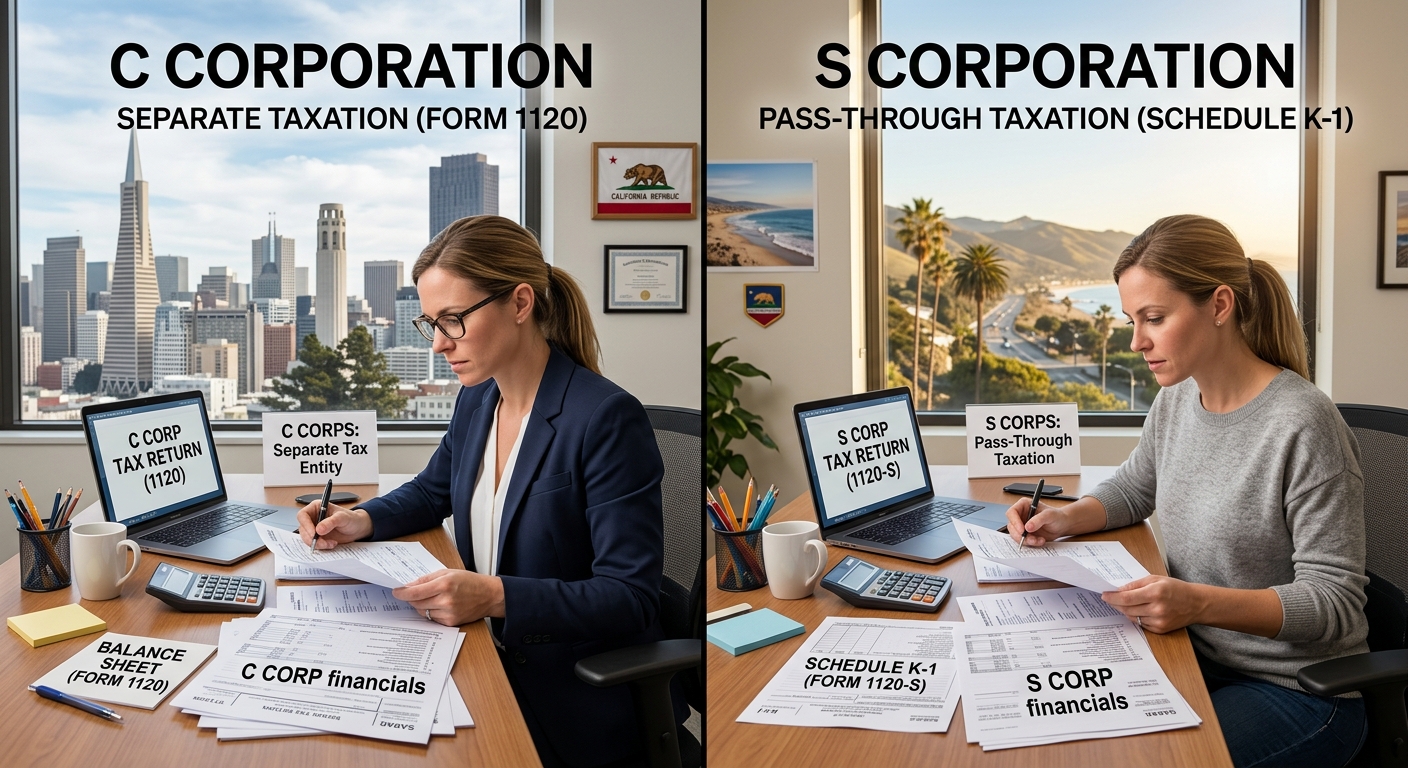
The core difference in the c corp vs s corp decision is how profits are taxed. A C corporation pays its own corporate tax, then shareholders pay tax again on dividends. An S corporation generally avoids that double layer: profits pass through to the owners and are taxed once on their personal returns, but owner-employees must take reasonable W-2 salary that is subject to payroll tax. In California, S corporations also pay a 1.5% franchise tax on net income (with a minimum tax), while C corporations pay 8.84% on net income.
How C Corporations Are Taxed
A C corporation is a separate taxpayer. It files Form 1120 and pays federal income tax on its profits, then may distribute after-tax cash to shareholders as dividends.
Federal C Corporation Tax Basics
- Flat federal corporate tax rate of 21% on taxable income.
- Dividends to individual shareholders are generally taxed again at 0%, 15%, or 20% plus the 3.8% net investment income tax, depending on income level.
- Losses stay inside the corporation and generally cannot be used on your personal return.
Example: Your C corporation earns $200,000 in profit in 2025. It pays 21% federal tax ($42,000), leaving $158,000. If the corporation distributes the full $158,000 as dividends and you are in the 15% qualified dividend bracket, you pay $23,700 in additional tax. Total tax on that $200,000 is $65,700, or about 32.9% before considering California.
California C Corporation Tax
California taxes most C corporations at 8.84% of net income, reported on Form 100. If that same $200,000 profit is from a California C corporation, state corporate tax is $17,680. Now your total tax bill on $200,000 of corporate profit plus dividends is over $83,000 when you combine federal and state layers. That is the double taxation people worry about, and in profitable, cash-flowing businesses it is very real.
When a C Corporation Can Still Make Sense
Even with double taxation, C corporations are not automatically bad. They can be useful when:
- You plan to retain most profits in the corporation to fund growth rather than distribute them.
- You may eventually sell company stock and potentially qualify for Section 1202 qualified small business stock exclusion.
- You want more flexibility issuing multiple classes of stock, preferred shares, or bringing in institutional investors.
For a high growth startup targeting venture capital, a C corporation is often the only realistic option. For a local service business with $150,000 to $500,000 in steady profit, the double tax usually becomes a drag.
How S Corporations Are Taxed
An S corporation is a tax status you elect with the IRS by filing Form 2553. The underlying legal entity is usually an LLC or corporation formed at the state level. From a tax perspective, the S corporation is a pass-through: it files Form 1120-S, but generally does not pay federal income tax itself. Instead, profits and losses are allocated to shareholders on Schedule K-1 and reported on their personal returns.
Federal S Corporation Tax Basics
- Business profit passes through and is taxed once at the shareholder level.
- Owner-employees must receive reasonable W-2 salary that is subject to Social Security and Medicare taxes.
- Remaining profit can be distributed as dividends that are not subject to self-employment tax or payroll tax.
- Many S corporation owners may qualify for the 20% qualified business income deduction under Section 199A, subject to thresholds and limitations; see IRS Publication 535 and IRS Publication 541.
Example: Your S corporation has $200,000 in profit before paying you as an owner-employee. You pay yourself $90,000 in W-2 wages and leave $110,000 as S corporation profit. You and the corporation together pay payroll taxes on the $90,000 salary (about $13,770 for Social Security and Medicare), but the $110,000 pass-through profit is not hit with self-employment tax. Compared with running the same business as a sole proprietor paying self-employment tax on the entire $200,000, this structure often saves $10,000 to $15,000 per year.
California S Corporation Tax
California treats S corporations differently from the federal government. The S corporation files Form 100S and pays a 1.5% tax on its net income, with a minimum franchise tax. Shareholders still report their share of S corporation income on their California personal returns. Using the same $200,000 example, if the corporation has $200,000 of net income, California levies $3,000 of corporate-level tax (1.5% of $200,000) before profits flow through to you.
This extra state tax reduces, but does not usually erase, the payroll-tax advantage of an S corporation. The bigger your profit above a reasonable salary, the more attractive the S corporation structure becomes.
Decision Framework: C Corp vs S Corp by Profit Level
To decide between a c corp vs s corp, you need more than slogans. You need a simple framework based on profit level, distribution plans, and exit strategy.
Under $60,000 Annual Profit
If your business is truly part-time or just getting off the ground, with under $60,000 in annual profit, the administrative cost and complexity of an S corporation may not be worth it yet. At this level, a single-member LLC taxed as a sole proprietorship or a simple partnership often makes more sense.
Why? The payroll setup, extra tax returns, and California S corporation minimum taxes can eat up a big chunk of the savings. Many self-employed professionals in this income band are better served by tightening their bookkeeping, capturing all legitimate deductions, and planning for retirement contributions before layering in entity complexity.
$60,000 to $250,000 Annual Profit
This is the sweet spot for S corporations for service businesses. Suppose a consultant nets $180,000 after expenses. As a sole proprietor, they pay income tax plus roughly $25,000 in self-employment tax. As an S corporation, if they pay themselves a reasonable salary of $90,000 and take the rest as distributions, their combined payroll tax bill is closer to $13,770 and the remaining $90,000 of profit is not subject to self-employment tax. Even after California’s 1.5% S corporation tax and extra compliance costs, that can mean $8,000 to $12,000 per year in net savings.
At these profit levels, working with a firm that handles both bookkeeping and payroll, such as KDA’s bookkeeping and payroll services, becomes critical. Clean numbers and properly documented payroll are what make the S corporation structure defendable if the IRS ever asks questions about compensation.
Above $250,000 Annual Profit
Once profits climb past $250,000, the c corp vs s corp decision gets more nuanced. At this level:
- If you are reinvesting most profits into growth, a C corporation can make sense despite double taxation, especially if there is a potential qualified small business stock exit.
- If you are consistently distributing most profits, the double taxation of a C corporation will usually cost more than it saves, and an S corporation or other pass-through structure is often superior.
- High-income professionals such as doctors, engineers, and lawyers may have additional limitations on the Section 199A deduction when income exceeds certain thresholds; see IRS qualified business income deduction guidance for details.
Business owners in this profit range should strongly consider ongoing premium advisory services rather than once-a-year tax prep. The stakes are too high to guess.
KDA Case Study: Consultant Chooses S Corp Over C Corp
Maria is a 1099 marketing consultant in Los Angeles. In 2024 she formed an LLC and by early 2025 her business was on track to clear $190,000 in net profit. Her bank suggested incorporating as a C corporation so she could look more “official” to larger clients. She came to KDA asking which direction to take.
We modeled both scenarios. Under a C corporation, Maria’s company would pay 21% federal and 8.84% California tax on profits before any cash reached her. If she then pulled funds out as dividends to cover her living expenses, her effective combined federal and state tax rate on distributed profits would exceed 35%. Over the next five years, assuming similar profit levels and regular distributions, she would lose over $120,000 to double taxation compared with a pass-through structure.
Instead, we recommended that her LLC elect S corporation status. We set her up on payroll at $95,000 in W-2 wages, with the remaining $95,000 treated as S corporation profit. After factoring in payroll taxes, California’s 1.5% S corporation tax, and the Section 199A deduction that applied at her income level, Maria’s first-year savings compared with a C corporation path exceeded $14,000. Our annual fee for entity advisory, S corporation election, and ongoing support was under $4,000, giving her a first-year ROI of more than 3.5x, with ongoing savings every year she remains profitable.
Ready to see how we can help you? Explore more success stories on our case studies page to discover proven strategies that have saved our clients thousands in taxes.
Common Mistakes When Comparing C Corps and S Corps
The c corp vs s corp decision is often mishandled because business owners focus on sound bites instead of mechanics. Here are the traps we see repeatedly.
Ignoring Reasonable Compensation Rules
Many S corporation owners try to maximize distributions and keep W-2 wages artificially low. The IRS requires that shareholder-employees receive reasonable compensation for services performed. If you earn $300,000 in profit from your own labor and pay yourself $40,000 in salary, expect scrutiny. If the IRS reclassifies distributions as wages, they can impose back payroll taxes, penalties, and interest. For guidance, see IRS material on S corporation compensation.
We see California professionals in fields like engineering and medical services especially exposed on this point. If you are in that situation, review KDA’s focus area for medical professionals and high-income practices to understand how compensation planning fits into your broader tax picture.
Underestimating State-Level Differences
Some online calculators only consider federal tax, which can make an S corporation look more attractive than it actually is in California. The 1.5% California S corporation tax, minimum franchise taxes, and potential additional CA filing requirements all affect the net benefit. Conversely, focusing only on California’s flat corporate rate without modeling federal self-employment savings can make C corporations look better than they really are.
Forgetting About Exit Strategy
If you plan to sell your company in three to seven years, entity choice affects how that sale is taxed. C corporation stock sales can sometimes qualify for Section 1202 exclusion on up to $10 million of gain. Asset sales from S corporations flow through as capital gains to shareholders, which may or may not be preferable depending on your numbers. Ignoring exit impact is one of the biggest strategic misses we see with DIY entity setup.
Red Flag Alert: When the IRS Starts Asking Questions
Both C corporations and S corporations attract attention when numbers do not line up with expectations. Common red flags include:
- Very low officer compensation in an S corporation with high profit.
- Shareholder loans that are really disguised distributions.
- C corporation owners deducting clearly personal expenses as corporate write-offs.
- Missing or late payroll tax deposits for owner-employees.
For California businesses, Franchise Tax Board notices can follow if franchise tax estimates or minimum payments are missed. Having a proactive plan and clean bookkeeping avoids most of these problems. If you have already received a letter, KDA’s audit representation services can step in to manage communication and negotiate on your behalf.
What If You Chose the “Wrong” Entity?
Business owners often discover years into operations that their original entity choice does not fit where the company is now. The good news is that in many cases you can correct course.
Converting a C Corporation to an S Corporation
If you are currently a C corporation, you can generally elect S corporation status by filing Form 2553, provided you meet the eligibility rules (domestic corporation, limited number of shareholders, allowable shareholder types, and a single class of stock). However, there are important built-in gains tax rules when a C corporation with appreciated assets converts to an S corporation. The IRS can impose a corporate-level tax on certain gains recognized during a recognition period after the election. You should review these issues with a qualified advisor before filing.
Electing S Status for an LLC
An LLC can often elect to be taxed as an S corporation while remaining an LLC legally at the state level. This is a common path for service businesses once profits stabilize above that $60,000 to $80,000 range. The process involves filing Form 8832 (entity classification election) and Form 2553, typically effective at the start of a tax year. This move changes how profit is taxed, while your contracts and basic legal structure can stay intact.
Ready to Reduce Your Tax Bill?
KDA Inc. specializes in strategic tax planning for business owners, S Corps, LLCs, and high-net-worth individuals. Book a personalized consultation and walk away with a clear plan.
Frequently Asked Questions About C Corps and S Corps
Will an S Corporation Always Save Me Money?
No. For low-profit or loss-making businesses, the cost of payroll, extra tax filings, and California’s S corporation tax can exceed any self-employment tax savings. The structure shines when there is enough profit above a reasonable salary to generate real payroll tax savings.
Can I Take All Profit as Distributions in an S Corporation?
No. If you materially participate in the business, the IRS expects you to pay yourself reasonable W-2 wages. Only the profit above that wage level should be treated as distributions. Taking zero salary is a major audit risk.
Do C Corporations Avoid Self-Employment Tax?
Technically, yes, because shareholders are not self-employed. But owner-employees still receive W-2 wages subject to Social Security and Medicare taxes. There is no magic way around paying tax on money you actually earn for working in the business.
How Often Can I Change My Entity Type?
There are timing rules on when you can make or revoke S corporation elections, and frequent flips between structures can create complicated tax consequences. Think of entity choice as a 3 to 5 year strategic decision, not something to toggle every filing season.
Bottom Line: Choosing the Right Structure for Your Situation
The c corp vs s corp decision is not about which label sounds more sophisticated. It is about how profits flow, how you pay yourself, how California treats the entity, and what your exit plan looks like. A structure that works beautifully for a venture-backed tech company can be punishing for a solo consultant, and vice versa.
This information is current as of 6/30/2026. Tax laws change frequently. Verify updates with the IRS or FTB if you are reading this later.
Book Your Tax Strategy Session
If you are unsure whether your current entity choice is quietly costing you thousands every year, it is time to get clarity. Our team at KDA specializes in helping business owners, consultants, and investors align their structure with their real goals and numbers. Click here to book your consultation now.



