
Quick Answer
If you are searching for C Corp S Corp or partnership where to find the right entity for your business, the answer depends on your income level, how you plan to distribute profits, and whether you operate in California. For most California business owners earning $80,000 or more in annual profit, the S Corporation delivers the lowest combined federal and state tax bill. C Corps trigger double taxation that can exceed 47% on distributed profits. Partnerships expose every dollar of net income to self-employment tax. Choosing wrong costs $8,000 to $42,000 per year, and the IRS does not send you a letter saying you picked the expensive option.
This information is current as of April 14, 2026. Tax laws change frequently. Verify updates with the IRS or FTB if reading this later.
Why the Entity Question Costs California Business Owners More Than Any Other Tax Decision
The IRS processed over 7.4 million S Corporation returns in the most recent filing year and roughly 2.1 million C Corporation returns. Millions more businesses filed as partnerships or sole proprietorships on Schedule C. Every one of those filings started with a single decision: what type of entity should this business operate under?
Most business owners make that decision once, usually at formation, and never revisit it. That is the mistake. The difference between a C Corp, S Corp, or partnership is not just a legal technicality. It is a tax math problem that compounds every single year. On $200,000 in business profit, a California C Corp owner pays roughly $94,200 in combined federal and state taxes when profits are distributed. An S Corp owner on the same profit pays approximately $53,900. A partnership owner pays about $68,400 when you include self-employment tax.
That spread, $25,800 to $40,300 per year depending on the comparison, is real money that left your bank account because of a checkbox on a formation document.
Key Takeaway: Your entity classification is the single largest variable in your annual tax bill, and the wrong one silently drains $8,000 to $42,000 per year without triggering a single IRS notice.
C Corp, S Corp, or Partnership: What Each Structure Actually Means for Your Tax Return
Before comparing numbers, you need to understand what each entity does to your income. Many business owners file their returns without realizing how fundamentally different these three structures treat the same dollar of profit.
C Corporation: The Double Taxation Machine
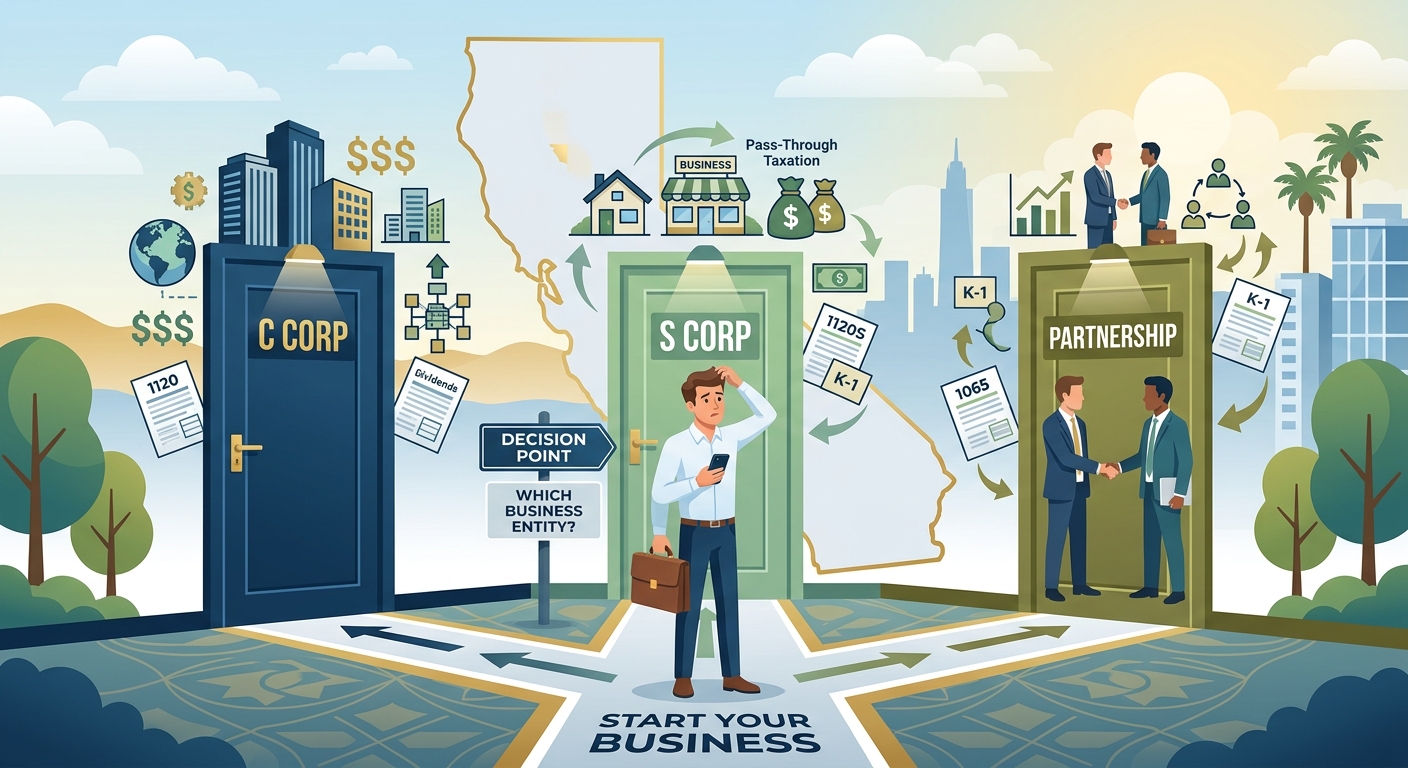
A C Corporation is a separate taxpaying entity. It files Form 1120 and pays federal corporate tax at a flat 21% rate under IRC Section 11. In California, it also pays an 8.84% franchise tax under Revenue and Taxation Code Section 23151. That is the first layer of tax.
When the corporation distributes remaining profits to shareholders as dividends, those dividends are taxed again on the shareholder’s personal return. Qualified dividends face a maximum federal rate of 20% plus the 3.8% Net Investment Income Tax (NIIT) under IRC Section 1411. California taxes dividends as ordinary income at rates up to 13.3%, because the state does not recognize the federal qualified dividend preference.
Run the math on $200,000 in profit: the corporation pays $59,680 in combined federal and state corporate tax. The remaining $140,320 is distributed and taxed at roughly 24.6% combined (federal qualified dividend rate plus California ordinary income rate for a mid-bracket taxpayer), producing another $34,519 in personal tax. Total: $94,199. That is a 47.1% effective rate before you factor in state payroll taxes or the $800 minimum franchise tax.
S Corporation: The Pass-Through With Salary Savings
An S Corporation files Form 1120-S but pays no federal entity-level tax. Instead, all income passes through to shareholders on Schedule K-1 and is reported on their personal returns. California charges a 1.5% franchise tax on net income under R&TC Section 23802, a fraction of the C Corp rate.
The key advantage is the salary-distribution split. S Corp shareholders who actively work in the business must pay themselves a “reasonable salary” per Watson v. Commissioner. On that salary, you pay full payroll taxes (Social Security at 12.4% up to the $168,600 wage base in 2025/2026, plus 2.9% Medicare, plus 0.9% Additional Medicare on wages above $200,000). But profits above the reasonable salary are distributed without self-employment tax.
On $200,000 profit with a $75,000 reasonable salary, you save roughly $14,130 in self-employment tax compared to a partnership or Schedule C. Add the QBI deduction under IRC Section 199A (up to 20% of qualified business income) and the AB 150 Pass-Through Entity (PTE) tax election that bypasses the $40,000 SALT cap under the One Big Beautiful Bill Act (OBBBA), and the S Corp total drops to approximately $53,900.
For a deeper breakdown of every S Corp strategy available to California business owners, read our complete guide to S Corp tax strategy in California.
Partnership: Full Self-Employment Tax Exposure
A partnership files Form 1065 and issues Schedule K-1 to each partner. Like the S Corp, there is no entity-level federal tax. California charges an $800 annual franchise tax on LLCs taxed as partnerships plus a graduated gross receipts fee up to $11,790 under R&TC Section 17942.
The problem is self-employment tax. Under IRC Section 1402(a), general partners owe 15.3% self-employment tax on their entire distributive share of partnership income, not just a reasonable salary. On $200,000 in profit, that produces approximately $24,725 in self-employment tax alone. An S Corp on the same income, with a $75,000 salary, generates only $10,598 in payroll tax. The gap: $14,127 per year, every year, for the same work and the same revenue.
If you want to see exactly how these numbers play out for your specific income level, plug your figures into this small business tax calculator to estimate the difference.
Side-by-Side Comparison: C Corp vs S Corp vs Partnership on $200,000 Profit
| Tax Layer | C Corp | S Corp | Partnership |
|---|---|---|---|
| Federal Entity Tax | $42,000 (21%) | $0 | $0 |
| CA Entity Tax | $17,680 (8.84%) | $3,000 (1.5%) | $800 + fee |
| Self-Employment / Payroll Tax | N/A at entity | $10,598 (on $75K salary) | $24,725 (on all income) |
| Federal Personal Income Tax | $34,519 (on dividends) | $28,320 (after QBI) | $31,840 (after SE deduction) |
| CA Personal Income Tax | Included above | $11,982 | $11,035 |
| Total Combined Tax | $94,199 | $53,900 | $68,400 |
| Effective Rate | 47.1% | 26.9% | 34.2% |
Key Takeaway: The S Corp saves $40,299 over the C Corp and $14,500 over the partnership on identical $200,000 profit. Over five years, the C Corp disadvantage compounds to $201,495.
Five Costliest Mistakes When Choosing Between C Corp, S Corp, or Partnership
Picking the wrong entity is expensive. But the real damage comes from five specific mistakes that California business owners repeat year after year. Our entity formation services exist precisely because these errors cost clients tens of thousands before they ever sit down with a strategist.
Mistake 1: Defaulting to LLC Without Electing S Corp Status
When you form an LLC in California and do nothing else, the IRS treats it as a sole proprietorship (single member) or partnership (multi-member). Every dollar of profit is subject to self-employment tax. Filing Form 2553 to elect S Corp status takes 15 minutes. Skipping it costs $8,000 to $16,000 per year in unnecessary self-employment tax at income levels between $80,000 and $250,000.
Mistake 2: Choosing C Corp Because Your Attorney Said So
Many business attorneys default to C Corp formation because it is what they learned in law school. C Corps work for venture-backed startups seeking multiple share classes or companies planning an IPO. They do not work for service businesses, consulting firms, or professional practices earning $100,000 to $500,000 per year. The double-taxation penalty at these income levels ranges from $16,000 to $51,000 annually.
Mistake 3: Ignoring the March 15 Form 2553 Deadline
The S Corp election must be filed by March 15 of the year you want it to take effect, or within 75 days of formation for new entities, per IRC Section 1362(a)(2). Miss the deadline and you remain a C Corp or default LLC for the entire year. Late election relief exists under Revenue Procedure 2013-30, but only within three years and 75 days of the intended effective date. After that window closes, you need a Private Letter Ruling at $15,300 or more.
Mistake 4: Staying in a Partnership When Profits Exceed $60,000
Partnerships work fine at low income levels where the self-employment tax burden is minimal. Once annual profit crosses $60,000, the S Corp salary-distribution split produces measurable savings. At $100,000 in profit, the annual S Corp advantage over a partnership is roughly $5,400. At $200,000, it reaches $14,500. At $350,000, the gap exceeds $22,000. Every year you delay conversion is a year of savings you cannot recover.
Mistake 5: Not Accounting for California’s Separate Entity Tax Rules
California does not fully conform to federal tax law on several critical points. The state imposes a 1.5% franchise tax on S Corp net income under R&TC Section 23802, charges an $800 minimum franchise tax on both LLCs and corporations, does not conform to 100% federal bonus depreciation under R&TC Sections 17250 and 24356 (California caps Section 179 at $25,000), and taxes all income at up to 13.3% with no capital gains preference. Business owners who plan only for federal taxes routinely underpay California estimates by $3,000 to $8,000.
Pro Tip: The AB 150 PTE tax election allows S Corp and partnership owners to bypass the $40,000 SALT cap by paying state tax at the entity level and claiming a federal deduction. This election is not available to C Corps. If you are a C Corp owner earning over $100,000, you are permanently locked out of this workaround.
Where to Actually Find Your Entity Classification (And How to Verify It)
Many business owners do not actually know what entity type they are operating under. Here is exactly where to look and what each document tells you.
Check Your IRS Confirmation Letter (CP 575 or 147C)
When you applied for your Employer Identification Number (EIN), the IRS sent a CP 575 notice confirming your EIN and entity classification. If you lost it, request a 147C verification letter by calling the IRS Business and Specialty Tax Line at (800) 829-4933. This letter states whether the IRS recognizes your entity as a corporation, partnership, or sole proprietorship.
Check Your State Formation Documents
Your California Secretary of State filing determines your legal structure. Articles of Incorporation create a corporation. Articles of Organization create an LLC. A partnership agreement (or lack of formal filing) creates a general partnership. You can verify your entity status through the California Secretary of State’s bizfile system at bizfileonline.sos.ca.gov.
Check for Form 2553 Acceptance
If you believe you elected S Corp status, look for the IRS acceptance letter for Form 2553. Without this letter, you are not an S Corp regardless of what your accountant told you. You can verify your S Corp election status by calling the IRS or checking the entity classification on your most recent tax transcript using IRS Get Transcript Online.
Check Your Most Recent Tax Return
The form number on your last return reveals your entity type. Form 1120 means C Corp. Form 1120-S means S Corp. Form 1065 means partnership. Schedule C on Form 1040 means sole proprietorship. If you are filing the wrong form for your intended entity type, you have a problem that needs immediate correction.
Check Your California FTB Account
The Franchise Tax Board maintains separate records. Log into your FTB account or call (800) 852-5711 to confirm whether the state recognizes your S Corp election. California requires a separate S Corp election acknowledgment. Filing Form 2553 with the IRS does not automatically notify the FTB, and mismatches between federal and state classifications trigger audit flags under R&TC Section 18622.
KDA Case Study: Sacramento Digital Marketing Firm Saves $38,400 by Switching From Partnership to S Corp
Marcus and Dina ran a two-person digital marketing agency in Sacramento structured as a multi-member LLC taxed as a partnership. Combined business profit: $240,000. Each partner reported $120,000 on their individual returns and paid self-employment tax on every dollar. Their combined annual self-employment tax bill exceeded $29,000.
When they came to KDA, we identified the core problem immediately: neither partner had filed Form 2553 to elect S Corp status. They had been bleeding self-employment tax for three years.
KDA’s strategy included four steps. First, we filed Form 2553 with late election relief under Revenue Procedure 2013-30, making the S Corp election retroactive. Second, we established reasonable salaries of $70,000 per partner based on industry compensation data. Third, we set up the AB 150 PTE tax election to bypass the SALT cap, saving an additional $4,200 in federal tax. Fourth, we opened Solo 401(k) accounts for both partners, sheltering $23,500 each and reducing taxable income by $47,000 combined.
Year one results: total tax savings of $38,400 compared to their prior partnership structure. KDA’s engagement fee: $4,800. Return on investment: 8.0x in the first year alone. Projected five-year savings: $192,000.
Ready to see how we can help you? Explore more success stories on our case studies page to discover proven strategies that have saved our clients thousands in taxes.
OBBBA Permanent Changes That Shift the C Corp vs S Corp vs Partnership Equation in 2026
The One Big Beautiful Bill Act (OBBBA) signed into law in 2025 made several provisions permanent that directly affect the C Corp S Corp or partnership where to find the best tax outcome question:
- QBI Deduction (IRC Section 199A): Now permanent. S Corp and partnership owners below the income threshold ($191,950 single / $383,900 married in 2026) deduct up to 20% of qualified business income. C Corp owners get zero QBI benefit. On $200,000 in profit, that is up to $40,000 in deductible income the C Corp misses entirely.
- 100% Bonus Depreciation: Restored to 100% for assets placed in service through 2029. S Corps and partnerships deduct equipment purchases immediately at the federal level. California does not conform under R&TC Sections 17250 and 24356, requiring separate depreciation schedules.
- Section 179 Increase: Federal limit raised to $2.5 million. California remains capped at $25,000, creating a $2.475 million gap between federal and state deductions for business owners who rely solely on Section 179 (see IRS Publication 946 for current depreciation rules).
- SALT Cap at $40,000: Permanent cap on state and local tax deductions. The AB 150 PTE election available only to S Corps and partnerships provides a workaround. C Corp owners have no equivalent bypass.
- Estate Exemption at $15 Million: Relevant for business owners evaluating succession planning alongside entity selection.
These permanent provisions tilt the math further toward S Corp status for California businesses earning $80,000 or more in annual profit. The QBI deduction alone can be worth $8,000 to $30,000 per year depending on income, and it is simply unavailable to C Corps.
When a C Corp or Partnership Actually Makes Sense
The S Corp wins the tax math for most California businesses, but there are narrow exceptions where a C Corp or partnership is the better choice.
Three Scenarios Where a C Corp Wins
- Venture Capital Funding: VCs require preferred stock classes that S Corps cannot issue due to the single-class-of-stock rule under IRC Section 1361(b)(1)(D). If you are raising institutional capital, you need a C Corp.
- QSBS Exclusion (IRC Section 1202): Qualified Small Business Stock allows up to $10 million in capital gains exclusion on the sale of C Corp stock held for five or more years. This benefit is only available to C Corporations.
- Full Profit Retention: If you plan to retain all profits inside the entity for reinvestment and will not distribute dividends for five or more years, the 21% flat corporate rate can work. But beware the accumulated earnings tax under IRC Section 531 if the IRS determines you are retaining earnings beyond reasonable business needs.
Two Scenarios Where a Partnership Wins
- Loss Allocation: Partnerships offer flexible loss allocation under IRC Section 704(b) that S Corps cannot match. If your business is generating losses in early years and partners need those losses on their personal returns, the partnership structure provides superior flexibility.
- Multiple Owner Classes: Partnerships can have unlimited partners of any type, including other entities. S Corps are limited to 100 shareholders, all of whom must be U.S. citizens or residents, and cannot include C Corps or partnerships as shareholders.
Red Flag Alert: If none of these exceptions apply to your business and you are still operating as a C Corp or partnership, you are likely overpaying by thousands every year. The cost of maintaining the wrong entity structure accumulates silently because the IRS never notifies you that a cheaper option exists.
The 8-Step Process to Switch to the Right Entity
If you have confirmed you are in the wrong entity, here is the exact process to fix it:
- Verify Current Entity Status: Pull your IRS CP 575 or request a 147C letter. Confirm your California Secretary of State filing and FTB classification.
- Calculate the Tax Gap: Compare your current entity’s tax cost against the S Corp alternative at your specific income level. Include California franchise tax, self-employment tax, QBI deduction, and PTE election impact.
- Determine the Correct Filing Window: Form 2553 must be filed by March 15 for current-year effect. If you have missed the deadline, evaluate late election relief under Revenue Procedure 2013-30 (available within 3 years and 75 days).
- File Form 2553 With the IRS: Complete all sections including shareholder consent. For late elections, attach the required reasonable cause statement.
- Notify the California FTB: California does not have a separate S Corp election form but requires you to file Form 100S once the election is accepted. Confirm the FTB recognizes the election to avoid dual-classification issues.
- Establish Payroll: Set up a reasonable salary based on industry compensation data. Run payroll through a qualified provider, issue W-2s, and make quarterly 941 deposits.
- File the AB 150 PTE Election: Elect into the Pass-Through Entity tax on or before the original due date of the S Corp return (March 15). This election bypasses the $40,000 SALT cap.
- Restructure Retirement Accounts: As an S Corp, you can establish a Solo 401(k) with both employee deferrals ($23,500 in 2026) and employer profit-sharing contributions up to 25% of W-2 wages, sheltering up to $70,000 annually.
Ready to Reduce Your Tax Bill?
KDA Inc. specializes in strategic tax planning for business owners, S Corps, LLCs, and high-net-worth individuals. Book a personalized consultation and walk away with a clear plan.
Frequently Asked Questions About C Corp S Corp or Partnership Selection
Can I Change My Entity Type Mid-Year?
No. Under IRC Section 1362(a)(2), an S Corp election filed after March 15 takes effect the following tax year. You cannot convert a C Corp to an S Corp mid-year. Partnerships converting to S Corps face the same deadline constraint. Plan your conversion for January 1 and file Form 2553 before March 15.
Does California Automatically Recognize My Federal S Corp Election?
Not automatically. While California generally follows the federal S Corp election, you must file Form 100S (California S Corporation Franchise or Income Tax Return) to confirm your state-level status. The FTB independently verifies your election, and discrepancies between federal and state filings can trigger examination under R&TC Section 18622.
What If My Business Has Two Owners With Unequal Ownership?
An S Corp can accommodate unequal ownership, but profits must be distributed in proportion to shareholding. You cannot allocate profits disproportionately in an S Corp the way you can in a partnership under IRC Section 704(b). If you need flexible profit allocation, the partnership may be the better structure despite the self-employment tax cost.
Will Switching From C Corp to S Corp Trigger the Built-In Gains Tax?
Potentially. Under IRC Section 1374, if your C Corp has appreciated assets at the time of conversion, selling those assets within the five-year recognition period triggers a built-in gains (BIG) tax at 21%. This applies to asset appreciation that existed before the S Corp election took effect. A Net Unrealized Built-In Gain (NUBIG) analysis at conversion is essential.
How Do I Know If My Salary Is “Reasonable” for S Corp Purposes?
The IRS evaluates reasonable compensation based on training, experience, duties, time spent, comparable wages for similar positions, and the company’s dividend history. In Watson v. Commissioner, the Tax Court found that an accounting firm owner paying himself $24,000 on $200,000+ in profit was unreasonable. A salary between 35% and 50% of net profit is a common starting benchmark for service-based businesses, but each case depends on specific facts.
What Happens If I Do Nothing and Keep My Current Entity?
Nothing changes on your tax return, and that is the problem. You continue paying the higher rate every year. On $200,000 in annual profit, a C Corp owner who delays switching to an S Corp for five years loses roughly $201,495 in cumulative unnecessary taxes. A partnership owner who delays loses approximately $72,500. The IRS will never notify you that a cheaper option exists. That notification is your responsibility.
“The IRS does not penalize you for choosing the expensive entity. They only penalize you for choosing the illegal one. Everything between those two lines is strategy.”
Book Your Entity Strategy Session
If you are not sure whether your business is structured as a C Corp, S Corp, or partnership, or if you suspect you are overpaying because of the wrong classification, stop guessing and get clear answers. Book a personalized consultation with our strategy team and we will calculate your exact tax gap, identify the optimal entity for your income level, and map out the conversion process step by step. Click here to book your consultation now.



