
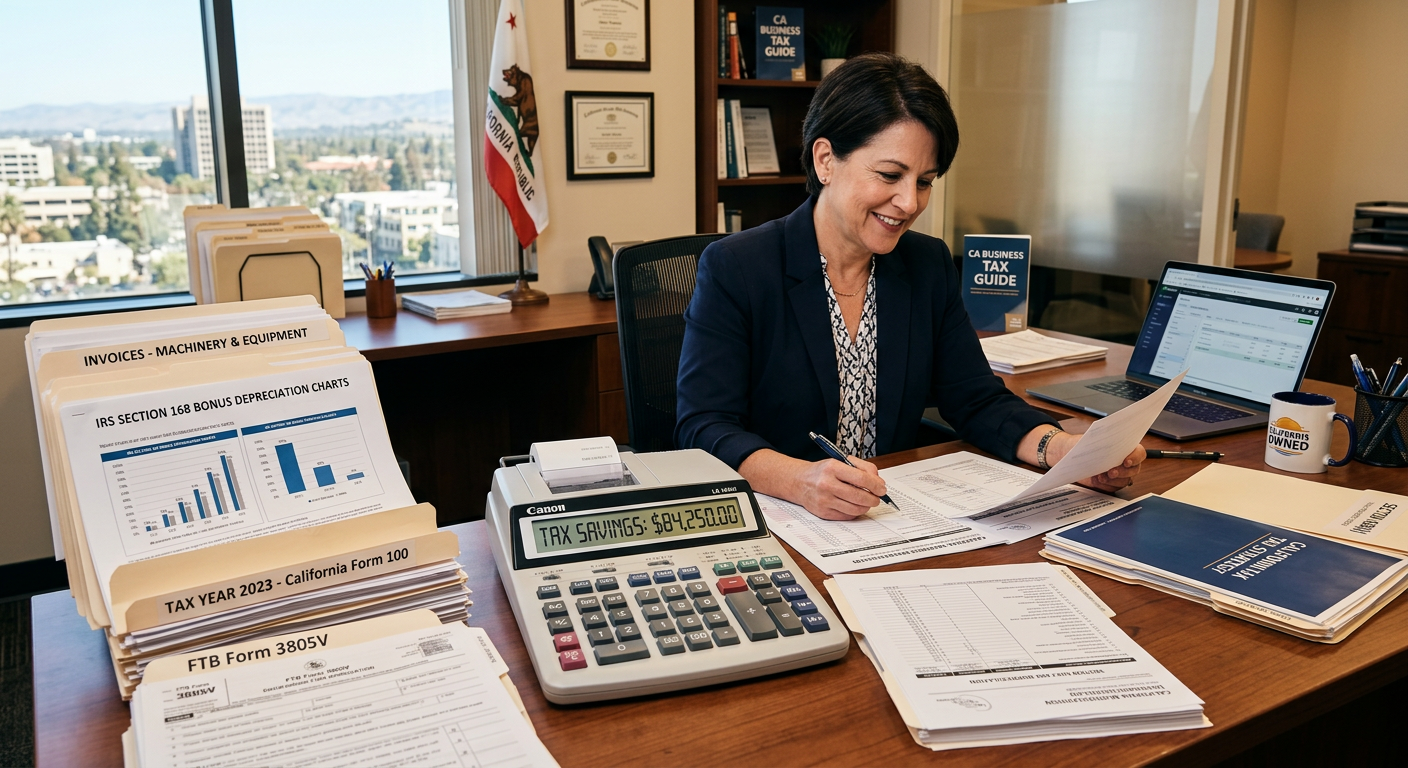
Here is a tax strategy sitting in plain sight inside the IRS tax code that most California business owners are walking past every single year. A landscaping company in Fresno buys $180,000 worth of equipment in 2024. Their accountant depreciates it over five years, creating a modest deduction each year. A competing landscaping company two miles away does the same equipment purchase — and deducts the entire $180,000 in year one. Same equipment. Same state. The difference? One owner understood bonus depreciation example 2024 California planning. The other did not. That gap cost the first owner roughly $28,000 to $34,000 in unnecessary taxes.
This guide breaks down exactly how bonus depreciation works under current federal rules, where California diverges from those rules, and what you need to do right now to capture the maximum deduction before the window gets smaller.
Quick Answer: What Is Bonus Depreciation and What Changed in 2024?
Bonus depreciation is a federal tax provision under IRC Section 168(k) that allows businesses to immediately deduct a large percentage of the cost of qualifying new or used property placed in service during the tax year, instead of spreading that deduction across the asset’s useful life. The concept is straightforward: instead of waiting years to recover the cost of a piece of equipment, you front-load that deduction into year one.
Here is where the numbers stand for 2024: under the phase-down schedule set by the Tax Cuts and Jobs Act of 2017, bonus depreciation dropped to 60% for property placed in service in 2024. That is down from 80% in 2023 and 100% in 2022. The rate continues to decline: 40% in 2025 and 20% in 2026 under current law, unless Congress acts to restore higher rates.
For California business owners specifically, there is a critical layer most advisors gloss over: California does not conform to federal bonus depreciation rules. The state decoupled from Section 168(k) years ago. That means any federal bonus depreciation deduction you claim on your federal return gets added back on your California return. You are operating in two separate depreciation universes simultaneously.
How the Federal 60% Bonus Depreciation Works in 2024
Let’s walk through an actual example so the math is concrete. Say you are a Sacramento-based general contractor. In October 2024, you purchase a $200,000 excavator and place it in service before year-end. Here is what the federal deduction looks like:
- Asset cost: $200,000
- 2024 federal bonus depreciation rate: 60%
- Year-one federal bonus deduction: $120,000
- Remaining depreciable basis: $80,000 (depreciated over MACRS schedule, typically 5 years for equipment)
If your federal effective tax rate is 25%, that $120,000 deduction saves you $30,000 in federal taxes in year one instead of spreading those savings over five or more years. Cash flow improvement is immediate.
New vs. Used Property: What Qualifies
One of the most valuable changes the Tax Cuts and Jobs Act introduced was extending bonus depreciation to used property. Before 2018, you could only use bonus depreciation on new assets. Now, both new and used qualifying property is eligible provided the taxpayer has not previously used the property and it was not acquired from a related party. This opens the strategy to business owners purchasing pre-owned machinery, vehicles, and equipment on the secondary market.
Qualifying property categories include:
- Machinery and equipment (5-year or 7-year MACRS property)
- Vehicles under 6,000 lbs (subject to luxury auto limits)
- Heavy vehicles over 6,000 lbs (trucks, SUVs, vans)
- Computer hardware and software
- Qualified improvement property (interior commercial improvements)
- Certain film, television, and theater productions
Real property like land and buildings does not qualify. Structures themselves are excluded, though certain interior improvements may qualify under the Qualified Improvement Property designation. See IRS Publication 946 for the complete eligibility breakdown.
Many business owners in construction, manufacturing, logistics, and healthcare are sitting on significant equipment purchases that could generate six-figure year-one deductions — but only if their advisor is structured to catch it.
The California Conformity Problem Every Business Owner Must Understand
This is the part where most California business owners get blindsided. California Revenue and Taxation Code Section 24356 does not conform to IRC Section 168(k). When you file your California state return, bonus depreciation does not exist. Your state taxable income is higher than your federal taxable income because the entire bonus depreciation deduction you claimed federally gets added back on your CA Form 100 (corporations) or Schedule CA (individuals).
What California Does Allow Instead
California uses its own modified MACRS depreciation schedule. You still get to depreciate the asset — it just happens over its standard useful life rather than in one accelerated year. For a five-year asset like equipment, that means roughly 20% of the cost is deductible each year on your California return.
This creates a timing difference, not a permanent loss. The deduction still comes through eventually. But the loss of cash-flow acceleration on the California side is real and measurable. For a California business earning $500,000 in net income, the difference between federal and state depreciation treatment can create a $30,000 to $50,000 swing in state taxes in the first year of a major equipment purchase.
Tracking Two Depreciation Schedules Is Not Optional
Because federal and California depreciation differ, your bookkeeping must track two separate depreciation schedules for every asset. If your accountant is not maintaining both, you are either under-deducting on the federal side or creating errors on the California return. The FTB does not forgive these mistakes quietly. They generate notices, trigger back-assessments, and add interest that compounds fast. For a deeper look at California-specific strategies for business owners, the California Business Owner Tax Strategy Hub covers this dual-tracking obligation in detail.
Our tax planning services include dual-track depreciation setup for California businesses, so the federal acceleration is captured without creating a compliance gap on the state return.
Section 179 vs. Bonus Depreciation: Which One Wins in California?
California does conform to Section 179 expensing — but with important limits. For tax year 2024, California’s Section 179 limit is $25,000, compared to the federal limit of $1,160,000. That is not a typo. The state cap is dramatically lower than federal.
Here is how the two compare for a California business:
| Feature | Federal Bonus Depreciation (2024) | CA Section 179 | Federal Section 179 |
|---|---|---|---|
| Deduction Rate | 60% immediate | Up to $25,000 | Up to $1,160,000 |
| CA Conformity? | No | Yes (with state cap) | N/A (federal only) |
| Income Limitation? | No | Yes (phased out above $200,000 CA purchase) | Yes (phased out above $2.89M purchases) |
| Used Property Eligible? | Yes | Yes | Yes |
| Loss Creation? | Yes | No | Yes (limited) |
Practical strategy: For California business owners, the optimal approach is often to maximize federal bonus depreciation for federal tax reduction while separately using the modest California Section 179 allowance on the state side. These are not mutually exclusive — they serve different returns and different purposes. Want to estimate how this plays out for your specific situation? Run your numbers through this small business tax calculator to see your potential deduction impact.
KDA Case Study: Fresno Equipment Company Saves $31,400 in Year One
A Fresno-based agricultural equipment dealer came to KDA in early 2024 after receiving a large tax bill that felt disconnected from what they believed they owed. The owner, a sole proprietor filing as an LLC, had purchased $310,000 in used equipment during 2023 but had not claimed any bonus depreciation. Their prior preparer was unfamiliar with the used-property rule introduced in 2018 and had depreciated everything on a standard five-year schedule.
When KDA reviewed the prior-year return, the opportunity was immediate. The owner qualified for 80% bonus depreciation on the 2023 purchases (still at the 80% rate for that tax year). KDA filed an amended federal return claiming $248,000 in year-one bonus depreciation on the qualifying used equipment. At a combined federal effective rate of approximately 26%, that generated $64,480 in additional federal deductions translating to roughly $16,765 in federal tax savings from the amended return alone.
For the 2024 tax year, KDA implemented a forward-looking strategy: timing additional equipment purchases before December 31st to capture the 60% federal rate, setting up a dual-track depreciation schedule to properly manage California non-conformity, and applying California’s $25,000 Section 179 limit on the state side. The combined approach reduced federal tax liability by $31,400 in year one. The California state tax bill remained higher due to non-conformity, but the federal savings more than offset it — and the state timing difference will even out over the depreciation period.
The owner’s total investment in KDA’s tax planning was $4,800. The first-year return was 6.5x. The amended return alone covered the fee three times over.
Ready to see how we can help you? Explore more success stories on our case studies page to discover proven strategies that have saved our clients thousands in taxes.
Common Mistake: Waiting Until After Year-End to Plan Depreciation
The single most expensive mistake California business owners make with depreciation is treating it as a tax return exercise rather than a tax planning exercise. Bonus depreciation only applies to property placed in service during the tax year. If your equipment is delivered on January 3rd instead of December 28th, you lose an entire year of the current rate and land in the next lower rate tier.
For 2024, that meant the difference between 60% and nothing. For 2025, the rate drops to 40%. Every year you delay a qualifying purchase past December 31st costs real money.
The “Placed in Service” Rule Is Not Just Delivery
The IRS defines “placed in service” as the point at which the asset is in a condition or state of readiness and availability for its specifically assigned function. An asset sitting in a warehouse, still being assembled, or waiting for installation does not count. It must be operational and ready to use. This distinction has been litigated, and the IRS has won cases where taxpayers claimed bonus depreciation on equipment that was delivered but not yet functional.
Documentation matters: keep delivery records, installation invoices, and a dated note or photo showing when the asset became operational. The FTB in California is particularly aggressive in auditing depreciation claims on amended returns — having a paper trail is non-negotiable.
The Luxury Auto Limitation Still Applies
If you are planning to use bonus depreciation on a vehicle, the luxury auto caps under IRC Section 179(b) apply. For 2024, passenger vehicles are subject to annual depreciation limits regardless of bonus depreciation elections. However, SUVs, trucks, and vans with a gross vehicle weight rating (GVWR) over 6,000 lbs are treated as equipment and not subject to the passenger vehicle caps. This is why many business owners purchase heavy SUVs rather than standard passenger vehicles — it bypasses the luxury limitation and allows significantly higher first-year deductions.
The Phase-Down Schedule: Why 2024 Still Matters
The current phase-down schedule under federal law looks like this:
- 2022: 100% bonus depreciation
- 2023: 80%
- 2024: 60%
- 2025: 40%
- 2026: 20%
- 2027 and beyond: 0% (under current law)
There is ongoing legislative conversation about restoring 100% bonus depreciation retroactively, and some proposed legislation has included provisions to do so. But as of filing deadlines for 2024 tax years, the rate is 60%. Counting on Congress to save you is not a strategy. Filing correctly with current law is.
If you purchased equipment in 2024 and have not yet filed your 2024 return, this is your window. If your return is already filed and you did not claim bonus depreciation, an amended return may be possible. The rules around elections and amendments are narrow, but the opportunity is worth reviewing with a qualified tax professional before the window closes.
How to Elect Bonus Depreciation: The Mechanics
Claiming bonus depreciation is done on IRS Form 4562, Depreciation and Amortization. Here is the step-by-step process for a business owner filing Schedule C or a corporate return:
- List the asset – Enter the date placed in service, description, cost basis, and MACRS class life in Part II or Part III of Form 4562
- Apply the special depreciation allowance – In Part II, Line 14, calculate your bonus depreciation (cost x 60% for 2024)
- Calculate remaining basis – Subtract the bonus amount from total cost to determine the remaining depreciable balance for MACRS purposes
- Carry to your Schedule C or 1120S – Total depreciation flows to Line 13 on Schedule C or directly to the income section of your corporate return
- Prepare California adjustment – On Schedule CA (540) or CA Form 100, add back the federal bonus depreciation amount and substitute California-allowable depreciation using standard MACRS
If you want to opt out of bonus depreciation for a specific asset class, the election must be made on a timely filed return. You cannot selectively opt out for individual assets — the election applies to the entire MACRS class. Opt-outs are sometimes strategic: if a business has net operating losses already, taking large bonus depreciation deductions may not help in the current year and could complicate carryforward calculations.
Ready to Reduce Your Tax Bill?
KDA Inc. specializes in strategic tax planning for business owners, S Corps, LLCs, and high-net-worth individuals. Book a personalized consultation and walk away with a clear plan.
Frequently Asked Questions About Bonus Depreciation in California
Can I use bonus depreciation if my business has a net loss?
Yes, at the federal level. Bonus depreciation is not subject to an income limitation and can create or increase a net operating loss (NOL). That NOL can then be carried forward to offset income in future profitable years. California, however, has its own NOL rules and currently limits the use of California NOL deductions in certain high-income situations. The federal NOL and California NOL must be tracked separately.
Does bonus depreciation affect my QBI deduction?
Yes, it can. The Qualified Business Income (QBI) deduction under Section 199A is calculated as 20% of qualified business income. If large bonus depreciation deductions reduce your QBI significantly, your Section 199A deduction shrinks accordingly. For businesses already near the QBI threshold or subject to the W-2 wage limitation, this interplay needs to be modeled before you pull the trigger on a major bonus depreciation election.
What if I bought the equipment on a loan or lease?
Bonus depreciation is based on the asset’s full cost, not the amount you paid out of pocket. If you financed $200,000 worth of equipment with a $50,000 down payment and a $150,000 loan, the full $200,000 is depreciable in year one (at 60%, that is $120,000). The financing arrangement does not affect the deduction. Operating leases, however, do not qualify — you must own the asset, not rent it.
Can an S Corp take bonus depreciation?
Yes. S Corps file their own tax return (Form 1120-S) and claim depreciation at the entity level. The deduction then flows through to each shareholder’s Schedule K-1 in proportion to their ownership. Shareholders use that number on their individual returns. California S Corps face the same non-conformity issue on the California 100S return as any other entity. The dual-track depreciation schedule is essential for every California S Corp with significant equipment.
What This Means for Your 2024 Return Right Now
If you are still within filing season for your 2024 return and you have not had a depreciation review performed, the clock is running. Every qualifying asset purchased and placed in service before December 31, 2024 is eligible for the 60% federal rate. A $100,000 equipment purchase means a $60,000 federal deduction. At a 28% effective tax rate, that is $16,800 staying in your business instead of going to the IRS.
For California, you will still pay state taxes on that income in year one — but the federal savings are real, immediate, and significant. The state deductions come in over the following years as the asset’s remaining basis runs through the MACRS schedule.
This information is current as of March 4, 2026. Tax laws change frequently. Verify updates with the IRS or FTB if reading this later.
Key Takeaway: California business owners buying equipment in 2024 can claim 60% federal bonus depreciation in year one, but must add that amount back on their California state return and depreciate normally under state MACRS — requiring two separate tracking schedules and careful planning to avoid errors and maximize combined savings.
“The IRS built the bonus depreciation phase-down into law. The only question is whether your business is using what’s still available — or leaving it on the table while the window closes.”
Stop Leaving Depreciation Money on the Table
If you purchased equipment in 2024 and your tax return does not reflect a bonus depreciation analysis, there is a real probability you overpaid federal taxes this year. A qualified review takes less than a week. The savings can be immediate, either on a current return or through an amendment. Book a personalized consultation with the KDA strategy team and we will walk through your asset list, identify every qualifying purchase, run both the federal and California scenarios, and tell you exactly what you left on the table and how to fix it. Click here to book your consultation now.


