
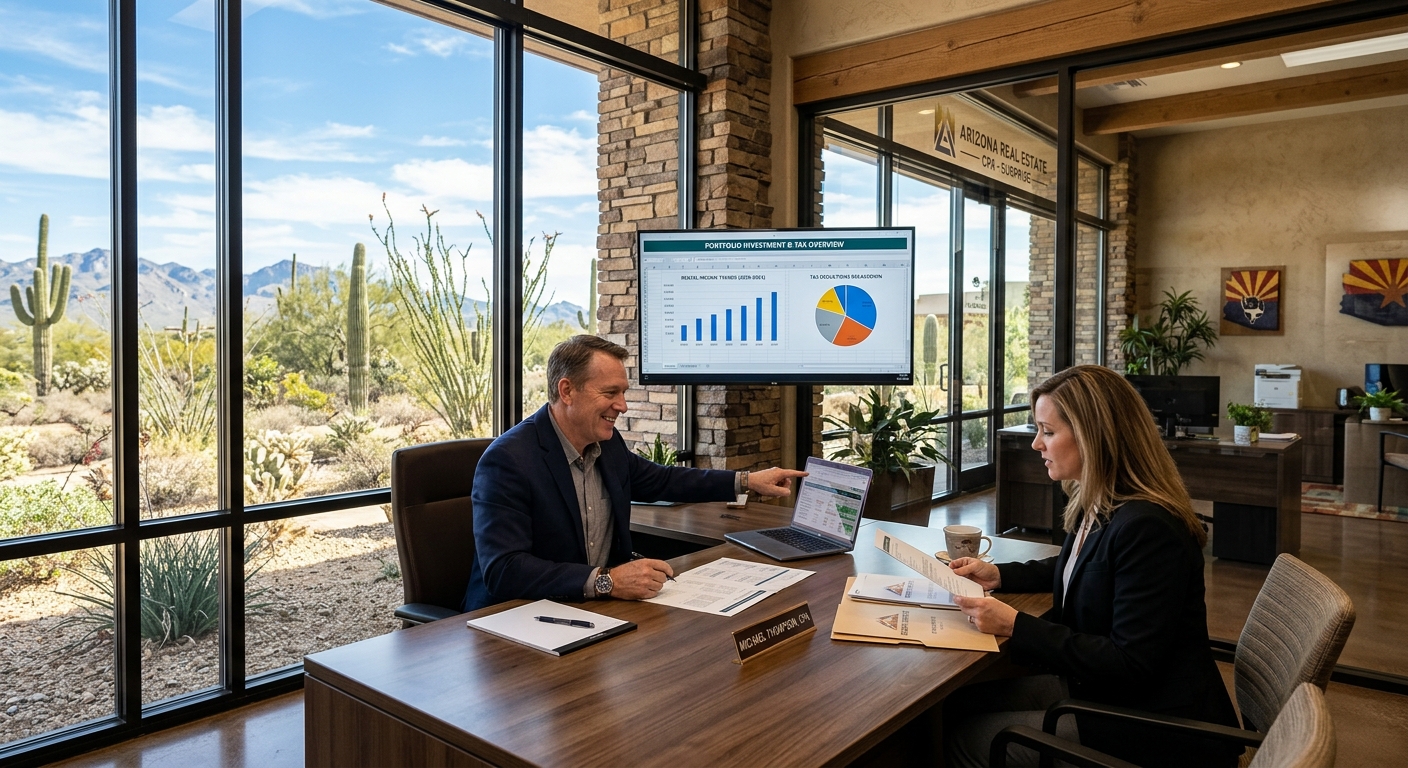
If you own rental properties in Surprise, Arizona, or you’re thinking about jumping into the Maricopa County real estate market, there’s one decision that will shape your tax bill more than almost anything else: the CPA you choose. Finding the best real estate CPA in Surprise, Arizona is not just about getting your return filed on time. It’s about keeping more of your rental income, claiming every deduction the IRS allows, and building a tax strategy that actually matches the way Arizona property investing works. If you’re looking for professional tax services in Surprise, this guide will walk you through everything you need to know before hiring someone to handle your real estate taxes.
Surprise has become one of the fastest-growing cities in the Phoenix metro area. That growth is driving property values up, which is great for equity but creates real complexity at tax time. Whether you hold a single rental condo, a portfolio of fix-and-flips, or commercial property along Bell Road or Grand Avenue, the tax rules are layered and unforgiving if you get them wrong.
This information is current as of 5/31/2026. Tax laws change frequently. Verify updates with the IRS or FTB if reading this later.
Quick Answer
The best real estate CPA in Surprise, Arizona, is one who understands Schedule E reporting, depreciation recapture, 1031 exchanges, and the specific Arizona property tax landscape. A generalist who files W-2 returns all day is not equipped to handle the multi-layered complexity of investment property taxation. You need a specialist, and this guide will show you exactly how to find one.
Why Surprise, Arizona Real Estate Investors Need a Specialized CPA
Most CPAs can handle a standard 1040. That’s not what real estate investors need. When you own property in Surprise, you’re dealing with a set of tax rules that overlap at the federal, state, and local level. Getting any one of them wrong can cost you thousands.
Here’s what makes real estate taxes in Surprise different from a typical individual return:
- Depreciation schedules that span 27.5 years for residential and 39 years for commercial property
- Passive activity loss rules under IRC Section 469 that can trap your deductions if your income is too high
- Arizona’s unique property tax structure, where primary and secondary assessed values create different tax obligations
- 1031 exchange timelines that require precise identification within 45 days and closing within 180 days
- Cost segregation studies that can accelerate tens of thousands of dollars in depreciation into the first year
A general practitioner might know these terms exist. A real estate-focused CPA knows how to layer them together so they work in your favor. The difference between a good CPA and a great one is often $5,000 to $15,000 per year in tax savings on a single rental property.
What Arizona’s Tax Structure Means for Real Estate
Arizona does not have a state-level property tax. Instead, property taxes are levied at the county and municipal level. In Maricopa County, where Surprise sits, the average effective property tax rate hovers around 0.55% to 0.65% of assessed value. That might sound low compared to states like New Jersey or Illinois, but the devil is in how those assessments are calculated.
Arizona uses two assessed values for every property: the full cash value (used for secondary taxes like bonds and overrides) and the limited property value (used for primary taxes). Your CPA needs to understand both, because the way they interact affects your total tax burden and your ability to appeal assessments that are too high.
On the income tax side, Arizona’s flat income tax rate of 2.5% applies to rental income after federal deductions flow through. That means every deduction you take on your federal Schedule E directly reduces your Arizona tax liability as well. A real estate CPA who understands this two-layer benefit can stack your savings at both levels.
KDA Case Study: Surprise Rental Investor Recovers $11,400 in Missed Deductions
A Surprise-based property investor came to KDA with three single-family rentals in the West Valley. He had been using a national tax chain for four years. His returns looked clean on the surface, but a deeper review told a different story. His previous preparer had been using straight-line depreciation without considering a cost segregation study, had missed the home office deduction for his property management activities, and had failed to deduct travel expenses between properties.
KDA’s real estate tax preparation team conducted a full review of all three properties. We reclassified components like appliances, flooring, and landscaping into shorter depreciation categories using a cost segregation approach. We documented his home office, which he used exclusively for tenant communications and bookkeeping. And we captured mileage deductions for the 2,400 miles he drove between his Surprise home and his properties in Goodyear and Buckeye.
The result: $11,400 in additional deductions in the first year. At his combined federal and Arizona tax rate of roughly 26%, that translated to approximately $2,964 in real tax savings. His investment in KDA’s services was $1,800, giving him a 1.6x return in year one alone, with the depreciation reclassification continuing to produce savings for years to come.
Ready to see how we can help you? Explore more success stories on our case studies page to discover proven strategies that have saved our clients thousands in taxes.
7 Deductions Every Surprise Real Estate Investor Should Claim
If you’re searching for the best real estate CPA in Surprise, Arizona, one of the quickest ways to evaluate a candidate is to ask them about these seven deductions. If they can’t explain each one clearly and tell you whether it applies to your situation, keep looking.
1. Depreciation (Including Cost Segregation)
The IRS allows you to depreciate the structure of a residential rental property over 27.5 years (see IRS Publication 946). But certain components, such as appliances, cabinetry, flooring, and landscaping, can be depreciated over 5, 7, or 15 years using a cost segregation study. On a $400,000 Surprise rental property, this can move $60,000 to $100,000 of depreciation into the first few years of ownership.
2. Mortgage Interest
Interest paid on loans used to acquire or improve rental properties is fully deductible on Schedule E. This is separate from the mortgage interest deduction on your personal residence. For a Surprise investor with a $320,000 mortgage at 6.5%, that’s roughly $20,800 in deductible interest in the first year. If you want to see how your own mortgage numbers break down, run them through this mortgage interest calculator.
3. Property Management Expenses
Whether you use a management company or self-manage, the associated costs are deductible. Management fees typically run 8% to 10% of gross rent in the Surprise market. If you self-manage, you can deduct your home office, phone use, and mileage.
4. Repairs and Maintenance
Routine repairs like fixing a leaky faucet, repainting a unit, or replacing a broken window are deductible in the year they occur. Capital improvements, like a new roof or HVAC system, must be depreciated. A sharp CPA knows the difference and will classify each expense correctly so you get the fastest tax benefit.
5. Travel Between Properties
If you drive between your home and your rental properties, or travel to inspect properties you’re considering purchasing, that mileage is deductible. For 2026, the IRS standard mileage rate is $0.70 per mile for business use. An investor who drives 5,000 miles per year between Surprise and properties across the West Valley picks up $3,500 in deductions.
6. Professional Fees
Fees paid to your CPA, real estate attorney, property inspector, and even your bookkeeper are deductible as ordinary business expenses. If you’re paying $2,000 per year for a CPA and $500 for legal consultations, that’s $2,500 in deductions you might be missing if you’re not tracking them.
7. Insurance Premiums
Landlord insurance, umbrella policies, and flood insurance (if applicable) are all deductible. In Surprise, where monsoon season can bring unexpected water damage, carrying the right insurance is both a financial protection and a tax benefit.
Key Takeaway: A real estate CPA who understands all seven of these deductions can save you $8,000 to $20,000 per year depending on the size and number of your Surprise properties.
How to Evaluate the Best Real Estate CPA in Surprise, Arizona
Not every CPA who says they handle real estate actually specializes in it. Here’s a framework for evaluating candidates so you don’t end up with a generalist who learns on your dime.
Questions to Ask Before Hiring
| Question | What a Good Answer Looks Like | Red Flag Response |
|---|---|---|
| How many real estate clients do you serve? | “30% or more of my practice is real estate investors” | “We handle all kinds of returns” |
| Do you handle cost segregation? | “Yes, we coordinate studies and integrate them into your depreciation schedule” | “What’s cost segregation?” |
| Have you filed a 1031 exchange? | “Yes, multiple times, and I work with qualified intermediaries” | “I think I did one a few years ago” |
| Do you handle Arizona-specific property tax issues? | “Absolutely. I understand primary vs. secondary assessed values” | “I mostly focus on federal returns” |
| Can you help with passive loss limitations? | “Yes. We look at material participation and REPS status to unlock losses” | “Those losses just carry forward” |
Real Estate Professional Status (REPS)
This is one of the most powerful, and most misunderstood, tax strategies for property investors. Under IRC Section 469, rental activities are generally treated as passive. That means your losses are limited to $25,000 per year if your adjusted gross income is under $100,000, and the deduction phases out completely at $150,000 AGI.
But if you qualify as a Real Estate Professional, those passive activity limitations disappear. You can deduct unlimited rental losses against your other income, including W-2 wages, business income, and capital gains.
To qualify, you must spend more than 750 hours per year in real property trades or businesses, and more than half of your total working hours must be in real estate activities. A CPA who understands REPS can help you document your hours, structure your activities, and defend your status if the IRS ever asks questions.
For Surprise investors who are full-time landlords or who have spouses managing the properties, this can be a game-changer worth $10,000 or more per year.
1031 Exchanges: What Surprise Investors Need to Know
The 1031 exchange is one of the most powerful tools in real estate tax planning. It allows you to defer capital gains tax when you sell an investment property and reinvest the proceeds into a like-kind property. In a market like Surprise, where properties that sold for $250,000 five years ago might now be worth $400,000 or more, the capital gains on a sale can be substantial.
Here’s a quick breakdown of the numbers:
| Scenario | Without 1031 Exchange | With 1031 Exchange |
|---|---|---|
| Sale Price | $400,000 | $400,000 |
| Original Purchase Price | $250,000 | $250,000 |
| Capital Gain | $150,000 | $150,000 |
| Federal Capital Gains Tax (20%) | $30,000 | $0 (deferred) |
| Arizona Income Tax (2.5%) | $3,750 | $0 (deferred) |
| Net Investment Income Tax (3.8%) | $5,700 | $0 (deferred) |
| Total Tax Saved | N/A | $39,450 |
That’s nearly $40,000 in tax kept in your pocket and reinvested into your next property. But the rules are strict. You must identify the replacement property within 45 days and close within 180 days. You must use a qualified intermediary to hold the funds. And the exchange must be structured correctly from day one, which is why your CPA needs to be involved before you list the property, not after.
Our Surprise, Arizona tax team works with investors on 1031 exchanges from start to finish, coordinating with your real estate agent, title company, and qualified intermediary to make sure every deadline is met and every dollar is protected.
Common Tax Mistakes Surprise Property Investors Make
After working with hundreds of real estate investors, we see the same mistakes come up again and again. Any CPA claiming to be the best real estate CPA in Surprise, Arizona, should be catching these before they cost you money.
Mistake 1: Mixing Personal and Rental Expenses
If you use a property for personal purposes and as a rental, the IRS applies strict allocation rules under Section 280A. Using your Surprise vacation rental for two weeks of personal use can trigger limitations on your deduction. A competent CPA will help you track usage days and allocate expenses correctly.
Mistake 2: Ignoring Depreciation Recapture
When you sell a rental property, the IRS recaptures the depreciation you’ve taken (or should have taken) and taxes it at a flat 25% rate. Many investors are surprised by this when they sell. A proactive CPA plans for recapture from the start and may recommend strategies like a 1031 exchange to defer it.
Mistake 3: Not Tracking Capital Improvements Separately
A $12,000 kitchen renovation is not the same as a $200 faucet repair. Improvements must be capitalized and depreciated. Repairs can be deducted immediately. Misclassifying these creates risk. The IRS tangible property regulations (see IRS Tangible Property Regulations) provide the framework, but applying them correctly to your Surprise rental requires experience.
Mistake 4: Failing to Document Home Office for Self-Managing Landlords
If you manage your Surprise rentals from a home office, you may qualify for the home office deduction under IRC Section 280A(c)(1). But you need a dedicated space used exclusively and regularly for your rental business. Many self-managing landlords skip this because they assume it’s only for traditional businesses.
Mistake 5: Not Planning for Arizona’s Transaction Privilege Tax
Arizona imposes a Transaction Privilege Tax (TPT) on certain rental activities, particularly short-term rentals. In Surprise, short-term rental operators may owe TPT at the city and state level. A CPA unfamiliar with Arizona’s TPT structure might miss this entirely, leaving you exposed to back taxes and penalties.
Should You Choose a Local Surprise CPA or a National Firm?
This is a question that comes up constantly. The answer depends on what you value more: local presence or specialized expertise.
Local vs. National: A Comparison
| Factor | Local Surprise CPA | National Firm with AZ Expertise |
|---|---|---|
| Knowledge of Surprise market | Strong | Moderate to Strong |
| Real estate specialization | Varies widely | Often more specialized |
| Arizona TPT knowledge | Usually strong | Depends on team |
| Cost segregation capability | Often outsourced | Often in-house |
| 1031 exchange coordination | Depends on experience | Usually well-established |
| Availability for year-round planning | Varies | Typically yes |
| Price range | $500-$2,500/year | $1,500-$5,000/year |
The best choice is a CPA who combines deep real estate tax knowledge with familiarity in Arizona’s unique tax landscape. Whether they sit in an office on Dysart Road or work remotely from their Phoenix headquarters matters less than their track record with real estate investors.
Arizona vs. Other States: Why Real Estate Tax Strategy Differs Here
Arizona’s tax environment creates both advantages and quirks for real estate investors that CPAs from other states might not anticipate.
Advantage: Low flat income tax rate. Arizona’s 2.5% flat tax rate means your state tax burden on rental income is lower than in California (up to 13.3%), New York (up to 10.9%), or Oregon (up to 9.9%). This makes Arizona rental properties more profitable on an after-tax basis.
Advantage: No state estate tax. Arizona does not impose a state-level estate tax. For investors building a real estate portfolio for generational wealth, this is a significant planning advantage.
Quirk: Transaction Privilege Tax on rentals. Unlike most states that impose a sales tax, Arizona uses the TPT system. Short-term rental operators in Surprise must collect and remit TPT, which functions like a sales tax but is technically paid by the business, not the customer. For 2026, the combined state and local TPT rate for short-term rentals in Surprise is approximately 12.57%.
Quirk: Dual assessment values. As mentioned earlier, the primary and secondary assessed value system in Arizona can create confusion for investors trying to appeal their property tax bills or estimate their carrying costs.
Key Takeaway: A CPA who only knows federal real estate tax rules will miss at least two or three Arizona-specific issues that could cost you $2,000 to $5,000 per year.
Step-by-Step: How to Hire the Best Real Estate CPA in Surprise, Arizona
- Define your needs clearly – Are you a single-property landlord, a fix-and-flip operator, or a portfolio investor? Your CPA needs to match your complexity level.
- Ask for real estate client references – A CPA confident in their real estate expertise will gladly connect you with current clients who invest in properties similar to yours.
- Request a sample engagement letter – This document should clearly outline what services are included, what’s extra, and what the CPA’s responsibilities are versus yours.
- Verify credentials – Confirm they’re a licensed CPA in Arizona. Check with the Arizona State Board of Accountancy to verify their status.
- Test their knowledge – Use the evaluation table above. Ask about cost segregation, 1031 exchanges, passive activity rules, and Arizona TPT. Their answers will tell you everything.
- Discuss year-round availability – Tax planning is not a once-a-year event. Your CPA should be available for mid-year check-ins, especially before you buy or sell property.
- Compare pricing transparently – Don’t choose the cheapest option. A CPA who charges $2,000 but saves you $12,000 is a far better investment than one who charges $500 and misses $8,000 in deductions.
Ready to Reduce Your Tax Bill?
KDA Inc. specializes in strategic tax planning for business owners, S Corps, LLCs, and high-net-worth individuals. Book a personalized consultation and walk away with a clear plan.
Frequently Asked Questions
Do I need a CPA if I only own one rental property in Surprise?
Yes. Even a single rental property involves depreciation calculations, Schedule E reporting, and potential passive loss limitations. The complexity is not about the number of properties. It’s about getting the tax treatment right on each one.
Can my CPA help with short-term rental taxes in Surprise?
A qualified real estate CPA should absolutely help with this. Short-term rentals in Surprise trigger Arizona TPT obligations, potential self-employment tax issues, and different depreciation rules depending on average rental period. This is an area where generalist CPAs frequently make mistakes.
How much does a real estate CPA in Surprise typically charge?
Expect to pay between $1,000 and $3,500 per year for a CPA who handles your real estate returns, depending on the number of properties and complexity. For investors with 1031 exchanges or cost segregation studies, fees may be higher but the tax savings typically outweigh the cost by a factor of 3x to 5x.
What’s the difference between a CPA and a tax preparer for real estate?
A CPA is a licensed professional who has passed the Uniform CPA Exam and meets continuing education requirements. A tax preparer may have limited training and no licensing requirement in many states. For real estate investors, the distinction matters because CPAs can represent you before the IRS in an audit, provide strategic tax planning, and sign off on complex returns with professional liability.
Should I form an LLC for my Surprise rental properties?
That depends on your liability exposure, number of properties, and income level. An LLC provides liability protection but does not change your federal tax treatment unless you elect S Corp status. A real estate CPA can help you evaluate whether an LLC, S Corp, or holding company structure makes sense for your portfolio. Learn more about entity formation options.
Can I deduct losses on my Surprise rental if I have a high income?
If your AGI exceeds $150,000, the $25,000 passive loss allowance is fully phased out unless you qualify as a Real Estate Professional. REPS status removes the passive activity limitations entirely. Your CPA should be evaluating your eligibility for this status every year.
Why Smart Surprise Investors Work with KDA
Finding the best real estate CPA in Surprise, Arizona, means finding a team that goes beyond filing returns. At KDA, we specialize in building complete tax strategies for real estate investors across Arizona. From cost segregation and 1031 exchanges to entity structuring and passive loss optimization, we handle the full spectrum of real estate tax planning.
Our clients don’t just file. They plan ahead, reduce their tax liability year over year, and build portfolios with tax efficiency baked in from the start. Ready to work with a tax professional who understands Surprise property investors? Explore our Surprise, Arizona tax services or book a consultation below.
Book Your Real Estate Tax Strategy Session
If you’re a Surprise, Arizona property investor wondering whether you’re leaving money on the table with your current CPA, let’s find out. Book a personalized consultation with KDA’s real estate tax team and get a clear plan for cutting your tax bill, protecting your deductions, and building wealth through smarter property investing. Click here to book your consultation now.



