
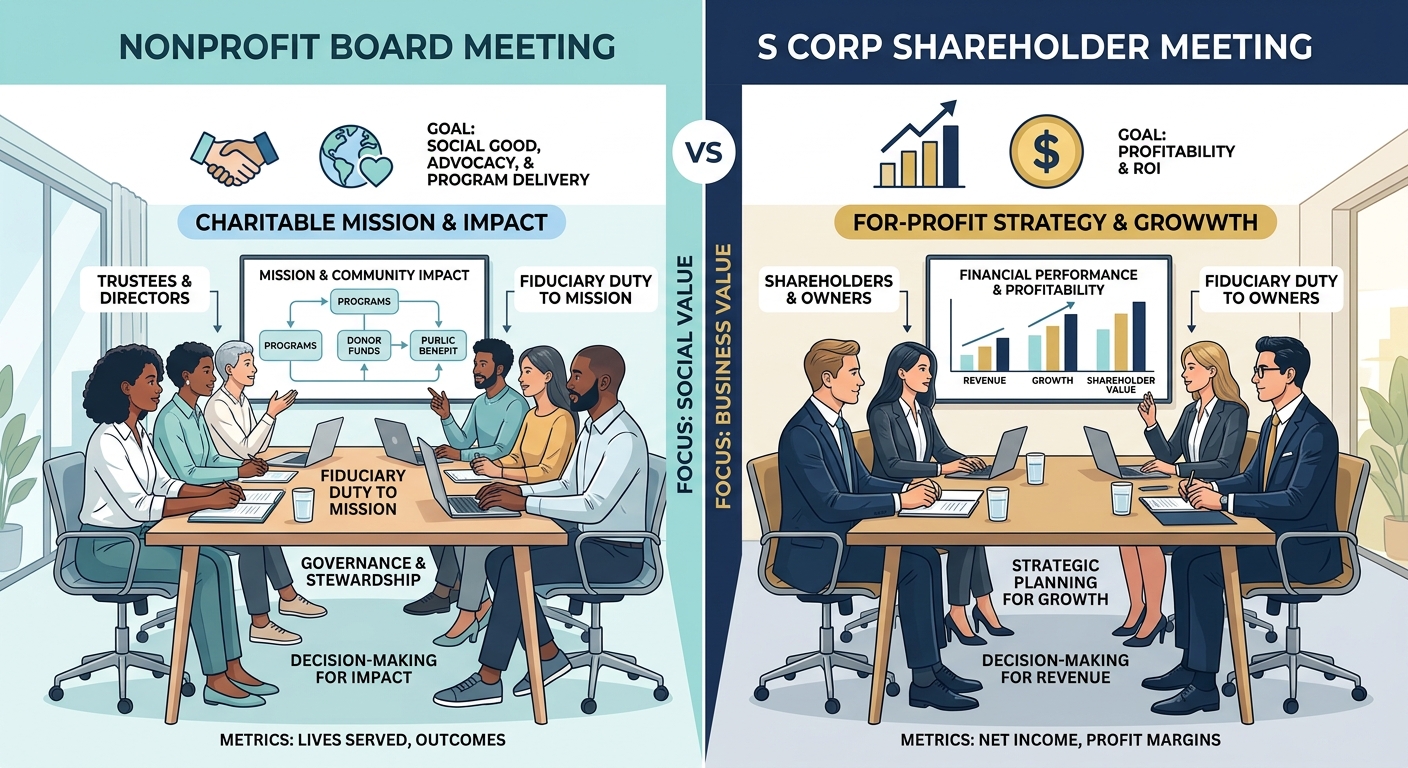
Many founders assume that once they file nonprofit articles with their state, they are dealing with a special category that sits outside the usual corporate tax rules. That assumption is exactly why so many new charities burn time and money trying to answer a basic but critical question: are non-profit corporations c corp’orations or s corp’orations for federal tax purposes?
Quick Answer
A nonprofit corporation is almost always treated as a C corporation by default under federal tax law, but it can seek exemption from income tax under section 501 of the Internal Revenue Code. It cannot elect S corporation status because S corps must be for profit, have shareholders, and meet strict eligibility rules described in IRS guidance. So the real choice for a nonprofit is not C versus S, but taxable C corporation versus tax exempt 501(c) organization.
How Entity Labels Actually Work For Nonprofits
To understand where nonprofits fit, you have to separate three layers that are often blended together in conversation but never in the Internal Revenue Code:
- State law entity type
- Federal tax classification
- Tax exemption status
At the state level, you can form a nonprofit corporation by filing articles that say the entity has no owners and that any surplus must be used for its mission, not distributed as profits. From the IRS point of view, that entity starts life as a regular corporation, the same broad bucket that includes for profit C corporations.
That is why, technically, most nonprofits line up with C corporation treatment, not S corporation treatment. The S election, made on Form 2553, is available only to certain small, domestic, for profit corporations with a limited number of allowed shareholders. A nonprofit has no shareholders at all, so it fails the first requirement before the conversation even begins.
Why Nonprofits Cannot Be S Corporations
Because the question are non-profit corporations c corp’orations or s corp’orations comes up so often, it is worth walking through the S corporation rules in plain English. According to IRS Form 2553 instructions, an S corporation must:
- Be a domestic corporation
- Have only allowable shareholders, such as individuals, certain trusts, and estates
- Have no more than 100 shareholders
- Have only one class of stock
- Not be an ineligible corporation, such as certain financial institutions and insurance companies
A nonprofit fails these tests in several ways. There are no shareholders. There is no stock, so there cannot be a single class of stock. There is no ownership interest to pass through profits or losses. Instead, a nonprofit has members or simply a board of directors that stewards the mission. That structure is deliberately designed so that no one “owns” the organization or can take out profits, which is the opposite of what S corporation rules assume.
When you read IRS Publication 557, which governs tax exempt status, you will see that exempt organizations are discussed separately from S corporations. Publication 557 focuses on whether the entity serves a qualifying purpose, whether earnings benefit insiders, and how assets are distributed if the organization dissolves. None of that language assumes an S corporation style pass through to individual owners.
What Being C Corporation by Default Really Means For Nonprofits
If nonprofits cannot be S corporations, are they stuck paying corporate income tax like any other C corporation? The answer depends on whether they obtain and maintain tax exempt recognition.
By default, a newly formed nonprofit corporation will be viewed as a taxable C corporation until it files the appropriate exemption application, usually Form 1023 or Form 1023 EZ for 501(c)(3) charities, or Form 1024 for other types of exempt entities. Once the IRS approves that application, the organization is generally exempt from federal income tax on its related program revenue. That is a very different destination than an S corporation, even though both began as general corporations under state law.
However, exemption does not mean the IRS stops caring. Nonprofits still file annual information returns, such as Form 990, 990 EZ, or 990 N, and they must track something called unrelated business taxable income. Income from a side activity that is not substantially related to the exempt purpose can be taxed, usually on Form 990 T, using rules that mirror C corporation taxation. This is where the underlying C corporation framework shows up in practice.
For a founder used to LLCs and S corps, the key takeaway is this. Your nonprofit is either:
- A taxable C corporation that happens to have nonprofit language in its articles, because you never filed for exemption; or
- A tax exempt corporation under section 501 that is largely outside the C versus S conversation, except for narrow pockets of taxable income.
KDA Case Study: High Income W 2 Professional Launches a Charitable Nonprofit
Consider Maria, a California physician earning $480,000 per year as a W 2 employee at a large hospital. She wants to start a scholarship fund for first generation medical students. Her first instinct is to ask whether the scholarship entity should be set up as an S corporation to avoid what she has heard described as double taxation on C corporations.
We walked Maria through the same framework this article uses. We clarified that her scholarship organization needed to be a nonprofit corporation under California law, which has no owners and cannot distribute profits, so the S corporation option was off the table. Instead, the real decision was whether to operate as a taxable C corporation or apply for 501(c)(3) status.
KDA helped her form a California nonprofit corporation, adopt a conflict of interest policy, and file Form 1023 EZ to request recognition as a public charity under section 501(c)(3). We also designed a simple contribution plan tied to her income. In year one, Maria donated $50,000 in cash and another $30,000 in appreciated stock. With proper documentation and planning around Adjusted Gross Income limits described in IRS Publication 526, she claimed $72,000 in charitable deductions against her personal return without triggering alternative minimum tax issues. That reduced her federal and California tax bill by roughly $30,000 for that year.
Because her nonprofit was recognized as tax exempt, the $80,000 collected and invested inside the organization faced no federal income tax. Assuming a conservative 5 percent annual return, that meant another $4,000 growing each year for scholarships instead of being lost to tax. Maria’s total out of pocket for legal and tax work through KDA was under $6,000 in the first year, so the after tax benefit and mission impact were both strong. Ready to see how we can help you? Explore more success stories on our case studies page to discover proven strategies that have saved our clients thousands in taxes.
How This Question Affects Real Taxpayers
Although the phrase are non-profit corporations c corp’orations or s corp’orations sounds like a technical detail, it translates to very practical planning decisions for different taxpayer groups.
W 2 Employees Who Want to Give Strategically
High income W 2 earners often wonder if they should create entities around their charitable giving. The answer is rarely about S corporation elections. Instead, it is about whether a standalone nonprofit or a donor advised fund makes more sense, and how those vehicles interact with their current tax bracket and itemized deduction profile.
For someone in a 35 percent federal bracket with California tax on top, shifting $30,000 of annual giving into a structure that is properly recognized as a 501(c)(3) can reduce combined tax by $12,000 or more, depending on the year’s income and deduction limits. Understanding that the nonprofit itself operates on a C corporation chassis keeps expectations realistic about compliance and reporting.
1099 Contractors and Business Owners
Self employed professionals sometimes try to blend business and charity by running a “nonprofit arm” through their S corporation or LLC. That is usually a mistake. Mixing exempt purpose activity with for profit operations in a single S corporation can create messy audit questions and jeopardize the S election if ownership and purpose rules are not respected.
A cleaner approach is to treat the operating business as what it is, then have that S corporation or LLC make contributions to a separate nonprofit corporation that pursues the charitable program. The nonprofit lives in the C corporation world for structural purposes, but its exemption application and annual Form 990 filings show the IRS that it is not a profit distribution vehicle.
If your primary income is 1099 based, working with advisors who understand both sides of this line is critical. Firms that regularly support self employed professionals can help you time contributions, coordinate entity level and personal deductions, and avoid structures that confuse the IRS.
How C Corporation Rules Show Up Inside Nonprofits
Even when a nonprofit is fully exempt, aspects of the C corporation regime still matter. A few examples:
- Unrelated business taxable income is taxed using C corporation rates and rules
- Some excise taxes, such as those on certain investment income, follow corporate frameworks
- State franchise or minimum taxes may apply based on corporate status, even if federal income tax does not
In California, for instance, a nonprofit corporation recognized as tax exempt by the Franchise Tax Board can still be subject to state filing fees and reporting. Details shift over time, so this information is current as of 5/28/2026. Always verify with the IRS or your state authority if you are reading this later.
Because the underlying bucket is still “corporation,” the IRS expects nonprofit boards to maintain minutes, document major decisions, and avoid private inurement, which is the technical term for insiders siphoning off value. When the Service challenges a nonprofit, it will often look at these same structural features you would see in a C corporation exam.
What the IRS Watches Closely With Nonprofits
Understanding that the federal system sees your nonprofit as a specialized kind of corporation also helps you predict IRS hot buttons.
Private Benefit and Insider Deals
In a for profit C or S corporation, paying an owner a high salary may be unwise, but it is not inherently forbidden. In a nonprofit, excessive compensation or sweetheart contracts with board members can jeopardize exemption entirely. Section 4958 imposes excise taxes on “excess benefit transactions,” which can be more painful than just losing deductions.
If your nonprofit leases space from a board member’s S corporation, runs events through an LLC owned by a founder, or hires family members, expect questions. The IRS will treat the nonprofit as the taxpayer, the insiders as disqualified persons, and apply a lens that is closer to C corporation enforcement than small partnership audits.
Unrelated Business Activities
When a tax exempt nonprofit operates a side business that competes with for profit companies, the revenue from that line can be subject to unrelated business income tax. The rules are outlined in IRS Publication 598. Again, that tax is applied using corporate rates, because the entity classification under the hood is still a corporation.
This is where founders who fixate on are non-profit corporations c corp’orations or s corp’orations often get surprised. They assume exemption shields every dollar of income, but the IRS is very comfortable carving off a revenue stream and treating it like a C corporation subsidiary for tax purposes.
Red Flag Alert: When Structure and Story Do Not Match
A common mistake is filing articles of incorporation that read like a nonprofit, but then running the organization in practice like a small for profit business. Examples include:
- Paying founders based on “profit shares” instead of W 2 wages or reasonable contractor payments
- Distributing residual cash at year end to insiders instead of retaining it for the mission
- Failing to keep separate bank accounts and accounting records for the nonprofit
From an IRS perspective, this looks like a C corporation that is failing to respect its own corporate formalities. It also screams private inurement, which is fatal to 501(c)(3) status. If you are in California and get a mismatch between what is on file with the Secretary of State and what shows up on your Form 990, expect both the IRS and the Franchise Tax Board to take a closer look.
Strategic advisory services, not just annual tax prep, are what keep these details aligned. That is why firms that provide ongoing premium advisory services tend to see fewer nonprofit audits and cleaner outcomes when questions do arise.
Pro Tip: Use Tools to Map Your Overall Tax Picture
If you are a W 2 or 1099 earner considering a nonprofit, your personal tax bracket and overall income mix matter just as much as the entity’s status. Running your projected income and deductions through a simple tax bracket calculator can help you see whether additional charitable deductions will actually reduce your tax or just shift which deductions you use first.
For example, a married couple with $400,000 of combined income, $25,000 in mortgage interest, $15,000 in state and local taxes, and $20,000 in charitable gifts might already be itemizing. Adding another $20,000 in giving could save around $7,000 in combined federal and state tax, depending on their exact situation. But the same couple at $180,000 of income might still be in a zone where the standard deduction competes with itemizing, so entity level planning around a nonprofit has a smaller incremental benefit.
Common Follow Up Questions
Can a Nonprofit Own an S Corporation?
In limited cases, a tax exempt organization can own shares in an S corporation, but only if it is treated as an allowable shareholder under S corporation rules. Even then, S corporation income flowing to an exempt organization can be treated as unrelated business taxable income. That means the nonprofit may owe corporate income tax on that flow through, which blurs the line between exempt status and C corporation style taxation.
Most small charities are better served avoiding direct S corporation ownership unless there is a clear, one time reason and experienced advisors involved. The compliance burden and risk of unintentionally terminating the S election are real.
What If We Already Filed as an S Corporation by Mistake?
Because nonprofits do not have shareholders, any attempted S election is usually invalid from the start. The IRS can treat the entity as a regular C corporation and ignore the S election. If you discover that someone filed Form 2553 while you were also pursuing exemption, you need to clean up the paper trail quickly, usually with the help of a tax professional.
In some situations, you may need to file amended returns, explain the error in writing, and confirm how the IRS is classifying the entity for the years in question. The stakes are high if donations were received under a promise of deductibility but the entity never actually secured 501(c)(3) status.
Will Treating My Nonprofit Like a Corporation Trigger an Audit?
Respecting corporate formalities does not increase audit risk; it reduces it. The IRS is more comfortable when a nonprofit looks like what it says it is. That means clear bylaws, documented board meetings, consistent Form 990 filings, and financials that match the story on those returns. Sloppy books, loose governance, and ignored filing requirements are far more likely to trigger scrutiny than a well structured board process.
Bottom Line
The right way to think about are non-profit corporations c corp’orations or s corp’orations is this. Nonprofit corporations are built on the same C corporation chassis as their for profit cousins, but they step onto a different track when they qualify for exemption under section 501. They do not and cannot become S corporations, because S status requires shareholders, profit motive, and a very different relationship between owners and earnings.
If you are a W 2 professional, 1099 contractor, real estate investor, or business owner looking at nonprofit structures, the strategic questions are about mission fit, governance, and how charitable deductions integrate with your personal or business tax picture, not about chasing an S election that is off limits by design. For a deeper dive into how S corporations actually work for operating businesses, see our comprehensive S corporation tax strategy guide for California owners. Understanding that framework will make the contrast with nonprofit treatment much clearer.
This information is current as of 5/28/2026. Tax law moves, and both the IRS and state agencies update their positions regularly. Before you commit to a structure or start soliciting donations, make sure your advisors are working from the latest version of IRS Publication 557 and the corresponding state level rules.
Ready to Reduce Your Tax Bill?
KDA Inc. specializes in strategic tax planning for business owners, S Corps, LLCs, and high-net-worth individuals. Book a personalized consultation and walk away with a clear plan.
Book Your Tax Strategy Session
If you are weighing whether to launch a nonprofit, keep everything inside your existing S corporation, or use a mix of entities, you should not be guessing what the IRS sees when it looks at your structure. Our team helps W 2 earners, 1099 contractors, business owners, and real estate investors design charitable and business entities that work together instead of at cross purposes. Click here to book your consultation now.



