
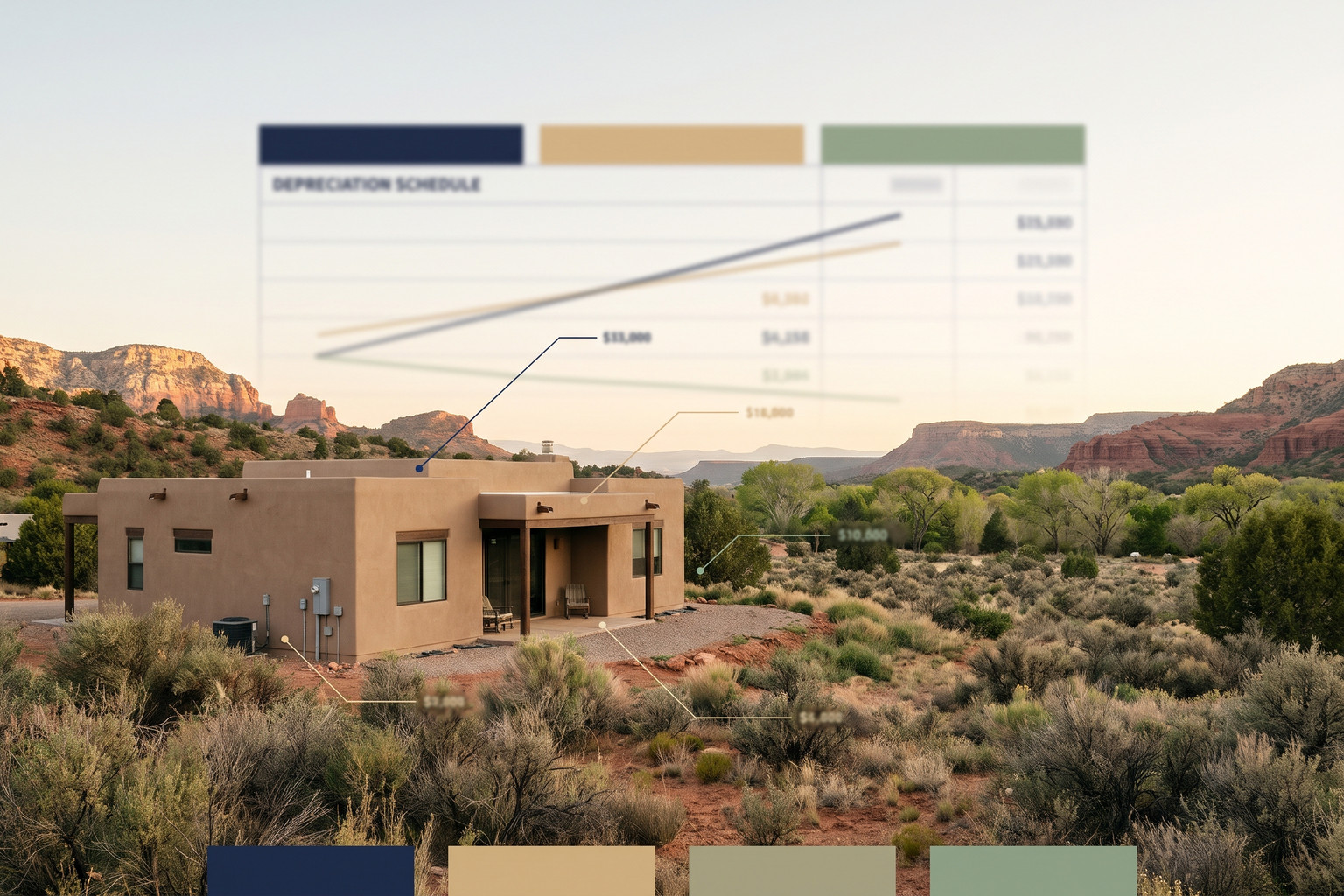
Most property owners in the Verde Valley hear about cost segregation at a dinner party, a real estate meetup, or from a firm that cold-calls every landlord within fifty miles of Phoenix. The pitch is always the same: accelerate depreciation, cut your tax bill, keep more cash. What nobody explains is the math that determines whether a study makes sense for your specific building. Cost segregation Camp Verde AZ property owners can actually benefit from is not a universal strategy. It is a numbers test, and plenty of buildings fail it.
If you own rental property, commercial space, or a short-term rental in the Verde Valley and you are weighing a study before year-end 2026, you need the feasibility math first. If you are looking for professional tax help in Camp Verde, this guide walks through the exact screen we run before we let a client spend a dollar on an engineering report.
Quick Answer
Cost segregation reclassifies parts of a building from 39-year or 27.5-year property into 5-, 7-, and 15-year property, which front-loads your depreciation deductions. For most Camp Verde properties, a study becomes worth the cost somewhere around a $500,000 depreciable basis, assuming you have passive income or active participation to absorb the deduction. Below that, the fee often eats the benefit. Above it, the first-year swing is frequently $30,000 to $90,000 in accelerated deductions.
Key Takeaway: The question is never “does cost segregation work.” It does. The question is whether your basis, your holding period, and your ability to use the loss justify a $4,000 to $12,000 engineering fee in 2026.
What Cost Segregation Actually Does
When you buy a rental property, the IRS makes you spread the building’s cost over 27.5 years for residential rental or 39 years for commercial. That is straight-line depreciation, and it is slow. A $600,000 residential building generates about $21,818 in annual depreciation. Steady, predictable, and unexciting.
A cost segregation study takes that single lump and breaks it apart. An engineer walks the property, reviews construction documents, and identifies components that do not belong in the 27.5-year bucket. Carpet, cabinetry, specialty electrical, decorative lighting, appliances, and dedicated plumbing for equipment often qualify as 5-year or 7-year personal property. Land improvements like paving, fencing, landscaping, and exterior lighting get 15-year treatment.
In plain English: you are telling the IRS that a parking lot is not the same thing as a roof, and it should not depreciate on the same schedule.
The Three Buckets That Matter
- 5-year property (carpeting, appliances, removable fixtures, certain wiring that serves equipment rather than the structure)
- 15-year land improvements (asphalt, concrete flatwork outside the footprint, fencing, exterior lighting, landscaping, drainage)
- 27.5- or 39-year structural (framing, roof, HVAC serving the whole building, windows, foundation)
On a typical Verde Valley residential rental, somewhere between 15 and 25 percent of the depreciable basis reclassifies out of the long bucket. On a commercial building with heavy site work, parking, or specialty buildout, that number climbs to 25 to 40 percent. The IRS describes the methodology and the substantiation it expects in the Cost Segregation Audit Techniques Guide, which is the document your engineer should be able to cite without hesitating.
The Feasibility Math: Five Numbers Before You Spend Anything
Here is the screen we run. If a property fails two or more of these, we tell the owner to skip the study. That conversation costs us revenue and saves the client money, which is the entire point of advisory work.
Number 1: Your Depreciable Basis
Start with purchase price, subtract land value, add capitalized improvements. Land is not depreciable, and in parts of Yavapai County land carries a meaningful share of the purchase price. A $700,000 property on five acres outside Camp Verde might allocate $180,000 to land, leaving $520,000 depreciable.
Rule of thumb: under $350,000 in depreciable basis, the fee rarely clears the benefit. Between $350,000 and $500,000, it depends on property type. Above $500,000, run the numbers seriously.
Number 2: Your Holding Period
Cost segregation is acceleration, not creation. You are pulling deductions forward, not inventing new ones. If you sell in three years, depreciation recapture claws back a chunk of the benefit, and the 5-year property you accelerated gets recaptured at ordinary income rates under Section 1245 rather than the 25 percent unrecaptured Section 1250 rate.
Planning to hold five years or more? The time value of the deferral works in your favor. Planning to flip within 24 months? The study is usually a wash or worse.
Number 3: Can You Actually Use the Loss?
This is where most people get burned, and it is the single most common failure point we see. A study might generate $95,000 in first-year deductions. Wonderful. But if you are a W-2 earner with no other passive income and you do not qualify as a real estate professional, passive activity loss rules under Section 469 suspend that loss. It carries forward. You get it eventually, maybe on sale, but not this year.
The IRS lays out these limits in IRS Publication 925. Read the material participation tests before you assume you clear them.
There are three paths to using the loss now:
- You have other passive income from rentals, partnerships, or other passive activities that the loss can offset
- You or your spouse qualify as a real estate professional under the 750-hour and more-than-half-your-time tests, and you materially participate in the rental
- The property is a short-term rental with average guest stays of seven days or fewer, and you materially participate, which takes it outside the per-se passive rental rule entirely
That third path matters a great deal around Camp Verde, Cottonwood, and the Sedona corridor, where short-term rental activity is substantial. We covered the mechanics of that test in detail in our breakdown of the short-term rental qualification standard most owners fail.
Number 4: Your Marginal Rate
A $90,000 deduction is worth $19,800 to someone in the 22 percent bracket and $33,300 to someone in the 37 percent bracket. Arizona’s flat 2.5 percent individual rate adds another $2,250 either way. The higher your rate, the stronger the case.
Number 5: The Study Fee
Engineering-based studies in this market generally run $4,000 to $9,000 for residential rentals and $8,000 to $18,000 for commercial, depending on size and complexity. The fee is deductible as a professional expense, which softens it, but it is still real cash out the door.
Feasibility Screen Summary
| Factor | Green Light | Red Flag |
|---|---|---|
| Depreciable basis | $500,000+ | Under $350,000 |
| Holding period | 5+ years | Under 3 years |
| Loss usability | REPS, STR, or passive income | W-2 only, no passive income |
| Marginal bracket | 32% or higher | 12% to 22% |
| Property type | Commercial, STR, multifamily | Small single-family long-term |
KDA Case Study: Verde Valley Short-Term Rental Owner
A client came to us in late 2025 owning two short-term rental properties in the Verde Valley, purchased for a combined $1.18 million. She ran a consulting practice generating roughly $240,000 in net self-employment income and handled all guest communication, scheduling, and vendor coordination for both properties herself. Her prior preparer had filed both rentals on Schedule E as standard passive rentals, took straight-line depreciation, and never asked a single question about average guest stay.
Two problems. First, average stays on both properties ran four to five nights, which under Reg. 1.469-1T(e)(3) means they are not rental activities for passive loss purposes at all. Second, her material participation was obvious and documented through the booking platform, but nobody had ever built the hour log.
We commissioned an engineering study on both properties. Depreciable basis after land allocation came to $872,000. The study reclassified 28 percent into 5-year and 15-year buckets, and with bonus depreciation applied to the qualifying short-life property, first-year accelerated depreciation hit $214,000 against the straight-line figure of about $31,700. Net additional deduction: roughly $182,000.
Because the activity was non-passive, that loss offset her consulting income directly. Federal and Arizona tax savings came to approximately $64,800 in year one. She paid $9,400 for the two studies and $3,600 in advisory and filing work. Total cost $13,000. First-year return: just under 5x.
Ready to see how we can help you? Explore more success stories on our case studies page to discover proven strategies that have saved our clients thousands in taxes.
Cost Segregation Camp Verde AZ: What Makes Local Property Different
Camp Verde and the broader Yavapai County market have a few characteristics that change the math compared to a Phoenix or Tucson property.
Land allocation runs high. Acreage properties are common here. A five-acre parcel with a modest structure might carry 30 to 40 percent of value in land, which is not depreciable and shrinks your study benefit. Always get a defensible land allocation before you estimate anything. County assessor ratios are a starting point, not an answer.
Site improvements are substantial. On the other side of the ledger, rural and semi-rural properties often have long driveways, well systems, septic infrastructure, fencing, gates, and extensive grading. Those are 15-year land improvements. On a property with 600 feet of paved drive and perimeter fencing, site work alone can reclassify $60,000 to $120,000.
Short-term rental density. Proximity to Sedona, Montezuma Castle, and the Verde River drives nightly rental activity. That seven-day average stay test is in play for a large share of local investors, and it is the single most powerful lever for making accelerated depreciation usable in the current year.
Our Camp Verde tax team reviews land allocation, site improvement scope, and participation documentation before recommending a study, because those three items determine whether the engineering fee returns anything.
How Bonus Depreciation Changes the 2026 Picture
Cost segregation and bonus depreciation are two different things that work together. The study identifies short-life property. Bonus depreciation determines how much of that short-life property you can write off immediately rather than over five or fifteen years.
Bonus depreciation applies to property with a recovery period of 20 years or less, which is exactly what a study produces. Without bonus, your $200,000 of reclassified 5-year property depreciates under MACRS over five years. With bonus at 100 percent, it comes off in year one.
The percentage has moved around considerably over the past several years, and legislative changes have restored full expensing for qualifying property. This is the single variable that most dramatically swings whether a study is worth it, so confirm the applicable percentage for your placed-in-service date before you model anything. The IRS covers the framework in IRS Publication 946.
We walked through the interaction between these two in more depth in our analysis of cost segregation and bonus depreciation acceleration math, which is worth reading alongside this one if you are modeling a 2026 purchase.
Can You Do This on a Property You Already Own?
Yes, and this is the part most owners do not know.
If you bought a property in 2021 and never did a study, you are not out of luck. You can perform a study now and claim the entire catch-up in the current year through a Section 481(a) adjustment, filed on Form 3115, Application for Change in Accounting Method. No amended returns required.
Step-by-Step: Claiming a Look-Back Study
- Confirm the property is still in service. You cannot do this on something you already sold.
- Order the engineering study. The engineer analyzes the property as of its original placed-in-service date, not today.
- Calculate the 481(a) adjustment. This is the difference between depreciation you took and depreciation you could have taken, cumulative through the current year.
- File Form 3115 with your return. This is an automatic change under the applicable revenue procedure, so no advance IRS consent is needed, but the form must be attached correctly and a copy filed separately per the instructions.
- Deduct the full catch-up in year one. A negative 481(a) adjustment is taken entirely in the year of change.
On a property held four years with a $650,000 basis, a look-back study commonly produces a catch-up adjustment in the $120,000 to $180,000 range. That is a current-year deduction for depreciation you simply never claimed.
Key Takeaway: If you have owned Verde Valley rental property for three or more years without a study, the look-back opportunity is usually larger than what a new purchase would generate.
What Happens When You Sell: The Recapture Reality
Nobody selling cost segregation studies likes talking about this section. We will.
Accelerated depreciation reduces your basis. Lower basis means larger gain on sale. And the character of that gain differs depending on which bucket the depreciation came from.
- Section 1250 property (the structural, 27.5- or 39-year portion) gets unrecaptured gain taxed at a maximum 25 percent rate
- Section 1245 property (the 5- and 7-year personal property you accelerated) gets recaptured as ordinary income, up to 37 percent federal
So if you accelerated $200,000 of 5-year property and you are in the 37 percent bracket at sale, you could owe $74,000 in ordinary recapture tax that you would not have faced under straight-line.
Three Ways to Manage Recapture
- 1031 exchange. Defer the entire gain, including recapture, by exchanging into like-kind replacement property. Personal property components complicate this post-2017, so plan carefully with a qualified intermediary.
- Hold until a low-income year. Recapture at ordinary rates hurts less in a year when your other income collapsed, such as a retirement transition or a business sale year.
- Hold through death. Basis steps up to fair market value for heirs under Section 1014, and the recapture liability disappears entirely.
Recapture does not make cost segregation a bad idea. It makes it a timing decision that requires an exit plan. If you have no exit plan, you have a deferral strategy with an unpriced liability attached.
Arizona-Specific Considerations
Arizona conforms to federal depreciation rules including bonus depreciation for individual income tax purposes, which means your federal acceleration generally flows through to your Arizona return without a separate state adjustment. That is a meaningful advantage compared to states like California, which decouple from bonus depreciation and force a separate state depreciation schedule.
Arizona’s flat 2.5 percent individual rate for 2026 means the state-level savings on a $180,000 accelerated deduction runs about $4,500. Not the main event, but not nothing either. Verify current conformity and rate details with the Arizona Department of Revenue before filing.
One more item specific to Yavapai County investors: if you hold property through an Arizona LLC, confirm your entity structure supports the participation claim you are making. A multi-member LLC with a passive co-owner creates participation questions that a single-member LLC does not. Our entity formation team handles this alongside the depreciation planning because the two decisions are linked.
Common Mistakes That Blow Up a Study
Mistake 1: Using a Non-Engineering Study
Some firms sell “rule of thumb” or software-only allocations for a few hundred dollars. The IRS audit guide explicitly favors detailed engineering approaches. A cheap study that gets disallowed costs you the deduction plus penalties plus interest.
Mistake 2: Ignoring the Passive Loss Trap
We see this constantly. Owner spends $7,000 on a study, generates $140,000 in deductions, and cannot use a dollar of it because the loss is suspended. The study was not wrong. The sequencing was.
Mistake 3: No Participation Log
If you are claiming real estate professional status or short-term rental material participation, you need contemporaneous hour records. Not a reconstruction built the week before an audit. Calendar entries, booking platform logs, vendor communications, and mileage records all count.
Mistake 4: Sloppy Land Allocation
Assigning too little value to land inflates your depreciable basis and your deduction. It is also one of the easier things for an examiner to challenge. Use an appraisal, a defensible assessor ratio, or a documented market analysis.
Mistake 5: Doing It Without an Exit Plan
See the recapture section. Acceleration without a disposition strategy is borrowing from your future self at an unknown rate.
Should You Order a Study? A Decision Framework
Yes, if:
- Depreciable basis exceeds $500,000
- You plan to hold five years or longer
- You qualify as a real estate professional, operate a short-term rental with material participation, or have passive income to offset
- Your combined marginal rate exceeds 32 percent
- The property has meaningful site improvements or specialty buildout
No, or not yet, if:
- Depreciable basis is under $350,000
- You expect to sell within 24 months
- You are a W-2 earner with no passive income and no participation pathway
- Your marginal rate is 22 percent or lower
- The property is raw land or predominantly land value
Maybe, run detailed numbers, if:
- Basis sits between $350,000 and $500,000
- Your participation status could change next year
- You are considering a 1031 exchange within three to five years
If you want a rough sense of how an accelerated deduction moves your overall liability before you commit to a study, run your figures through a federal tax calculator to see where the deduction lands against your current bracket.
Ready to Reduce Your Tax Bill?
KDA Inc. specializes in strategic tax planning for business owners, S Corps, LLCs, and high-net-worth individuals. Book a personalized consultation and walk away with a clear plan.
Frequently Asked Questions
How long does a cost segregation study take?
Typically three to six weeks from engagement to delivered report. Site visits in the Verde Valley are usually scheduled within two weeks. If you are trying to capture a deduction for the 2026 tax year, start by early November at the latest.
Does a study increase my audit risk?
A properly documented engineering study does not meaningfully increase audit risk. A poorly documented one does. The IRS has published its methodology expectations, and a quality report addresses each point directly.
Can I do cost segregation on a property I inherited?
Yes. Inherited property receives a stepped-up basis at fair market value on the date of death, and that new basis is fully eligible for a study. This is frequently overlooked and often produces the largest benefit of any scenario.
What if I renovated the property after purchase?
Capitalized improvements add to your depreciable basis and are included in the study. Renovations are often the richest source of short-life reclassification because new flooring, cabinetry, fixtures, and dedicated electrical all qualify.
Does this work for a property I live in part of the year?
Only the rental-use portion qualifies, and mixed-use allocation rules apply. If personal use exceeds the greater of 14 days or 10 percent of rental days, your deductions face additional limits under Section 280A.
What documents does the engineer need?
Closing statement, purchase agreement, any appraisal, construction or renovation invoices, blueprints if available, prior depreciation schedules, and property tax statements showing land versus improvement allocation.
Is the study fee deductible?
Yes, as an ordinary and necessary business expense in the year paid. See IRS Publication 535 for the general rules on deducting professional fees.
Can a partnership or LLC do a study?
Yes. The deduction flows through to partners or members on their K-1s, subject to each owner’s individual basis, at-risk, and passive loss limitations. Those limits apply at the partner level, not the entity level, which means two partners in the same deal can have completely different outcomes.
Putting It Together Before Year-End
The window for a 2026 deduction closes December 31. Realistically, you need to be in motion by mid-November to have a study completed, reviewed, and integrated into your return planning. That sequence looks like this:
- Week 1: Basis analysis and land allocation review
- Week 2: Participation status determination and loss usability modeling
- Weeks 3 to 5: Engineering study, including site visit
- Week 6: Report review, depreciation schedule rebuild, Form 3115 preparation if look-back applies
- Filing: Integration into the return with supporting documentation retained
Ready to work with a tax professional who understands Verde Valley property owners? Explore our Camp Verde tax services or book a consultation below.
This information is current as of 11/26/2026. Tax laws change frequently. Verify updates with the IRS or the Arizona Department of Revenue if reading this later.
Run the Feasibility Math Before You Pay for a Study
If you own Verde Valley rental or commercial property and you have never had someone actually calculate whether accelerated depreciation would help you this year, you are either leaving a five-figure deduction on the table or you are about to spend thousands on a report you cannot use. There is no third option. We will run your basis, your participation status, and your holding plan against the five-number screen in this article and tell you plainly which one you are. Book your cost segregation feasibility review now and get an answer before the December 31 window closes.



