
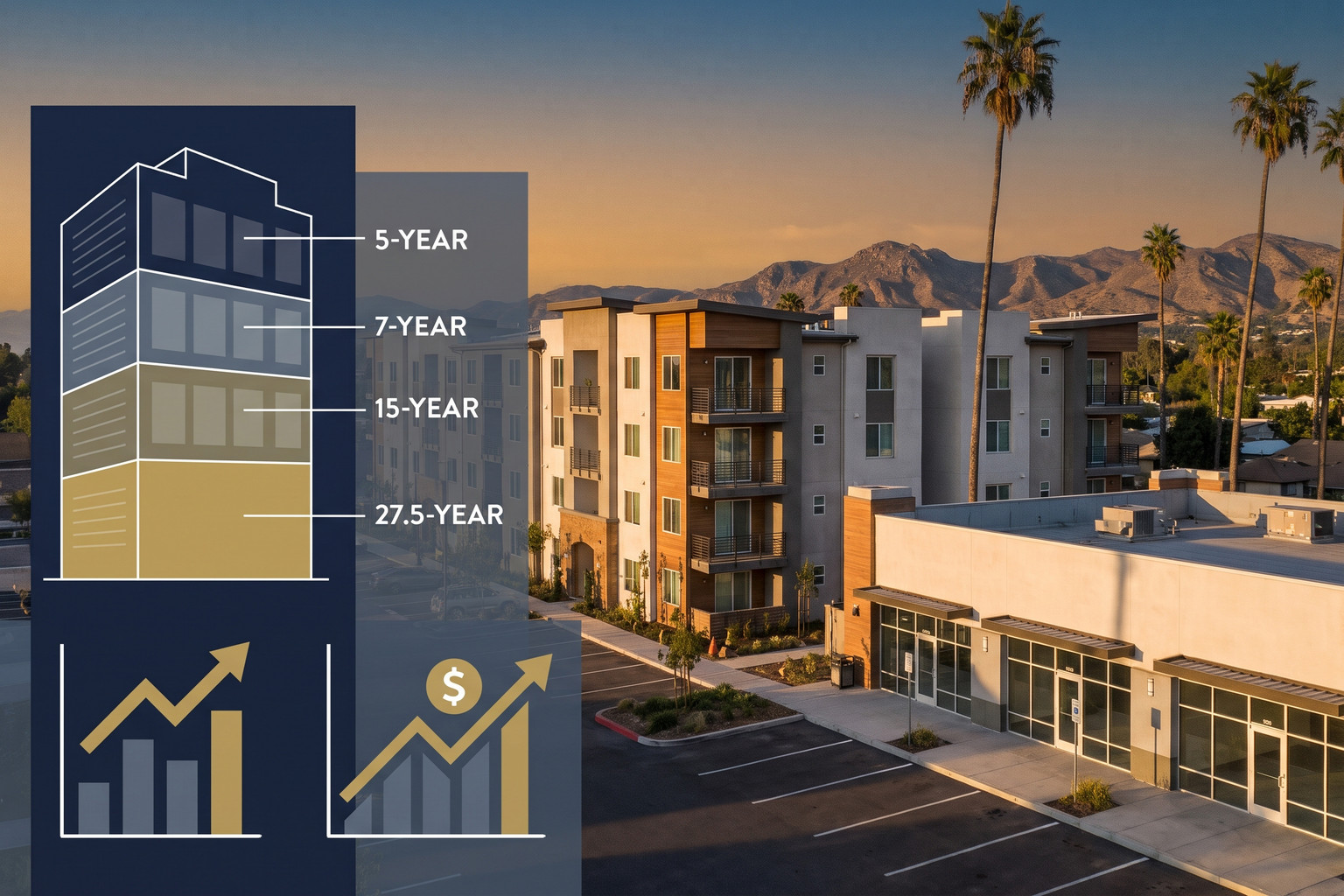
If you own a rental property, a commercial building, or a short-term rental anywhere in the Inland Empire, there is a decent chance you are depreciating the entire purchase price over 27.5 or 39 years when a large slice of it legally qualifies for a much faster write-off. That is the gap cost segregation Riverside CA investors keep leaving on the table. If you are searching for professional tax preparation services in Riverside, this guide walks through exactly how the study works, what it costs, when it pays, and when it does not.
Quick Answer
Cost segregation is an engineering-based study that breaks a building’s purchase price into shorter-life components. Instead of depreciating everything over 27.5 years (residential) or 39 years (commercial), you reclassify 5-year, 7-year, and 15-year property and deduct it far sooner. On a $900,000 Riverside fourplex, a typical study reclassifies 20 to 28 percent of basis, which can produce $150,000 to $220,000 of accelerated deductions in year one.
This information is current as of 11/24/2026. Tax laws change frequently. Verify updates with the IRS or FTB if reading this later.
What Cost Segregation Actually Is (In Plain English)
When you buy a building, the IRS default is simple and slow. You allocate the price between land (never depreciable) and the structure, then write the structure off in equal slices across decades. A $900,000 residential property with $250,000 of land value gives you $650,000 of depreciable basis, divided by 27.5 years. That is about $23,636 a year. Steady. Predictable. Painfully slow.
But a building is not one single asset. It is a collection of assets glued together. The carpet is not the foundation. The decorative lighting is not the load-bearing wall. The parking lot striping, the landscaping, the dedicated electrical for appliances, the cabinetry, the window treatments, the specialty plumbing serving equipment rather than the building itself, all of these have their own useful lives under the tax code.
A cost segregation study is the engineering and accounting exercise that separates them. A qualified team reviews construction documents, inspects the property, prices components, and produces a report that assigns dollars to each asset class with supporting documentation. The result is a legally defensible reallocation of basis into 5-year, 7-year, and 15-year buckets.
The IRS does not treat this as a loophole. It publishes an entire Cost Segregation Audit Techniques Guide that describes the methodology examiners expect to see. The agency’s position is not that the strategy is improper. Its position is that the study must be done properly.
The Asset Classes That Matter
| Asset Class | Recovery Period | Common Examples |
|---|---|---|
| Personal property | 5 years | Carpet, appliances, cabinetry, decorative lighting, window coverings |
| Certain equipment | 7 years | Office furniture, specific machinery, some fixtures |
| Land improvements | 15 years | Paving, striping, fencing, landscaping, site lighting, drainage |
| Residential structure | 27.5 years | Framing, roof, foundation, HVAC serving the building |
| Commercial structure | 39 years | Framing, roof, foundation, core building systems |
| Land | Not depreciable | Raw dirt value at acquisition |
Key Takeaway: The strategy does not create new deductions out of thin air. It moves deductions you were always entitled to into earlier tax years, where they are worth more because of the time value of money.
Why Cost Segregation Riverside CA Investors Get Outsized Results
Riverside County property has a specific profile that tends to produce strong study outcomes, and it comes down to three local realities.
First, land-to-building ratios. In coastal Orange County or Westside Los Angeles, land frequently represents 50 to 65 percent of purchase price. That is dead weight for depreciation purposes. In Riverside, Moreno Valley, Corona, and Jurupa Valley, land often sits closer to 22 to 32 percent of the price. More of your dollars land in the depreciable column before the study even starts.
Second, property type. The Inland Empire is thick with multifamily, light industrial, warehouse, and flex space. Industrial and warehouse properties carry heavy land improvement loads: acres of paving, truck courts, perimeter fencing, yard lighting, drainage systems. That is all 15-year property. A 20,000 square foot warehouse with a large paved yard can throw off reclassification percentages well north of what a typical downtown office condo generates.
Third, renovation activity. A huge share of Riverside acquisitions involve value-add work. Every renovation dollar you spend creates a fresh opportunity to classify components correctly from day one rather than reverse-engineering them later. Our Riverside tax preparation team works with investors who are mid-rehab specifically because the classification decisions are cleanest while the invoices are still fresh.
Riverside Example: The Fourplex Math
Consider a real-world shape. An investor buys a four-unit residential building in the Wood Streets neighborhood for $900,000 in March 2026. The county assessor’s ratio supports $250,000 of land value, leaving $650,000 of depreciable basis.
Without a study: $650,000 divided by 27.5 years equals $23,636 of annual depreciation. In a partial first year with mid-month convention, call it roughly $18,900.
With a study: The engineering report identifies $97,500 of 5-year personal property (appliances, flooring, cabinetry, fixtures) and $71,500 of 15-year land improvements (driveway, fencing, landscaping, exterior lighting). That is $169,000 reclassified, leaving $481,000 in the 27.5-year bucket.
The reclassified property is eligible for bonus depreciation treatment under IRS Publication 946, meaning a large portion of that $169,000 can be deducted immediately rather than spread out. At a combined federal and California marginal rate of 42 percent, roughly $169,000 of accelerated deduction translates to approximately $71,000 of tax deferred into the investor’s pocket in year one instead of dribbling out over decades.
That is cash. Cash that buys the next property.
KDA Case Study: Riverside Real Estate Investor
A client came to us in late 2025 owning three Riverside County rentals: a duplex near UCR, a single-family rental in Moreno Valley, and a small 6,000 square foot industrial condo off Iowa Avenue. Combined purchase basis across the three was $2.1 million, acquired between 2022 and 2025. His prior preparer had done exactly what most preparers do. Land allocation from the tax bill, straight-line everything else, file the return, move on.
His W-2 income from an engineering role was $215,000, and his wife had recently left her job to manage the portfolio full time. That detail mattered enormously, because it opened the door to real estate professional status, which can unlock passive losses against ordinary income rather than suspending them.
We ran cost segregation studies on all three properties and used a Form 3115 change in accounting method to claim the missed depreciation from prior years as a catch-up adjustment in a single tax year, rather than amending three returns. Combined reclassification came to $438,000 of basis moved into 5-year and 15-year buckets, producing a catch-up deduction of roughly $331,000 in the current year.
Net federal and California tax savings in year one: $127,400. Study fees plus our planning and filing work totaled $21,500. First-year return on the engagement was 5.9x, and the depreciation runway continues into future years.
Ready to see how we can help you? Explore more success stories on our case studies page to discover proven strategies that have saved our clients thousands in taxes.
Should You Do a Cost Segregation Study?
Yes, if:
- Your depreciable basis is above roughly $400,000 (below that, fees start eating the benefit)
- You plan to hold the property at least three to five more years
- You have income the accelerated deductions can actually offset
- You qualify as a real estate professional, materially participate, or run short-term rentals with average stays of seven days or less
- You acquired or substantially renovated the property within the last several years
No, or wait, if:
- You are selling within 12 to 24 months and recapture would swallow the benefit
- Your rental losses are already fully suspended with no offsetting income in sight
- Basis is under $300,000 and the property is a simple single-family rental
- You are in an unusually low bracket this year and expect much higher income later
That last point deserves emphasis. Acceleration is only valuable if the deduction lands in a high-rate year. A deduction taken at 24 percent that could have been taken at 45 percent is a planning mistake dressed up as a win. This is where coordinated tax planning beats a standalone study every time.
The Passive Loss Problem Most Articles Skip
Here is the part that gets glossed over in the sales pitch. Generating a $200,000 depreciation deduction does nothing for you if the loss is passive and you have no passive income to absorb it. Under the passive activity rules in IRS Publication 925, rental activity is passive by default. Passive losses offset passive income. Excess losses suspend and carry forward until you have passive income or you dispose of the property.
So the real question is never just “should I do a study.” It is “can I use the result.” There are four main doors.
Door One: Real Estate Professional Status
If you or your spouse spend more than 750 hours and more than half of total working time in real property trades or businesses, and you materially participate in the rentals, the losses become non-passive. They offset W-2 income, consulting income, anything. The hour tests are strict and the documentation burden is real. Contemporaneous logs, not reconstructed calendars.
Door Two: The Short-Term Rental Exception
If average guest stay is seven days or less, the activity is not a rental activity for passive loss purposes at all. You only need to clear material participation, which is a far lower bar than real estate professional status. For Riverside investors running furnished corporate or travel-nurse stays near the medical corridor, this route is often the most practical.
Door Three: The $25,000 Active Participation Allowance
Modest, but real. Active participants with modified AGI under $100,000 can deduct up to $25,000 of rental losses against ordinary income. The allowance phases out completely at $150,000 of MAGI. For a Riverside household at $130,000 of income with a single rental, this is often the only door available.
Door Four: Passive Income From Other Holdings
If you own other profitable rentals or passive business interests, accelerated losses from one property can shelter income from another. Grouping elections matter here and should be made deliberately, not accidentally.
Key Takeaway: Run the usability analysis before you pay for the study. A study that produces suspended losses is not worthless, but it is worth far less than the sales brochure suggests.
Step-by-Step: How a Riverside Cost Segregation Study Actually Runs
- Feasibility analysis (1 week) – A preliminary estimate using property type, purchase price, year built, and basic photos. You should receive a projected reclassification percentage and estimated tax benefit before paying anything substantial.
- Engagement and document collection (1 to 2 weeks) – You provide the closing statement, depreciation schedules, appraisal, construction invoices if available, and prior returns. Missing construction documents are not fatal; engineers use pricing databases and inspection data instead.
- Site inspection (1 day) – An engineer walks the property, photographs components, measures improvements, and catalogs assets. For Riverside industrial and multifamily, this almost always happens in person.
- Engineering analysis and costing (3 to 5 weeks) – Components are priced and assigned to asset classes with cited methodology. This is the part that makes the report defensible.
- Report delivery – You receive a bound study with asset detail, photo documentation, methodology narrative, and the reclassification schedule your preparer will use.
- Tax filing implementation – For a current-year acquisition, the schedule flows directly onto Form 4562. For prior-year properties, your preparer files Form 3115 to claim catch-up depreciation under a change in accounting method.
Total timeline for most Riverside properties: 6 to 10 weeks. Which is exactly why starting in late December is a bad idea and why November conversations are the right ones.
What It Costs
| Property Type | Typical Basis | Study Fee Range | Typical Reclassification |
|---|---|---|---|
| Single-family rental | $400K to $700K | $3,000 to $5,500 | 15% to 22% |
| Small multifamily (2-8 units) | $700K to $2M | $5,000 to $9,000 | 18% to 28% |
| Retail or office | $1M to $5M | $8,000 to $15,000 | 20% to 30% |
| Industrial or warehouse | $1.5M to $8M | $9,000 to $18,000 | 25% to 40% |
| Short-term rental (furnished) | $500K to $1.2M | $4,000 to $7,500 | 22% to 32% |
California-Specific Considerations Riverside Investors Must Know
This is where most national cost segregation content fails California readers completely, and where Riverside investors get an unpleasant surprise at filing time.
California does not conform to federal bonus depreciation. Not partially. Not with modifications. The Franchise Tax Board requires you to compute California depreciation separately, generally using MACRS without the bonus deduction. Your federal return might show a $200,000 first-year depreciation figure while your California return shows something closer to $45,000.
Practically, that means you maintain two depreciation schedules for the life of the asset. It also means your projected savings must be modeled on a split basis. An advisor quoting you “42 percent combined rate times $169,000” without separating the federal and state treatment is selling you a number that does not exist.
California also caps Section 179 expensing far below the federal limit, so the workaround some investors reach for does not fully solve the gap either. Check current-year figures directly with the California Franchise Tax Board before relying on any projection.
One more California wrinkle worth flagging for Riverside owners who hold through an LLC or S corporation: the state’s elective pass-through entity tax remains available through tax year 2030, and beginning in 2026 entities that miss the June 15 prepayment can still make the election, though each owner’s credit is reduced by 12.5 percent of the unpaid share. If your rental portfolio sits inside a pass-through, the PTET election and your depreciation strategy should be modeled together, not in separate conversations. Our work on California’s layered business tax stack covers how those pieces interact.
Key Takeaway: Model federal and California separately. Any study projection that gives you one blended number is incomplete.
Depreciation Recapture: The Cost Nobody Mentions Upfront
When you sell, the IRS wants some of that acceleration back. Section 1245 property (your 5-year and 7-year reclassified assets) recaptures at ordinary income rates, up to 37 percent federal. Section 1250 property recaptures at a maximum 25 percent rate. The structure you did not accelerate recaptures as unrecaptured Section 1250 gain.
So the honest framing is this: cost segregation is a deferral and a rate arbitrage, not a permanent exclusion. You win when the deduction is taken at a high marginal rate and recaptured at a lower one, or when you avoid recapture entirely.
Three ways Riverside investors avoid or defer the recapture hit:
- 1031 exchange – Roll into a replacement property and defer the entire gain including recapture, subject to the strict 45-day identification and 180-day closing windows
- Hold until death – Heirs receive a stepped-up basis under current law, wiping out the deferred recapture entirely
- Time the sale into a low-income year – Recapture at 24 percent after deducting at 45 percent is still a meaningful arbitrage
If you bought with a short horizon in mind, say a two-year value-add flip in Corona, the recapture math frequently kills the case. Run it before you commit. Our breakdown of how capital gains tax is calculated walks through the sequence.
Special Situations and Edge Cases
You Bought the Property Years Ago
You are not locked out. Form 3115 lets you change your accounting method for depreciation and claim the entire cumulative missed deduction in the current year, with no amended returns required and no statute of limitations problem on properties going back well over a decade. This is frequently the single highest-ROI move for a Riverside investor who has held rentals since 2017 and never ran a study.
You Own Through a Partnership or Multi-Member LLC
The deduction flows out on Schedule K-1 according to the operating agreement’s allocation provisions. If partners have different participation levels or different abilities to use passive losses, the benefit lands unevenly. Review the allocation language before commissioning the study.
Partial Asset Dispositions
Underused and valuable. If you replace a roof on your Riverside rental, you can write off the remaining basis of the old roof rather than continuing to depreciate a roof that is in a landfill. A cost segregation study gives you the component basis figures needed to make that election correctly.
Mixed-Use and House Hacking
If you live in one unit of a Riverside fourplex and rent the other three, only the rental portion is eligible. Allocation must be reasonable and documented, typically by square footage.
What Happens If You Get This Wrong
Three failure modes show up repeatedly.
The unsupported study. A provider runs a “rule of thumb” allocation with no engineering work, no site inspection, and no component pricing. Under examination, the IRS disallows the reclassification, your depreciation resets to straight-line, and you owe back tax plus interest plus potentially a 20 percent accuracy-related penalty. On a $150,000 overstated deduction, that is roughly $63,000 of exposure before interest.
The unusable deduction. You pay $7,000 for a study, generate $180,000 of accelerated depreciation, and every dollar of it suspends because you do not meet any participation threshold. You bought a carry-forward you could have gotten for free.
The California blindside. You project your savings at federal bonus depreciation rates, plan your cash accordingly, and discover in April that California gave you a fraction of it. Riverside investors who did not model this have been caught owing five figures to the FTB they did not plan for.
Each one is preventable with a feasibility analysis before engagement, not after.
Common Questions From Riverside Property Owners
Is cost segregation an audit red flag?
No. A properly documented study is a mainstream, IRS-acknowledged methodology. What draws attention is an aggressive allocation with no engineering support behind it. The report is your defense file.
Can I do this on a property I inherited?
Yes. Inherited property takes a stepped-up basis at date of death, and that new basis can be segregated. This is often overlooked and can be substantial.
Does it work on short-term rentals in Riverside County?
Often exceptionally well. Furnished short-term rentals carry heavy 5-year personal property loads, and the seven-day average stay exception removes the passive loss barrier for owners who materially participate.
How long must I hold the property for it to make sense?
Generally three years minimum, five or more preferred. Shorter holds risk recapture erasing the benefit.
Can my regular CPA do the study?
Your CPA implements the result and files the return. The study itself requires engineering expertise. The right structure is a qualified engineering firm producing the report and a tax strategist determining whether, when, and how to use it.
What if I already took straight-line depreciation for five years?
Form 3115 captures all of it in the current year. No amendments needed.
Does bonus depreciation still apply in 2026?
Federal bonus depreciation rules have shifted several times in recent years. Confirm the current-year percentage with your preparer before modeling, and remember California does not conform regardless.
Putting It Together for Your Riverside Portfolio
The investors who get the most out of this do three things in sequence. They confirm the deduction is usable before spending a dollar on a study. They model federal and California separately rather than accepting a blended projection. And they decide their exit strategy before they accelerate, because recapture is a known cost, not a surprise.
Everything else is execution. If the property basis clears $400,000, you can use the losses, and you intend to hold more than three years, a study on a Riverside property with favorable land ratios is one of the most reliable return-on-fee moves available to a real estate investor. If any of those three conditions fails, the right answer may be to wait a year, change your participation profile first, or skip it entirely.
Ready to work with a tax professional who understands Riverside property owners? Explore our Riverside tax services or book a strategy session below.
Ready to Reduce Your Tax Bill?
KDA Inc. specializes in strategic tax planning for business owners, S Corps, LLCs, and high-net-worth individuals. Book a personalized consultation and walk away with a clear plan.
Book Your Cost Segregation Feasibility Review
Before you pay an engineering firm a single dollar, you deserve to know three numbers: how much basis is likely to reclassify on your specific Riverside property, how much of that deduction you can actually use this year given your participation status, and what California will allow versus what the federal return shows. We build that analysis first and only recommend a study when the math holds up. Book your consultation now and get the feasibility numbers before you commit.



