
Most property owners hear about cost segregation years after they should have acted on it. They buy a building in 2022, file three returns with straight-line depreciation, and only learn in 2026 that they left six figures of deductions sitting on the table. The combination of cost segregation bonus depreciation is the single most powerful timing tool available to real estate owners right now, and in 2026 it is fully restored at 100 percent for qualifying property. That changes the math on almost every purchase, renovation, and improvement decision you are weighing before December 31.
This guide walks through the mechanics, the real numbers, the recapture math nobody explains, and the specific situations where a study is a waste of money. If you own commercial property, short-term rentals, or a portfolio of residential units, read the break-even section before you call anyone.
Quick Answer
Cost segregation is an engineering-based study that reclassifies parts of a building from 39-year or 27.5-year property into 5-, 7-, and 15-year property. Bonus depreciation then lets you deduct 100 percent of those shorter-life components in the first year instead of spreading them out. On a $2,000,000 commercial building, a study typically reclassifies 20 to 35 percent of the basis, producing $400,000 to $700,000 of first-year deductions instead of roughly $51,000.
What Cost Segregation Bonus Depreciation Actually Does
Start with the default. When you buy a commercial building, the IRS makes you depreciate it over 39 years. Residential rental property gets 27.5 years. Land gets nothing because land does not wear out. So a $2,000,000 office building with $400,000 allocated to land leaves $1,600,000 of depreciable basis, and you write off about $41,000 per year. For 39 years.
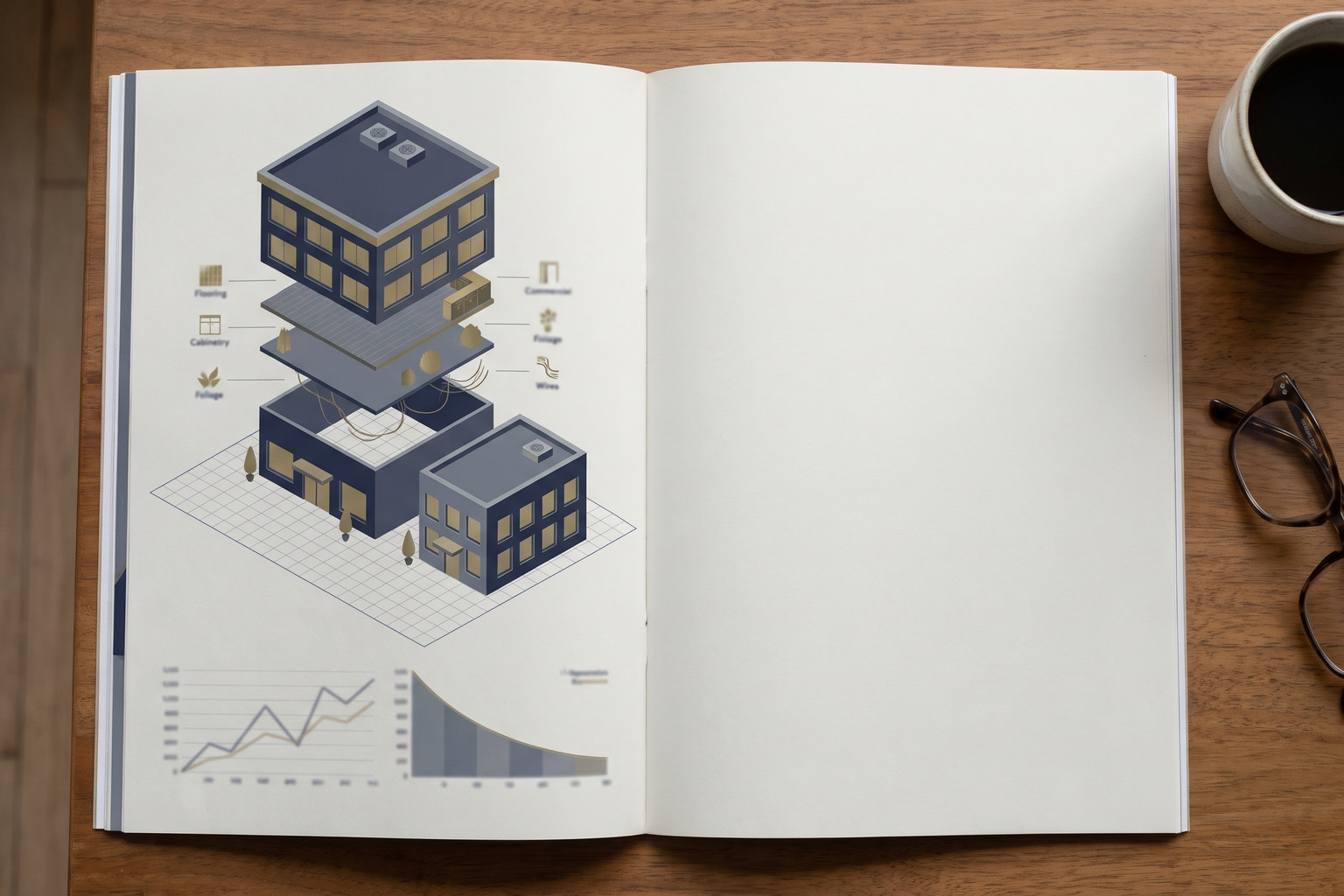
Here is what that default ignores. A building is not one asset. It is hundreds of assets bundled together. The carpet is not a 39-year asset. Neither is the decorative lighting, the specialty electrical feeding your equipment, the parking lot, the landscaping, the cabinetry, or the removable partitions. Under the tax code these items have their own recovery periods, and most of them land in the 5-year, 7-year, or 15-year buckets.
A cost segregation study is the engineering work that separates them. A qualified firm reviews construction documents, invoices, blueprints, and performs a site inspection, then assigns cost to each component with supporting documentation. The result is a reallocation of your basis.
The Component Breakdown in Plain English
| Asset Class | Recovery Period | Typical Examples | Bonus Eligible |
|---|---|---|---|
| Personal property | 5 years | Carpet, appliances, decorative lighting, specialty wiring | Yes |
| Office furnishings | 7 years | Built-in cabinetry, certain fixtures | Yes |
| Land improvements | 15 years | Parking lots, sidewalks, fencing, landscaping, site lighting | Yes |
| Residential structure | 27.5 years | Walls, roof, foundation, structural systems | No |
| Commercial structure | 39 years | Walls, roof, foundation, HVAC core, elevators | No |
| Land | Not depreciable | Raw dirt value | No |
Bonus depreciation is the second half of the equation. Under Section 168(k), property with a recovery period of 20 years or less qualifies for an immediate first-year write-off. For 2026, that percentage is back to 100 percent for qualifying property acquired and placed in service under the current rules. That means every dollar the study moves into the 5-, 7-, and 15-year buckets can potentially be deducted in year one.
Key Takeaway: Cost segregation finds the deductions. Bonus depreciation accelerates them. Neither one creates new deductions out of thin air. You are pulling future write-offs into the present.
The Real Numbers: Three Property Scenarios
Abstractions do not help you decide. Here are three scenarios with actual math.
Scenario 1: $2.4M Medical Office Building
A physician group purchases a medical office building for $2,400,000. The land allocation comes in at $500,000, leaving $1,900,000 of depreciable basis.
- Without a study: $1,900,000 divided by 39 years equals $48,718 in year-one depreciation
- With a study: The engineer reclassifies 28 percent, or $532,000, into short-life property. Specialty medical gas lines, dedicated electrical, exam room casework, flooring, and the parking lot all move
- Bonus depreciation on the reclassified amount: $532,000 deducted immediately
- Remaining 39-year basis: $1,368,000, producing $35,077
- Total year-one deduction: $567,077 versus $48,718
At a combined federal and California marginal rate of 45 percent, that additional $518,359 of deduction is worth roughly $233,000 in deferred tax. The study cost $14,000. That is a 16-to-1 return in the first year.
Scenario 2: $780,000 Short-Term Rental
An investor buys a furnished short-term rental in a vacation market for $780,000. Land is $230,000, so depreciable basis is $550,000. Furniture and fixtures were bought separately for $65,000.
- Without a study: $550,000 over 27.5 years equals $20,000 per year
- With a study: 24 percent reclassified, or $132,000, into 5- and 15-year property including the deck, landscaping, driveway, appliances, and flooring
- Plus the separately purchased furnishings: $65,000, fully bonus eligible
- Total accelerated: $197,000 in year one
- Plus remaining structure depreciation: roughly $15,200
The catch here is enormous and most people miss it. Those losses are only usable against ordinary income if the owner meets the short-term rental participation rules. Average guest stay must be seven days or less and the owner must materially participate. Without that, the $212,000 of deductions becomes a suspended passive loss that sits on your return doing nothing until you sell. We walk through the participation standard in depth in our breakdown of the short-term rental participation and depreciation rules.
Scenario 3: $14M Industrial Portfolio
A capital partner group acquires three industrial warehouses totaling $14,000,000 with $2,800,000 in land. Depreciable basis is $11,200,000.
- Study results: 22 percent reclassified, or $2,464,000, heavily weighted toward 15-year land improvements given the extensive truck courts, parking, and site work
- Year-one deduction with bonus: $2,464,000 plus $223,795 of structure depreciation
- Study cost: $38,000 for all three properties
At a 37 percent federal rate plus state, the partners defer approximately $1,100,000 of tax in year one. The money stays invested in the portfolio instead of going to the Treasury. This is the scenario where cost segregation services produce their largest absolute dollar impact.
KDA Case Study: Real Estate Investor Recovers Four Years of Missed Depreciation
A client came to us in early 2026 owning a $3,100,000 mixed-use building in Los Angeles County purchased in 2022. He is a full-time real estate professional with four other properties, roughly $420,000 in annual rental income, and he had been filing straight-line depreciation since acquisition. His previous preparer never mentioned cost segregation. Four filing seasons went by.
His concern was that the opportunity was gone. It was not. The IRS allows a taxpayer to adopt a new depreciation method on previously placed-in-service property by filing Form 3115, an Application for Change in Accounting Method, and claiming the entire cumulative catch-up as a Section 481(a) adjustment in the current year. No amended returns required.
We commissioned an engineering study that reclassified $694,000 of his $2,480,000 depreciable basis into 5-, 7-, and 15-year property. After netting the depreciation he had already taken on those components, the Section 481(a) catch-up adjustment came to $581,400, claimed entirely on his 2026 return.
Because he qualified as a real estate professional with material participation across his portfolio, the losses offset ordinary income rather than getting trapped as passive. His combined federal and California marginal rate was 48.3 percent.
- Tax deferred in year one: $280,816
- Engineering study cost: $16,500
- KDA planning, Form 3115 preparation, and filing: $7,200
- Total investment: $23,700
- First-year ROI: 11.8x
He redeployed the freed-up cash into a down payment on a fifth property in Q3 2026. Ready to see how we can help you? Explore more success stories on our case studies page to discover proven strategies that have saved our clients thousands in taxes.
Who Should Actually Run a Study (And Who Should Not)
This is where most content stops short. A cost segregation study is not universally beneficial, and plenty of firms will happily sell you one that nets negative value.
Yes, If:
- Your depreciable basis exceeds $500,000 for a single property, or you can bundle multiple smaller properties into one engagement
- You have enough taxable income, or passive income from other properties, to actually absorb the deduction this year
- You plan to hold the property at least five to seven years
- You materially participate, qualify as a real estate professional, or meet the short-term rental exception
- You recently completed a substantial renovation or tenant improvement build-out
- You are in a high marginal bracket now and expect a lower or equal bracket later
No, Or Probably Not, If:
- Your depreciable basis is under $300,000 and the study fee eats most of the benefit
- You have no income to offset and the losses will simply suspend as passive carryforwards
- You intend to sell within 18 to 24 months, which makes recapture bite almost immediately
- You are in a low bracket this year and expect a much higher bracket in two to three years
- The property is a net lease asset where you have minimal basis in improvements
- You already performed a study and are being pitched a second one on the same asset
Bottom Line: The break-even is roughly a $400,000 to $500,000 depreciable basis assuming a $7,000 to $12,000 study fee and a 40 percent-plus combined rate. Below that, run the numbers carefully before committing.
Depreciation Recapture: The Part Nobody Mentions on the Sales Call
Here is the honest version. Cost segregation does not eliminate tax. It defers it. When you sell, the IRS wants the accelerated depreciation back, and the rate depends on which bucket the asset came from.
| Asset Type | Recapture Rule | Maximum Federal Rate |
|---|---|---|
| 5- and 7-year personal property | Section 1245 ordinary recapture | Up to 37 percent |
| 15-year land improvements | Section 1250 unrecaptured gain | 25 percent |
| 39-year or 27.5-year structure | Section 1250 unrecaptured gain | 25 percent |
| Appreciation above basis | Long-term capital gain | 20 percent plus 3.8 percent NIIT |
That Section 1245 line is the one that surprises people. Personal property recaptures at ordinary rates, not the 25 percent unrecaptured 1250 rate. If you deducted $400,000 of 5-year property at a 37 percent benefit and recapture it at 37 percent, your net benefit is purely the time value of money, which is still real but smaller than the sales pitch suggested.
Three Ways to Manage Recapture
- Hold the asset – No sale, no recapture. The deferral becomes permanent in practice if you hold until death and heirs receive a stepped-up basis under Section 1014
- Use a 1031 exchange – A properly structured like-kind exchange defers the recapture along with the gain, though personal property no longer qualifies for 1031 treatment post-2017, so the 1245 portion needs careful attention. Our breakdown of 1031 exchange mechanics for rental owners covers the sequencing
- Time the sale into a low-income year – If you can place the disposition in a year where your ordinary rate drops, the 1245 recapture costs less
You can model the downstream impact with a capital gains tax calculator before you commit to a study, which is something most investors skip entirely.
The Lookback Opportunity: Form 3115 and Catch-Up Deductions
If you bought property in 2019, 2021, or 2023 and never ran a study, you have not missed the window. Revenue Procedure 2015-13 and the related automatic change procedures let you file Form 3115 and claim the entire cumulative difference in the current year.
Step-by-Step: How the Catch-Up Works
- Commission the engineering study – The firm analyzes the property as of its original placed-in-service date, not today. Timeline is typically 4 to 8 weeks
- Calculate depreciation you should have taken – Using the reclassified asset lives and the bonus percentage in effect in the acquisition year
- Subtract depreciation already claimed – The difference is your Section 481(a) adjustment
- File Form 3115 with your current-year return – Attach the study summary and file a duplicate copy with the IRS national office. This is an automatic consent change, designated change number 7
- Claim the full negative adjustment in year one – A favorable 481(a) adjustment is taken entirely in the year of change rather than spread over four years
One critical detail on bonus percentage. The bonus rate that applies is the rate in effect when the property was originally placed in service, not 2026 rates. Property placed in service in 2023 gets 80 percent bonus. 2024 gets 60 percent. 2025 property falls under the rules in effect for that year. Verify the applicable percentage before you model the savings, and see IRS Publication 946 for the governing depreciation tables.
The mechanics of actually reporting all of this correctly trip up more returns than the study itself. We covered the filing details in depth in our guide on how to report cost segregation to the IRS.
California-Specific Considerations You Cannot Ignore
This is the single largest gap in national cost segregation content, and it costs California owners real money when they model federal savings and forget the state side.
California does not conform to federal bonus depreciation. The Franchise Tax Board requires you to compute depreciation using pre-2002 federal rules for most purposes. Practically, that means:
- Your federal return shows the full accelerated deduction
- Your California return requires an adjustment adding most of it back
- You maintain two separate depreciation schedules, federal and state, for the life of the asset
- California depreciation on the reclassified components still runs faster than 39-year straight line because the shorter asset lives apply, just without the 100 percent first-year bonus
So on that $2,400,000 medical building, the federal benefit is the headline number. The California benefit is the acceleration from 39-year to 5-, 7-, and 15-year lives using MACRS or straight line, which is meaningful but far smaller. Budget for roughly 60 to 70 percent of your projected combined savings rather than the full 45 percent marginal rate applied to the whole deduction.
California also does not conform to Section 179 at federal levels. The state limit sits at $25,000 with a $200,000 investment phase-out threshold, a fraction of the federal allowance. Check current guidance on the Franchise Tax Board site before finalizing any projection.
What Happens If You Get This Wrong
Cost segregation is a legitimate, IRS-sanctioned strategy. The agency literally publishes an Audit Techniques Guide for cost segregation that describes what examiners look for. But sloppy work draws attention.
Red Flags That Invite Scrutiny
- No engineering basis – Rule-of-thumb studies or percentage-based estimates without a site inspection and component-level documentation. The ATG explicitly identifies the detailed engineering approach as the most reliable method
- Aggressive reclassification percentages – A study claiming 45 percent of an office building is 5-year property will not survive review
- Misclassified structural components – HVAC serving the building generally stays 39-year. Specialty HVAC serving specific equipment may not. The distinction matters
- Passive loss rules ignored – Claiming active losses without meeting material participation or real estate professional tests under Section 469
- Inflated land allocation games – Understating land to inflate depreciable basis is a separate and more serious problem
The penalty exposure is real. A 20 percent accuracy-related penalty under Section 6662 applies to substantial understatements, and in an audit you will need the full study documentation, the engineer’s credentials, and the supporting cost records. If you receive a notice, our audit representation team handles depreciation examinations regularly.
Common Questions About Cost Segregation Bonus Depreciation
Can I do a cost segregation study myself?
Technically nothing prohibits it. Practically, no. The IRS Audit Techniques Guide weights the credibility of a study heavily on the preparer’s engineering qualifications and methodology. A self-prepared estimate without construction cost expertise will not hold up. Expect to pay $5,000 to $15,000 for a single property and $25,000 to $60,000 for a portfolio.
Does a cost segregation study work on a property I inherited?
Yes, and it can be especially valuable. Inherited property receives a stepped-up basis to fair market value as of the date of death. That new basis is your starting point for a study, and the prior owner’s depreciation history does not carry over.
What if my property is held in an LLC or partnership?
The study is performed at the entity level and the resulting deductions flow through on Schedule K-1 to partners according to their ownership and any special allocations in the operating agreement. Partners then apply passive activity rules individually. Entity structure matters more than most owners realize, which we unpack in our comparison of LLC, S Corp, and C Corp entity math.
Can I combine cost segregation with a 1031 exchange?
Yes, but sequencing matters. If you acquired replacement property through a 1031 exchange, your basis includes both carryover basis from the relinquished property and any new cash invested. A study on the replacement property generally applies to the excess basis more cleanly, and the carryover portion requires careful handling. Do not run the study before the exchange closes.
How long does a study take?
Four to eight weeks from engagement to final report for a single property. Portfolio engagements run eight to twelve weeks. If you want the deduction on your 2026 return, start no later than early Q4.
Does bonus depreciation apply to used property?
Yes. Since the 2017 law change, used property qualifies for bonus depreciation as long as it was not previously used by you and was not acquired from a related party. This is why cost segregation works on acquisitions, not just new construction.
Will accelerated depreciation increase my audit risk?
Properly documented studies performed by qualified engineering firms are routine. The IRS expects them on commercial property. Risk increases with aggressive percentages, missing documentation, and passive loss violations, not with the strategy itself.
What about partial asset dispositions?
This is an underused companion strategy. When you replace a roof, HVAC system, or flooring, you can write off the remaining basis of the component you removed rather than depreciating a ghost asset alongside the replacement. A cost segregation study gives you the component-level basis needed to make that election. On a $180,000 roof replacement where the original roof had $62,000 of remaining basis, the disposition deduction is $62,000 on top of depreciating the new roof.
How to Decide Before Year-End
You have roughly six weeks. Here is the sequence.
- Pull your depreciation schedule – Identify every property with a depreciable basis above $400,000 that has never had a study
- Project your 2026 taxable income – Deductions you cannot use this year are worth far less than deductions you can
- Confirm your participation status – Material participation, real estate professional qualification, or short-term rental exception. Without one of these, your deduction is likely suspended
- Get a free feasibility estimate – Most reputable firms will model the expected reclassification at no cost before you engage
- Model the recapture – Factor your expected holding period and exit strategy into the decision
- Layer in the California adjustment – Reduce your projected combined savings accordingly
- Engage by early December – Studies for property placed in service during 2026 must be completed in time for your filing
Owners who treat this as a mechanical exercise usually leave money behind. Owners who integrate it with entity structure, participation planning, and exit timing capture the full value. That is the difference between a vendor selling a study and a tax planning strategy built around your actual portfolio.
For a deeper technical walkthrough of the study process itself, our cost segregation study guide breaks down each phase from document collection through final report delivery.
This information is current as of 11/19/2026. Tax laws change frequently. Verify updates with the IRS or FTB if reading this later.
Ready to Reduce Your Tax Bill?
KDA Inc. specializes in strategic tax planning for business owners, S Corps, LLCs, and high-net-worth individuals. Book a personalized consultation and walk away with a clear plan.
Book Your Cost Segregation Feasibility Review
If you own property with more than $500,000 in depreciable basis and you have never run a study, there is a real chance you are sitting on six figures of unclaimed deductions and a Form 3115 catch-up you can still take on your 2026 return. We will model the expected reclassification, project the federal and California impact separately, factor in your recapture exposure, and tell you honestly whether the study pays for itself. Book your consultation now and get a clear answer before the year closes.



