
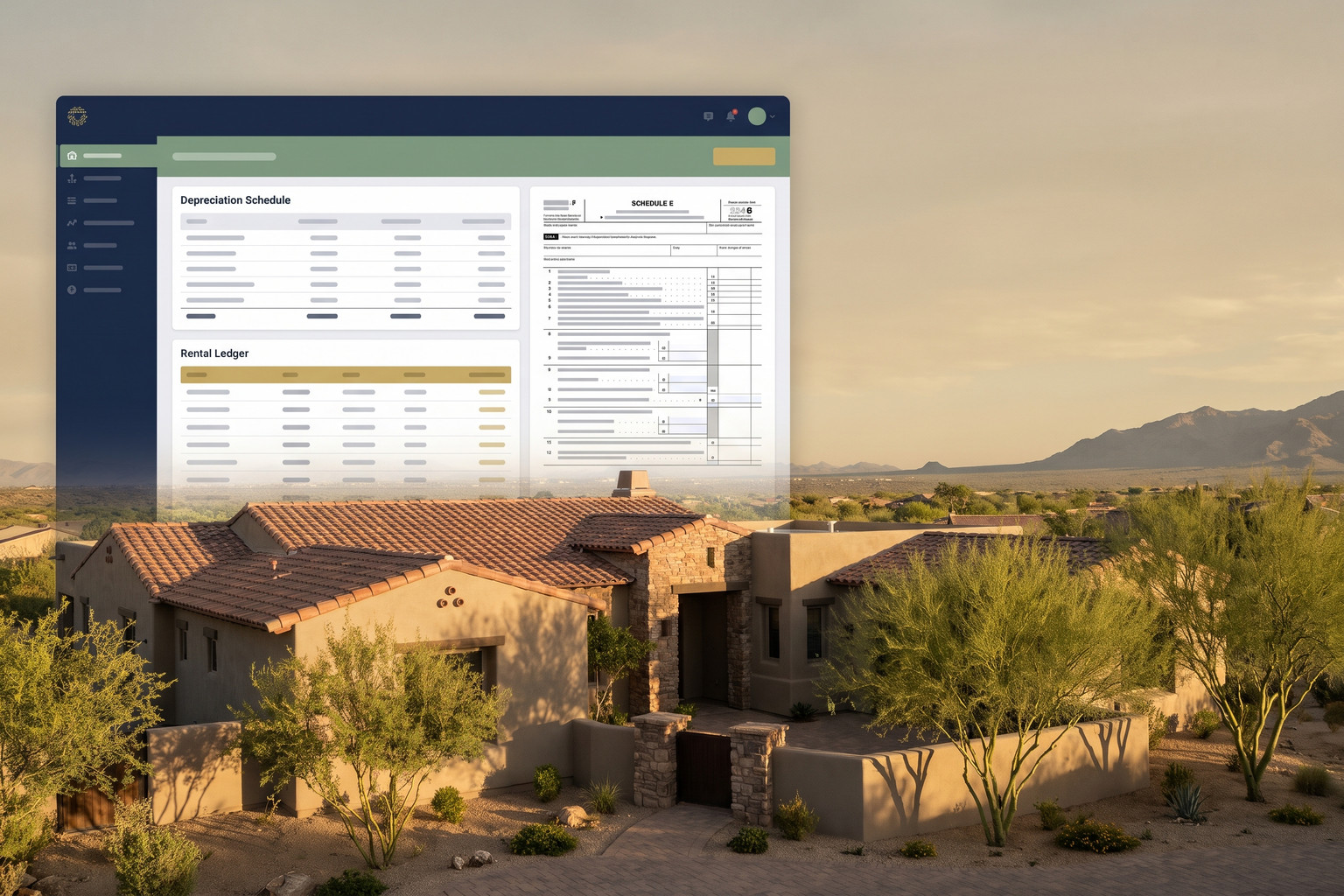
Arizona rental owners get sold the same three ideas every year: buy a cost segregation study, form an LLC, and write off your mileage. Those can all be fine moves. None of them is a plan. Real tax planning for landlords Arizona starts with a much less exciting question, and it is the one almost nobody asks before December: can you actually use the deductions you are about to generate? If you are looking for help across our Arizona and California service areas, that question is where we start every rental engagement.
Quick Answer
For the 2026 tax year, most Arizona landlords are limited by the passive activity loss rules in IRC Section 469, not by a shortage of deductions. Unless you qualify as a real estate professional, materially participate in a short-term rental, or fall under the $25,000 active participation allowance (which phases out between $100,000 and $150,000 of modified adjusted gross income), extra depreciation gets suspended and carried forward rather than cutting this year’s tax bill. Arizona adds a second layer: a 2.5% flat state income tax, no state-level depreciation divergence of consequence, and a transaction privilege tax on short-term rentals that trips up more owners than the IRS ever does.
Why Tax Planning for Landlords Arizona Is a Usability Problem First
Here is the pattern we see constantly. An owner in Chandler or Surprise buys a $520,000 rental, hears about bonus depreciation, and pays $5,500 for a cost segregation study. The study comes back beautifully. It reclassifies $118,000 into five, seven, and fifteen year property. On paper that is a massive first-year deduction.
Then the return gets prepared. The owner is a W-2 engineer making $210,000. The rental is long-term, not short-term. He does not qualify as a real estate professional. His modified AGI is far above $150,000, so the $25,000 special allowance is gone entirely. The entire loss gets suspended on Form 8582 and carried forward.
He spent $5,500 to accelerate a deduction he cannot touch until he either sells the property or generates passive income to absorb it. The study was not wrong. The sequencing was.
That is the whole game. Deduction generation is easy. Deduction usability is the constraint. Good tax planning for landlords Arizona runs the usability test before you spend a dollar on acceleration.
The Three Doors to Using Rental Losses
Under IRS Publication 925, rental activity is presumptively passive. There are only a few ways out:
- The $25,000 active participation allowance – Available if you actively participate (approve tenants, set rents, approve repairs) and your modified AGI is under $100,000. It phases out 50 cents on the dollar and disappears completely at $150,000 MAGI.
- Real estate professional status – Requires more than 750 hours in real property trades or businesses and more than half your total personal service time, per IRC Section 469(c)(7). Then you still need material participation in the rentals themselves, usually via a grouping election.
- The short-term rental exception – If average guest stay is seven days or less, the activity is not a rental under the Section 469 regulations. Material participation alone can make losses non-passive, with no 750-hour test.
Key Takeaway: If you cannot walk through one of those three doors in 2026, accelerating depreciation does not lower this year’s tax bill by a single dollar.
KDA Case Study: Scottsdale Landlord Who Sequenced It Correctly
A married couple came to us in early 2026. She is a W-2 hospital administrator at $168,000. He left a sales role in late 2025 to manage their properties full time. They own four Arizona rentals: two long-term duplexes in Mesa, one single-family in Glendale, and one short-term rental in Sedona. Combined basis, roughly $1.9 million.
Their prior preparer had filed everything as passive. Suspended losses had piled up to $71,000 over three years. Nothing had ever reduced their tax bill. They were about to spend another $8,000 on a cost segregation study for the Sedona property, which would have gone straight into the suspended pile under their existing setup.
We did three things. First, we documented the husband’s hours with a contemporaneous log and established real estate professional status for 2026 at 1,180 hours. Second, we filed a Section 469(c)(7)(A) grouping election so all four properties counted as a single activity for material participation. Third, we ordered the cost segregation study only after confirming the losses would be usable, and timed it for the Sedona property where the short-term rental rules gave us a second line of defense.
Result: $94,000 in now-deductible losses against their combined income for 2026. Federal savings of roughly $21,400, plus $2,350 in Arizona tax at the 2.5% flat rate. Total first-year savings: $23,750. They paid us $7,800 for planning, the grouping election, and return preparation. First-year ROI: roughly 3.0x. The suspended $71,000 is now positioned to release as well.
Ready to see how we can help you? Explore more success stories on our case studies page to discover proven strategies that have saved our clients thousands in taxes.
What Arizona Adds on Top of the Federal Rules
Arizona is a relatively friendly state for rental owners, but it is not frictionless. Our Arizona tax planning team sees the same four state-level issues repeatedly.
The 2.5% Flat Income Tax
Arizona runs a 2.5% flat individual income tax. For landlords this is mostly good news. It means a $40,000 usable rental loss saves you $1,000 at the state level, predictably, with no bracket math. It also means Arizona offers less planning leverage than California does, because there is no progressive rate to manage around. Your optimization energy belongs on the federal side.
Arizona starts from federal adjusted gross income, so federal depreciation decisions generally flow straight through to the Arizona return. There is no separate Arizona depreciation schedule to maintain for most residential rental property, which saves real compliance cost compared to multi-state portfolios.
Transaction Privilege Tax on Short-Term Rentals
This is where Arizona bites. Short-term rentals are subject to the state transaction privilege tax under the transient lodging classification, plus county and municipal taxes. Phoenix, Scottsdale, Sedona, and Flagstaff all layer their own rates on top. Owners who rent through platforms often assume the platform handles everything. Platforms typically remit some taxes but not all of them, and the license obligation stays with the owner.
You generally need a TPT license from the Arizona Department of Revenue even if a platform collects on your behalf. Verify your specific city’s requirements with the Department before assuming coverage. The penalty for unlicensed operation is a compliance problem that no amount of income tax planning fixes.
No Separate Arizona Entity-Level Tax on Most LLCs
Unlike California’s $800 minimum franchise tax and gross receipts fee under Form 568, Arizona does not impose an annual minimum tax on LLCs. This genuinely changes entity math. In California we often tell small landlords that a separate LLC per property costs more than the liability benefit is worth. In Arizona that calculus flips, because the carrying cost is close to zero.
If you are weighing structure across both states, the tradeoffs in our breakdown of S Corp, C Corp, and LLC choices for California show just how much the state-level cost layer drives the decision.
Arizona Property Tax and the Rental Classification
Residential rental property in Arizona is assessed differently from owner-occupied property. Owner-occupied residences receive a state aid to education credit that rentals do not. Many new investors buy a former primary residence, keep the old classification on file, and get a reassessment letter later. Report the change in use to your county assessor when the property converts to a rental.
The Usability Test: Run This Before You Spend on Acceleration
Here is the actual decision framework. Work through it in order.
Step 1: Calculate Your Modified AGI
Take your AGI and add back items like IRA deductions, student loan interest, and any passive losses already claimed. If the result is under $100,000 and you actively participate, you have up to $25,000 of usable loss. Between $100,000 and $150,000 you have a partial allowance. Above $150,000 that door is closed.
Step 2: Test for Real Estate Professional Status
You likely qualify if:
- You spend more than 750 hours in real property trades or businesses during 2026
- Those hours exceed half of all your personal service time for the year
- You keep a contemporaneous log, not a reconstruction built in March
- You materially participate in the rentals themselves, usually through a grouping election
You likely do not qualify if:
- You hold a full-time W-2 job of 2,000 hours or more
- Your hours are mostly investor activities like reviewing statements or researching markets
- You use a full-service property manager and cannot document hands-on time
The Tax Court has been unforgiving here. Logs created after an audit notice rarely survive. Build the log as you go.
Step 3: Check the Short-Term Rental Exception
If average guest stay is seven days or less, the activity escapes the rental definition entirely. You then only need material participation under one of the seven tests in the regulations. The most common path is the 100-hour test: you participate more than 100 hours and more than anyone else, including cleaners and co-hosts. For Sedona, Flagstaff, and Scottsdale owners, this is often the most accessible door. Our analysis of short-term rental tax documentation in Buckeye walks through the evidence standard in detail.
Step 4: Only Then Consider Acceleration
If and only if one of the doors above is open, cost segregation and bonus depreciation become powerful. Before that, they are expensive paperwork. The feasibility framework in our Gold Canyon cost segregation feasibility test applies equally across Arizona markets.
Deduction Categories Arizona Landlords Routinely Miss
Assuming you pass the usability test, these are the line items we most often add when we take over a return.
| Deduction | Commonly Missed Because | Typical Annual Value |
|---|---|---|
| Travel to inspect out-of-area property | Owner assumes personal trip disqualifies it | $800 – $3,200 |
| Home office for rental management | Believed to be a red flag | $1,100 – $2,400 |
| De minimis safe harbor election | Election never filed with the return | $2,000 – $8,000 |
| Partial asset disposition on roof replacement | Old roof basis never written off | $4,000 – $14,000 |
| Qualified Business Income deduction on rentals | Safe harbor hour log not maintained | Up to 20% of net rental income |
| Loan points amortization on refinance | Prior unamortized points never accelerated | $600 – $2,900 |
Partial Asset Disposition: The Most Overlooked One
When you replace a $19,000 roof on a Tucson rental, most preparers capitalize the new roof and move on. The remaining basis in the old roof keeps depreciating over 27.5 years as a ghost asset. A partial asset disposition election lets you write off that remaining basis in the year of replacement.
On a property bought in 2019 for $340,000 with roughly $22,000 of original roof allocation, you might write off $18,400 of remaining basis. At a 24% federal bracket plus 2.5% Arizona, that is about $4,876 in the year you make the election. The catch: it must be made on a timely filed return for the year of disposition. Miss the deadline and it is gone.
The Section 199A Safe Harbor for Rentals
Under Revenue Procedure 2019-38, a rental enterprise can be treated as a trade or business for the 20% qualified business income deduction if you perform 250 or more hours of rental services per year and keep contemporaneous records. Most landlords clear 250 hours easily. Almost none document it. On $48,000 of net rental income, the QBI deduction is worth about $9,600 of income exclusion, roughly $2,300 in federal tax at the 24% bracket.
Note that hours spent by employees and contractors count toward the 250, which makes this considerably easier than the real estate professional test. Different standard, different purpose. Do not confuse them.
What Happens If You Get This Wrong
The downside scenarios are specific and worth naming.
Claiming real estate professional status without a log. If the IRS examines and your hours cannot be substantiated, every loss you claimed reverts to passive. You owe the tax, plus interest, plus a potential 20% accuracy-related penalty under IRC Section 6662. On $90,000 of disallowed losses at a 32% bracket, that is $28,800 in tax, roughly $5,760 in penalty, and interest running from the original due date.
Operating a short-term rental without a TPT license. Arizona can assess back taxes and penalties. Cities run their own enforcement, and Sedona and Scottsdale have been particularly active.
Buying a cost segregation study you cannot use. Not a penalty, just wasted cash. A $6,000 study producing suspended losses is a $6,000 expense with zero current return. It is also harder to unwind than people expect, since you have already changed your depreciation method.
Missing the partial asset disposition window. No penalty, but the deduction is permanently lost on that improvement. You cannot amend your way back into a late election here.
Special Situations Most Guides Skip
Snowbird Owners Who Split Time Between States
Plenty of Arizona rental owners are part-year residents. If you maintain a Minnesota or Illinois domicile and own Arizona rentals, you file an Arizona nonresident return reporting Arizona-source rental income. Your home state generally taxes the same income and grants a credit for Arizona tax paid. The credit is usually limited to the lower of the two liabilities, so Arizona’s 2.5% rate rarely creates a problem for residents of higher-tax states. The mistake is simply not filing the Arizona nonresident return at all.
Married Filing Separately Landlords
MFS filers who lived together at any point during the year get a $0 special allowance under Section 469. Not reduced. Zero. Filers who lived apart the entire year get $12,500, phasing out between $50,000 and $75,000 MAGI. This surprises divorcing couples with rentals almost every time.
Inherited Arizona Rentals
Arizona is a community property state. When one spouse dies, community property generally receives a full step-up in basis on both halves, not just the decedent’s half. On a Phoenix rental bought in 2004 for $180,000 and worth $610,000 at death, the surviving spouse may get a basis of $610,000 and a fresh 27.5-year depreciation schedule. We see surviving spouses continue depreciating the old basis for years, giving up meaningful deductions.
Converting a Primary Residence to a Rental
Your depreciable basis is the lower of adjusted basis or fair market value at conversion. If your Gilbert home cost $390,000 and is worth $355,000 when you convert, you depreciate from $355,000. Owners routinely use the higher number and overstate depreciation, which creates recapture exposure at sale. Also watch the Section 121 exclusion clock: you generally need two of the prior five years as a primary residence, so a long rental period can cost you up to $500,000 of excludable gain.
Your 2026 Arizona Landlord Planning Calendar
- January through March – Start your contemporaneous hour log if you are pursuing REPS or the 199A safe harbor. A log that begins in January is credible. One that begins in October is not.
- By April 15, 2026 – File 2025 returns including any partial asset disposition elections for 2025 improvements. These cannot be made late.
- Second quarter – Verify TPT licensing for any short-term rentals and reconcile what your platform actually remits versus what you owe.
- Third quarter – Run a mid-year usability test. Project MAGI and determine which Section 469 door is open before you commit to acceleration spending.
- October through November – Order cost segregation studies only for properties where losses will be usable. Studies need lead time to be completed before year-end.
- December – Time repairs, make the de minimis safe harbor election decision, and confirm your hour log is complete and signed.
If you want a rough read on what a sale would cost before you make a disposition decision, run the numbers through our capital gains tax calculator as a starting point, then bring the real figures to a planning session.
Ready to Reduce Your Tax Bill?
KDA Inc. specializes in strategic tax planning for business owners, S Corps, LLCs, and high-net-worth individuals. Book a personalized consultation and walk away with a clear plan.
Frequently Asked Questions
Does Arizona tax rental income differently from wage income?
No. Arizona applies the same 2.5% flat rate to net rental income reported on Schedule E as it does to wages. There is no separate rental income rate and no Arizona-specific rental surtax at the state level.
Can I deduct rental losses against my W-2 income in Arizona?
Only if you clear one of the Section 469 doors: the $25,000 allowance under $150,000 MAGI, real estate professional status, or the short-term rental material participation exception. Otherwise losses suspend and carry forward. Arizona follows the federal treatment because it starts from federal AGI.
Do I need an LLC for each Arizona rental property?
Not for tax purposes. A single-member LLC is disregarded and changes nothing on your return. The case is liability isolation. Because Arizona imposes no annual minimum LLC tax, the carrying cost is low enough that per-property LLCs are often reasonable here, unlike in California.
How many hours do I need for the QBI rental safe harbor?
250 hours of rental services per enterprise per year, with contemporaneous records including time, description, and who performed the work. Contractor and employee hours count. This is a separate and much easier standard than the 750-hour real estate professional test.
Is my Sedona short-term rental subject to Arizona TPT?
Generally yes, under the transient lodging classification, plus applicable county and city rates. You typically need your own license even when a booking platform collects some taxes. Confirm current requirements directly with the Arizona Department of Revenue and your city.
Can I still do a cost segregation study on a property I bought three years ago?
Yes. You file Form 3115 for a change in accounting method and take a catch-up adjustment in the current year. No amended returns needed. The usability test still applies, so confirm you can use the resulting loss first.
What records should I keep for an Arizona rental?
Closing statements, a depreciation schedule with component detail, repair versus improvement documentation, your hour log, TPT filings for short-term rentals, lease agreements, and mileage records. Keep them at least three years after filing, and keep basis records for the entire holding period plus three years after sale.
Bringing It Together
Strong tax planning for landlords Arizona is sequencing, not shopping. Determine which Section 469 door is open to you. Build the documentation that keeps it open. Then, and only then, spend money accelerating deductions you can actually use this year. Owners who run that order typically save multiples of what the planning costs. Owners who run it backward buy expensive studies and wait years for the benefit.
Ready to work with a tax team that understands Arizona rental owners? Explore our service areas and local tax support or book a consultation below.
This information is current as of 11/12/2026. Tax laws change frequently. Verify updates with the IRS or the Arizona Department of Revenue if reading this later.
Book Your Arizona Rental Strategy Session
If you own Arizona rentals and your losses keep landing on Form 8582 instead of lowering your tax bill, that is a fixable sequencing problem, not bad luck. We will run the usability test on your actual numbers, tell you honestly whether a cost segregation study makes sense this year, and build the documentation that holds up under examination. Click here to book your consultation now.



