
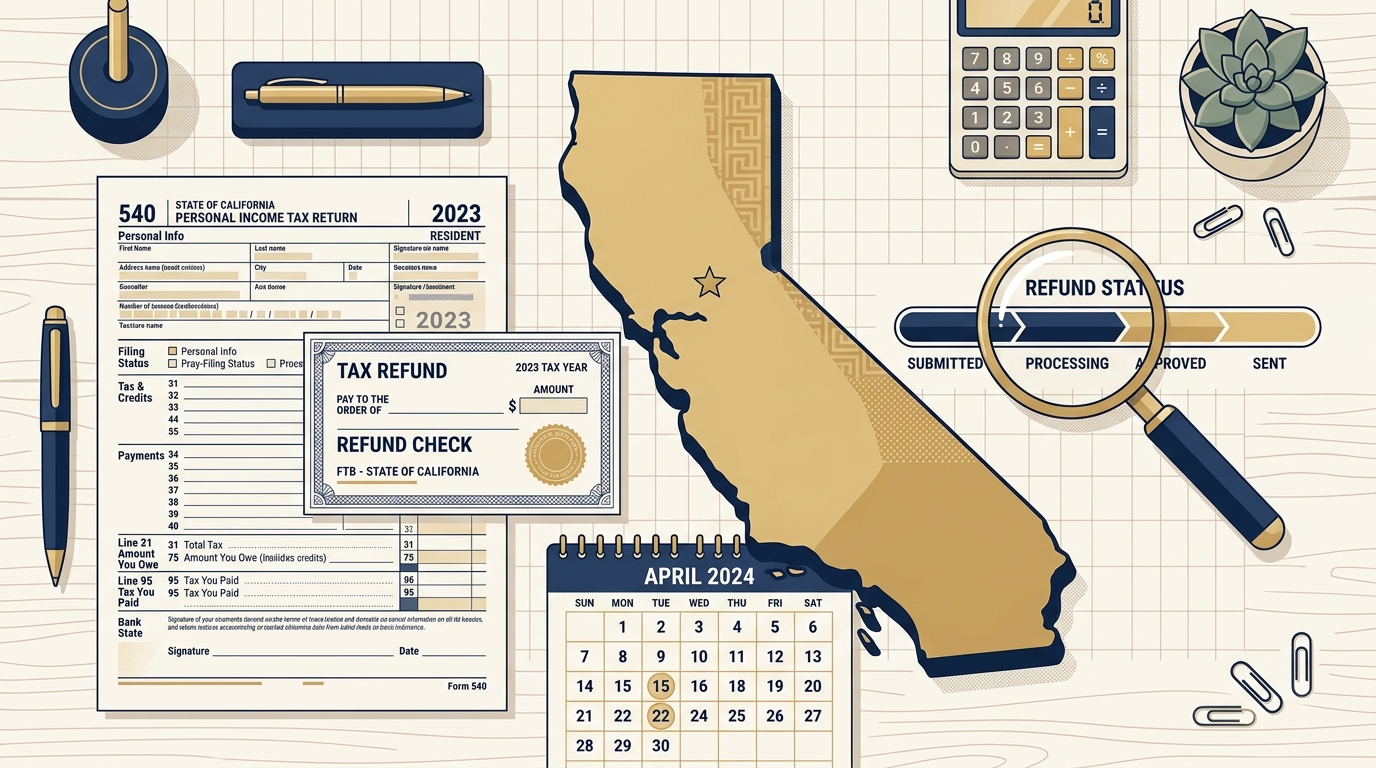
Every filing season, the same scene plays out across California. The return goes out, the confirmation email lands, and then the waiting starts. Two weeks pass. Then four. The Franchise Tax Board refund tracker still says “processing,” and the money that was supposed to cover a tax bill, a roof repair, or a quarterly estimate is sitting somewhere in Sacramento. Most people assume the delay is random. It almost never is. A stalled California tax return refund is usually the result of something specific on the return itself, and once you know what triggers a hold, you can either fix it or avoid it entirely next year.
Quick Answer: How Long Should a California Refund Take?
An electronically filed California return with direct deposit typically produces a refund in about three weeks. A paper return takes roughly three months. Anything beyond those windows usually means the Franchise Tax Board, the state agency that administers personal income tax in California, has flagged the return for identity verification, a math correction, a missing schedule, or a debt offset. You can check status directly through the FTB Where’s My Refund tool using your Social Security number, ZIP code, and the exact refund amount claimed.
Key Takeaway: Three weeks for e-file, three months for paper. Past that, assume something on the return needs attention rather than assuming the state is simply slow.
How the FTB Actually Processes a California Tax Return Refund
Understanding the pipeline matters, because each stage has its own failure point. When your Form 540, the California Resident Income Tax Return, hits the FTB system, it moves through four distinct stages before money leaves the state treasury.
The Four Stages
- Receipt and acceptance: The e-file transmission is validated. Rejections at this stage happen within 24 to 48 hours and are usually caused by a mismatched Social Security number or a prior-year AGI that does not match state records.
- Return validation: The FTB compares your reported wages and withholding against the W-2 and 1099 data employers and payers already submitted. Mismatches trigger manual review.
- Offset screening: Before any refund is released, the amount is screened against outstanding state debts, court-ordered obligations, and federal claims through the Treasury Offset Program.
- Disbursement: Direct deposit posts in two to five business days once approved. Paper checks add another seven to ten days of mail time.
E-File Versus Paper: The Timeline Difference
| Filing Method | Typical Refund Window | Error Rate Risk |
|---|---|---|
| E-file with direct deposit | Up to 3 weeks | Lowest |
| E-file with paper check | 3 to 4 weeks | Low |
| Paper return, direct deposit | Up to 3 months | Higher |
| Paper return, paper check | 3 months or more | Highest |
| Amended return (Schedule X) | 4 to 6 months | Manual review always |
The gap between the top row and the bottom row is roughly eleven weeks of your own money sitting idle. On a $6,000 refund, that is not catastrophic, but for a business owner covering payroll or an investor waiting to fund a down payment, eleven weeks of dead capital is a real cost.
Seven Reasons Your California Tax Return Refund Gets Held
Here is what actually causes the holds, ranked by how often we see them when clients bring us a stalled return.
1. Withholding That Does Not Match State Records
If your Form 540 claims $9,400 in California withholding but the W-2 data on file shows $9,040, the return stops. A single transposed digit buys you a six to eight week manual review. Always pull the actual figure from Box 17 of the W-2 rather than from a pay stub estimate.
2. Identity Verification Letters
California sends identity verification notices aggressively, particularly when a refund is unusually large relative to prior years or when a direct deposit account is new. The letter gives you a response deadline. Miss it and the return sits indefinitely. Nothing restarts until you respond.
3. Missing or Incomplete Schedules
Schedule CA, the California Adjustments schedule, is the single most commonly botched attachment. California does not conform to every federal provision, so the adjustments column exists to reconcile the difference. Leave it blank when it should be populated and the state recomputes your return by hand.
4. Credit Claims Without Documentation
The California Earned Income Tax Credit and the Young Child Tax Credit both carry higher review rates. So does the renter’s credit when address history looks inconsistent. These are legitimate credits worth claiming, but expect a slower path.
5. Business Income Reported Inconsistently
For LLC members, S corporation shareholders, and sole proprietors, mismatches between the entity filing and the personal return are a frequent trigger. If your K-1 shows $84,000 of pass-through income and your Form 540 reports $78,000 without an explanatory adjustment, the refund waits. This is where clean books stop being an accounting preference and start being a cash-flow decision. Our California tax preparation and filing services exist largely to eliminate these reconciliation gaps before a return is ever transmitted. Business owners managing multiple entities should also review our California business owner tax strategy hub for the entity-level planning that prevents these mismatches in the first place.
6. Bank Account Errors
A wrong routing number does not produce an error message. It produces a rejected deposit, which converts your refund into a paper check mailed to the address on the return. That adds three to four weeks minimum.
7. Prior-Year Balances
If you owe from a previous year, the current refund is applied to that balance first. You will receive a notice explaining the application, but the notice often arrives after you have already started wondering where the money went.
Pro Tip: Before filing, request your FTB account transcript through MyFTB. It shows prior balances, estimated payments on record, and withholding the state already has. Reconcile to that, not to your own spreadsheet.
KDA Case Study: The 1099 Consultant Who Waited Fourteen Weeks
Marcus, a 42-year-old independent marketing consultant in Orange County, came to us in July after filing his own return in April. He was expecting a $7,200 California refund driven by large estimated payments he had made the prior year. Fourteen weeks in, the refund tracker still showed processing, and he had received one letter he assumed was a routine notice and filed away unopened.
That letter was an identity verification request with a 30 day response window that had already expired. Worse, when we pulled his transcript, we found the deeper problem. He had made four estimated payments totaling $11,000, but the third payment had been applied to the wrong tax year because the voucher was submitted with an outdated form. The state showed $8,250 on account, not $11,000, so the refund he calculated did not match the refund the state could verify.
We responded to the verification notice, filed a written payment reallocation request, and reconciled his Schedule C income against the 1099-NEC forms his clients had filed. The refund released at $7,150, within $50 of his original figure, about nine weeks after we engaged. More importantly, we restructured his estimated payment schedule and moved him to an entity structure that reduced his self-employment tax exposure by roughly $6,800 annually going forward.
Marcus paid $2,400 for the cleanup and planning engagement. Between the released refund he had nearly written off and the first year of restructuring savings, his return on that fee exceeded 2.8x in year one, and the structural savings repeat every year after.
Ready to see how we can help you? Explore more success stories on our case studies page to discover proven strategies that have saved our clients thousands in taxes.
Red Flag Alert: Offsets, Intercepts, and the Notice You Ignored
Red Flag Alert: California participates in an interagency offset program that allows your state refund to be intercepted for debts that have nothing to do with taxes. Unpaid court fines, delinquent child support, defaulted state university balances, DMV obligations, and certain county debts can all claim your refund before you see a dollar. The intercept is legal, automatic, and does not require your consent.
The federal side works the same way. Under the Treasury Offset Program, described in IRS Topic No. 203, refunds can be reduced for past-due support and certain federal debts. California’s program mirrors that structure at the state level.
What makes offsets painful is the sequencing. You typically learn about the offset after it happens, through a notice that arrives weeks later. If you believe the underlying debt is wrong, the dispute goes to the agency that claimed the money, not to the FTB. The FTB is the collector, not the creditor.
The second red flag is the unopened envelope. State correspondence carries response deadlines, and those deadlines are not suggestions. A notice that sits on the kitchen counter for 45 days converts a two-week fix into a three-month one. Open every piece of state mail the day it arrives, even if you file it immediately after reading.
Step-by-Step: How to Track, Chase, and Unlock a Delayed Refund
- Confirm acceptance first: Verify your return was accepted, not just transmitted. Your preparer or software should show an acceptance acknowledgment. Takes two minutes.
- Check the refund tracker with exact figures: Enter the refund amount to the dollar. A rounded figure returns no match and creates false alarm. Takes one minute.
- Create or log into MyFTB: The online account shows notices issued, payments posted, and balances due that the public tracker does not display. Registration requires a mailed authorization code, so allow seven to ten days if you are new.
- Pull your account transcript: Compare withholding and estimated payments on record against what you claimed. This single step identifies the majority of holds.
- Respond to any open notice in writing: Send the requested documentation with a cover letter referencing the notice number and tax year. Keep proof of delivery.
- Call only after 21 days for e-file or 90 days for paper: Calling earlier wastes your time. Representatives cannot expedite a return still inside the normal processing window.
- Escalate to the Taxpayer Advocate if a hardship exists: California maintains a Taxpayers’ Rights Advocate office that can intervene when a delay causes genuine financial hardship and normal channels have failed.
Why a Large Refund Is Not the Win You Think It Is
Here is the contrarian part. A $9,000 refund is not a windfall. It is a receipt showing you lent the state and federal government roughly $750 a month at zero percent interest for a year. For a W-2 employee, that is an inconvenience. For a business owner or a real estate investor carrying a line of credit at 9 percent, that same over-withholding costs real money in interest you would not otherwise pay.
The better target is a refund between zero and about $1,000. That range keeps you clear of underpayment penalties while leaving the cash in your accounts where it works. Before you adjust anything, run your projected numbers through a federal tax calculator so you know what your actual liability looks like rather than guessing.
Should You Adjust Your Withholding?
Yes, reduce your withholding if:
- Your refund exceeded $5,000 in each of the last two years
- Your income and deductions are stable year over year
- You carry any debt at an interest rate above 5 percent
No, leave it alone if:
- Your income varies significantly, such as commission or 1099 work
- You have owed a balance and paid an underpayment penalty in the last three years
- You use the refund as a forced savings mechanism and know you will not save otherwise
Special Situations and Edge Cases Most Articles Skip
Part-Year Residents and Movers
If you moved into or out of California during the year, you file Form 540NR rather than Form 540, and the refund calculation depends on the income sourcing rules. California taxes nonresidents on California-source income, which means a remote worker who left the state mid-year may still owe on wages earned while physically present. These returns get reviewed more closely and run longer.
Amended Returns
To amend a California return, you file the original form with Schedule X attached explaining the changes. Expect four to six months. Amended returns never process automatically. Do not amend to chase a small correction the state will catch anyway.
The Four-Year Refund Deadline
California generally allows four years from the original due date to claim a refund. Miss that window and the money is gone permanently, regardless of how legitimate the claim is. If you have unfiled years with withholding on record, file them.
Refunds for a Deceased Taxpayer
A refund owed to someone who has passed requires additional documentation from the personal representative. Without it, the refund holds indefinitely rather than being denied, which is why families often discover the issue years later.
Is Your California Refund Taxable on Your Federal Return?
Sometimes. If you itemized deductions on your federal return and deducted state income taxes, part or all of your state refund may be taxable federal income in the year you receive it. This is the tax benefit rule, explained in IRS Publication 525. If you claimed the standard deduction, your state refund is generally not taxable federally.
California issues Form 1099-G reporting the refund amount. Receiving that form does not automatically mean the amount is taxable. It means the state reported it, and your federal treatment depends on what you did the prior year. Plenty of taxpayers pay federal tax on a refund they never owed tax on simply because the 1099-G showed up and got entered without analysis.
Ready to Reduce Your Tax Bill?
KDA Inc. specializes in strategic tax planning for business owners, S Corps, LLCs, and high-net-worth individuals. Book a personalized consultation and walk away with a clear plan.
Frequently Asked Questions
Can I change my direct deposit information after filing?
No. Once a return is filed, the banking information cannot be modified. If the deposit rejects, the state issues a paper check to the address on the return. Update your address first if you have moved.
Does filing an extension delay my refund?
California grants an automatic extension to file, but the extension does not start your refund clock. Your refund processes from the date the actual return is filed, not the original deadline. Filing in October means a refund in November at the earliest.
Why is my state refund smaller than I calculated?
The three most common causes are a math correction by the FTB, an offset for another debt, or a disallowed credit. In every case, a notice explaining the adjustment is mailed separately from the refund itself, usually arriving a week or two later.
Can I split my refund between accounts?
California does not offer the multi-account split that the federal system allows. One account, one deposit.
Here is the line worth remembering: a delayed refund is rarely a processing problem, it is a documentation problem wearing a disguise.
This information is current as of 9/28/2026. Tax laws change frequently. Verify updates with the IRS or FTB if reading this later.
Stop Guessing and Get Your Refund Released
If your refund has been sitting in limbo for more than a month, or if you are tired of handing the state an interest-free loan every single year, that is a fixable problem. Our team reconciles state transcripts, responds to FTB notices, and rebuilds withholding and estimated payment schedules so your cash stays where it belongs. Book your tax strategy session with KDA today and get a clear plan for this filing season and the next one.



