
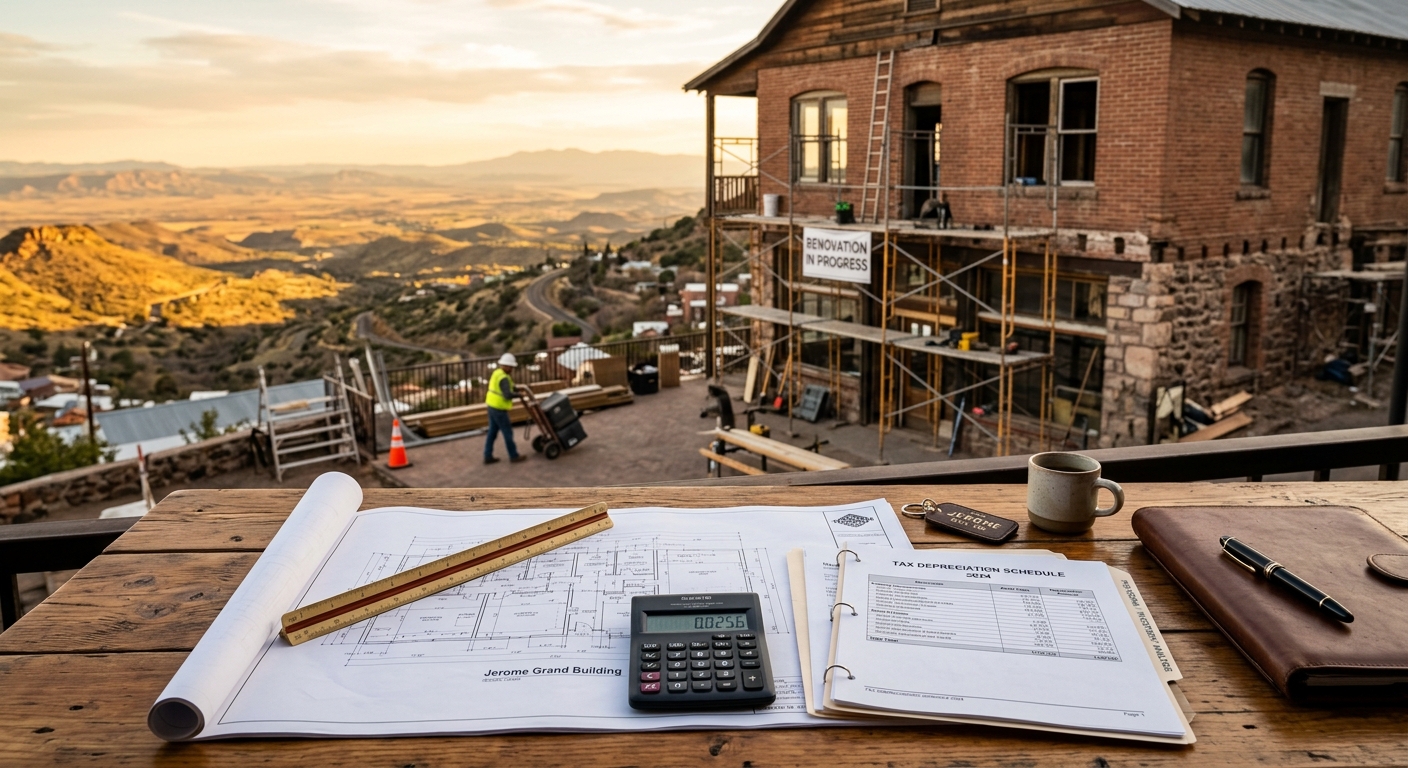
If you own investment property in this historic Yavapai County town, understanding cost segregation Jerome AZ strategies could be the single most valuable move you make this year. Jerome is a small mountain town packed with older buildings, vacation rentals, and commercial spaces that were built decades ago, and that unique real estate profile makes it a surprisingly strong candidate for accelerated depreciation. For property owners who work with the right advisors, the tax savings can reach into the tens of thousands of dollars in the very first year. If you want a partner who understands Arizona real estate taxation, our team specializing in cost segregation services in Jerome can help you unlock that value.
This information is current as of 9/26/2026. Tax laws change frequently. Verify updates with the IRS or your state tax authority if reading this later.
Quick Answer: What Is Cost Segregation and Why Does It Matter in Jerome?
Cost segregation is a tax strategy that lets real estate investors reclassify parts of a building into shorter depreciation categories so they can deduct those costs faster. Instead of writing off an entire property over 27.5 or 39 years, a study can move items like flooring, fixtures, and land improvements into 5, 7, or 15 year buckets. For a Jerome rental valued at $600,000, this can generate first-year deductions of $80,000 to $150,000 depending on the property mix.
Why Cost Segregation Jerome AZ Investors Should Pay Attention Now
Jerome sits on a hillside overlooking the Verde Valley, and its real estate market is unlike anywhere else in Arizona. The town is filled with converted mining-era buildings, boutique short-term rentals, art galleries, and small commercial properties. Many of these structures were purchased or renovated in recent years, which means owners are sitting on depreciable improvements they may not even realize qualify for accelerated treatment.
Here is the core idea in plain English. When you buy a building, the IRS normally makes you spread the deduction for that cost across nearly three or four decades. A cost segregation study is like taking a magnifying glass to your property and pulling out every component that legally deserves a faster write-off. Think of it as unbundling one slow deduction into several fast ones.
The reason timing matters in 2026 is bonus depreciation. Under recent federal tax legislation, bonus depreciation rules were adjusted, and the ability to immediately expense qualifying short-life assets remains a powerful lever. When you combine a cost segregation study with bonus depreciation, the components that get reclassified into 5, 7, and 15 year categories can often be deducted almost entirely in year one. That is where the largest savings come from.
For investors in Jerome and the surrounding Yavapai County area, this creates a rare window. Property values have appreciated, renovation activity is high, and the tax code still rewards those who move quickly and document properly.
How Cost Segregation Works: A Step-by-Step Breakdown
Most property owners have heard the term but have no idea what actually happens during a study. Here is the process from start to finish.
- Property analysis – An engineering-based team reviews your purchase price, closing documents, blueprints if available, and physical property. This typically takes one to two weeks.
- Component identification – The team separates the building into its parts: structure, electrical systems, plumbing, flooring, cabinetry, landscaping, parking, signage, and more.
- Cost allocation – Each component gets assigned a value and a proper depreciation life under IRS guidelines.
- Report generation – You receive a detailed, audit-ready study documenting every reclassification with supporting evidence.
- Tax filing integration – Your tax professional applies the accelerated deductions to your return, and if you are catching up on prior years, files Form 3115 to capture missed depreciation.
The entire process usually takes 30 to 45 days from engagement to delivered report. The best part is that if you have owned the property for several years without doing a study, you can still capture the missed deductions retroactively without amending old returns.
KDA Case Study: Jerome Short-Term Rental Investor Recovers $47,000
Consider a real estate investor we will call Marcus, a 1099 consultant who purchased a converted historic building in Jerome for $585,000 and operated it as a high-end vacation rental. Marcus had been depreciating the entire property over 39 years, generating a modest annual deduction of roughly $15,000. He assumed that was simply how commercial-style property worked, and he had no idea he was leaving substantial money on the table.
When Marcus came to KDA, our team performed an engineering-based cost segregation analysis. We identified that nearly 32 percent of the building value, close to $187,000, qualified for 5, 7, and 15 year depreciation categories. This included custom cabinetry, specialty lighting, flooring, exterior landscaping, a paved parking area, and dedicated appliance circuits.
By combining the reclassification with available bonus depreciation, Marcus captured a first-year deduction of approximately $138,000 instead of $15,000. At his marginal tax rate, that translated to roughly $47,000 in first-year tax savings. He paid $6,500 for the study and integration work, which produced a first-year return of more than 7 times his investment.
Marcus reinvested that savings into a second property, effectively using the tax code to accelerate his portfolio growth. His story is common among investors who finally take advantage of what the law allows.
Ready to see how we can help you? Explore more success stories on our case studies page to discover proven strategies that have saved our clients thousands in taxes.
Which Jerome Properties Qualify for Cost Segregation?
Not every property produces the same results, but the range of qualifying real estate is broader than most people assume. Our Jerome cost segregation team regularly works with investors who own the following property types.
- Short-term and vacation rentals – Jerome is a tourism destination, and furnished rentals are loaded with qualifying components.
- Commercial buildings – Galleries, restaurants, wineries, and retail spaces contain significant short-life assets.
- Long-term residential rentals – Even standard rental homes benefit, especially after renovations.
- Mixed-use properties – Buildings with both living and business space often have the highest reclassification percentages.
Key Takeaway: If your property is worth at least $300,000 and you have owned it for a few years or recently purchased it, a study almost always pays for itself many times over.
Should You Get a Cost Segregation Study?
Yes, if:
- Your property basis is $300,000 or more
- You have taxable income the deductions can offset
- You plan to hold the property for at least a few years
- You have completed renovations or improvements
Probably not, if:
- Your property basis is under $150,000
- You expect to sell within 12 months
- You have little or no taxable income to shelter
The Numbers: A Real-World Cost Segregation Example
Let us walk through the math so you can see exactly how the savings materialize. Assume you own a Jerome rental with a depreciable building basis of $500,000.
| Depreciation Method | Year 1 Deduction | Tax Savings at 32% |
|---|---|---|
| Standard straight-line (27.5 yr) | $18,182 | $5,818 |
| Cost segregation with bonus depreciation | $135,000 | $43,200 |
In this scenario, the study accelerates roughly $37,000 in additional first-year tax savings. If you want to estimate the potential impact of a real estate sale or capital event down the road, running your numbers through a capital gains tax calculator can help you plan for the depreciation recapture that eventually comes due.
Common Mistakes Jerome Real Estate Investors Make
Even savvy investors trip over the same avoidable errors. Here are the ones we see most often.
Mistake 1: Assuming It Is Too Late
Many owners believe cost segregation only works in the year of purchase. In reality, you can perform a look-back study on property you have held for years and capture all the missed depreciation at once using a change in accounting method.
Mistake 2: Ignoring Depreciation Recapture
Accelerated depreciation is powerful, but it is not free money. When you sell, some of those deductions get recaptured and taxed. A good tax strategy accounts for this in advance, often pairing the study with a 1031 exchange plan to defer the recapture entirely.
Mistake 3: Using a DIY or Non-Engineering Approach
The IRS expects engineering-based studies with proper documentation. A cheap or estimate-only study can trigger scrutiny. According to the IRS Cost Segregation Audit Techniques Guide, the quality and methodology of the study directly affect how well it holds up under examination.
Mistake 4: Forgetting the Passive Activity Rules
Large paper losses from depreciation may be limited by passive activity loss rules unless you qualify as a real estate professional or use the short-term rental exception. Planning around these rules is essential to actually use the deductions.
California and Multi-State Considerations for Arizona Investors
Many Jerome property owners live in California or other states while holding their Arizona real estate as an investment. This creates important cross-border considerations. Arizona conforms to federal depreciation rules in most respects, but California does not fully conform to bonus depreciation, which means a California resident with Arizona property may see different results on their federal versus state returns.
If you file in multiple states, coordination becomes critical. Our team helps investors reconcile these differences so the federal savings are maximized while state filings remain accurate. This is precisely the kind of complexity that generic online guidance ignores, and it is where working with professionals who understand both federal and state treatment pays off. You can learn more about our full range of tax and advisory services to see how these strategies fit together.
Ready to Reduce Your Tax Bill?
KDA Inc. specializes in strategic tax planning for business owners, S Corps, LLCs, and high-net-worth individuals. Book a personalized consultation and walk away with a clear plan.
Frequently Asked Questions About Cost Segregation in Jerome
How much does a cost segregation study cost?
For most Jerome properties, an engineering-based study ranges from $4,000 to $12,000 depending on property size and complexity. The tax savings almost always exceed the cost by several multiples in the first year.
Can I do a study on a property I bought years ago?
Yes. A look-back study lets you capture all previously missed depreciation in the current year by filing Form 3115. You do not need to amend prior returns.
Does cost segregation increase my audit risk?
A properly documented, engineering-based study performed by qualified professionals is fully supported under IRS guidelines. The key is quality documentation, not avoidance of the strategy.
What happens to my savings when I sell the property?
Some accelerated depreciation is recaptured at sale and taxed. Strategic investors often defer this through a 1031 exchange or plan the timing to minimize the impact.
Do short-term rentals in Jerome qualify?
Absolutely. Vacation rentals are often the strongest candidates because they contain a high percentage of short-life components like furnishings, fixtures, and appliances.
How long does the whole process take?
From engagement to a completed, filing-ready report typically takes 30 to 45 days.
What Happens If You Skip Cost Segregation?
The cost of doing nothing is simply lost money. If you continue depreciating a $500,000 property over 27.5 years instead of accelerating qualifying components, you may defer $30,000 to $45,000 in tax savings that you could have used this year to reinvest, pay down debt, or grow your portfolio. Money today is worth more than money spread out over three decades, and inflation only makes that gap wider.
For investors who are actively acquiring or improving Jerome properties, skipping this strategy year after year quietly compounds into six figures of foregone savings over a portfolio lifetime.
Ready to work with a tax professional who understands Jerome and Yavapai County real estate? Explore our local Jerome tax services or book a consultation below.
Book Your Cost Segregation Strategy Session
If you own investment property in Jerome and you are still depreciating it the slow way, you are likely leaving tens of thousands of dollars unclaimed. Let our team run the numbers, identify every qualifying component, and build an audit-ready study that puts real cash back in your pocket this year. Click here to book your personalized cost segregation consultation now.



