
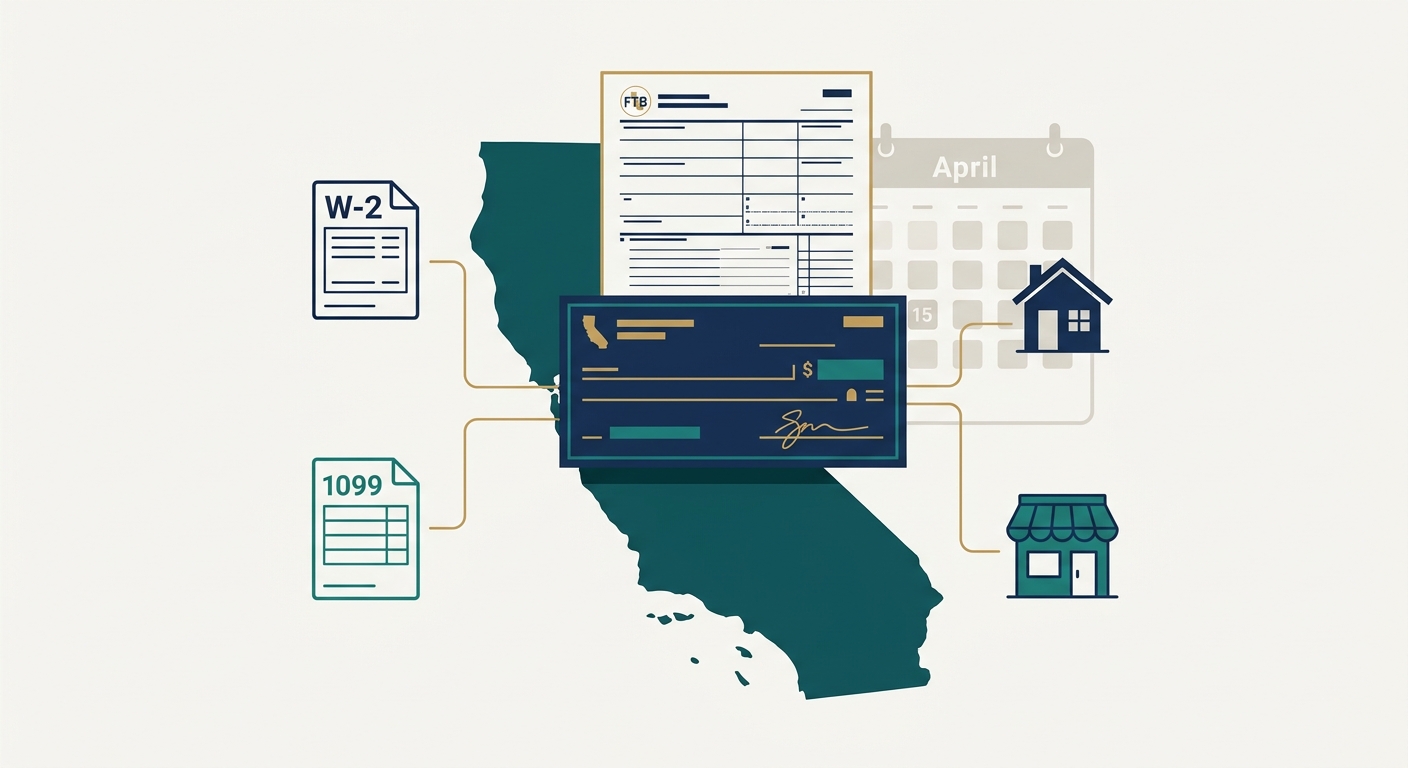
Every spring, thousands of Californians refresh the Franchise Tax Board refund tracker like it owes them money. Technically, it does. But the frustration is rarely about the tracker. It is about not understanding why the number is smaller than expected, why it is taking nine weeks instead of two, or why the state kept part of it without asking.
Here is the turn: a california tax return refund is not a bonus, a prize, or a reward for good behavior. It is the state returning money you loaned it interest free for up to fifteen months. And once you understand the mechanics behind how that refund gets calculated, delayed, reduced, or seized, you stop being a passenger in the process and start controlling it.
This guide breaks down exactly how California refunds work in 2026, what slows them down, what triggers a review, how offsets quietly shrink them, and how to stop overpaying in the first place.
Quick Answer: How a California Tax Return Refund Actually Works
A california tax return refund is the difference between what you paid California during the year through withholding and estimated payments, and what you actually owed after credits. If you paid more than you owed, the Franchise Tax Board sends the difference back. E-filed returns with direct deposit typically process in up to three weeks. Paper returns typically take up to three months. Returns flagged for identity or income verification can take significantly longer.
Key Takeaway: The Franchise Tax Board, not the IRS, handles your state refund. Your federal refund and your state refund move on completely separate timelines and can differ wildly in both amount and arrival date.
What Is the Franchise Tax Board and Why Does It Control Your Refund?
The Franchise Tax Board (FTB) is California’s state income tax agency. It is the state equivalent of the IRS. The IRS administers federal income tax. The FTB administers California personal income tax and corporate franchise tax. They are separate agencies with separate systems, separate notices, and separate processing queues.
This matters more than most taxpayers realize. People call us in March genuinely confused because their federal money landed in eleven days and their state money has not moved at all. Nothing is wrong. The two agencies simply do not talk to each other in real time and do not share a processing calendar.
Which Form Generates Your Refund?
Most California residents file Form 540, the California Resident Income Tax Return. Part-year residents and nonresidents with California-source income file Form 540NR. The refund line appears near the bottom of the return, after all credits and payments are applied against your total state tax liability.
Your refund is arithmetic, not opinion. Total California tax owed, minus California withholding from your W-2 (Box 17), minus estimated payments you made during the year, minus refundable credits. If that math lands negative, you get a refund. If it lands positive, you write a check.
The Three Inputs That Determine Your Refund Size
- Withholding accuracy – How closely your DE 4 allowance election matched your actual tax situation
- Estimated payments – What you sent in quarterly if you have self-employment or investment income
- Credits claimed – California Earned Income Tax Credit, Young Child Tax Credit, renter’s credit, dependent exemption credits
Miss one of those credits and your refund shrinks by hundreds or thousands. The renter’s credit alone is worth $60 for single filers and $120 for joint filers who meet the income limits, and it is one of the most commonly skipped items on a self-prepared return.
2026 Processing Timelines: What Is Normal and What Is Not
Timeline anxiety drives most of the refund questions we field. So let’s set real expectations for the 2026 filing season, covering 2025 tax year returns.
Standard Processing Windows
| Filing Method | Typical Window | Refund Delivery |
|---|---|---|
| E-file + direct deposit | Up to 3 weeks | Fastest option |
| E-file + paper check | Up to 4 weeks | Mail adds 5 to 10 days |
| Paper return + direct deposit | Up to 3 months | Manual data entry required |
| Paper return + paper check | 3 months or more | Slowest possible route |
| Amended return (Form 540X) | 4 to 6 months | Manual review always |
Those are FTB’s own published expectations, not estimates. A paper return is roughly four times slower than an e-filed one for the same refund. There is no strategic reason to file on paper in 2026 unless your specific situation blocks e-filing.
Why Filing Early Does Not Always Mean Getting Paid Early
Filing on January 20 does not guarantee money by February 10. The FTB batches returns, runs fraud screening, and cross-matches wage data reported by employers. If your employer’s wage reporting has not posted to the state system yet, your return sits in a verification queue until the data arrives. Waiting until early February, after all W-2 and 1099 data has been transmitted to the state, often produces a faster net result than filing the second the window opens.
Pro Tip: Check your california tax return refund status using the FTB’s online refund tool rather than calling. Phone hold times during peak season routinely run past an hour, and the phone representative sees the exact same screen you do.
Five Reasons Your California Tax Return Refund Is Delayed
When a refund stalls past the normal window, it is almost never random. Here are the actual causes, ranked by how often we see them.
1. Identity Verification Hold
California aggressively screens for refund fraud. If your return pattern changed, new address, new bank account, significantly different income, dependent claimed for the first time, the FTB may issue an identity verification letter. Until you respond, your refund does not move. These letters get mistaken for junk mail constantly. Open every envelope from the Franchise Tax Board.
2. Income Mismatch Against Reported Wage Data
The state receives W-2 and 1099 data independently from employers and payers. If your reported income does not match what the state received, the return goes to manual review. This happens frequently to people who forgot a 1099-NEC from a short contract gig or omitted a 1099-INT from a savings account.
3. Math or Credit Eligibility Errors
Claiming the California Earned Income Tax Credit without qualifying income, or claiming a dependent who was also claimed on another return, triggers a hold. The FTB will often adjust the return itself and send a reduced refund with an explanatory notice, rather than rejecting the whole filing.
4. Refund Offset for Other Debts
This one blindsides people. California participates in the Interagency Intercept Collection program. Your refund can be intercepted to pay unpaid child support, delinquent court fines, outstanding vehicle registration, unpaid tuition at a state college, or prior year tax debt. You receive a notice after the fact explaining who took it and why.
5. First Time Filing or Long Filing Gap
If you have never filed in California, or have not filed for several years, the state has no baseline to compare against. Expect extra scrutiny and a longer wait on that first return.
Red Flag Alert: If it has been more than twelve weeks since you e-filed and the refund tracker still shows no progress, you likely have an unopened notice sitting somewhere. Do not keep waiting passively. A stalled refund almost always means the FTB is waiting on you, not the other way around.
KDA Case Study: The Self-Employed Designer Who Was Lending California $9,400 a Year
Marissa, a 34 year old freelance brand designer in Long Beach, came to us in February with what she described as a good problem. She had received a $9,400 california tax return refund two years running and treated it as forced savings for a summer trip.
Her setup: roughly $142,000 in 1099 income, one legacy part-time W-2 job at a studio where she had elected the maximum extra state withholding years earlier and never revisited it, plus quarterly estimated payments she was calculating from the prior year’s numbers without adjusting for deductions.
She was double paying. The W-2 over-withholding and the estimated payments were both sized as though the other did not exist. On top of that, she had never taken a home office deduction, had not been tracking the $6,800 in annual software and equipment costs properly, and was not deducting the self-employment health insurance premiums she paid out of pocket.
What we did: restructured her DE 4 withholding down to accurate levels, rebuilt her quarterly estimated payment schedule off current year projections rather than stale numbers, documented and claimed the home office deduction using the simplified method, captured the equipment and software write-offs, and claimed the self-employed health insurance deduction. We also modeled whether an S Corp election made sense at her profit level and advised waiting one more year rather than pushing her into payroll complexity prematurely.
Result: her actual combined federal and state tax liability dropped by $7,900 in the first year. Her refund shrank to $1,100, which was the entire point. She recovered roughly $8,300 in cash flow spread across the year instead of waiting until April for a lump sum. She paid $2,700 for the engagement. First year return: 2.9x.
If you are self-employed and your books are running on guesswork, our tax preparation and filing services catch the deductions that self-prepared returns routinely leave behind.
Ready to see how we can help you? Explore more success stories on our case studies page to discover proven strategies that have saved our clients thousands in taxes.
The Big Refund Trap: Why a Large Check Is a Planning Failure
Let’s kill a myth. A large refund is not a win. It is evidence that you overpaid the state by a meaningful margin and received zero compensation for the use of your money.
Run the math. A $6,000 refund means you averaged roughly $500 per month of excess payment across the year. Parked in a high yield savings account earning four percent, that same money would have generated around $130 in interest. Applied to a credit card balance carrying twenty two percent interest, it would have saved you closer to $700. Contributed monthly to a retirement account, it compounds for decades.
California does not pay you interest on money it holds during the year. You are running an interest free lending operation for a state government.
The Counterargument, Addressed Honestly
Some people genuinely cannot save unless the money is out of reach. That is a real behavioral consideration and we do not dismiss it. But there are better mechanisms. An automatic transfer to a separate savings account on payday accomplishes the same forced saving and actually earns you something. The refund method is the most expensive version of a savings plan available.
The Right Refund Target
- Ideal range: A small refund or a small balance due, within a few hundred dollars either direction
- Acceptable: Up to roughly $1,500 refund if your income is variable and hard to predict
- Needs fixing: Anything consistently above $3,000 year after year
If you want to see where your total federal number is likely to land before you adjust anything, run your figures through this federal tax calculator and work backward from there.
How to Fix Your Withholding and Stop Overpaying California
Adjusting withholding is the single highest leverage move available to a W-2 employee who keeps getting oversized refunds. It takes about fifteen minutes.
Step-by-Step: Correcting Your California Withholding
- Pull your most recent pay stub – Locate the year to date California state income tax withheld figure. This takes two minutes.
- Find last year’s total California tax – On your Form 540, this is your total tax line, not your refund and not your withholding.
- Compare the two trajectories – Annualize your current year to date withholding. If the projected total materially exceeds last year’s tax liability and your income has not jumped, you are over-withholding.
- Complete a new Form DE 4 – This is California’s Employee’s Withholding Allowance Certificate, the state counterpart to the federal Form W-4. Increase your allowances or remove any additional flat dollar withholding you previously elected.
- Submit it to payroll and verify – Check the next two pay stubs to confirm the change took effect. Payroll errors on this are common.
Timeline: changes typically appear within one to two pay cycles. Make the adjustment in January or February and you capture the benefit across the entire remaining year.
If You Are Self-Employed Instead
You do not have a DE 4 to adjust. Your lever is Form 540-ES, the estimated tax voucher. Recalculate each quarter based on actual year to date profit rather than blindly repeating last year’s payment amount. California estimated payment due dates are April 15, June 15, September 15, and January 15, and California uses an unusual front loaded schedule requiring thirty percent, forty percent, zero percent, and thirty percent across those four installments. That third quarter zero surprises almost everyone.
For a sense of what your quarterly obligation should actually look like, the self-employment tax calculator gives you a workable starting figure before you finalize the vouchers.
California Credits That Quietly Increase Your Refund
Every credit you fail to claim is refund money left with the state permanently. These are the ones most commonly missed on self-prepared California returns.
California Earned Income Tax Credit (CalEITC)
A refundable credit for lower income working Californians. Refundable means it can generate a refund even if you owed no tax at all. It applies to both W-2 and self-employment income. Many eligible filers skip it because they assume it mirrors the federal EITC rules exactly. It does not, and the California income thresholds differ.
Young Child Tax Credit
Available to CalEITC qualifiers with at least one child under the age of six. It stacks on top of the CalEITC rather than replacing it.
Nonrefundable Renter’s Credit
$60 for single filers, $120 for joint filers, available to California renters under the income limits who rented their principal residence for at least half the year. Small, but it is pure refund and takes one line to claim.
Dependent Parent and Senior Head of Household Credits
Both are routinely overlooked by people supporting aging parents. These are state-specific credits with no direct federal equivalent, which is precisely why software users blow past them.
Key Takeaway: California maintains state-only credits that do not exist federally. Preparing your state return as a copy paste of your federal return guarantees you leave money behind.
What Happens If the FTB Takes Your Refund
Refund offset is the outcome people find most upsetting, because it happens without any advance conversation.
Who Can Intercept Your California Refund
- California Department of Child Support Services for past due support obligations
- Courts and counties for unpaid fines, fees, and traffic citations
- The Department of Motor Vehicles for outstanding registration balances
- California public colleges and universities for unpaid tuition
- The FTB itself for prior year state tax debt
- The IRS, through the Treasury Offset Program, in certain federal debt situations
What to Do When It Happens
You receive a notice identifying the intercepting agency and the amount taken. Critically, you dispute the underlying debt with that agency, not with the FTB. The FTB is just the collection mechanism. Calling them about a child support intercept wastes your afternoon.
If the offset was applied to a debt that was already satisfied or does not belong to you, gather proof of payment and contact the originating agency directly. If the intercept relates to a prior year California tax balance you dispute, that is a different conversation entirely and our audit representation services handle those directly with the state.
Injured Spouse Situations
If you filed jointly and your refund was intercepted for a debt belonging solely to your spouse, you may be able to recover your share. California has a process for this, and it requires proactively filing a claim. The money does not come back automatically.
Ready to Reduce Your Tax Bill?
KDA Inc. specializes in strategic tax planning for business owners, S Corps, LLCs, and high-net-worth individuals. Book a personalized consultation and walk away with a clear plan.
Frequently Asked Questions About California Tax Return Refunds
Why is my California refund smaller than my federal refund?
Different tax rate structures and different credit systems. California has its own bracket schedule and its own standard deduction, both of which differ substantially from federal figures. Your California withholding is also typically a much smaller share of your paycheck than federal withholding. A smaller state refund is normal and usually means nothing is wrong.
How long can California hold my refund before paying interest?
The FTB generally must pay interest if a refund is not issued within a defined period after the later of the filing due date or the date the return was actually filed. In practice, interest on delayed refunds is uncommon because most delays are attributed to taxpayer response time on verification requests rather than agency processing time.
Can I still get a refund if I file a prior year California return late?
Yes, within limits. California generally allows a refund claim within four years of the original due date of the return, or one year from the date of overpayment, whichever is later. That four year window is longer than the federal three year statute, meaning some people who lost their federal refund to the deadline can still recover the state portion.
Does an amended return delay my original refund?
Not usually. If your original return already processed and the refund was issued, filing Form 540X to amend it is handled separately. Any additional refund from the amendment arrives later, typically four to six months out, because amended returns require manual review.
Will checking my refund status repeatedly slow it down?
No. The refund tracker is a read only lookup. Checking it hourly does nothing except raise your blood pressure. Once weekly is plenty.
The Bottom Line on Your California Refund
The size of your california tax return refund tells you almost nothing about whether you did your taxes well. A $7,000 refund can reflect a year of terrible planning. A $200 refund can reflect a year of excellent planning. The number that actually matters is your total tax liability, and that is determined by the deductions you documented, the credits you claimed, and the entity and withholding decisions you made months before you ever opened a filing portal.
Stop measuring your tax outcome by the refund. Start measuring it by what you kept.
Per IRS Publication 505, taxpayers are required to pay tax as income is earned throughout the year, which is exactly why withholding and estimated payment accuracy matters more than the April headline number. For business expense substantiation standards that support the deductions reducing your liability in the first place, see IRS Publication 535.
This information is current as of 9/26/2026. Tax laws change frequently. Verify updates with the IRS or FTB if reading this later.
Get Your Refund Right Before Next Filing Season Starts
If you have received an oversized California refund two years in a row, you are not winning. You are financing state government operations for free while your own cash flow stays tight all year. And if your refund came back smaller than expected, was delayed for months, or got intercepted without warning, there is a specific fixable reason behind it. Our team will review your last two returns, identify the California credits you missed, correct your withholding or estimated payment schedule, and build a plan that puts your money in your account during the year instead of in Sacramento’s. Click here to book your consultation now.



