
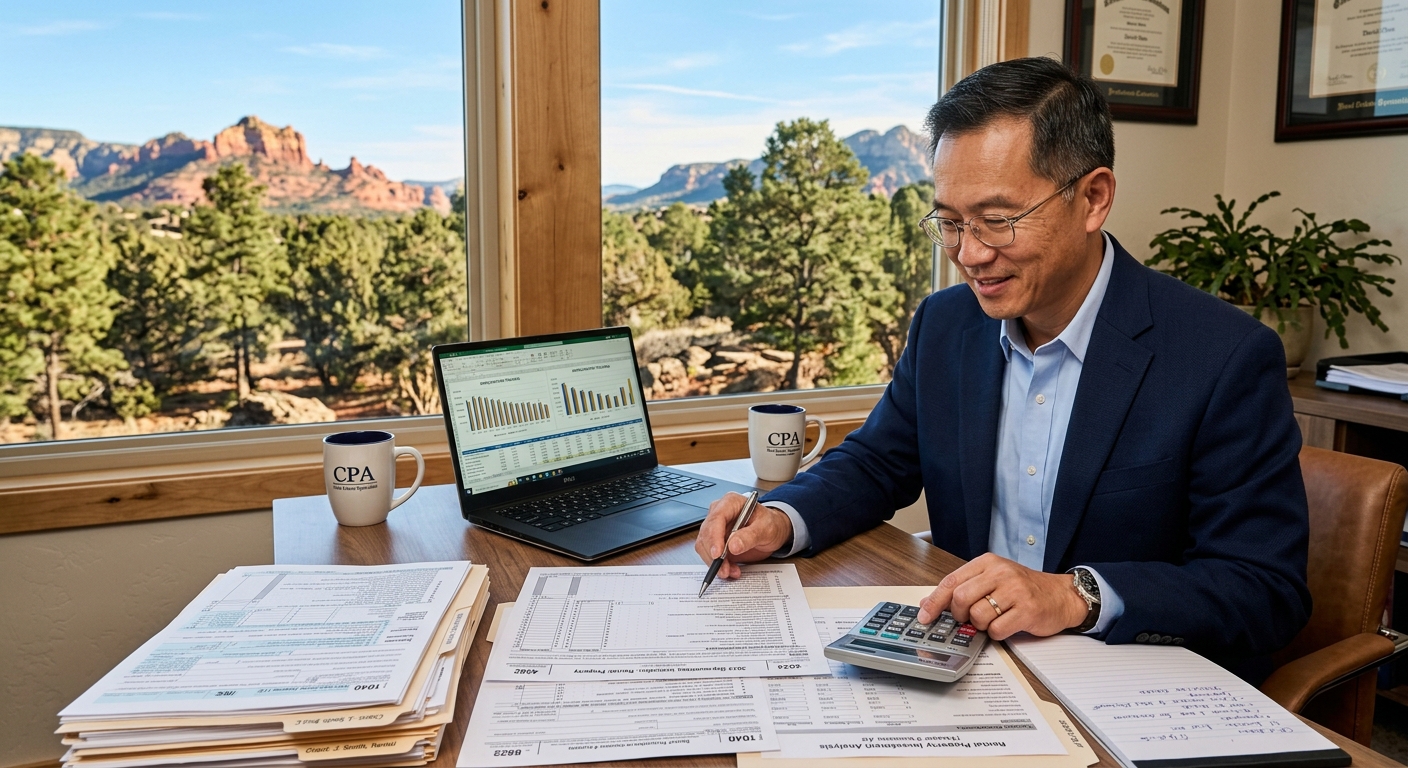
If you own rental property, flip homes, or hold a growing portfolio anywhere in the high country, finding the best real estate CPA Yavapai County has to offer is not a luxury. It is the single highest-leverage financial decision most property investors will make all year. The difference between a generalist who files your return and a strategist who plans your taxes can easily reach five figures annually. This is not an exaggeration. It is math, and we see it play out on real returns every tax season.
Yavapai County covers Prescott, Prescott Valley, Sedona, Cottonwood, Chino Valley, and the surrounding areas, and it has become one of Arizona’s most active real estate markets for both long-term rentals and short-term vacation properties. That activity creates opportunity, and it creates tax complexity. This 2026 guide walks you through exactly what a top real estate CPA does, how to evaluate one, and the specific strategies that separate the best from the rest.
Quick Answer
The best real estate CPA in Yavapai County is one who does year-round tax planning, not just April filing. They understand depreciation, cost segregation, the short-term rental loophole, 1031 exchanges, and Arizona-specific rules. A strong real estate CPA typically saves investors 3 to 10 times their fee, meaning a $3,000 engagement can return $9,000 to $30,000 in tax savings for an active portfolio.
This information is current as of 8/28/2026. Tax laws change frequently. Verify updates with the IRS or the Arizona Department of Revenue if reading this later.
What the Best Real Estate CPA in Yavapai County Actually Does
Most people think a CPA just prepares tax returns. A great real estate CPA does something entirely different. They engineer your tax outcome before the year ends, when there is still time to change the result. Filing is backward-looking. Planning is forward-looking. The best real estate CPA Yavapai County investors can hire spends the majority of their value in the planning phase.
Here is what genuine real estate tax expertise looks like in practice:
- Depreciation optimization (in plain English: legally writing off the cost of your building over time to offset rental income)
- Cost segregation analysis to accelerate deductions in the early years of ownership
- Passive activity loss planning under the IRS rules that limit how much rental loss you can deduct
- Real estate professional status qualification, which unlocks unlimited loss deductions for those who qualify
- 1031 exchange coordination to defer capital gains when you sell and reinvest
- Entity structuring to protect assets and reduce self-employment tax exposure on flips
A generalist CPA may know these terms. A specialist lives in them daily. When you are interviewing candidates, ask them to explain a cost segregation study without notes. If they hesitate, keep looking.
Planning vs. Filing: Why the Distinction Matters
Consider two identical investors in Prescott, each with $120,000 of rental income across four properties. Investor A hires a filing-only preparer who enters the numbers and submits the return. Investor B works with a strategist who orders a cost segregation study, times a major repair into the current year, and confirms real estate professional status for a spouse. Investor A pays tax on nearly the full $120,000. Investor B legally reduces taxable rental income to near zero through accelerated depreciation and active loss treatment. Same income. Radically different tax bill. That gap is the entire value of choosing well.
How to Evaluate the Best Real Estate CPA Yavapai County Has Available
Not every CPA who says they handle real estate actually specializes in it. Use this framework to separate the marketers from the real strategists. When you understand how our team approaches tax planning for real estate investors, you will quickly recognize the traits that matter most.
Step-by-Step: How to Vet a Real Estate CPA
- Confirm real estate is a core focus – Ask what percentage of their clients own rental or investment property. You want 40 percent or higher, not an afterthought.
- Test their depreciation knowledge – Ask how they handle a roof replacement versus a repair. The best answer explains capitalization versus expensing and the safe harbor thresholds.
- Ask about cost segregation – A specialist will tell you when it makes sense (typically properties over $200,000) and when it does not.
- Probe their short-term rental experience – Sedona and Prescott have booming vacation rental markets. Your CPA must understand the material participation rules that make STR losses non-passive.
- Verify year-round availability – The best real estate CPA answers questions in July, not just April. Tax planning happens all year.
- Confirm Arizona-specific fluency – They should understand Arizona’s flat income tax, transaction privilege tax on rentals, and county assessment nuances.
Key Takeaway: If a CPA cannot clearly explain cost segregation, the short-term rental loophole, and real estate professional status in your first conversation, they are not the specialist you need for a serious portfolio.
KDA Case Study: Sedona Short-Term Rental Investor Saves $27,400
A married couple owned three short-term vacation rentals in the Sedona and Cottonwood area, generating roughly $185,000 in gross rental income for 2025. Their previous preparer, a general practitioner, filed their return treating all rental losses as passive, which meant those losses were suspended and provided no immediate benefit against their $210,000 of combined W-2 and consulting income. They came to us frustrated, convinced they were overpaying but unsure why.
Our team performed a full diagnostic and identified two missed opportunities. First, because the average guest stay was under seven days and the couple materially participated in managing the properties, the rentals qualified for non-passive treatment under the short-term rental exception. This meant the losses could offset their active income directly. Second, we commissioned cost segregation studies on all three properties, accelerating roughly $340,000 of building components into bonus and accelerated depreciation categories.
The combined effect produced a first-year federal and state tax reduction of $27,400. The couple invested $4,800 in our planning and study coordination, delivering a 5.7 times first-year return. Beyond the immediate savings, we built a multi-year depreciation schedule so they can plan future acquisitions with the tax impact known in advance.
Ready to see how we can help you? Explore more success stories on our case studies page to discover proven strategies that have saved our clients thousands in taxes.
The Core Tax Strategies a Yavapai County Real Estate CPA Should Deploy
Once you have hired the right professional, these are the strategies that should be on the table. If your current CPA has never mentioned them, that is a signal worth taking seriously.
1. Depreciation and Cost Segregation
Standard residential rental property depreciates over 27.5 years. That is slow. A cost segregation study reclassifies components like flooring, appliances, landscaping, and certain fixtures into 5, 7, and 15-year categories, letting you front-load deductions. On a $500,000 Prescott rental, a study might accelerate $120,000 to $150,000 into the first few years. For guidance directly from the source, see the IRS Publication 946 on depreciating property. Our cost segregation services handle the engineering-based study that stands up to scrutiny.
2. The Short-Term Rental Loophole
This is one of the most powerful and misunderstood strategies for Sedona and Prescott investors. Normally, rental losses are passive and cannot offset your salary. But if the average guest stay is seven days or less and you materially participate, the activity is not treated as a passive rental. That means losses, including accelerated depreciation, can offset W-2 or business income. This single distinction has saved our clients tens of thousands.
3. 1031 Exchanges
When you sell an investment property, you normally owe capital gains tax. A 1031 exchange lets you defer that tax by reinvesting the proceeds into a like-kind property within strict timelines: 45 days to identify and 180 days to close. For an appreciated Prescott Valley property with $200,000 of gain, deferring the tax can preserve $40,000 or more of buying power for your next acquisition. Review the mechanics in IRS guidance on like-kind exchanges.
4. Real Estate Professional Status
If you or your spouse spends more than 750 hours per year and more than half your working time in real estate activities, you may qualify as a real estate professional. This removes the passive loss limitation entirely, allowing all your rental losses to offset any income. Documentation is everything here. The best real estate CPA Yavapai County offers will insist on a contemporaneous time log.
5. Entity Structuring for Flippers
House flipping is treated as an active business, not passive investment, which means flip profits get hit with self-employment tax on top of income tax. Structuring flip activity through an S corporation can reduce that self-employment tax burden significantly. Our entity formation team helps investors decide when this move actually pays off.
S Corp vs. LLC for Real Estate Investors: A Comparison
One of the most common questions we hear from Yavapai County investors is how to hold their properties. Here is a clean comparison for the two most common structures.
| Factor | LLC (buy and hold) | S Corp (flipping) |
|---|---|---|
| Best use | Rental properties | Active flipping business |
| Self-employment tax | None on rental income | Only on reasonable salary |
| 1031 exchange eligible | Yes | No (inventory, not investment) |
| Asset protection | Strong | Strong |
| Administrative burden | Low | Higher (payroll required) |
The wrong structure can cost you 1031 eligibility or expose rental income to unnecessary self-employment tax. This is precisely why entity decisions belong with a real estate specialist, not a template from an online formation site. You can also run rough numbers on your projected profit using a small business tax calculator before your planning meeting.
Arizona-Specific Considerations for Yavapai County Investors
Federal strategy is only half the picture. Arizona has its own rules that the best real estate CPA will navigate on your behalf.
- Flat state income tax – Arizona uses a flat 2.5 percent individual income tax rate, which simplifies planning compared to graduated-bracket states, but state depreciation conformity still matters.
- Transaction privilege tax – Short-term rentals in Arizona are generally subject to transaction privilege tax and local hospitality taxes. Sedona and Prescott have their own rates, and compliance failures trigger penalties.
- County property assessments – Yavapai County reassesses property values, and understanding the assessment appeal process can lower your carrying costs.
- Nonresident owner rules – Many Yavapai County vacation rentals are owned by out-of-state investors who must file Arizona nonresident returns.
If you are searching for the best real estate CPA Yavapai County has for both federal and Arizona strategy, confirm they file Arizona returns regularly and understand the transaction privilege tax obligations tied to short-term rentals.
Common Mistakes That Cost Yavapai County Investors Thousands
Even experienced investors make these errors. A strong CPA catches them before they cost you.
Mistake 1: Treating Repairs and Improvements the Same
Repairs are deductible now. Improvements must be capitalized and depreciated. Misclassifying a $15,000 improvement as a repair can trigger an audit adjustment and penalties. The tangible property regulations set the rules here, and a specialist applies the safe harbors correctly.
Mistake 2: Ignoring Depreciation Recapture
When you sell, the depreciation you claimed gets recaptured and taxed. Investors who never planned for this get an ugly surprise. A good CPA models the exit tax years before you sell so there are no shocks.
Mistake 3: Poor Recordkeeping on Material Participation
The short-term rental loophole and real estate professional status both depend on documented hours. Without a contemporaneous log, the IRS can disallow the treatment. The best real estate CPA sets up your tracking system on day one.
Mistake 4: Missing the 1031 Timeline
The 45-day identification and 180-day closing windows are absolute. Miss them and the entire deferral collapses. A specialist coordinates with your qualified intermediary to keep every deadline on track.
What Should You Expect to Pay a Real Estate CPA?
Fees vary based on portfolio size and complexity, but here is a realistic range for Yavapai County investors.
| Service Level | Typical Fee Range | Best For |
|---|---|---|
| Return preparation only | $800 to $2,000 | 1 to 2 simple rentals |
| Planning plus preparation | $3,000 to $6,000 | 3 to 8 properties, active investors |
| Premium advisory | $6,000 and up | Large portfolios, multi-entity |
Focus on return on investment, not the sticker price. A $4,000 planning engagement that saves $20,000 is far cheaper than a $1,000 preparer who leaves that money on the table. Explore our full tax services to see how planning-focused engagements are structured.
Ready to Reduce Your Tax Bill?
KDA Inc. specializes in strategic tax planning for business owners, S Corps, LLCs, and high-net-worth individuals. Book a personalized consultation and walk away with a clear plan.
Frequently Asked Questions
Do I need a local CPA, or can I work with one remotely?
You do not strictly need a physically local CPA, but you do need one who understands Yavapai County and Arizona rules. Many top firms serve clients across the county and state remotely with secure document portals while maintaining deep local knowledge of Prescott, Sedona, and Cottonwood markets.
When should I hire a real estate CPA?
Ideally before you buy your first investment property, and no later than your second. Early planning around entity structure and depreciation strategy sets you up for years of savings. Waiting until tax season means you have already lost most of the planning opportunities.
Is cost segregation worth it for a single rental?
Often yes, if the property is worth more than $200,000 and you have taxable income to offset. The accelerated deductions can produce immediate savings that far exceed the study cost. A specialist runs a free preliminary analysis to confirm.
Can rental losses reduce my W-2 income?
Generally no, because rental losses are passive. But there are two major exceptions: qualifying as a real estate professional, or using the short-term rental exception when average stays are seven days or less and you materially participate. Both require documentation.
What is depreciation recapture and how do I avoid it?
Depreciation recapture is tax owed on previously claimed depreciation when you sell. You cannot fully avoid it, but a 1031 exchange defers it, and careful timing can minimize its impact. Your CPA should model this well before any sale.
How do short-term rental taxes work in Sedona and Prescott?
Short-term rentals are subject to Arizona transaction privilege tax plus local taxes that vary by city. You must register, collect, and remit these taxes. A real estate CPA ensures you stay compliant and avoid penalties.
Book Your Real Estate Tax Strategy Session
If you own rental property or short-term rentals in Prescott, Sedona, Cottonwood, or anywhere across Yavapai County and you are not sure whether you are capturing every depreciation dollar, S corp savings, and passive loss opportunity available to you, that uncertainty is likely costing you real money right now. Our team builds a personalized, year-round strategy tailored to your portfolio and Arizona’s specific rules. Click here to book your consultation now and find out exactly how much you could be keeping instead of overpaying.



